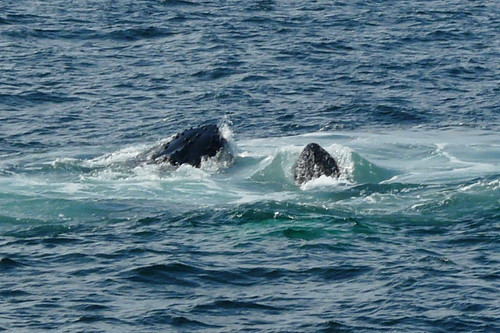
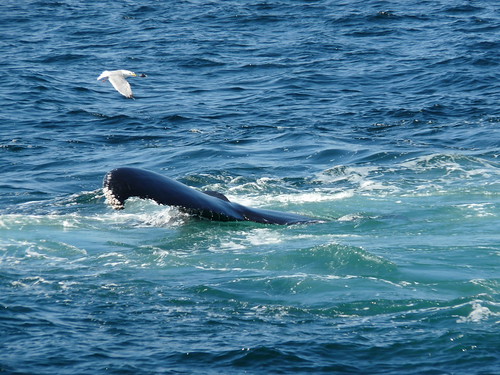
We've Moved!

Hi and Welcome to the AnimalTourism.com blog. But we've moved just down the street to this site, animaltourism.com/news. Please comment there.
Showing posts with label whale. Show all posts

Monday, May 24, 2010

Whales are People, Too, Group Says

The Whale and Dolphin Conservation Society announced this weekend that they've gotten a bunch of cross-disciplinary experts together and decided  that cetaceans have human rights.

The Declaration of Cetacean Rights, which anyone can sign, basically includes the right not to be killed, captured, abused or owned. The society, which met at the University of Helsinki (nice touch), says their rights to "life, liberty and well-being" are due after we figured out that they have more intelligence, self-awareness and culture than we previously thought. The petition gets at the idea that it's okay to care about the fate of not just the health of a species population or ecosystem, but an individual animal.

Most westerners would go along with most of that--although the part that would ban Sea World or swim with dolphin programs might shock some. We already don't hunt whales and changed the tuna industry to avoid dolphins (which are really just small whales). Japan still kills about 23,000 dolphins a year on purpose.  Hundreds of whales are killed each year--no one is sure how many exactly how many--mainly by Japan, Norway, Iceland, Greenland and Russia.


The controversial part, at least in my mind, is that they also "affirm that all cetaceans as persons." I don't think they're persons. Individuals, sure. Anyone who's spent time with higher functioning animals can tell you they're individuals. They don't need to be people to have individuality and rights. Then again, if they didn't put a little bit of crazy talk in there, who would write about them?


Where to Go See Dolphins
Where to Go See Whales

Friday, May 14, 2010

Chukotkans Gobble 419 Pounds of Gray Whale Each Year According to Russia's 140 Whale a Year Quota

A gray whale illegally harpooned off by the Makah tribe in Washington
Do the Chukotka people really each eat 419 pounds of gray whale each year? That's what the Russian government is asking the world to believe as it asks the International Whaling Commission to extend its absurd "subsistence" quota of 140 gray whales for the Chukotka people.

They're the ones Sarah Palin can see from her house; Chukotka is a peninsula of Russia on the Bering Sea. Only one-third of the tiny population of Chukotka (53,000) is native. That means 18,000 people are supposed to be eating 140 whales that each weigh 27,6,00 to 36,000 kg  (59,000 to 79,000 pounds).  That amounts to a stunning 466 pounds of whale per person.

What about bones? Ok, soft tissue makes up 90% of a whale's weight. That's still an amazing 419 pounds per native person. Could anyone eat 18 ounces of whale every single day, all year? Absurd. By contrast, Americans--not known for our tiny appetites--eat 222 pounds of meat a year, up from 144 in 1950.

A while back the Chukotka were caught using their sustenance meat to feed fox on fur farms--which still managed to be unprofitable. A gray whale with a Russian harpoon washed up in California in March. Russia is required to report whales that get away, but never mentioned this one. Gray whale meat with evidence of harpoons has shown up in Japanese markets, according to Oregon State University.

In June The International Whaling Commission, which wants to legalize whale hunting again, is set to consider a proposal to allow the 140 whale a year habit to continue for a decade. Russia has even argued that they would really like 350 whales--even though they are now eating more whale than ever. Whale used to account for 50% of their meat in 1985; now it's 90%.

The western gray whale population is about 26,000; this is the one that migrates to Chukotka. No one thinks they mix with the eastern population, which is only about 130--even though no one is supposed to be hunting it--and lives in an area where it's disturbed by Russian oil drilling. Now California whale watchers are saying that their whales may not be as secure; numbers are mysteriously dropping. Could it have anything to do with where they spend the winter?

About 10% of gray whales are what biologists call "stinky." Stinky whales are inedible. Dogs won't even eat them and if you do eat them, you'll get sick. V. Ilyashenko writes: 
hunters state that sometimes they can identify “stinky” whales in the ocean, if the wind blows from the spout toward the whaling boat. In some hunting areas, the hunters have estimated that up to ten percent of the whales are “stinky” in a given year. Skilled hunters do not attempt to kill “stinky whales”. Nevertheless, several “stinky whales” are struck and landed in most years. In some years up to 10 “stinky” whales were harvested. Sometimes the “stinky” whale odor appears only during cutting up the whale or only while cooking whale meat.
Stinky whales have been noticed since the 60s and it's no surprise that their numbers are increasing. They're evolving a defense mechanism. The stinkier they are, the safer they are from whalers. If they can pass on their propensity to stinkiness, they're really have something. The stinky factor alone should push the IWC to make the Russians find another food source.


In other gray whale news, Lilly, a gray whale freed from fishing lines in Dana Point, still lingers and looks sickly

Tuesday, May 11, 2010

Meditteranean Gray Whale: Explorer or Lone Lost Soul

Gray whale from Israel Marine Mammal Research and Assistance Center
A lone gray whale showed up in the Mediterranean Sea this week. Biologists are baffled. Gray whales haven't been seen on this side of the Atlantic for centuries. Is this bad news--just a lone whale hundreds of miles off track? Or good news--a lone explorer, trying out a new migration oute--or, really, an ancient one?

The Israel Marine Mammal Research and Assistance Center verified it as definitely a gray whale. Biologist are betting on the lone lost soul explanation. NOAA's Phillip Clapham of  told Discovery that either "there has been a relict population in the North Atlantic that no one has noticed (virtually impossible), or (more likely) that this whale came down through the ice-free Northwest Passage and is now hopelessly lost."

I'd like to think there's a third possibility: the whale is forging a new route. Maybe in response to the whaling pressure it still faces in Asia. Migration routes aren't stagnant. Animal populations are constantly changing, usually led by a lone male branching out looking for a mate. Marine biologists used to think the manatees that migrate up the east coast were lost, so they'd catch them and haul them down to Florida. Now they realize it's just what they do.

There used to be four populations of gray whales, Jim Darling notes. Two--the ones one the east and west shores of the North Atlantic--are dead.

Two populations survive--on the east and west of the Pacific. The one that hugs the North American coast has been protected since 1947 and now is about 20,000. They thrive, delighting whale watchers with their friendly overtures towards boaters. Gray whales used to roam Florida to New England. Imagine the kind of animal tourism attraction we're missing. Right in Florida we'd probably have the same magical, close-up whale watching experience people now trek to Baja to get.

The Asian population is anemic--only 100 to 200. Even though nobody is supposed to be hunting it. And no one is sure if the two populations touch.


Where to Go to See Whales

Thursday, April 29, 2010

Groups Recruiting Volunteers to Clean up to 400 Wildlife Species at Risk From Oil Spill

A stunning 400 species of birds, marine mammals, turtles, land mammals and reptiles could be hurt by the Deepwater Horizons oil spill, which is now just 6-7 miles off Louisiana. The current strong winds may blow the muck to shore by Friday morning, the latest report says.

Nola.com obtained a list of 400 species put in harm's way by the oil from the Louisiana Department of Natural Resources. Bob Marshall writes that this is a particularly horrible time for the oil spill--right when birds are migrating through or nesting. The soon-to-be oiled area is:

vital wintering or resting spot for more than 70 percent of the nation's waterfowl, is used by all 110 neo-tropical migratory songbirds, and produces 50 percent of the nation's wild shrimp crop, 35 percent of its blue claw crabs and 40 percent of its oysters. Ressearchers say 90 percent of all the marine species in the Gulf of Mexico depend on coastal estuaries at some point in their lives, and most of those estuaries are in Louisiana.
The New York Times has a great chart highlighting which species are most at risk, mostly migrating birds. The brown pelican was just removed from the endangered species list.

The Oiled Wildlife Care Network--a collection of wildlife responders across California--has sent its director down and is collecting info on volunteers.  They say it's too late to train you to clean up animals but you could become a "convergent volunteer." Specialized groups or state rehabber associations do oil training seminars in preparation for a disaster like this.

The International Bird Rescue and Research Center is on alert, too. They regularly offer classes in Fairfield (northern California) and San Pedro (Southern California) for people to become volunteers.

The International Bird Rescue and Research Center is on alert, too.

Audubon of Florida is recruiting volunteers for the onslaught of oiled birds to be cleaned up at the Center for Birds of Prey in Maitland, FL.

The unified command for oiled wildlife is 800-557-1401.

The Lousiana Wildlife Rehabilitators Association directs residents to call (866) 557-1401 for the Oiled Wildlife Unified Command Center. Not sure which prefix is correct, but it's the same number.

The feds say they're setting up staging areas to protect the shoreline in Biloxi, Miss., Pensacola, Fla. Venice, La., Pascagoula, Miss., and Theodore, Ala.

AnimalTourism.com: Where to Go to See Wildlife

Wednesday, April 28, 2010

Pelicans, Otters, Manatees Could be Hurt by Deepwater Horizon Oil Spill

Deepwater Horizon oil spill seen from space over LA
Imagery courtesy of NASA Earth Observatory
Endangered sea turtles, herons, white and brown pelicans, dolphins, whales, manatees, tuna and assorted sea birds  could all be hurt by the Gulf of Mexico oil spill that is now 16 miles off the tip of Louisiana and alarming wildlife officials all the way to Florida.

The Coast Guard is burning the oil, hoping that will keep it from making landfall and destroying wetlands. I wonder if, ironically, the giant dead zone in the gulf may mean that the area the oil spill hits may be devoid of life anyway. The next step for wildlife rescuers would be to herd animals out of the area by hazing them.
 
The International Bird Rescue Research Center in Texas says they've been put on alert for the decapitated oil well, which is gushing about 1,000 barrels (42,000 US gallons) of crude daily and already can be seen from space, with a circumference of 600 miles.
If the spill stays offshore then the impact will likely be minimal to birds. Coastal birds that are highly at risk if the spill hits shore are brown and white pelicans, terns, gulls, shorebirds, skimmers and herons. Nesting and feeding areas for birds and sea turtles such as marshes and beaches could be impacted.
Loggerhead and Kemp's Ridley turtles are in the area, Live Science says. Birds are vulnerable if they ingest the oil or get coated in it. The oil removes their waterproofing, then they die of cold. In a report on dealing with oil spills, the EPA says mammals that groom themselves with their mouths, like otters, end up eating oil and getting it in their eyes. Sea otters don't live there; river otters do. No one really knows how to help marine mammals stuck in oil, they say.
Procedures for capturing, treating, and releasing animals may hurt them more than the oil does. For example, manatees are particularly susceptible to secondary fungal and bacterial infections following capture or transportation. 
Whales, dolphins, seals and manatees end up breathing hydrocarbon vapors that hurt their lungs, getting it in their eyes and nursing young eat it. Manatees summer as far west as Texas (but that's rare); a few regularly visit Mobile, AL. The biggest danger to manatees, which spend the summer as far west as Texas, may be getting hit by boats responding to the disaster.

So far the Tampa Tribune reports that the Florida Fish and Wildlife Conservation Commission hasn't found any oiled birds, but they are doing necropsies (animal autopsies) on 15 migratory birds found dead Tuesday in the Pass-a-Grille area of St. Pete Beach.


In Alabama, the Dauphin Island Sea Lab is sending boats out to test the waters and "trying to re-establish oiled bird emergency response plans that have not been exercised for many years." They fear it could be the worst Gulf oil spill ever. Coast Guard Rear Adm. Mary Landry goes even further: "If we don't secure this well, this could be one of the most significant oil spills in U.S. history."

Where the oil spill is on 4/28
Where to Go to See Animals Down South

Friday, April 16, 2010

DNA Reveals International Black Market for Whale Meat; Also: Horse Meat Fraud

The whale meat sold at a hipster Santa Monica sushi restaurant came from Japan, a paper in Royal Society's Biology Letters shows. The results highlight a growing body of research that shows there's a thriving international black market for whales caught both under the guise of research and bycatch.  

We all knew that the whale sushi sold in the U.S. wasn't caught off the Santa Monica pier, but we didn't know where it came from beyond the Mercedes in the parking lot. Biologists now want the normally flaccid International Whaling Commission to stand up to recalcitrant whaling countries and demand a public DNA registry of the whales they admit taking.  The database of legal whales could show just how many whales are being poached.

Charles Hableton, producer of the Cove, is the big Hollywood name on the paper and at the original sting operation, but the big academic name is C. Scott Baker, associate director of the Marine Mammal Institute at Oregon State University. Baker is a pioneer in using whalemeat DNA to show where whales were caught--often where they weren't supposed to. Some of his previous work has shown:


Baker warned at the time that this excuse of bycatch was getting out of hand. How many whales can you catch on accident? 

In response to the study, Korea  confiscated whale meat from a Japanese restaurant to see whether it had been illegally imported.

An ironic side note in the paper: the Santa Monica menu also claimed to contain horse meat, but tests showed the restaurant was just suckering their despicable patrons who wanted to eat "adventurously." The supposed horse meat was really cow.  Which begs the question: why didn't they just fake it with the whale meat, too?


See Dolphins in the Wild 
Where to Go to See Whales

Friday, April 09, 2010

Doomed Baby Humpback Shot in the Hamptons

Wildlife officials decided early on that a baby humpback  beached in the Hamptons was doomed have finally shot it to death, days after it was found and started drawing sympathetic crowds. The whale created a weird whale-watching spectacle with hundreds visiting Main Beach in East Hampton for a curious, sad vigil. Everyone wanted to find some way to save the whale, but without its mother or some supersized facility, it wouldn't work.

Euthanizing the whale didn't go too smoothly: the New York Post denies it died.  The Huffington Post says it died overnight. Gothamist quotes subscription-required Newsday saying shots rang out. But an earlier story says they were using darts, not some kind of Old Yeller euthanasia pistol. Carissa Katz writes in The East Hampton Star that they used a highly specialized kind of dart to deliver an overdose of sedatives, first Wednesday, then again on Thursday:
The darts the system uses are designed to go through the whale’s blubber and into muscle. The whale is estimated to weigh about 10,000 pounds. The amount of the drug needed to sedate an animal that size is “enough to kill 100 people,” [David Morin, a marine mammal biologist with the National Oceanographic and Atmospheric Administration] said. 

Whale beaching is still a mystery. They'll do a necropsy--the animal equivalent of an autopsy. The Sag Harbor Express said earlier in the week that they'll do the necropsy on site and probably bury it there, too.It may be the whale was sick or injured. Or it could have lost its mother, whom it needs for milk. Even the wolf-killing, Sarah Palin-loving state of Alaska says humans are usually somehow to blame for humpback whale deaths--either through fishing line entanglements, boat collisions or toxins.

The Riverhead Foundation says they handled 40 cetacean (which includes dolphins, porpoises and whales) strandings in 2008.

Where to Go to See Whales
Where to See Animals Around New York City

Friday, March 19, 2010

A Whale Wars Horror Flick: Harpoon: The Reykjavik Whale Watching Massacre

We've seen the battle between whalers and whale-watchers turned into a reality TV hit in Whale Wars; now it's moving to the horror film genre. Iceland's Harpoon: The Reykjavik Whale Watching Massacre features whale watchers cast adrift at sea who are preyed upon by rogue whalers.

You'd think Iceland--where whaling and defying international opinion--are considered almost a patriotic duty, would produce a film with  the Sea Shepherd crew on the rampage. But this film seems to be, dare I say it, more subtle. The family of whalers has gone mad--after they aren't allowed to hunt whales anymore. The trailer shows the whalers shooting harpoons at someone in the water. And the tourist cries out, "No! Please! I'm a friend of nature! No! Argghh!" So, the tourists pretty much had it coming. I'd want to harpoon anybody who said that.

I haven't had access to the film, which played at the Glasgow Film Festival in February and is set to be released in the UK on DVD soon. The MonstersandCritics blog horror fan pans it as "just another average horror film with various characters being pitted against a family of psychotic whale hunters." But I'm glad to see the whale issue now playing out in pop culture. Hey, every movie can't be The Cove.


Tuesday, March 09, 2010

Santa Monica Sushi Restaurant Serves Whale, Makers of The Cove Document on Way to Pick Up An Oscar

The people who made The Cove, the documentary about Japanese Dolphin slaughter that won an Academy Award Sunday, used some of the same techniques to bust a hipster Santa Monica sushi restaurant for selling whale, the New York Times reports. DNA tests confirmed that a $60 piece of sushi that The Hump sold as whale was in fact the endangered Sei Whale (Balaenoptera borealis). that $60 piece of sushi was sei whale.

DNA-testing sushi is now becoming a food investigation mainstay; it's almost as popular and fun as finding e. coli at food carts. But normally the results are the opposite: the fish is not what the restaurant says. It's a cheap substitute. In this case it was on the Omakase, or tasting menu, and the wait staff told the undercover diners they were eating whale, sometimes calling it by its Japanese name, kujira.

The food blog Shizuokasushi explains how whale is served casually in Japan, though usually sperm whales. Japan hunts about 100 sei whales a year under the guise of "research," according to the IUCN Red List.

Louie Psihoyos, photographer and director of The Cove, worked with “director of clandestine operations” Charles Hambleton, who made tiny cameras for diners to wear--once for themselves and a second time for investigators. An affadavit from investigators describes a search of the restaurant and suggests the whale may have arrived via a Mercedes parked out back.

It won't be as exciting as The Cove, but I sure hope they make video of the sting.


See Dolphins in the Wild 
Where to Go to See Whales

Monday, March 08, 2010

Will Asking People To Text for Dolphins Work Post-Haiti?

Last night dolphins near Taijii, Japan, were oblivious to the break The Cove won an Oscar. The film's hero, former Flipper trainer Ric O'Barry, has been trying to show Taijii's dolphin slaughter to the world for years, even if it meant walking around with a TV on his chest. So, it's no surprise he'd use the stage for the dolphins. O'Barry unfurled a banner saying "TEXT DOLPHIN TO 44144".

What was the reaction? Twitter immediately ricocheted the message around thousands of time--and it's still bouncing. This USAToday blogger says the sign--and its inherent naughtiness--got him to look up the film. But over at the Huffington Post, they ran a story explaining "What Happens if You Follow Ric Barry's Sign?" The answer: you're signed up for text message updates, up to 30 a month. Call me old-fashioned, but I subscribe to his blog, so that's about 30 more than I need.

The Haiti earthquake taught the public that the easiest way you can donate money to a cause is by texting a charity. I doubt that causes can ask you to just text them anymore without people worrying how much it will cost. The various charities send you back a confirmation before your cellphone carrier sends off your money, Charity Navigator explains. If you haven't done it, you won't know that.

O'Barry wants you to write a letter to Obama. Taiji was, predictably, annoyed at the win. Controversy is swirling, the LA Times says. But what else does controversy do? Before the movie Japanese fishermen killed about 2,000 - 3,000 dolphins a year in Taijii and about 18,000 to 27,000 elsewhere, the Japan Times reports. The little town is also the last known place to catch wild orcas--and where fishermen ride them "rodeo style," the Whale and Dolphin Conservation Society reports. Japan claims it's cultural imperialism to cringe at their killing of dolphins while we kill and eat cows.

The Cove has already pushed the town to halt the the dolphin slaughter for now. Expect more backlash when the film gets broader play in Japan. That'll happen with or without your text messages.

See How You Can See Dolphins in the Wild


Excerpt from the Whale and Dolphin Conservation Society 2001 report Captive Orcas: Dying to Entertain You.

Japan: 1972 - to date. 28 orcas captured, of which 19 were taken into captivity (14
are now dead, 5 survive)

To date, no marine park outside Japan has purchased orcas taken from Japanese waters. Captures for dolphinariums have been largely unregulated, being carried out by inexperienced local fishermen using two main methods - harpooning, and herding the animals into a net. Capture methods can be very crude - attempts to wrestle the whales into submission by riding them 'rodeo-style' have been reported. 

Several orcas have died shortly after capture: for example, three orcas captured off Japan in 1979 had all died within three months of capture. The better Japanese marine parks, perhaps wary of
being tainted by association with 'iruka no oikomi ryo', the annual drive fishery responsible for the slaughter of thousands of small whales and dolphins, have increasingly turned to Iceland and North America for their orcas.


However, on February 7th, 1997, a group of ten orcas - believed to be transients - were taken at Hatajiri Bay, near Taiji, Wakayama prefecture. Fishermen from the Isana Fishing Co-operative first spotted the group of orcas, including two calves, about 50km off the Japanese coast. They sent eight fast boats out to encircle the pod and, by using water bombs and banging on iron rods to create a barrage of noise, succeeded in driving the group into the bay.

Tuesday, March 02, 2010

Where to See Orcas Not in Captivity

Shamu Rocks
Shamu Rocks, at Orlando Sea World
courtesy of Miss 
Quarel.
Want to see a killer whale that hasn't been captured, trained to do tricks and kept in a tiny tank? You've got plenty of options other than Sea World, where their primary breeding male was involved in his third human death last week. Instead of seeing the 42 captive orcas go through their routines for your amusement, wouldn't you rather see them doing what they do naturally?


The Pacific northwest is probably the best place to see killer whales in the world. The whales hang out just to the west of the San Juan Islands in Washington state. Tour boats run to and from the San Juans from all over the region, including from Seattle 90 miles to the south.

Better yet, you can even see them from the shore. Industrious whale lover Donna Sandstrom corralled a pack of agencies to set up The Whale Trail, a series of sites where you can see whales from the shore. Behavioral biologist and author Toni Frohoff, says land-based whale watching is "the ideal form," because it doesn't disturb the whales at all. Plus, it's basically free.


The orcas can also be found up a little north in British Columbia. You can take boat trips off Vancouver Island that will let you see grizzly bears, eagles, sea lions and other kinds of whale. On the other side of Canada, Battle Harbor, Newfoundland has orca pods visit in September. Killer whales are spotted off Hokkaido, the rugged, northern island of Japan.

Orcas can be seen from every continent. Tysfjord, Norway, is the best place in Europe, according to the Complete Whale-Watching Handbook. But you might find the tours off St. David's, Wales, easier to get to. The orcas that visit Port Elizabeth, South Africa, in May are famous for eating dolphins. Playa Punta Norte in Argentina is where the whales have learned to beach themselves to attack a sea lion colony. (That's a rare occurrence, but you can see them from shore.) Japan's northern, rugged island of Hokkaido has lots of orca sightings. Orcas are known to grab stingrays from the ocean floor near Australia, where surfers have paddled around with the whales, too. With all these options who would want to sit on a bench and watch a whale forced through a hoop?

Sunday, February 21, 2010

Australians Geared Up For Years to Fight Japanese Whaling; Sunken Vessel Just Ticked Them Off to Do It

TITLE
,
The Australian Government collects photos for a potential court case.
When the Japanese whaling ship Shonan Maru 2 mowed down Sea Shepherd's Ady Gil they ticked off an already anti-whaling Australia. The incident seems to have pushed Australia to threaten Japan with legal action this week, but Australia has been grinding its teeth and preparing for battle for years after watching Japan flout international whaling rules off its shores. The outcome will turn on Australia's claim over its nearby waters and which international body has jurisdiction.

This week prime minister Kevin Rudd gave Japan a November deadline to cut its whaling quota to nothing. New Zealand may join the fight, too, it announced Feb. 22. Australia is holding some undoubtedly awkward talks with Japanese diplomats this weekend. Some Australians fear a court case could solidify a lack of Australian control over nearby waters.

Australians says they can head to the International Court of Justice at The Hague or the International Tribunal for the Law of the Sea in Germany to get an injunction against whaling. Japan, meanwhile, plays down the fight as "unfortunate" and threatens to appeal to the International Commission on Whaling. They banned whaling in 1986 but let Japan continue under the fig leaf of "research," even in an area Australia considers a whale sanctuary.

The first signs Australia had reached its limit were just after the Sea Shepherd's skirmishes when Bob Brown, head of the Green Party, started pushing for international court action. He called Rudd's government slumbering and wanted to haul the whalers to Australian court and give them a $3 million bill for the sunken batmobile-like craft. "Mr. Okada does not want to be confronted by the ugly reality of Japanese whaling which is opposed by 94% of Australians," Senator Brown said. "He is squibbing on whaling." (Meanwhile, Japan is holding a protester who boarded a whaling ship to present them with a bill.)

But Australia has been gearing up for this fight for years. Donald R Rothwell, a professor at Australia National University, who specializes in maritime law, did a report laying out the government's legal options. According to an Australian 7:30 news report, the four main areas of law Japan could be sued for breaking are pollution standards for the southern Ocean; safety standards; failure to tell Australia and New Zealand rescue authorities where they are in case of emergency; and refueling without an environmental impact assessment.

A couple years ago Australia sent out boats to get photographs for a potential international court case. Legitimate scientists have surveyed the area, demonstrating how real research doesn't demand slaughter. The whole world knows these research trips are really whaling ventures. More than New Zealand should be joining in; the United States should, too.

Sunday, January 31, 2010

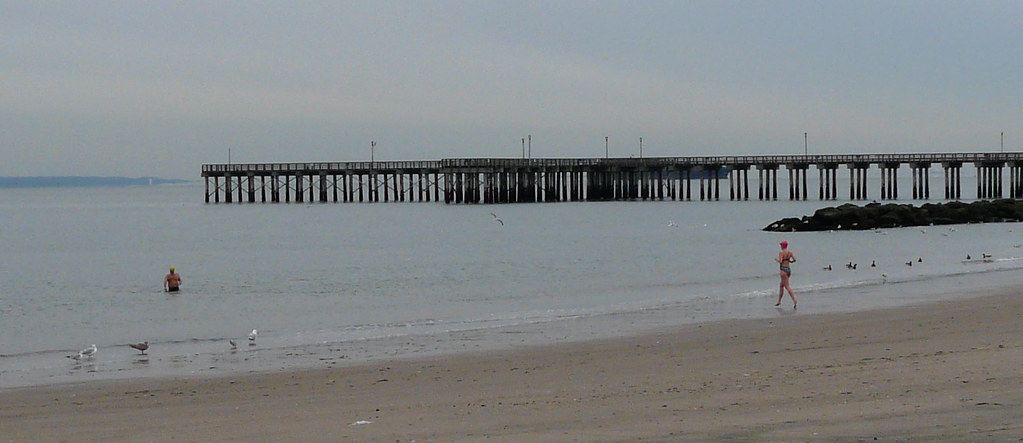
Coney Island Marine Mammal Tour Yields Only Polar Bears

The New York City Parks Department's first shot at a marine mammal tour from Coney Island yielded absolutely none of the hoped for seals, porpoises, dolphins or whales. But we were all shocked and delighted to see real Coney Island polar bears going into the water in bikinis on what turned out to be one of the coldest days of winter. their existence is well-documented on every cheesy local news, but I consider it a rarity to see one in person.


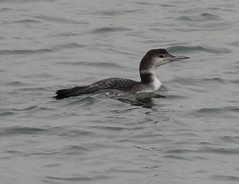
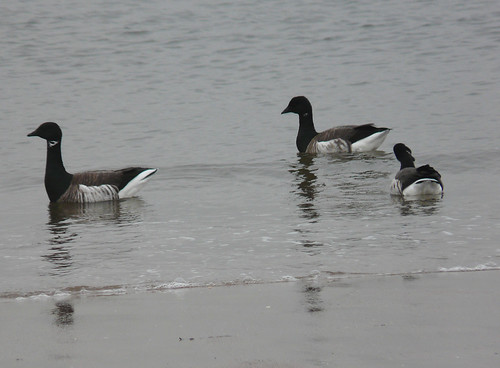
Our park ranger guides, Marissa and Andy, couldn't have been more enthusiastic or knew more about what we might hope to see. They had us carefully watch a cluster of birds feeding on the surface to see if we saw any seal heads pop up. Andy told us about the loons and Brant Geese (Branta bernicla) wading by the polar bears. Marissa told us stories about dolphins she's seen regularly patrolling east to west off the Rockaways. She told us about the time a seal hauled out on Coney Island and helpful New Yorkers dragged it back to sea--twice--before realizing it just wanted to sit on the sand.

 Wildlife watchers know there are no guarantees in this business. So several of us consoled ourselves with another Coney Island rarity: pizza. Maybe we'll try one of the other tours to see seals around NYC.


Where to See Seals

Thursday, January 28, 2010

Set out on the Whale Trail: See Orcas from the Shore in Washington State

People may have heard of watching orcas off San Juan Islands,  but Donna Sandstrom wants everyone to realize whales are all over the coastal waters of Washington State, including the Salish Sea. For the last two years she's been working with seven government groups pulling together The Whale Trail, 15 spots where people can see whales from the shore.

Aside from Lime Kiln Point State Park, which bills itself as the best shore-based whale-watching site in the whole world, the Whale Trail reaches up to Vancouver and down to coastal La Push, where the Quileute Nation welcomes the gray whales when they return from their migration to Mexico.


"They could go extinct in 100 years and that's heartbreaking to me," she says. "We are right at the intersection of whether they make it or not." Yet down the coast from the San Juans people in her native Seattle are largely oblivious to the presence of killer whales, Orcinus orca right outside their doors. "It always makes me a little sad that people are surprised whales are here," she says.

Now they'll be able to look up public places where they can see whales from public land--which means the viewing is free for people, environmentally low impact and no hassle for whales. Tour operators, sensing the project will just spur more interest, even helped set it up. Behavioral biologist and author Toni Frohoff, has called land-based whale watching "the ideal form," noting that it works so well in the area "because it gets so deep right off" the shore.

Sandstrom pulled together what she calls a dream team of area whale experts, many of whom she met when they cooperated to rescue Springer, a calf separated from her mother. They pulled together a list of places people could visit where there was a "reasonable chance of viewing whales" at least part of the year.

All of the invited spots said yes. The idea of organizing the spots "seems like its latent in the air," she says. Oregon has organized Whale Spoken Here sites along its coast. Labrador and Newfoundland provide a neat map of boat and shore-based sites. But those were largely government projects that had tourism in mind. Sandstrom's project is more focused on the community--getting people to enjoy and understand their wildlife. "To me it's all about local community," she says. "These are communities who want to be part of this."

Each spot will get signs detailing what people can expect to see in the area and when. The focus is on killer whales, but gray whales, seals and sea lions won't be neglected. Eventually they'd like to train volunteers in each spot.  

The inspiration was the Mission Bell trail in her native California, but the resulting Whale Trail is, I think, even better. The whales are alive and the whale trail will grow as more people figure it out.

Check out the Whale Trail  
Find More Places to See Whales

Friday, September 11, 2009

An Easier Way to Find a Good Whale Watch on the East Coast?

Picking out a whale-friendly East Coast whale watch just got a little easier. NOAA and the Whale and Dolphin Conservation Society just started Whale Sense, a voluntary program to ensure tours from Virginia to Maine don't bother whales.

The rules are complicated--more than just stay back 100 feet, though that is the basic distance. (If the whale approaches you, stay put. If it's a right whale, back off 1,500 feet.) What I found more amusing were the rules against advertising showing whale watchers touching, swimming with or even chasing the whales. Is Jerry Bruckheimer running a watch somewhere?

So far the group has signed up five companies, mainly in Massachusetts. I count at least 30 tour companies from Virginia to Maine, with 18 going to Stellwagen Bank--not included the odd charters that line the whole coast. So what about the ones not on the list?

Even Frank Kelley, operations manager for Mass Bay Lines (listed) says that right now the program is so new that you can't judge an operation for not participating. Lots of the tours work with other whale groups. For example, Bar Harbor Whale Watch Company is tied to Allied Whale. The New England Aquarium's whale watch, which I just went on, isn't part of the program yet (they're still examining the details), says spokesman Tony LaCasse. But since they already do most of it and they helped push voluntary standards decades ago, they'll probably be part of it.

When you're out on Stellwagen it's not the commercial whale watching boats you see encroaching on whales, but the tiny recreational fishing boats. Kelley says many tour operators worry that the small boats don't understand the protocols (which is elaborate when it comes to many boats wanting to see the same whales). NEAQ's LaCasses says that personally he'd like to see an enforcement presence on the water--like the Coast Guard is for boating regulations.

When I talked with marine mammal expert Toni Frohoff (she's a behavioral biologist and research director at TerraMar Research) she mentioned that generally it's better to have one big boat in the water around a whale instead of a bunch of little ones. At first that seems counterintuitive; we normally don't think of going out in a big, hulking, Hummer of a boat as being eco-friendly. But that's what it is, at least to the whales.

The tricky thing for whale watchers is picking tours that won't annoy--or hit--the whales. In Puget Sound tour boats are known to crowd the orcas, which could interfere with their eating or mating. I haven't seen that on the vast waters East Coast boats troll.

Consumers can't easily tell from an ad or website that attitude of operation. (Well, ok, I am a little skeptical when I read "Imagine the sight of dolphins dancing and frolicking right alongside The Silver Bullet. See whales surfacing and breaching...[from a] shiny, brand new 70 ft. long ocean going projectile." But most whale watches at least claim to be whale-friendly. But is that like a processed cereal labeled as organic? I hope the Whale Sense program grows and offers up an easy way for wildlife watchers to pick the responsible tours.

Tuesday, September 08, 2009

NEAQ Whale Watch: Humpback Bubble Cloud Feeding off Boston?

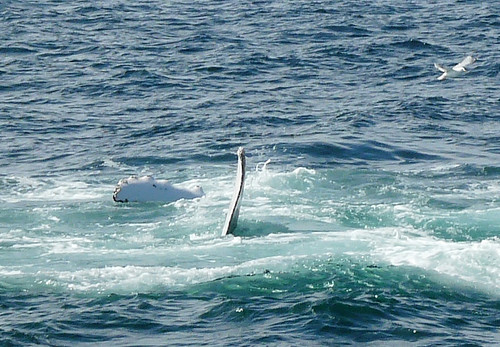
This weekend we got to see a pod of humpback whales bubble cloud feeding--that is cooperatively blowing bubbles to herd tiny fish into a concentration near the surface, then gobbling them up. The New England Aquarium's's tour brought us close enough to the whales that we could actually see, understand and anticipate what they were doing.

You first know you're going to see this specialized hunting technique when a huge patch of light turquoise water appears. Bubbles surface, then enormous black snouts covered with bumps (technically, tubercules or hair follicles). There's lots of jostling and swirling, then fins and finally a "whale footprint" or eerily smooth patch of sea that, we learned, whalers first thought was leaked whale oil.

I found some discussion online that humpbacks only bubble net feed off Alaska, Antarctica and west of South America. I'm not a whale expert, so I'm not sure if this is any different from what we all saw. But we clearly got to see it a few times. We had at least three whales at it, Echo, a mother; her calf, who stuck close to her; and another whale named Zooney.

The New England Aquarium has the system down to bring whales to the masses: a huge, fast catamaran whisks you an hour off-shore into Stellwagen Bank, a shallow feeding ground and sanctuary. Right from the center of Boston you can spend three hours and $40 and see one of the most active whale-watching sights in the world. Whale-watching tours from Cape Cod, Plymouth, Cape Ann, New Hampshire and Maine all head to Stellwagen. The boat's stable, so only a few get sick. You spend an hour speeding out to sea, an hour watching and an hour coming back. They sometimes see minke or fin whales, dolphins and basking sharks. A guy filming the trip for NOAA said it was the best he'd been on.

Not in Boston? Here are a ton of great places to see whales.

More places to see animals in the Northeast.

Got suggestions for animal watching places? Tell us.

Monday, August 17, 2009

What is Collaborative Whale-Watching and Wildlife Viewing?

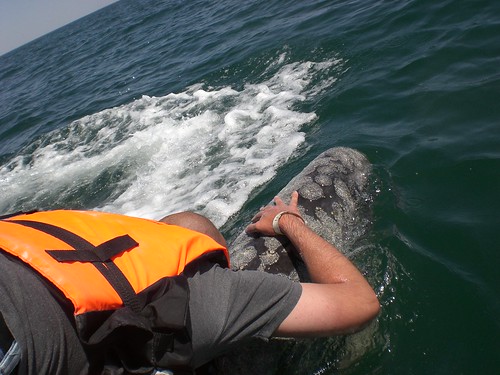
Photo of man hugging gray whale in San Ignacio Bay courtesy of Marc Uhlig of Jupiter Labs.
Biologist Toni Frohoff has a new way see whales and other wildlife: collaborative watching. That's right: she wants us to work with whales so we all get something out of the experience. Instead of just being stalkers, we'd interact on mutually agreeable terms. What Frohoff, research director at TerraMar Research and the Trans-Species Institute of Learning, is proposing is an overhaul of eco-tourism standards. She wants the whales (and other animals) to be in on it, to collaborate with the humans that want to watch them.
Sound impossible? Well, she does it all the time with gray whales in Baja California. As a behavioral biologist she made an appearance in the much-discussed New York Times Magazine story Watching Whales Watching Us. The gray whales migrate up and down the west coast, seemingly indifferent to humans, but once they reach their nursery harbors off Baja, they suddenly become curious about people. That's even more remarkable since people once slaughtered whales here--so much so the species was almost wiped out. But now they've realized people--or at least the people in these harbors--aren't throwing harpoons, they are offering hugs.

Photo of whale near row boat courtesy of FarFlungPhotos and Tarnya Hall.
What do the whales get out of it? For reasons no one can explain, they seem really into it, coming up to boats curiously and seeking out interaction, not just tolerating it.

What the whales can see is this: The whale watching boats have a code of conduct. They have a whales-only area where the whales can go for some down time. And if there are too many whale tourists in the water, they'll get called back. That's important to keep from loving the whales to death, says Frohoff, author of Dolphin Mysteries: Unlocking the Secrets of Communication and Between Species: Celebrating the Dolphin-Human Bond. Though if you're having a meaningful interaction with a whale, you'll find it difficult to leave. "It's harder than not eating ice cream," she says, "but it's necessary for us not be greedy to respect and cultivate this special inter-species bond."

What the whales can't see is the more important big picture of what the whale watchers are bringing them: peace, security and respect. The whale-watching industry is now a $2.1 billion industry worldwide. No one is sure exactly how big the rogue whale-hunting industry is, but we do know whale meat prices have sagged and the governments of Norway, Japan and Iceland have to effectively put their on welfare. The World Wildlife Foundation estimates that Japan spends $12 million a year propping up whaling; while Norway spends $500,000 to support an anemic $2 million industry.

I think eco tourists would love the idea of collaborative whale watching. Of course we want the fascination to be mutual and fair; that's human nature. I think people naturally want to give something in return if someone offers them something nice. People leave out food for birds and animals mainly for practical reasons of drawing them in close. But part of us also wants to be nice--or at least appear nice--to them. We are, in effect, paying the cardinals to show up at our feeder by putting out sunflower seeds.

Will other animals start to collaborate with us? Sure would be nice. I've had a sunfish focus his big, ghastly eye on me; squirrels look at me and bark until I figured out they were standing above a cat they wanted me to chase away; deer stare into a window at me staring at them. Of course, for every one of these delights, I've had 100 or 1,000 experiences of an animal fleeing, fearing that I'm hunting them. That is wildlife watching in the early 21st Century. It wasn't always this way. And, once we start offering animals something in return--ideally something more abstract than food--maybe we'll see it again.

Want to see some whales yourself? Here's where you can do it.


View AnimalTourism.com WHALES in a larger map

Thursday, July 30, 2009

Worldwide Whale Watch Week?

Humpback photo courtesy of Ruben Ayala, taken on Seven Seas Whale Watching based out of Gloucester, MA, in Sept., 2006.
Great Britain just got through with another Whale Week, with sightings of an impressive eight species of cetaceans--dolphins and whales. Minke and humpback whales visited Scotland. Bottlenose dolphins ventured farther south than ever; common dolphins pushed north. The event, sponsored by BG Group, so far only extends to the British Isles, but it would be great to see it expanded worldwide.

Right about now is the peak season for seeing blue whales--the largest creature on earth, ever--in one of their largest concentrations, off Santa Barbara, right outside Los Angeles. The Los Angeles Chapter of the American Cetacean Society is having its annual blue whale trip this Saturday. The southern California whale watching industry is geared more towards the spectacle of gray whales migrating up and down the coast in spring and winter. But Santa Barbara's Condor Cruises has $98 4.5 hour trips to where the blue whales and calves like to feed. Up the coast in central California, Monterey Bay Whale Watch goes out all year.

The trouble with an international Whale Watch Week would be that the peak season is different on migration routes all over the world. Oregon's Whale Watching Spoken Here has two big gray whale weeks a year: Christmas week and March 20-27. Still, summer is great time to see whales in lots of places. Cape Cod, the best whale watching spot on the East Coast, has a season from roughly July to September. Hawaii is year-round (though humpbacks are winter) and whale watch week is a fun way to let people know. We've certainly all caught on to Shark Week as the time to see sharks on the Discovery Channel (which starts Sunday). Why not whales in the water?

Want to go look for dolphins?
Want to see some whales? Here are some of the best places.


Wednesday, March 18, 2009

Killer Whale Free To Good Home

This poor killer whale (replica). First he was damaged during a redecorating at the New York Aquarium. They didn't want him because his tail was slightly broken. A worker there rescued him. But after two months living in a garage delighting children, he's being thrown out again, this time by the worker's mother who thought better of the whole arrangement. And needs the room in her garage.
"Why she would rather have a mini-van than a whale i don't know, but she's put her foot down. I need to get rid of the whale ASAP and will part with it for free as long as it goes to a good home," Caroline Hertz posts on Craigslist. Surely in this recession this would be a good catch for someone.

UPDATE: Looking around I found a similar ad on Craigslist in many cites. The only variation was the story of how the seller strangely acquired the whale. So, sorry, no whale for sale. 

Thursday, September 04, 2008

Whalers Try To Revive Desire For Whale Meat


The old argument for whale meat used to be that it was a cheap, familiar meat for old people who had grown up on it. Sustenance and self-sufficiency came up a lot. Now that Japan and Iceland have spurned international bans on whaling, they're hard to market whale meat to new customers.

The Wall Street Journal reported this week that in Reykjavik marketer Gunnar Bergmann Jonsson is trying to "hook" urban hipsters on whale meat by selling it in vacuum-sealed ready packs and offering recipe tips.

The Journal quotes Eva Maria Thorarinsdottir, marketing manager of Reykjavik's Elding Whale Watching saying hunting has made minke whales much shier. So all the government of Iceland's support of the nostalgic whaling industry is hurting people who are making a living on animal tourism. "Our business is much more profitable than theirs," she says.

The Washington Post says the Japanese government and pro-whaling groups spend $5 million a year for promotions like to getting school kids to try whale meat. Meanwhile, though, demand is so low that prices have fallen 20% from 1999 to 2004 ($15 a pound to $12 a pound). And they still have extra that they have to freeze.

This looks like yet another program where a government is throwing money away to support a dying industry (whaling) rather than throwing money behind a growing industry (whale watching).

Find the Best Places to Go Whale-Watching Around the World
Where to See More Animals in Europe