We've Moved!

Hi and Welcome to the AnimalTourism.com blog. But we've moved just down the street to this site, animaltourism.com/news. Please comment there.
Showing posts with label whale watching. Show all posts

Friday, September 11, 2009

An Easier Way to Find a Good Whale Watch on the East Coast?

Picking out a whale-friendly East Coast whale watch just got a little easier. NOAA and the Whale and Dolphin Conservation Society just started Whale Sense, a voluntary program to ensure tours from Virginia to Maine don't bother whales.

The rules are complicated--more than just stay back 100 feet, though that is the basic distance. (If the whale approaches you, stay put. If it's a right whale, back off 1,500 feet.) What I found more amusing were the rules against advertising showing whale watchers touching, swimming with or even chasing the whales. Is Jerry Bruckheimer running a watch somewhere?

So far the group has signed up five companies, mainly in Massachusetts. I count at least 30 tour companies from Virginia to Maine, with 18 going to Stellwagen Bank--not included the odd charters that line the whole coast. So what about the ones not on the list?

Even Frank Kelley, operations manager for Mass Bay Lines (listed) says that right now the program is so new that you can't judge an operation for not participating. Lots of the tours work with other whale groups. For example, Bar Harbor Whale Watch Company is tied to Allied Whale. The New England Aquarium's whale watch, which I just went on, isn't part of the program yet (they're still examining the details), says spokesman Tony LaCasse. But since they already do most of it and they helped push voluntary standards decades ago, they'll probably be part of it.

When you're out on Stellwagen it's not the commercial whale watching boats you see encroaching on whales, but the tiny recreational fishing boats. Kelley says many tour operators worry that the small boats don't understand the protocols (which is elaborate when it comes to many boats wanting to see the same whales). NEAQ's LaCasses says that personally he'd like to see an enforcement presence on the water--like the Coast Guard is for boating regulations.

When I talked with marine mammal expert Toni Frohoff (she's a behavioral biologist and research director at TerraMar Research) she mentioned that generally it's better to have one big boat in the water around a whale instead of a bunch of little ones. At first that seems counterintuitive; we normally don't think of going out in a big, hulking, Hummer of a boat as being eco-friendly. But that's what it is, at least to the whales.

The tricky thing for whale watchers is picking tours that won't annoy--or hit--the whales. In Puget Sound tour boats are known to crowd the orcas, which could interfere with their eating or mating. I haven't seen that on the vast waters East Coast boats troll.

Consumers can't easily tell from an ad or website that attitude of operation. (Well, ok, I am a little skeptical when I read "Imagine the sight of dolphins dancing and frolicking right alongside The Silver Bullet. See whales surfacing and breaching...[from a] shiny, brand new 70 ft. long ocean going projectile." But most whale watches at least claim to be whale-friendly. But is that like a processed cereal labeled as organic? I hope the Whale Sense program grows and offers up an easy way for wildlife watchers to pick the responsible tours.

Tuesday, September 08, 2009

NEAQ Whale Watch: Humpback Bubble Cloud Feeding off Boston?

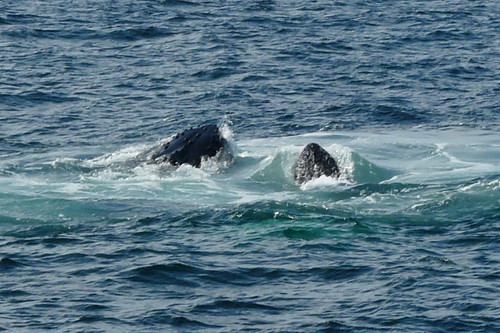
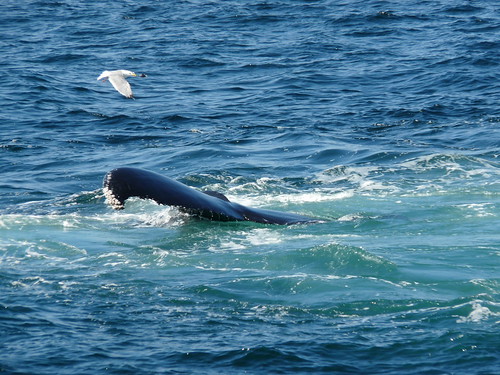
This weekend we got to see a pod of humpback whales bubble cloud feeding--that is cooperatively blowing bubbles to herd tiny fish into a concentration near the surface, then gobbling them up. The New England Aquarium's's tour brought us close enough to the whales that we could actually see, understand and anticipate what they were doing.

You first know you're going to see this specialized hunting technique when a huge patch of light turquoise water appears. Bubbles surface, then enormous black snouts covered with bumps (technically, tubercules or hair follicles). There's lots of jostling and swirling, then fins and finally a "whale footprint" or eerily smooth patch of sea that, we learned, whalers first thought was leaked whale oil.

I found some discussion online that humpbacks only bubble net feed off Alaska, Antarctica and west of South America. I'm not a whale expert, so I'm not sure if this is any different from what we all saw. But we clearly got to see it a few times. We had at least three whales at it, Echo, a mother; her calf, who stuck close to her; and another whale named Zooney.

The New England Aquarium has the system down to bring whales to the masses: a huge, fast catamaran whisks you an hour off-shore into Stellwagen Bank, a shallow feeding ground and sanctuary. Right from the center of Boston you can spend three hours and $40 and see one of the most active whale-watching sights in the world. Whale-watching tours from Cape Cod, Plymouth, Cape Ann, New Hampshire and Maine all head to Stellwagen. The boat's stable, so only a few get sick. You spend an hour speeding out to sea, an hour watching and an hour coming back. They sometimes see minke or fin whales, dolphins and basking sharks. A guy filming the trip for NOAA said it was the best he'd been on.

Not in Boston? Here are a ton of great places to see whales.

More places to see animals in the Northeast.

Got suggestions for animal watching places? Tell us.

Monday, August 17, 2009

What is Collaborative Whale-Watching and Wildlife Viewing?

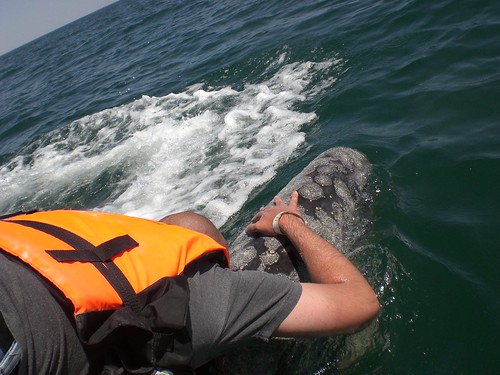
Photo of man hugging gray whale in San Ignacio Bay courtesy of Marc Uhlig of Jupiter Labs.
Biologist Toni Frohoff has a new way see whales and other wildlife: collaborative watching. That's right: she wants us to work with whales so we all get something out of the experience. Instead of just being stalkers, we'd interact on mutually agreeable terms. What Frohoff, research director at TerraMar Research and the Trans-Species Institute of Learning, is proposing is an overhaul of eco-tourism standards. She wants the whales (and other animals) to be in on it, to collaborate with the humans that want to watch them.
Sound impossible? Well, she does it all the time with gray whales in Baja California. As a behavioral biologist she made an appearance in the much-discussed New York Times Magazine story Watching Whales Watching Us. The gray whales migrate up and down the west coast, seemingly indifferent to humans, but once they reach their nursery harbors off Baja, they suddenly become curious about people. That's even more remarkable since people once slaughtered whales here--so much so the species was almost wiped out. But now they've realized people--or at least the people in these harbors--aren't throwing harpoons, they are offering hugs.

Photo of whale near row boat courtesy of FarFlungPhotos and Tarnya Hall.
What do the whales get out of it? For reasons no one can explain, they seem really into it, coming up to boats curiously and seeking out interaction, not just tolerating it.

What the whales can see is this: The whale watching boats have a code of conduct. They have a whales-only area where the whales can go for some down time. And if there are too many whale tourists in the water, they'll get called back. That's important to keep from loving the whales to death, says Frohoff, author of Dolphin Mysteries: Unlocking the Secrets of Communication and Between Species: Celebrating the Dolphin-Human Bond. Though if you're having a meaningful interaction with a whale, you'll find it difficult to leave. "It's harder than not eating ice cream," she says, "but it's necessary for us not be greedy to respect and cultivate this special inter-species bond."

What the whales can't see is the more important big picture of what the whale watchers are bringing them: peace, security and respect. The whale-watching industry is now a $2.1 billion industry worldwide. No one is sure exactly how big the rogue whale-hunting industry is, but we do know whale meat prices have sagged and the governments of Norway, Japan and Iceland have to effectively put their on welfare. The World Wildlife Foundation estimates that Japan spends $12 million a year propping up whaling; while Norway spends $500,000 to support an anemic $2 million industry.

I think eco tourists would love the idea of collaborative whale watching. Of course we want the fascination to be mutual and fair; that's human nature. I think people naturally want to give something in return if someone offers them something nice. People leave out food for birds and animals mainly for practical reasons of drawing them in close. But part of us also wants to be nice--or at least appear nice--to them. We are, in effect, paying the cardinals to show up at our feeder by putting out sunflower seeds.

Will other animals start to collaborate with us? Sure would be nice. I've had a sunfish focus his big, ghastly eye on me; squirrels look at me and bark until I figured out they were standing above a cat they wanted me to chase away; deer stare into a window at me staring at them. Of course, for every one of these delights, I've had 100 or 1,000 experiences of an animal fleeing, fearing that I'm hunting them. That is wildlife watching in the early 21st Century. It wasn't always this way. And, once we start offering animals something in return--ideally something more abstract than food--maybe we'll see it again.

Want to see some whales yourself? Here's where you can do it.


View AnimalTourism.com WHALES in a larger map

Thursday, July 30, 2009

Worldwide Whale Watch Week?

Humpback photo courtesy of Ruben Ayala, taken on Seven Seas Whale Watching based out of Gloucester, MA, in Sept., 2006.
Great Britain just got through with another Whale Week, with sightings of an impressive eight species of cetaceans--dolphins and whales. Minke and humpback whales visited Scotland. Bottlenose dolphins ventured farther south than ever; common dolphins pushed north. The event, sponsored by BG Group, so far only extends to the British Isles, but it would be great to see it expanded worldwide.

Right about now is the peak season for seeing blue whales--the largest creature on earth, ever--in one of their largest concentrations, off Santa Barbara, right outside Los Angeles. The Los Angeles Chapter of the American Cetacean Society is having its annual blue whale trip this Saturday. The southern California whale watching industry is geared more towards the spectacle of gray whales migrating up and down the coast in spring and winter. But Santa Barbara's Condor Cruises has $98 4.5 hour trips to where the blue whales and calves like to feed. Up the coast in central California, Monterey Bay Whale Watch goes out all year.

The trouble with an international Whale Watch Week would be that the peak season is different on migration routes all over the world. Oregon's Whale Watching Spoken Here has two big gray whale weeks a year: Christmas week and March 20-27. Still, summer is great time to see whales in lots of places. Cape Cod, the best whale watching spot on the East Coast, has a season from roughly July to September. Hawaii is year-round (though humpbacks are winter) and whale watch week is a fun way to let people know. We've certainly all caught on to Shark Week as the time to see sharks on the Discovery Channel (which starts Sunday). Why not whales in the water?

Want to go look for dolphins?
Want to see some whales? Here are some of the best places.


Thursday, September 04, 2008

Whalers Try To Revive Desire For Whale Meat


The old argument for whale meat used to be that it was a cheap, familiar meat for old people who had grown up on it. Sustenance and self-sufficiency came up a lot. Now that Japan and Iceland have spurned international bans on whaling, they're hard to market whale meat to new customers.

The Wall Street Journal reported this week that in Reykjavik marketer Gunnar Bergmann Jonsson is trying to "hook" urban hipsters on whale meat by selling it in vacuum-sealed ready packs and offering recipe tips.

The Journal quotes Eva Maria Thorarinsdottir, marketing manager of Reykjavik's Elding Whale Watching saying hunting has made minke whales much shier. So all the government of Iceland's support of the nostalgic whaling industry is hurting people who are making a living on animal tourism. "Our business is much more profitable than theirs," she says.

The Washington Post says the Japanese government and pro-whaling groups spend $5 million a year for promotions like to getting school kids to try whale meat. Meanwhile, though, demand is so low that prices have fallen 20% from 1999 to 2004 ($15 a pound to $12 a pound). And they still have extra that they have to freeze.

This looks like yet another program where a government is throwing money away to support a dying industry (whaling) rather than throwing money behind a growing industry (whale watching).

Find the Best Places to Go Whale-Watching Around the World
Where to See More Animals in Europe

Thursday, August 14, 2008

Baby Beluga Shows Up in Bay of Fundy

Baby Beluga Shows Up in Bay of Fundy

Teri at Bay of Fundy Blog reports that a young Beluga Whale has shown up in the bay between Nova Scotia and New Brunswick known for its record tides. What's unusual is a) a Beluga showing in the bay at all and b) any whale showing up this deep in the bay.

CTV has a great story on the whale, known as Q, and describe the two-year-old as friendly and curious. This isn't a story about an endangered animal increasing its range--which would be terrific. It's more the story of an individual somehow getting separated from its family--which is sad and scary. Some belugas live up in the St. Lawrence, so maybe that's where Q's pod is.

Scientists are also worried about people hanging around Q too much. Local fishermen are taking understandably excited locals out to see Q. The Whale Stewardship Project on Nova Scotia says that "orphaned, lost or somehow separated from their family pods, juvenile whales often begin to seek out human companionship and interact with boats and other objects." The project is worried that whales will get used to friendly boats then get hurt by not so friendly people or propellers.

Let's hope this doesn't turn into yet another story where the people who love an animal end up causing it harm.

Where to See Animals in Canada
Best Whale-Watching Spots Around the World