We've Moved!

Hi and Welcome to the AnimalTourism.com blog. But we've moved just down the street to this site, animaltourism.com/news. Please comment there.
Showing posts with label wolf. Show all posts

Friday, April 23, 2010

Happy Joint Birthday, Indiana Wolves, Enjoy Your Frittata

Would you like to treat a wolf to a frittata? What if you know it was his birthday? And that the wolf happened to looove frittata? Indiana's Wolf Park--probably the most innovated wolf sanctuary in the country-- is having a joint birthday party for its wolves this Saturday, April 24.

All the wild canids (including coyotes and foxes) at Wolf Park breed and give birth around the same time. Last year the center, which started in 1972, started having an adorable birthday party. You can buy your favorite wolf a birthday cake (a $25 donation) and then get a picture of them devouring it.
The cakes aren't really cake, but a frittata with eggs, butter, cheese and chunks of meat, says assistant manager Dana. "The wolves don't really have much of sweet tooth," she says. They are very popular with the wolves. The human visitors enjoy the happy spectacle.

For the wolves that live in pairs or their own enclosures, delivering the cake isn't much of a problem. But some in the main pack got ripped off last year. "The trickeist ones we have are the main pack. Last year we made larger cake they could all eat. One wolf, Tristan, the alpha a the time, just ate it all and was sick afterwards with a tummy ache," Dana says. This year, they'll deliver individual cakes, which they expect the wolves to run off with.

Cake time is 2 p.m. Saturday. Since they don't want any wolves to go without, the $25 really goes to the cake fund. The park spends about $62 a day just to keep each wolf fed, happy, safe and healthy. That's about $23,000 a year per wolf, not including frittata costs.

Wolf Park: This month the center is open weekends 1-5 and on Saturday nights for a howl. In May they'll be open six days a week. General admission is $7, $5 for kids 6-13, little kids free. The howls are the same price. Joint admission is $12. They've also got photo and behavior seminars. They're a little over an hour from Indianapolis and two hours from Chicago (765) 567-2265 4004 East 800 North, Battle Ground, Ind.


Where to Go To See Wolves
See More Animals in the Midwest

Tuesday, March 30, 2010

A Guide To Yellowstone Guides

To animal tourists, Yellowstone National Park is Mecca, with a Broadway show that also somehow includes the the U.S. Capitol. You have to go once; it's spectacular, important, historical. But most Americans don't ever get to go. If you do go, chances are you can't stay as long as you'd like. So, even though it's a wildlife wonderland, you may want to hire a guide so you don't miss out.

Normally animaltourism.com focuses on seeing animals close to where people live in cities and suburbs. Anybody can tell you there are a lot of bears in Alaska or Wyoming. (And too many guide books give that kind of impractical and expensive advice.) But since my husband and I are planning a trip to Yellowstone, I'm checking out all the options there and assembling a guide to the guides.

These guides are expensive. But these are the people that know Yellowstone wildlife intimately, professionally and may be able to save you from an afternoon hoping for a bear jam. If you're only traveling with a couple people, the science centers seem ideal. The private tours are generally priced for groups of four to six, making them two to three times more expensive for couples.  I'm sure this chart will grow and I'd like to focus on each in depth.

Check out the chart of Yellowstone Guides


Friday, March 26, 2010

Easter Bunny Will Leave Eggs At Wolf Park--Then Quickly Leave The Enclosure

Kailani finds goodies in an old stump.  Monty Sloan/ Wolfpark.org
The Easter Bunny visits Indiana's Wolf Park this weekend, but don't worry about his personal safety.
The park assures visitors "The Easter Bunny will hop into the wolf enclosure (the wolves will be elsewhere) and will hide Easter eggs for the wolves to find (after the Bunny leaves)." Whew!

The non-profit, educational park is really clever in coming up with events that both keep wolves busy and gently persuade the public to enjoy wolves instead of fearing them. They recently had a Twilight event, give the wolves pumpkins at Halloween, have a communal birthday party (all the wolves are born around the same time) and have overnight kids camps.

Volunteer Caity did let us in on an Easter secret: the wolves prefer other treats to the traditional colored hard-boiled eggs (just like people!). Wolves go for peeps and sausages. "The eggs are not necessarily their favorites, but they do look really cute," Caity says. The wolves catch onto the game right away. "They're very inquisitive," she says. "Some are braver than others when it comes to exploring new items, but they all  pretty quickly notice it is food."

The event, now in its eighth year, also includes Easter egg hunts for kids--no sausage included.


Where to Go To See Wolves
See More Animals in the Midwest

Tuesday, March 23, 2010

Wolf Parks Jump on the Twilight: New Moon Bandwagon

Wolf at Longleat Captivated by Twilight New Moon
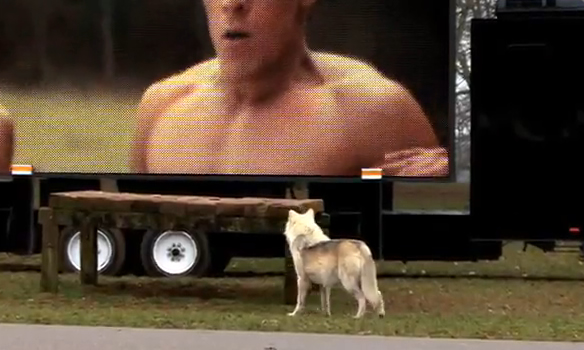
The wolves at Longleat Safari Park in England were impressed with the realism of Twilight: New Moon. At a special showing in the their park west of London, they paid attention to the wolf scenes and howled back, the Telegraph reports. They're just the latest tie-in wolf parks are making with the vampire movie.
Sure, the whole "World Wolf Premiere" thing is a ploy for the DVD release. “Whilst we're used to deafening screams for Robert Pattinson, it's a nice change to hear howls of approval for the rest of the cast, including the screen wolves themselves," one movie promoter said. 

But at least the wolves were entertained. Or enriched, as animal care people say. They circled the giant screen pulled by a semi, making sure it wasn't a predator about to attack. Then they started watching and sometimes howling. "They seem to be really keen on the wolf bits," Ian Turner, the park’s deputy head warden said.


The folks at Indiana's Wolf Park were way ahead of the Brits. In January they hosted a special night for Twilight fans, who learned the differences between real wolves and those hunks in the film.

As every hack journalist knows, you need three events to make a trend, so here you go. Turns out the animators for the movie got their accuracy on by hanging out at Wolf Mountain Sanctuary in California. "They all climbed into a 40ft pen with the wolves and spent the afternoon feeding, touching and walking around with the wolves, observing wolf behaviour first hand," Digital Media World reports. The wolves at this sanctuary outside San Beradino aren't wild of course; the sanctuary, founded in 1980, has 17 wolves rescued from private homes or the movie industry. The center allows some very close contact with wolves. If you want to see the wolves Twilight makers learned from and help out a sanctuary in financial distress--you can visit. It's $20 for an hour tour, $120 for an all-day visit. Now that would be the ultimate Twilight fan experience.


See if there's a wolf preserve near you

Thursday, March 18, 2010

Hunters Jump on Probable Alaska Fatal Wolf Attack to Argue for More Hunting

A self-portrait on Candice Berner's blog
The horrible death last week of Candice Berner, an adventurous special ed teacher spending the year in remote Alaska villages, may be the first confirmed fatal attack by wolves in modern American history. Berner, 32, was attacked and partially eaten by animals March 8. Alaska wildlife officials shot two area wolves March 15 and are figuring out if they are the killers and if they have rabies, a common cause of rare wolf attacks. Hunting advocates are already jumping on the case as proof wolves are dangerous and need to be hunted.

Originally, because wolf attacks are so rare, authorities even wondered if she had died first, then been attacked. A fellow Alaska teacher said on her own blog that she couldn't believe it.

Initially, I was in shock. Wolves, seriously? My knee-jerk reaction was bullshit. I did some research, and this is only the second time in history a wolf killed a human. A bear would attack a human, not wolves. It seemed too obscure to actually be true. Sometimes, I am angry. There is a part of me that thinks there must be something more to the story, perhaps foul play. Although she was tiny (standing at 4’11 and maybe 100lbs soaking wet), she was also a hunter and a trapper.

But her  autopsy points to just to an animal attack. Wolf tracks were at the scene and the other big predator, bears, are still hibernating.


Berner usually ran an impressive six miles. She was an enthusiastic, veteran teacher, with a master's degree and many years experience in both California and Pennsylvania. Her blog Adventures of an Alaska Bush Teacher shows how excited she was to get the full Alaska experience, seeing the wildlife and learning from everyone she met. She went trapping; caught a fox, hoped to catch a wolf. She admired villagers who survived on what they fished, hunted and gathered. She went with the kids on an impromptu field trip to see a slain moose that would provide meat for the winter.

 Only in bush Alaska does a successful morning hunting equal a school wide break.  Subsistence hunting and fishing takes priority over many things including spelling tests, because it's survival.   

But she didn't care for the tourist trophy hunters.

I personally do not like the bears being shot, I think they're beautiful and amazing animals to watch.  Most hunters don't eat the meat, and only keep the fur... 

She mentions carrying bear spray when she getting two roaming village dogs to accompany her to watch out for bear and other animals.


During our run they chase away ravens, magpies and sometimes foxes. They're great company to have and I feel safer running on the trails. At the end of our run I reward them with another milk bone.

Berner's picture of her school's wolf mascot
That was in her home base of Perryville; she flew by bush plane to four other remote villages. Just that day she had landed in the 100-person Chignik Lake to teach, then went running after school. Stray dogs in Chignik Lake were known to go missing; residents blamed wolves, local TV reports. It's too bad some of Berner's dog friends weren't with her to protect her--or at least warn her. She had an iPod and may not have heard them coming until they lunged, police told her father. Even having dogs along may not have helped. Wolves are known to attack dogs and the people with them.

Hunters are already jumping on the case as an opportunity. They argue for more hunting by saying we need them to kill dangerous animals. They put themselves in the uncomfortable position of routing for animal attacks. When someone says wolf attacks are rare, Black Bear Blog, responds: "That is an outrageous statement that is simply not true." Look at all the comments from this Field and Stream report saying wolves have killed hundreds and blaming her for not carrying a gun and jogging, which can trigger prey drive. Readers on fishingbuddy castigate her father for not rushing out to slaughter the wolves with an assault weapon. 

According to the International Wolf Center, said a 2005 attack on a geology student in Saskatchewan was the first confirmed wolf attack death. Dr. L. David Mech, founder of the non-profit International Wolf Center and a wolf biologist with the United States Geological Survey said that the 2005 attack was a horrible "but one fatal wolf attack in the recorded history of North America does not warrant widespread alarm."

Her father Bob Berner, despite his horrible loss, didn't try to stir up any anti-wolf rage."They're just doing what wolves do," Berner told the Anchorage Daily News. "Their nature happened to kill my daughter, but I don't have any anger towards wolves."
Read Berner's Blog About her Adventures in Alaska


Wednesday, February 10, 2010

Idaho Wolf Activist Cleverly Undermining Wolf Hunting Quota


A Wolf Smiles
Courtesy of SigmaEye
Wolf advocate Lynne Stone tried to find a way to get Idaho Fish and Game to count the wolves they shoot for killing livestock towards the hunting total. She knew where officials shot down the alpha female of the Basin Butte pack in November. So she bought a hunting tag ($11) and claimed it has her own, the Times-News of Magic Valley says, hoping it would count towards the region's total.

One more wolf claimed for the hunting total means one less wolf cold be legally shot. Not so fast, Fish and Game said. They confiscated the wolf and gave Stone a warning. Because hunters enjoy a great deal of legal protection, they had to sell her another tag. (She had asked permission beforehand to use the tag like that and only got unclear answers.)

Stone heads the Boulder White Clouds Council, which wants permanent protection for the area, so she obviously isn't going to go hunting for real. Stone is so well known in the area and the frequent subject of harassment from anti-wolf activists. Isn't it derogatory to call them anti-wolf? No, amazingly, that's what they call themselves. And they vow to eradicate the "Canadian gray wolf" like it was some illegal immigrant taking jobs away from American wolves.


Idaho hunters are about two-thirds of the way to bagging this year's quota of 220 wolves. The Sawtooth region where this wolf lived has a hunting quota of 55, with 30 already dead and 15 more allowed to be shot by March 31. This area has the biggest wolf population and legal and illegal kills. They did count one illegal kill against the quota.

At minimum they should count all the illegal kills against the quota so that legal hunters have an incentive against poachers. In a state that hunts Sandhill Crane I don't really expect much revulsion at someone hunting wolves out of season.

Stone's clever plan is more provocative because she was willing to pay to have a wolf not killed. Hunters have long claimed that they support conservation and wildlife departments through their hunting tag dollars. America's 71 million wildlife watchers far outspend versus the 12.5 million hunters, ($46 billion versus on animal watching versus $23 billion on hunting), according to the U.S. Fish and Wildlife Service.What if we all were allowed to pay $11 to save a wolf?

Idaho Wolf Population: about 800
Dead in 2009: 273
Hunted: 135
State Control Action: 87
Illegally Hunted: 13
Other (such as natural causes or car accidents): 8
Shot in Defense of Livestock: 6
Source: Idaho Fish and Game 

Where to Go to See Wolves and Coywolves Near You

Monday, December 21, 2009

Get a Glimpse of Native Illinois Wildlife on their Winter Break--Join the Wildlife Prairie State Park

Just a couple hours west of Chicago a herd of bison is taking the winter off from delighting kids. Wildlife Prairie State Park--a unique combination of wildlife center, praire re-enactment and park--closes for the winter.

The animals in big herds, the elk and bison, are taken off public display to give their summer pastures a rest, says park spokesperson Kelly Stickelmaier. The enclosures (80 acres for the elk) are big enough to approximate a natural setting, but not so huge you can't see them. (Just check the park's very active flickr group and you can see how much of the animals visitors can see.)

The park's 18 bison are especially cooperative, coming up to the viewing stand, where they're fed at 1 o'clock.  "The elk are a little more persnickety, especially the boys," Stickelmaier says. Because the bison herd reproduces, the park sells off however many are born each year to keep the total at 18.

Badger at WPSP
Badger at WPSP,
originally uploaded by Mark Koonce.
I don't think I've seen another wildlife park that has badgers--and, believe me, I've looked. They've also have otters, eagles that came in through wildlife rehabilitation, skunks, bobcats and cougars.

Philantrhopist Will Rutherford started the park in 1978 mainly as a kind of rehab area for animals from the Brookfield Zoo. The park eventually shifted to native animals, then Rutherford gave the park to the state in 2000.

 Rutherford's family's Forest Park Foundation still supports the park, the Peoria Journal-Star says, but it can't make up for all the money now disgraced governor Rod Blagojevich cut from their budget. In one of his last acts, Blago used a line item veto to chop $828,000 from the Peoria park's $1.2 million budget, prompting worries it would close, according to Prairie State Outdoors. The park has come up with some creative ways to raise and save money to support their animals. You can still visit while the park is closed in winter if you become a member or rent a cottage. You can rent out a room for a business meeting or party--maybe even the one that looks out on the wolf pen. And they've even loaned out a couple bears. Certainly it's worth a visit and maybe a membership.


Join Wildlife Prairie State Park
Find other places to see wildlife in the Midwest with this AnimalTourism.com map
Where can I find the nearest buffalo herd?

Friday, November 20, 2009

Meet the Coywolf, the New Canine Predator of North America

You can spend thousands of dollars watching wolves in Yellowstone or $50 - $200 to get a much closer and scientific view of the new canine species that is replacing the wolf: the coywolf. And if you'll have trouble getting to Cape Cod by dusk or dawn, you can even stay in the house of wildlife biologist Dr. Jon Way so he can take you out to see the animal he studies.

Way can take you along for field work when he's using his radio collars to track the animals that are laregely taking on the role of predator across the east, where the wolf was wiped out. He describes his accomodations as "rustic casual:" you sleep in the basement and eat with his family. But the real attraction is the coywolf  and Way, one of its strongest advocates. He is pushing to change the way the coywolf is classified and treated.

Some state wildlife agencies (in the mid-Atlantic) have been treating these coywolves, which are conspicuously larger than western coyotes, simply as an invasive species from the west. They appeared after the wolf was wiped out. Invasive (as opposed to native) means they don't belong and were introduced by humans. The invasive designation means about the only management these new coyotes get is hunting by the federal government through its controversial Wildlife Services agency. Even in states where it's not labeled invastive, there's no bag limit and long hunting seasons--something Way wants to change.

"We should not be calling this animal a coyote. This animal is really a native animal, essentially a product without human assistance," he says. "By getting rid of wolves, we clearly opened up the niche for this animal."

The evidence is showing that the coy-wolf--a term Way predicts will catch on within a year or so--is really a hybrid of the coyote and the endangered Eastern Red Wolf (Canis rufus). Those invasive-native categories have come under attack in books like Playing God in Yellowstone because they presume the American wilderness was pristine and frozen before Europeans showed up.

The coywolf has forced biologist to rethink many old classifications. They are discovering that many of the previously distinct species of wild dog may really be the same. The red wolf is being reintroduced but one of the obstacles is that the animals go out and breed with coywolves.

What we're witnessing is evolution in our lifetimes. The wolf's niche was largely wiped out by development, but a slightly different niche opened up and the coywolf filled it. The coywolf is more amenable to living near people and more flexible in its diet: it eats tiny rodents up to deer.

Eating deer may be the thing that makes the coywolf popular. Way thinks the coywolf could be the answer to the exploding deer population--if people would just let the coywolf do its job.

"The answer is right in front of our face," he says. He supports the reintroduction of the wolf, but thinks they're never going to be able to be as widespread or effective as the coywolf in modern America. Wolves won't be able to exist in suburban areas where deer generate complaints.

Way would like to end the no bag limit hunting that is keeping coywolves in check. About 400,000 coyotes are killed every year, according to a story by Mike Finkel in Audubon. "That is more than 1,000 coyotes a day -- almost a coyote a minute," Finkel writes. The federal government is, remarkably still in the business of predator eradication and its Wildlife Service division itself killed 89,300 coyotes in 2008.


The Adirondacks tourism office, for example, boasts that call coyote hunting "one of the fastest growing sports in the country." With an estimate of 20,000 to 30,000 coyotes in New York, the office pitches, "there are plenty of opportunities in the Adirondack Park." In Way's Massachusetts, last year hunters killed 442 coyotes, almost double the previous years' total.

Way wants to encourage another way to enjoy the coywolves: come out an watch them in action. Aside from his personalized treks, he hopes to open a center so people can learn and enjoy them all the time.

Tuesday, September 01, 2009

Montana Hunts Wolves--Along with Bison and Sandhill Crane

Montana will start hunting for the recovering wolf in two weeks--unless a judge steps in to stop it. The plan is to shoot 75 wolves, though by yesterday hunters had bought 9,000 permits, some just for a fun souvenir ($19 a pop.) Hunters are supposed to call in within 12 hours so Montana Fish Wildlife & Parks can call off the hunt.

That got us thinking about what other kinds of rules Montana has about hunting. Here's a sampling that will give you how hunting trumps all other concerns.


Photo Courtesy of Thomas Roche

  • Go ahead and hunt wolf pups. While you are banned from hunting lactating mountain lions, you can shoot wolves born this year. "This means you can shoot any wolf you see including pups if you so choose," notes huntwolves.com. You can't bait wolves or use electronic calls, but you can use manual or old-fashioned ones (typically calls of prey animals.) You can't use night vision or--unlike Alaska--an airplane. (Well, you can use it to spot them, but you can't shoot them till the next day.) Also, you can dump the carcass in the field, but you have to bring back the head and "evidence of sex: males: testicles; females: vulva or mammaries."
  • They hunt bison. That's right--the symbol of the west, the symbol of wasteful hunting. Apparently there was a reason for this rule: "It is unlawful to possess or transport the fetus or reproductive tissues of a bison away from the kill site." Just as Alston Chase described in Playing God in Yellowstone, they hunt them just outside the border of Yellowstone National Park.
  • They hunt Sandhill Cranes. Cranes! You get a free permit at either the Bowdoin or Medicine Lake National Wildlife Refuges or Fish, Wildlife & Parks regional headquarters. You can take up to three a day and have up to six. There's also a drawing for more convenient Sandhill crane hunting sites. According to the International Crane Foundation, their population is expanding, except where "small breeding populations can face disproportionate mortality on fall staging areas due to over-hunting."
  • They hunt swans. "Swan hunters must have, as a means of retrieving swans, a
    watercraft, a dog capable of retrieving or chest-high waders along while hunting the dikes at Freezout."
  • They hunt mountain lions--but not lynx or bobcats. "Mountain lion is excluded from being considered as “suitable for food” under big game regulations. A person that harvests a mountain lion must possess the head and hide, with evidence of sex naturally attached. The remaining carcass may be taken in possession or be left in the field."
  • They're still trapping fisher, wolverine and and marten.
  • They want an urban deer hunt.

Friday, August 29, 2008

Palin Picked Outnumbered Hunters Over Wildlife Watchers

Photo via Grizzly Bay by way of Kinship Circle.

Looks like John McCain has picked Alaska Governor Sarah Palin as his vice president. Palin does have a lot going for her: she's anti-corruption, smart, young. She is the anti-Ted Stevens. She has a reputation as a straight shooter, both literally and figuratively.


But in her recent moves to support aerial hunting of wolves, she has been acting more out of personal loyalties than her state's best interest. One of the things that makes her so popular in Alaska is that she loves hunting and guns. She supports the controversial aerial shooting of wolves, a plan that leaves more moose and bear for hunters to shoot. This week Alaskans voted to keep aerial shooting--after an ad campaign that got $400,000 from the state and $350,00 from hunting groups.


Defenders of Wildlife tried to get animal lovers to write to her to stop aerial hunting. They posted a youtube video explaining how the wolves often survive the shot and die of exhaustion.


According to the U.S. Fish and Wildlife Service's 2006 survey of outdoor recreation, wildlife watchers outnumber those who went fishing or hunting in Alaska. For every three Alaska residents who go hunting or fishing, four just go watch wildlife. And lots of them would like to see wolves. And when you include non-residents enjoying the outdoors in Alaska the ratio goes to almost three to five. Even in Alaska, only 11% of the population hunts anymore.


The argument to kill wolves to support hunting is that hunters spend more money. But of $1.3 billion spent in Alaska on enjoying the outdoors, only $674 million was spent on hunting and fishing. The report doesn't break out what's just for fishing.


Friday, August 15, 2008

Here's How To Comment on the Softening of the Endangered Species Act

The Bush administration is making a last minute attempt to plunder the Endangered Species Act before they leave office. The Associated Press dug up a draft copy of new proposed rules that would eliminate the need to consult with scientists about whether major construction projects would impact any endangered species. Like taking all those animals off the list wasn't enough, huh?

They're just changing the rules, so Congress doesn't even need to approve. Instead they have to let the public comment--but not actually listen to it. The San Francisco Gate reports that they've even stopped accepting emails. And cut the comment period from 90 to 30 days, says gristmill.

Just try to find a way to comment on the proposal. I couldn't find it anywhere in the Fish and Wildlife Service page. Not even their page just on endangered species. To find it, I had to use the document number from the National Wildlife Federation. Here's the magic word you need to know: "50 CFR part 402". That's the only way you're going to find it. Here's the official proposal online.

And here's their instructions on how to submit a comment. Now it's confusing because first they tell you where to comment, then they tell you they won't accept your email.

If they do take it, here's the place to submit a comment on 50 CFR part 402. I tried it and it seems to work.

And here are their ambiguous instructions:

Submit your comments or materials concerning this proposed
rule in one of the following ways:
(1) Through the Federal eRulemaking Portal at http://frwebgate.access.gpo.gov/cgi-bin/leaving.cgi?from=leavingFR.html&log=linklog&to=http://www.regulations.gov.
Follow the instructions on the Web site for submitting comments.
(2) By U.S. mail or hand-delivery to Public Comment Processing,
Attention: 1018-AT50, Division of Policy and Directives Management,
U.S. Fish and Wildlife Service, 4401 North Fairfax Drive, Suite 222,
Arlington, VA 22203.
We will not accept e-mail or faxes. We will post all comments on
http://frwebgate.access.gpo.gov/cgi-bin/leaving.cgi?from=leavingFR.html&log=linklog&to=http://www.regulations.gov. This generally means that we will post any
personal information you provide us (see the Public Comments section
below for more information).