We've Moved!

Hi and Welcome to the AnimalTourism.com blog. But we've moved just down the street to this site, animaltourism.com/news. Please comment there.
Showing posts with label wildlife watching. Show all posts

Friday, September 11, 2009

An Easier Way to Find a Good Whale Watch on the East Coast?

Picking out a whale-friendly East Coast whale watch just got a little easier. NOAA and the Whale and Dolphin Conservation Society just started Whale Sense, a voluntary program to ensure tours from Virginia to Maine don't bother whales.

The rules are complicated--more than just stay back 100 feet, though that is the basic distance. (If the whale approaches you, stay put. If it's a right whale, back off 1,500 feet.) What I found more amusing were the rules against advertising showing whale watchers touching, swimming with or even chasing the whales. Is Jerry Bruckheimer running a watch somewhere?

So far the group has signed up five companies, mainly in Massachusetts. I count at least 30 tour companies from Virginia to Maine, with 18 going to Stellwagen Bank--not included the odd charters that line the whole coast. So what about the ones not on the list?

Even Frank Kelley, operations manager for Mass Bay Lines (listed) says that right now the program is so new that you can't judge an operation for not participating. Lots of the tours work with other whale groups. For example, Bar Harbor Whale Watch Company is tied to Allied Whale. The New England Aquarium's whale watch, which I just went on, isn't part of the program yet (they're still examining the details), says spokesman Tony LaCasse. But since they already do most of it and they helped push voluntary standards decades ago, they'll probably be part of it.

When you're out on Stellwagen it's not the commercial whale watching boats you see encroaching on whales, but the tiny recreational fishing boats. Kelley says many tour operators worry that the small boats don't understand the protocols (which is elaborate when it comes to many boats wanting to see the same whales). NEAQ's LaCasses says that personally he'd like to see an enforcement presence on the water--like the Coast Guard is for boating regulations.

When I talked with marine mammal expert Toni Frohoff (she's a behavioral biologist and research director at TerraMar Research) she mentioned that generally it's better to have one big boat in the water around a whale instead of a bunch of little ones. At first that seems counterintuitive; we normally don't think of going out in a big, hulking, Hummer of a boat as being eco-friendly. But that's what it is, at least to the whales.

The tricky thing for whale watchers is picking tours that won't annoy--or hit--the whales. In Puget Sound tour boats are known to crowd the orcas, which could interfere with their eating or mating. I haven't seen that on the vast waters East Coast boats troll.

Consumers can't easily tell from an ad or website that attitude of operation. (Well, ok, I am a little skeptical when I read "Imagine the sight of dolphins dancing and frolicking right alongside The Silver Bullet. See whales surfacing and breaching...[from a] shiny, brand new 70 ft. long ocean going projectile." But most whale watches at least claim to be whale-friendly. But is that like a processed cereal labeled as organic? I hope the Whale Sense program grows and offers up an easy way for wildlife watchers to pick the responsible tours.

Tuesday, September 08, 2009

NEAQ Whale Watch: Humpback Bubble Cloud Feeding off Boston?

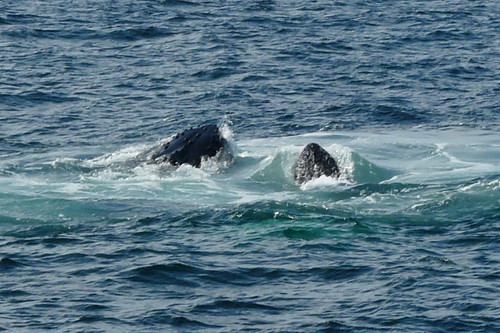
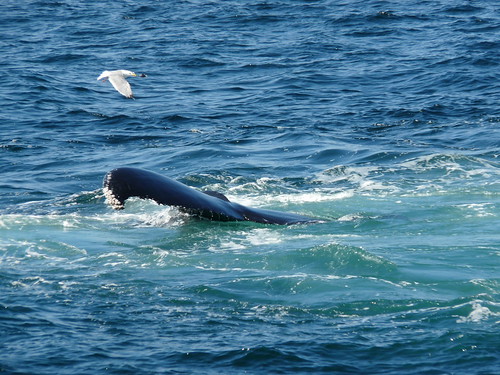
This weekend we got to see a pod of humpback whales bubble cloud feeding--that is cooperatively blowing bubbles to herd tiny fish into a concentration near the surface, then gobbling them up. The New England Aquarium's's tour brought us close enough to the whales that we could actually see, understand and anticipate what they were doing.

You first know you're going to see this specialized hunting technique when a huge patch of light turquoise water appears. Bubbles surface, then enormous black snouts covered with bumps (technically, tubercules or hair follicles). There's lots of jostling and swirling, then fins and finally a "whale footprint" or eerily smooth patch of sea that, we learned, whalers first thought was leaked whale oil.

I found some discussion online that humpbacks only bubble net feed off Alaska, Antarctica and west of South America. I'm not a whale expert, so I'm not sure if this is any different from what we all saw. But we clearly got to see it a few times. We had at least three whales at it, Echo, a mother; her calf, who stuck close to her; and another whale named Zooney.

The New England Aquarium has the system down to bring whales to the masses: a huge, fast catamaran whisks you an hour off-shore into Stellwagen Bank, a shallow feeding ground and sanctuary. Right from the center of Boston you can spend three hours and $40 and see one of the most active whale-watching sights in the world. Whale-watching tours from Cape Cod, Plymouth, Cape Ann, New Hampshire and Maine all head to Stellwagen. The boat's stable, so only a few get sick. You spend an hour speeding out to sea, an hour watching and an hour coming back. They sometimes see minke or fin whales, dolphins and basking sharks. A guy filming the trip for NOAA said it was the best he'd been on.

Not in Boston? Here are a ton of great places to see whales.

More places to see animals in the Northeast.

Got suggestions for animal watching places? Tell us.

Tuesday, September 01, 2009

Montana Hunts Wolves--Along with Bison and Sandhill Crane

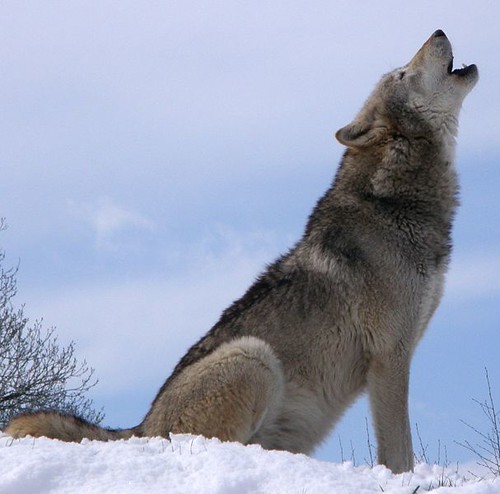
Montana will start hunting for the recovering wolf in two weeks--unless a judge steps in to stop it. The plan is to shoot 75 wolves, though by yesterday hunters had bought 9,000 permits, some just for a fun souvenir ($19 a pop.) Hunters are supposed to call in within 12 hours so Montana Fish Wildlife & Parks can call off the hunt.

That got us thinking about what other kinds of rules Montana has about hunting. Here's a sampling that will give you how hunting trumps all other concerns.


Photo Courtesy of Thomas Roche

  • Go ahead and hunt wolf pups. While you are banned from hunting lactating mountain lions, you can shoot wolves born this year. "This means you can shoot any wolf you see including pups if you so choose," notes huntwolves.com. You can't bait wolves or use electronic calls, but you can use manual or old-fashioned ones (typically calls of prey animals.) You can't use night vision or--unlike Alaska--an airplane. (Well, you can use it to spot them, but you can't shoot them till the next day.) Also, you can dump the carcass in the field, but you have to bring back the head and "evidence of sex: males: testicles; females: vulva or mammaries."
  • They hunt bison. That's right--the symbol of the west, the symbol of wasteful hunting. Apparently there was a reason for this rule: "It is unlawful to possess or transport the fetus or reproductive tissues of a bison away from the kill site." Just as Alston Chase described in Playing God in Yellowstone, they hunt them just outside the border of Yellowstone National Park.
  • They hunt Sandhill Cranes. Cranes! You get a free permit at either the Bowdoin or Medicine Lake National Wildlife Refuges or Fish, Wildlife & Parks regional headquarters. You can take up to three a day and have up to six. There's also a drawing for more convenient Sandhill crane hunting sites. According to the International Crane Foundation, their population is expanding, except where "small breeding populations can face disproportionate mortality on fall staging areas due to over-hunting."
  • They hunt swans. "Swan hunters must have, as a means of retrieving swans, a
    watercraft, a dog capable of retrieving or chest-high waders along while hunting the dikes at Freezout."
  • They hunt mountain lions--but not lynx or bobcats. "Mountain lion is excluded from being considered as “suitable for food” under big game regulations. A person that harvests a mountain lion must possess the head and hide, with evidence of sex naturally attached. The remaining carcass may be taken in possession or be left in the field."
  • They're still trapping fisher, wolverine and and marten.
  • They want an urban deer hunt.

Friday, July 10, 2009

Moose Alley, NH Tips: 10 Things Locals Won't Tell You

Believe the name. When you visit Moose Alley, New Hampshire,
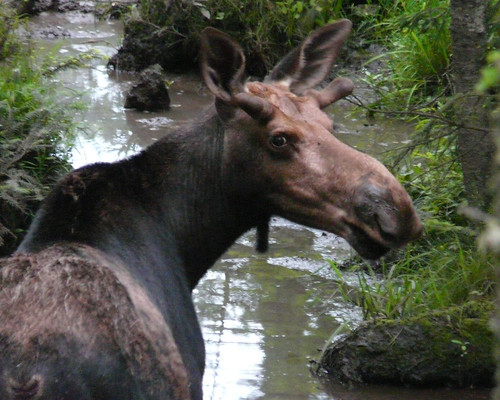
(not an actual town, but Route 3 north of Pittsburg up to the Canadian border) you will see moose. It's like magic; you just always see moose. I was skeptical, too--the victim of too many parks boasting of animals I would never see. But Moose Alley, way up in Coos County, has never failed me.

I kept asking the locals for moose-watching tips--since moose follow routines. Usually I got nowhere with that line of questioning--lots of encouragement to look "anywhere," "any road" at "any time." So I came up with what I would tell a friend visiting Moose Alley.


1. Look for Roadside Wallows.
Moose hang out by the side of the road to drink from ponds and puddles with salt run-off. You can spot the wallows because they tend to have trampled mud around them and a moose trail leading away from the road.


2. Look for Roadside Parking.
Where there are established wallows there is effectively wallow parking. Moose return at the same time every day. Moose watchers follow. One particularly popular wallow has a lot next to it--and still gets an overflow crowd parking on Route 3 at dusk. For that matter if you see a roadside parked car, as you will quickly figure out, it's probably your fellow moose watcher. Just ask if they've actually seen a moose there and are not just acting on a hunch that "that looks like a perfect place for a moose"--a phrase you will find yourself using repeatedly.


3. Moose also like recently cut trees.

Georgie Lyons told me that a logger off Route 26 says that a dozen moose appear in the morning when they hear him start his chainsaw. (She's in the visitor's center near Colebrook, but in the Chamber of Commerce back office. She knows everything about the area and is happy to share it.)


4. Timing matters, but not completely.
You will be exhorted to Go at Dusk and Dawn. Moose are crepuscular--meaning most active then. I've had the best luck seeing them in the hour right before dark. But they're also really active at night. A truck driver reports he recently saw 27 moose (not all at once) along a nearby road at 2 a.m. The problem with this--as with dusk--is that if you get any picture, it'll be lousy. And for that matter, you may see them during the day, too. Locals stress that they see them all times of day. I had my best sighting at 10 am. Moose's Hours Inconvenient? Go Anytime.

5. Route 3 is the best, but any area road will do.
The heart of Moose Alley is Route 3, but Routes 145, 26 and 16 all are local hotspots. So are the logging roads off Route 3, especially one marked Gate 137. For that matter, the people I talked to just said to drive any local road, especially ones bordering wilderness. The thoughtfully-built official viewing area on 26 hasn't had moose in a while, locals say. (We rented a house at a delightful Poodle Farm in Colebrook, a good mid-point.)

6. Lurk.
Once you find a moose spot, come back at the same time tomorrow. And if the moose get spooked by watchers, just sit and wait. You'll have the moose all to yourself.

7. You may not see any antlers.
First off, you're going to see more cows than bulls because the bulls are more wary. Second, the antlers fall off after the fall mating season, then resprout in early summer.


8. Your moose call is only going to work in mating season.

Moose don't just call each other to figure out where everyone's at--like some species do. They only call in season. Experienced moose hunters say it really works--and may even work a month or so after the season because some females may be late. But moose hunting seasons are timed to coincide with the rut. So you may just draw in hunters. And the moose catch on pretty quickly to the hunt and become much more cautious about people, hunting guide Larry Adair told me last year.

9. The logging drivers hate you.
They're trying to work and here we are trolling around for moose, half stopping. If you go on the logging roads, you have to be ready to get out of their way. They show their annoyance by driving fast past you.

10. The moose aren't that fond of you, either. And they really hate your dog.
Moose will run off if you get too close--or they may warn you off, but the signs may be too subtle: they raise the hackles on their rump, point ears back and lip their lips. Also, they give you a dirty look. They can bluff charge, charge for real and go out of their way to kick a dog. You car is actually a pretty good wildlife blind, especially if you've got a sun roof. Though when there's a Moose Jam, families will get out. You'll feel like a chump staying in your car. But the moose will eventually get spooked by people on foot.

For all that, it's still a thrill to get to watch one of these giant animals eat. I've been trolling likely looking bogs throughout New England and the Maritimes and Moose Alley is about the easiest place to do it.

Monday, May 25, 2009

San Diego Wants to Get Rid of One of Country's Best Seal-Viewing Spots


Despite protests from local residents and the distaste of City Hall, San Diego is on the verge of spending $700,000 a year to play the sound of dogs barking to the 100-some seals at the Children's Pool. The harbor seals (small, gray and shy) and sea lions (big and more aggressive) have been hanging out at the beach for years, delighting tourists, seal protectors and at least some residents.

But others are fighting to use the area the way donor Ellen Browning Scripps originally intended and state law proscribes: for children. The manmade beach is the subject of dueling lawsuits. Valerie O'Sullivan wants to get rid of the seals and she got a state court judge to order the city to get rid of the seals to clean up the bacteria in the water.

Who is Valerie O'Sullivan? A former resident of La Jolla who moved out of the country years ago and isn't even a citizen. So, the city has argued she shouldn't have a say in the matter. But meanwhile, the city had to come up with this absurd, expensive plan to get rid of the seals by playing dogs barking dawn to dusk and spraying water on the seals.

Meanwhile seal lovers and the Animal Protection and Rescue League tried to get protection for the seals in federal court. The federal fisheries agency was no help: they said the city didn't need any special permit to get rid of the federally protected animals. Then again, that was a Bush era ruling, so is anyone surprised?

Meanwhile a third plan to save the seals is that the legislature could just change the the law about the purpose of the beach. San Diego says that the seals will just move to "Mission Beach, Pacific Beach and other nearby coastal spots." Of course if they knew that for sure, there wouldn't be any fuss really. Nobody knows what will become of the seals if they are forced out. It would be a lot easier to move the children's part of Children's Beach to one of those areas. It's a lot easier to get parents to comply with some common sense adaptations--aside from Ms. O'Sullivan. You can't tell seals where to go.

This is also a perfect case for federal protection. This beach is a unique natural attraction in the country. It's one of the few places you can go to see sea mammals reliably hauled out on the beach. The beach itself is no natural wonder; it's one of those giant let's mess with nature infastructure projects that would never get off the ground today. The sea lions that showed up one day at the San Francisco Pier 39 certainly got in the way of boaters. But the city reasonably worked out a way to let them stay--and got a delightful addition to the city.

Wednesday, February 11, 2009

Now's The Time To Go See Eagles and Seals


Just because it's winter doesn't mean there aren't lots of animals to watch. Here's a list of places to watch bald eagles all around the country are having their eagle watch or eagle festivals. Eagles can either migrate or stay put. This time of year the birds that live up north come down for open waters to fish in. They especially like waters near power plants and dams. (I guess they don't have to migrate as far down south if they can find some artificially heated water.

Although I grew up in a time when any eagle sighting would have been spectacular, eagles are now getting much easier to see on just about any big river. The Eagle Fest last weekend offered heated tents and experts, but since Croton Point Park near the Metro-North train station is one of the best spots, you could go anytime in probably from probably January to March This last week was an eagle watching festival at Croton-on-Hudson, which is just an hour north of New York City. Bruce Yolton took spectacular pictures of eagles riding the ice flows. Another great local raptor photographer, Francois Portman, told me he went up recently but only saw birds flying in the air. So, as always it's hit and miss.

Last weekend I tried to go see the seals that come to Sandy Hook in the winter, but just missed them. A ranger told me they had been right on the sand at Beach B, but I found none. When I walked out a mini-pier near Fort Hancock I asked two photographers if they'd seen anything. "Just a seal," one said. Just? But I didn't see any. The ranger also said that they're often seen just on the island or ice off shore.

Tuesday, October 07, 2008

See Bears Without Hunting Them?


I finally got to see wild bears on a trip last month to New Brunswick, Canada. Acadian Richard Goguen built a bear-viewing tower and an increasingly succesful business on his family land, Little, Big Bear Safari.

Back in 2000 Richard got tired of guiding hunters to kill animals they weren't going to eat. (He's not anti-hunting; he still hunts for food.) He had more fun taking people out to take pictures of the bears, says his multi-lingual wife, Vivianne.

Richard first built a tower for six people in 1998, but he's had to expand. His current tower (his third) fits about 50 people, has two covered staircases, a wood stove and lots of open windows to see bears.

The experience starts back at the Goguen house in Acadieville, which is about 150 miles from Maine. The Goguens pass around pictures, tell stories and all the bear tourists meet up. The night I went there was a German couple, another European couple, and a few locals who were friends of Richard. They're forest rangers and sometimes fill in for Richard, who also works as a school bus driver. One brought his father, a bear hunter.

If this were in America, I'm sure there would've been tons of t-shirts, shot glasses and bear junk available. (And I probably would've bought some.) They just have a few key chains and some paintings. We all signed legal waivers. In the U.S. I'm sure they would've been more than the one page. Actually, I'm pretty sure this wouldn't happen at all--both because of liability and prohibitions against feeding bears unless you're hunting them.

Which is what makes this a great place for Americans to visit. It's only 150 miles from Maine, near Kouchibouguac National Park on the coast of the Northumberland Straight.

Vivianne drives us out to the bear tower in a little white bus. In the back are bushels of apples, which Richard dispenses with piles of meat and nuts. Then, she'll drive back to the house. The bears would climb on if they left the van there, Richard explains. (But if anyone gets spooked, they'll come pick them up.)

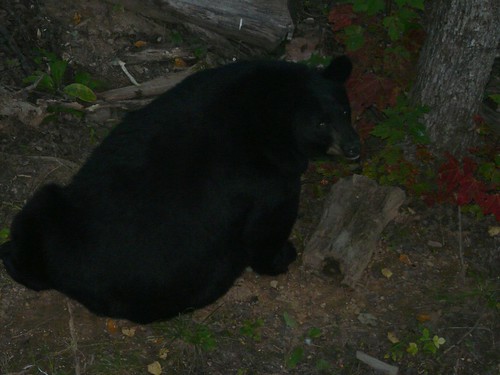
Along the way Richard explains that he has known three generations of this group of bears. One bear--now the grandmother--used to follow him around. Then her daughter did. And now the daughter has shown her two youngsters to do the same. But, he says, he doesn't know all the bears. Some bears are regulars and some come and go. Last night there were 13--putting to rest my fears that there wouldn't be any.

When we pull up to the bear tower, none are in sight. But by the time Richard delivers the food, four come out of nowhere. We hustle up the wood stairs (covered by metal gates) and onto the viewing platform. Richard leaves the food on different sides so there's plenty of room to see the bears from the windows on two sides of the tower. Richard tells us to keep our voices low, but that flashes don't bother the bears. The sound of metal--like change jingling--does though, he says.

Within minutes all of the bear viewers are giddy and awestruck. We get to see the bears interacting. Some are family. Two juveniles eat, but cautiously. One gets chased up a tree by an adult. Later one adult chases another down the dirt road. One big bear hogs the meat. Others just lounge by the apples, swooping up the fruit with their paws. Still others wander between feeding stations, like shoppers always worried someone else is getting something better.

Richard says that since I'm a journalist, he'll let me go down to the open viewing platform below the main one. Here's it's just an outdoor wood staircase, like a Chicago fire escape. I'm about 15 feet up and can see and hear the bears walk under the platform. Some look up at me. When I see the young bear climb a tree, I am reminded that they could climb up to where I am in seconds. I'm tempted to go back inside. But I'm too fascinated to leave.

Blue jays and red squirrels come by. They seem to know the feeding schedule, too. The bears half-heartedly swat them away.

Towards the end of our 90 minute visit, Richard goes out and feeds some of the bears by hand. Then I feel ridiculous for being afraid that these bears, who have a feast in front of them, after all, would contemplate eating me. Richard insists that he knows the bears he's feeding. His wife says that he never approaches a bear, he waits for the bear to come to him. He jokes that neighbors tell him that some day he will end up in a bear's tummy.

Still, the whole hand feeding thing makes me nervous. As I film it, I feel like I'm watching the beginning of a horrible youtube clip. I think about Timothy Treadwell, who also thought he had a special relationship with bears and who was killed by an aggressive bear he didn't know. (But those were the more aggressive grizzlies.) Also, it makes the bears seem less wild.

On the drive back I talk with one of the forest rangers. He's happy to see a New Yorker like me--or anyone from far away--coming to enjoy the New Brunswick bears. And he should be proud of it. What the Goguens have built is a really smart animal tourism attraction, unique in the world, one that takes provides a regular income to locals off wildlife without killing the bears. There are bear-viewing places out west, but they rely on grizzlies eating salmon. Here they've created their own food source (which wouldn't work in a populated area and I'm sure would raise objections to people worried about bears becoming habituated to humans and human food). Richard hopes to I'd recommend the experience to anyone and I wouldn't be surprised to see it copied.

Where to Go See Bear
Where to See Wildlife in Canada

Sunday, September 21, 2008

New Brunswick Moose Cruise


I've heard about going with hunting guides on wildlife watching tours, but never done it. A guy I know who gives bear viewing (and not hunting) tours says the hunters mock the watchers. But the wildlife watching business isn't nearly as developed as the hunting guide one. So where do you go if you want someone that really knows animals?

Staying in Fundy National Park I saw a brochure for nearby Adair's Wilderness Lodge and their "wildlife tours." Another couple in the park said everyone who went there loved it. I called and talked to Ida Adair, who said we might see deer or moose, but nothing's guaranteed. Wildlife watchers know that's part of the deal. The only ones who say you're going to see an animal for sure either are lying or have some place staked out where habituated animals visit regular. The Adairs are neither. Also, they said taking our dog was fine. Larry Adair takes his shepherd with on trips, too.

We cruised around in Larry's white van, pounding over dusty clay roads, looking in every field. A good part of the fun of the trip with Larry Adair is hearing his stories about his past adventures in the wild, with animals and with people. He may have been holding back any hunting stories that would've turned me off, but I think of him more as an enthusiastic outdoorsman. When I took a class for a hunting license for research, the instructor talked about the true sportsmen, who didn't care whether they actually killed any animals, just about whether they had a good time with friends and helped others enjoy the wilderness. That's Larry.

When I mentioned how some people in the states now get annoyed at seeing deer (which are still relatively rare in these parts), he responded "There's nothing more exciting than seeing a wild animal."

And we did get to see two moose cows. One, off in a field in the perfect sunset glow. The other was there when we looped back. Larry told me I could get in closer, just move when the moose's head was down. Smart tip.

Larry mentioned that a big hunk of land near him might become part of Fundy National Park. When people asked him whether that would put him out of business, he said, no, he can make money teaching people how to hunt, with a gun or with a camera.

Ida, who made the pumpkin pie we had for dinner, also had neat stories about wildlife, like seeing the migration of nighthawks.

We also really appreciated the more laid back attitude in general in Canada about travelling with dogs. Originally for this fall trip David and I planned on going to Maine and maybe see some moose in the rut. But, we're travelling with our old dog Jolly. He's nearly 15 and we don't know if this will be his last adventure.

But Maine wasn't so accommodating. Baxter State Park doesn't allow dogs. A moose tour out of Millinocket doesn't either. David would've been content to stay behind but they didn't even allow dogs in the cottage. So, we decided to head to New Brunswick, figuring it would be just like Maine, only more so.

We're definitely tempted to come back to Adair's in a bit. Larry says right after the 3-day moose hunt this week will be the rut. And then he'll be able to call in a bull moose.

Where to See More Moose
See More Wildlilfe in Canada

Friday, August 29, 2008

Palin Picked Outnumbered Hunters Over Wildlife Watchers

Photo via Grizzly Bay by way of Kinship Circle.

Looks like John McCain has picked Alaska Governor Sarah Palin as his vice president. Palin does have a lot going for her: she's anti-corruption, smart, young. She is the anti-Ted Stevens. She has a reputation as a straight shooter, both literally and figuratively.


But in her recent moves to support aerial hunting of wolves, she has been acting more out of personal loyalties than her state's best interest. One of the things that makes her so popular in Alaska is that she loves hunting and guns. She supports the controversial aerial shooting of wolves, a plan that leaves more moose and bear for hunters to shoot. This week Alaskans voted to keep aerial shooting--after an ad campaign that got $400,000 from the state and $350,00 from hunting groups.


Defenders of Wildlife tried to get animal lovers to write to her to stop aerial hunting. They posted a youtube video explaining how the wolves often survive the shot and die of exhaustion.


According to the U.S. Fish and Wildlife Service's 2006 survey of outdoor recreation, wildlife watchers outnumber those who went fishing or hunting in Alaska. For every three Alaska residents who go hunting or fishing, four just go watch wildlife. And lots of them would like to see wolves. And when you include non-residents enjoying the outdoors in Alaska the ratio goes to almost three to five. Even in Alaska, only 11% of the population hunts anymore.


The argument to kill wolves to support hunting is that hunters spend more money. But of $1.3 billion spent in Alaska on enjoying the outdoors, only $674 million was spent on hunting and fishing. The report doesn't break out what's just for fishing.