We've Moved!

Hi and Welcome to the AnimalTourism.com blog. But we've moved just down the street to this site, animaltourism.com/news. Please comment there.
Showing posts with label owl. Show all posts

Tuesday, April 13, 2010

Chicagoland Wildlife Refuge Could Be Chance to See Cougar, Trumpeter Swan, Cranes

This week the Fish and Wildlife Service announced they'd study a plan to start a wildlife refuge between Milwaukee and Chicago. What would the Hackmatack National Wildlife Refuge mean for wildlife watchers?
A chance to see cranes, trumpeter swan, otter, badger, coyote, deer--and possibly cougar, whooping cranes, a funny kind of squirrel and some threatened bats and turtles.


The Friends of the Hackmatack NWR  who have already been working for years to get this gonig, in part inspired by the fact that when Audubon Magazine boasted that "a wildlife refuge is located within an hour’s drive of every major metropolitan area" Chicago proved them wrong. It's the biggest city without one. This refuge takes note of the need for wildlife watching near where people live; it's designed to be within two hours of Chicago and Milwaukee. Judging by the excited email I got from my friend David Hall and others, I'd say it would be pretty popular.

Hackatack--named after the larch tree--would try to sew together the patchworkd of 88 parks and preserves already there so that wildlife can have some breathing room. The wildlife service wouldn't force anyone out, but they would offer to buy property within the refuge boundaries.

I did some research on what animals we might expect to see if we visited the refuge:


Cougar:  The Cougar Network has two confirmed sightings in the refuge area since 2008, one with physical evidence, the other verified by a qualified pro.


Trumpeter Swan
Trumpeter Swan: Maybe! This endangered native swan is already very close by in Wisconsin and has benefitted from a massive reintroduction program in Iowa. Illinois seems to be doing next to nothing for these straight-necked swans--except accidentally shooting them down south.

Bats: McHenry County has six species of bats. That includes four that Wisconsin is keeping special watch over:  Eastern Red Bat, Hoary Bat, Northern Long-eared Bat, and the Silver-haired Bat.

Whooping Cran © Luther Goldman
Cranes: Sandhill cranes definitely pass through. The site is on the flyway of the flock of 21 endangered whooping cranes that summer in Necedah National Wildlife Refuge in Wisconsin and winter in  Chassahowitzka National Wildlife Refuge. They are famously being taught the route, which makes stopovers in national wildlife refuges, by ultralight aircraft.

River Otter: Yep, it's all over Wisconsin


Franklin's Ground Squirrel © Tom Schultz
Franklin's Ground Squirrel: Wisconsin calls this a species of greatest concern. It's like a small prairie dog, but quiter and less entertaining.


Badger: Badgers are all over Wisconsin, but rarely seen.

Owls : McHenry has 13 species of owl, including the snowy owl.

Blanding's Turtle: This threatened turtle takes 17 to 20 years to reach maturity.
Blanding's Turtle


Black Bear: Probably not, says Wisconsin, who rates appearances here as rare. No way, says Illinois, who says only one black bear has been seen in the state since 1870 and they kicked that one out.

Wolf: Nope

Lynx: No way

American Marten: No, he's all the way up on Lake Superior

 Where to See More Animals Around the Midwest

Thursday, March 25, 2010

Everybody's Watching Molly, the San Diego Owl, Hatch Her Family

Unbeknownst to Molly, a young barn owl mother, about 2 million people are scrutinizing her egg-sitting, feeding and every move, day and night, asking questions and offering critiques about every 30 seconds. Since January, when Molly moved into a backyard owl box in San Marcos, CA, the box's landlords started adding progressively more advanced photo equipment, culminating in the live streaming camera at Ustream, which has had about 2 million views.

Viewers won't be disappointed. Molly fusses over her eggs--and now two chicks--like a Park Slope parent. She incessantly gets up to rearrange herself, providing a glimpse of the chicks. Her mate arrives just after sunset with dinner--once a whole rabbit. 

A retired couple, Carlos and Donna Royal, have been waiting for just such a visitor for years. "We have a very eco-friendly backyard; we live on an acre lot with lots of trees and plants for wildlife," they say in their Ustream profile. "We have had kestrels, bluebirds, hummingbirds, phoebes, wild ducks, killdeer and mockingbirds all nest and raise their young in our habitat. We do not have any cats or dogs to disturb the wildlife."

Carlos, a former real estate broker,  told the San Diego Union-Tribune that they put up the house two years ago, but got no tenants. Then in January a neighbor asked if they heard the owls screeching in a storm. With the help of their teenage grandson, they added a camera on the outside of the box, then an infrared camera and hooked it up to the internet. (Since Ustream is free, the whole arrangement probably only costs a less than $300.)

The Royals, who had a casual backyard blog Birds R Us before Molly, are clearly having a good time with their owl family. Back when Molly was a just a smalltime internet spectacle with 33,000 fans, they declared her "the most famous barn owl in the world." They sell Molly Merchandise. They've changed their blog profile to suit Molly. The author's occupation is listed as laying eggs, her favorite movie: The Birds.


Live TV : Ustream

Wednesday, March 24, 2010

Birding Bob; Northern Saw-whet Owl Stops in Central Park; Woodcocks in the East Village

Dr. Robert "Birding Bob" DeCandido leads birding tours around New York City. Usually he takes people to see owls in Central Park, which he helped reintroduce. He lets us run his newsletter here. This week he saw a northern Saw-whet owl in Central Park and the carcass of a woodcock.


Northern Saw-Whet Owl, by Richard Leche


The carcasses are in bloom! Yellow and purple and some white - or so it was on Sunday when we were in for other surprises as well. On our walks, we were able to provide discussions of the age of migrating Saw-whet Owls (including photos by Debs), American Woodcocks and more in Central Park in the last several days - by our group. We think with birds...and to find them, we have to think like birds too.

Our historical notes include a NYC area summary of the spring season - 1920. Today, our observations show that many bird species are arriving earlier than in the past. Why? We will leave it to others to explain. In the meantime, we document the changes, and provide the historical record for comparison. We also provide the first records of breeding Tree Swallows in our area. Now they are common breeders at Jamaica Bay and elsewhere on Long Island - but not 90 years ago!

Not had enough of us yet? Beginning the first week of April, our Sunday and Tuesday walks will begin meeting at the Dock on Turtle Pond.
=====================================
Good! Here are the bird walks for this week:

Friday, March 26th: 9:00am. Central Park - Meet at the entrance to Conservatory Garden (105th street and 5th Avenue)
Sunday, March 28th: 9:00am
- Central Park - Meet at the Boathouse $10 -  rain or shine.
Tuesday, March 30th: 9:00am - Central Park - Meet at the Boathouse
$5.
--------------------------------------------------------------------------------------------
The fine print: Our early spring SUNDAY walks meet at the [Loeb] Boathouse (approximately 74th street and the East Drive; the SE corner of the lake). - $10 for adults, and $5 for kids.  Easiest way to get to the Boathouse is to enter the park at 5th Avenue and 72nd street and walk west until you find the south to north road (the East Drive) that intersects the 72nd street "transverse." Then just walk north for about 1-2 minutes...Look for a small restaurant type place with chairs/tables outside - we are inside. 
On FRIDAYS, we meet at 9am at Conservatory Garden, 105th street and 5th Avenue (just inside the main gates). Easiest way to get there by subway is to take the #2 or #3 train to 110th street and Central Park North.  Then cross the street to Central Park and head east (to the left) toward Fifth Avenue, and then south until you reach Conservatory Garden (about a 7-10 minute walk from the train station; easy and safe).   Most Friday bird walks last about two to three hours in autumn-winter, but feel free to leave at anytime, we won't take it personally.  We have an extra pair or two of binoculars to rent, so if you want to rent a pair, just call or email before the walk to let us know.  Also, if you are thinking of purchasing new binoculars, ask us - we probably have used them, and we will let you know how to get them for the best price. These days we like a relatively unknown brand by the name of  Zen-Ray, specifically their 8 x 43 model.

---------------------------------------------------------------------------------------------
Here is what we saw last week (selected highlights) with some anecdotal notes and observations.  Not all species we saw are reported here - we list the best:

Friday, March 19th - we found two significant occurrences today, one common - an abundance of Dark-eyed Juncos in Central Park, and even Madison Square Park on 23rd street (thanks Sandra). Juncos on the move turning up everywhere - they were mostly gone from CP by Tuesday (23 March). The second, a most unusual spring migrant in New York City - a Northern Saw-whet Owl. Here is the owl after a squirrel had flushed it from its perch in an evergreen cedar halfway down the "Point" in the Ramble:

Debs, wanting to know more about the age/sex of this owl asked some questions of the local owl experts, Trudy Battaly and Drew Panko. They have been banding and tracking these little owls in NYC and Westchester County Parks. Debs wanted to know why (when she greatly enlarged the photo) the edges on all the primary/secondary feathers were very worn. Drew and Trudy emailed back that this is most likely a bird in its second calendar year (SY).  In other words it is an owl that was hatched last summer (2009).  These young birds make up the bulk of the migrants since they outnumber adults. Juvenile feathers of saw-whets wear out faster than adult feathers, and that is exactly what can be seen in enlarged images - the feathers are very uniformly worn suggesting that the feathers are all the same age. Trudy went on to write: "I think we are near the end of their [Saw-whet Owl] spring migration, and yours is most likely a SY female who is not in too big a rush to get back because she knows there is a male already on territory waiting for a female to fly by."

OK let's tell that story with photos. Here is a photo of another SY Saw-whet Owl - note how all the feathers look the same.

On the other hand, here's an After Second Year (ASY) saw-whet, in February.  Note the three different types of feathers (= ages) in the wings:

Banding birds allows you to see much more - ultimately to think about birds. That is why precise age/sex identification is important - it leads to thinking.
--
Sunday, March 21st (Central Park, Ramble) - I was sitting in the Boathouse with Dan Silbert on this lovely mild and sunny Sunday. He casually remarked that he had just returned from Death Valley. To which someone replied: "I hope it wasn't too serious and you are better now." :-) Right about then, some whisperings began that Deborah Allen had a woodcock in her pocket. This turned out to be true - Ed Simon had given her a dead one, that he had found on Third Avenue and Tenth Street. (Frank Rutella had found another approx. ten days earlier, about 40th street also on the East Side.) Deborah took the woodcock and did a feather demonstration with it - she could age/sex this bird. The very russet (almost orange color) suggested adult male, and the width of the three outer primaries confirmed it. Why? The males use the narrow primaries to make the winnowing sound during aerial courtship displays.

Not to forget other birds we headed off to the Ramble. Here we noted good numbers of Northern Flickers (new arrivals). Isaiah Wender found a male Wood Duck perched, where else, in a tree above us...and then he added Golden-crowned Kinglet, Song Sparrow, Black-capped Chickadee and a number of others. Jack Walsh found us a Red-tailed Hawk in flight. Others were contributing too: Eastern Towhee at the feeders; two Brown Thrashers at the Maintenance Meadow; two Red-breasted Nuthatches; a Yellow-bellied Sapsucker (male); Cedar Waxwings (flock); Swamp Sparrow (Emilie) and many others. Easily the best day of the year. And one other important spring sighting: Yellow and Purple Carcasses were in bloom everywhere. Dan Silbert, based upon his visit to Death Valley, identified them immediately. He and I are like psychedelic Turkey Vultures when it comes to blooming carcasses. We zeroed in on them...and await everyone else to join us next week.

Tuesday, March 23rd (Central Park, Ramble) - Anders, Tom and I wandered about the middle of the Park. Our most exciting sightings were the young Sharp-shinned Hawk chasing a Red-bellied Woodpecker; a female Hairy Woodpecker (there is a male at the north end; the pair tried to nest last year); a pair of Wood Ducks in a tree; and a diving large falcon, probably Peregrine in the area of the Great Lawn. Otherwise it was a bit breezy and surely cold. We recalled the 70 degree temps of last week - and lamented the real spring of the present.
======================
THE SEASON XIX. February 15 to April 15, 1920

New York Region.—The last half of February saw an increase in Redpolls, now in considerable flocks, but they soon disappeared again. There seems also to have been a flight of Long-eared Owls at
this time, noted at Amityville, Douglaston, Staten Island, Englewood, and the vicinity of Plainfield. February 23 a number of Evening Grosbeaks were found in a patch of red cedar woods at  Amityville, Long Island, feeding on cedar berries. With them were many Goldfinches, some Red Crossbills, and a few Purple Finches The Evening Grosbeak has been reported repeatedly from Douglaston, Long Island (G. C. Fisher), last seen April 10 and likely still around. The attraction here seems to be the fruit of the hackberry.

More than in the New Jersey direction, late February and the very first of March usually find an increase of scattered Robins on Long Island. We have been at times in doubt as to whether these birds are arrivals from the South or have been driven in from southern New England where, at that date, the Robin is generally present in considerable flocks. This year these early Robins were less than usually noticeable on the Island, an indication that they are southern birds, as late winter birds from the North of all species were more than usually represented.

The spring was late in putting in an appearance with its first migrants from the South. The entire absence, during the very end of winter, of Song Sparrows at Garden City, Long Island, made it possible
to determine when the first individuals returned, March 12. Fox Sparrow and Grackle were present here for the first time on March 14, the Grackles being about two weeks later than their usual arrival,
the end of February. The first unquestioned increase in Meadowlarks came on the 21st and they became common on the 24th. The Flicker put in an appearance on the 28th, and Chipping Sparrows only on April 7 this year, although they had been reported from the New York Region a few days previous. Up the Hudson, vicinity of Rhinebeck and Poughkeepsie, data compiled by M. S. Crosby shows the earliest arrivals to have been delayed: Fox Sparrow, March 14; Grackle and Song Sparrow, March 15; Robin, March 2. The next lot of birds were, however, as early as one could expect them: Phoebe, March 23; Flicker and Cowbird; March 26: Chipping Sparrow and Tree Swallow, April 3; Barn Swallow, April 11; Louisiana Waterthrush, April 12; etc.

Reports from New Jersey indicate retarded migration, though by April 1 spring arrivals were about 'on time'; and a better showing than usual of the less-abundant Ducks. At Englewood, Rough-legged
Hawk, March 21, Golden-eye Duck and Tree Sparrow, April 11, are late dates obtained by L. Griscom, who also reports the Hooded Merganser, Baldpate, Blue-winged Teal, and Ruddy Duck from there. C. H. Rogers and W. DeW. Miller found the Baldpate, Green-winged Teal, and Pintail at South River, April 4.

A Blue-gray Gnatcatcher was noted in Prospect Park on April 7 by R. Friedmann, and the record corroborated by a number of Brooklyn observers who found it there again April 12 and 14. The occurrence of this species north of its regular range at so early a date is doubtless correlated with the fact that, like other southern species, its regular spring migration comes early.

J. T. Nichols, New York City.

Wednesday, December 02, 2009

Atlanta's Wildlife Hosptial


Flirty Arigato - SW Bobcat - L. rufus baileyi (Merriam)
Just 20-30  minutes south-east of Atlanta, wildlife rehabilitator Michael Ellis is nursing some dwarf baby squirrels, teaching a great-horned owl independence and giving permanent shelter to a couple bobcats. His outfit, AWARE (Atlanta Wild Animal Rescue Effort), is the biggest wildlife rehab center so close to such a big city  I've seen.

Ellis, whose been rehabbing wildlife for two decades, says having big Route 20 nearby is crucial. You ride a few miles off the highway through farmland and the Arabia Mountain National Heritage Area and you're at Aware, which looks like a house with an extensive kennel system. If you serve animals, why  be near a city? Most wildlife injuries involve people (or their cars or cats). But more importantly, the best way to help animals is to teach people how not to kill them.

"I could spend 45 days saving one opossum or 45 minutes with one class of 30 kids and end up saving 1,000 animals over their lifetime," Ellis says. The grim truth of wildlife rehab is that--except for maybe a few endangered species--its broad impact on animal populations is pretty much nothing. Squirrels and starlings are in no danger of going extinct. "But it makes a big difference to that one animal," says Ellis. And each of the animal treated impacting the people who find them or learn about them at the center. That's why Aware wants to reach every kid in Atlanta.

A few of those that can't make in the wild live out their time at Aware. A local bulldozed a bobcat den, then decided to raise the cub instead of letting the mom retrieve it. The small shy cat hid in his house while I was there. Meanwhile a much bigger and bolder bobcat, Arigato, preened. He's a southwestern subspecies that someone tried to raise in Georgia as a pet. Lauren Satterfield, a volunteer who hopes to study wildlife conflicts, says ill-treated Arigato is surprisingly friendly.  Indeed, the big cat is absolutely flirty. A big ham, he nuzzled up to the fence, then turned his butt towards me. Much to my surprise, he sprayed me with his pee. All over. In bobcat world, I think Arigato now owns me; he was incredibly pleased with himself, lolling around showing off his spotted belly afterwards. A few flightless owls clicked their beaks at me. I don't speak owl, but I'm pretty sure they were showing me that they are tough guys. Most patients are transients and never see the public so they won't get too comfortable around people. Every fall Aware seems to get a batch of gray squirrels that have fallen out of trees that are about half the normal size and suffer from a skin rash.

Ellis modestly describes Aware as too small, but it seems to me better equipped and organized than most vet offices I've seen. Each animal gets an intake form and individual care, with a view to being released near where it was found. Although Aware meets the technical space requirements of each species, they'd like to give unreleasable tenants a bigger space and more natural and interesting daily life. "When it comes to permanent residents, they deserve the best," Ellis says.

Sometimes they have to turn down requests from wildlife officials for big animals like bears that they don't have the capacity to care for well--yet. That's part of the reason they're planning on adding 5,000 square feet of facilities over the next few years--provided they get the donations.

Donate to Aware
Find other places to see wildlife down south


Fun Facts: Even in good ole boy Georgia, wildlife watchers outnumber hunters about four to one.

Georgia Residents: 

1.1 million fishermen
481,000 hunters
2 million wildlife watchers


Non-Residents Enjoying Wildlife in Georgia:
136,000 fishermen
136,000 hunters
183,000 wildlife watchers

Saturday, November 21, 2009

Great Horned Owl Sticks Around In Central Park

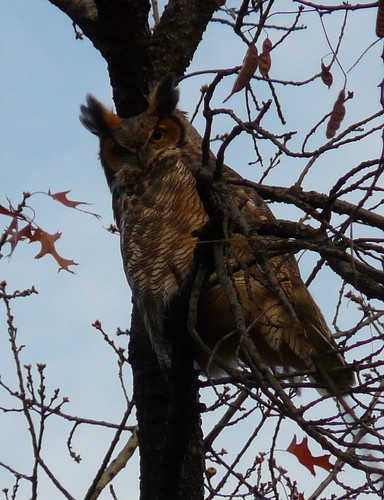
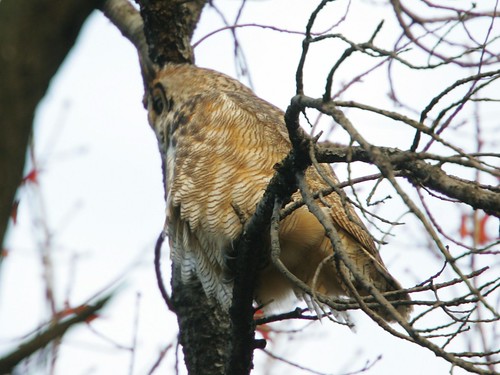
I finally go up to Central Park and see the great horned owl (bubo virginianus) who's been visiting the ramble this week. I showed up about an hour before dusk, when the owl flies out to hunt. He (or she) spent a lot of the time puffing up, stretching, then tucking his head back to rest. He reminded me of a person trying to ignore an alarm clock. Though he was sharp enough to glare at movement on the ground and a mobbing blue jay.

It's a huge bird, but it could still be tough to find. I'd found out he was there from my friend Donegal Brown, who takes and gets great animal pictures from readers around the country at Pale Male Irregulars. But, as is often the case in Central Park, you don't have to be a keen enough spotter to find the bird. You only have to be observant enough to find a bunch of people with giant lenses looking up. By darkness I think 20-25 people had come to see the bird. 

I was especially lucky. The guy with the pro camera let me look through his lens, then even asked for my memory card and shot some wonderful close-ups. Who was this photographer who was impossibly generous? Turns out it was Lincoln Karim, who runs Palemale.com, where you will find dramatic pictures of the owl's open mouth and clenched foot. Lincoln is a well-known advocate for wildlife in the park. Among other things, pushing to end dangerous rat poisoning. (It's his picture of the owl with the side view here.)

Lincoln says this bird is unusual in that he keeps moving around. He flies around from spot to spot during the day. And he ends up in a different spot when his fans come to find him at dusk. I asked Lincoln why the owl bobbed his head once he flew out. He guessed that owls are triangulating on its prey; which is exactly what the Owl Pages says. No one knows how long this owl will stick around

Looking for more wildlife around New York City? Here's a map and guide.

Wednesday, August 12, 2009

Owl Lands on Central Park Birders

Notes from Robert DeCandido (PhD), who gives tours in Central Park as Birding Bob.

We have again added two Eastern Screech-owl walks in Central Park this week. Both walks will meet at the North End, since we had very good luck there with owls and bats. In fact, in one unbelievable moment, the most amazing thing, ever (ever) happened on a Bob owl walk:

I couldn't believe my eyes. I was playing the owl tape via the Ipod for a few people when an owl swooped in and landed on Tom Walsh's hand. His son Jack was finally impressed - and I am finally absolved of running the most boring bird (and owl) walks of all time!

Further details about the owls we saw last week (including Great Horned Owls) are provided below. We also include a New York Times article from June 1934 about a "savage" screech-owl that was attacking people in Douglaston, Queens - and an excerpt from Sam Yeaton about screech-owls in Queens covering the 1919-1945 time frame.

Bird Walk Info
=====================================
Bird walks for this week ($5):

1. Thursday 7:30, Aug. 13: Owls and Bats of Central Park (The North Woods) - meet at 5th Ave and 106th street
2. Friday, Aug. 14: Conservatory Garden (105th street and 5th Ave.) at 9am.
3. Sunday, Aug. 16: 9:00 am - Turtle Pond Dock.
4. Sunday 7:30 pm, Aug. 16 $5. Owls and Bats of Central Park (The North Woods)

In the last week of August, we will add some trips to the Empire State Building at night. Why? We just received this report from Sandra Critelli: (night of August 11th) - Hi Bob! I wanted to tell you that last night I went to the Empire SB to take my friend from Italy and it was a good night for birds, at least the little time I was there. I counted 29 birds flying mostly low, a little higher than the deck, small to medium (robin) sized birds. All between 8.30pm and 9.25pm when I had to leave unfortunately (I was enjoying the birds). And at 8.50 I saw a flock of approximately 25 little birds flying south and at eye level. And numerous moths low and high. And too many Italian tourists out there!!! Goodnight Sandra
--------------------------------------------------------------------------------------------

---------------------------------------------------------------------------------------------
Here is what we saw last week (selected highlights) with some anecdotal notes and observations. Not all species we saw are reported here - we list the best:

Owl and Bat Walks (three walks) Summary - the burning question of the week was, "Where is David Mills?" David, who is back in England with his lovely wife Geraldine, took control of the bat portion of our walks last year with the aplomb of a general. In a recent email, he wrote, "Education, education! Far more people die of bee stings or dog rabies (or get struck by lightening) in the US every year then get bat rabies, so people should not worry too much. More people get dog rabies in a year than they do in 10 years with bats but do people go "all protective" and scared when seeing dogs in Central Park?
In comparison with most people's views about bats, they should!! Bats do not make nests, or enlarge holes, or chew wires etc in houses as they just hang up etc in caves, trees, bridges & houses. Do let me know if you have any questions on bats or pass my email (see above) to anyone with a question to answer that you can't. And tell them to raise a glass to bats when they enjoy a margarita as "no bats - no tequila" (only bats pollinate the Blue Agave plant)."
OK we had great luck with Red Bats on both walks in Central Park - the north woods were filled with them hunting along the paved path and making us duck as they swooped in and about our heads. As for owls - in the north woods we brought in two Eastern Screech-owls (email me if you want info about their history in Central Park and NYC), but had no luck with owls on the Ramble night walk. (So this week we are only doing North End owl/bat walks.) And in the Bronx (Pelham Bay Park) at the Bartow-Pell Mansion after a NYC owl slide talk, we went outside and called in not one, but two! Great Horned Owls. Bob was even impressed.


===================================
Queens Vigilantes Hunt Savage Bird(New York Times 18 June 1934; Page 19)

Patrol Douglaston with Rakes and Clubs for Creature that Attacked Passerby

Woman's Face is Gashed

Five Other Victims Reported - Dr. Blair Suspects Screech-owl is 'Protecting' Nest
A vigilante committee formed to hunt down a savage night bird that had attacked at least five persons along 241st Street Douglaston [Queens], within the last five nights [June 1934], patrolled the vicinity for at least five hours last night without catching a glimpse of the marauder.

Just before the vigilantes turned out, the mysterious bird - which is believed to be a screech-owl - chalked up his sixth victim. He was Charles Taylor, a student at New York University. Taylor reported that the bird struck him while he was crossing the lawn to his home. He ducked and the bird skimmed past his head.

The bird's other victims, all neighbors on 241st street in the Douglaston Park sector, were Arthur L. Stemler of Bancamerica Blair; Russell cardigan, a stock broker; Mrs. Earl R. Evans, 23 year-old housewife; Peggy Noone, 13 year-old daughter of John B. Noone, assistant treasurer of Standard Brands; and William MacDonald.

The Vigilantes Set Out
The vigilantes, about twenty strong, assembled at Mr. Cardigan's home before nightfall. They were armed with lawn rakes, rug beaters, tennis racquets, an assortment of clubs, and even one bayonet and one rusty machete, souvenir of the Cuban insurrection. Henry M. Ferguson, a bank engineer, wore a Prussian helmet. Earl Trangmar, director of marketing research for Metropolitan Life, had another steel hat and carried the machete.

Up and down the street they marched, using unarmed decoys to lead the way, while the rake or strong-armed men carried up the rear. Joseph Spiro, owner of Douglaston's taxi fleet, hooted at intervals. Once, his imitation was so realistic that a vigilante swatted him with a tennis racquet.

Mosquitos came and went, leaving their mark on the vigilantes. A group of youngsters strolled by chanting, "Who's afraid of the big bad bird?" Wives hooted from suburban doorways. Patrolman George Ludwig was summoned by a grouchy neighbor to drive the rowdies away. And there wasn't a chip out of the man-eating bird, not a single hoot, even of derision.

Finally the vigilantes broke up. Their wives and unsympathetic friends saw that they got their bird - but not the one they were seeking. Their initial defeat did not, however, change their stories of the savagery of the feathered attacker.

All six attacks were on Snell Boulevard and Rushmore Avenue. The heavy foliage of the Maple trees on both sides of the street hides the marauder by day, and at night serves as a leafy ambuscade, whence at any moment, a winged fury with blazing eyes and nerve-shattering screech may drop upon an unprotected head.

Mr. Stemler was the first to have an encounter with the "Douglaston Devil." The next victim was Mr. Cardigan. When he told his story the next day to commuters, they joked about it so mercilessly that he determined to capture the bird. He is the organizer of the vigilantes.

Mrs. Evans was attacked shortly before midnight, Saturday. She and her brother, Mr. Tyrell, had gone for a walk. Hardly had they left their home at 46-54 241st Street, when the bird flew down. They beat it of but it returned to the attack. It flew at them five times and then disappeared.

What the Bird is Like
"I could not see the bird clearly at all," Mrs. Evans said. "It seemed dark and had a wingspan of about sixteen inches. It kept flapping its wings in my face and shrieking and trying to get at my eyes."

Other persons in the neighborhood could add little to that description except that the bird seemed soft and furry.

Dr. W. Reid Blair, curator of the Bronx Zoo, said he believed the nightbird would prove to be a screech-owl with a nest in the vicinity.
============================
"The common nester in our streets and backyards was the [eastern] screech-owl. In 1919, people in Flushing [Queens] were familiar with owls (Barn, Long-eared, and Screech), and no one disturbed the screech-owls. For example, there was one in a hole in a maple about twelve feet above the ground on the corner of Sanford Avenue and Kissena Boulevard in front of St. Joseph’s Home, and a sign nailed to the tree called it to the attention of all passersby and said, “Please do not disturb this owl.” Squirrels on the other hand were rare. A friend of mine, seeing a squirrel in his neighborhood, made a house and nailed it to a tree in his backyard. Immediately, he got a screech-owl that lived there for many years. A screech-owl also lays four eggs in a well-protected hollow tree and usually fledges all four, much less subject to predation than baby Robins.... However in 1919, screech-owls, while perhaps not abundant, were actually plentiful. And this was for many years. I remember one Christmas Count after World War II when Frank and Norton Smithe counted 13 screech-owls in Douglaston alone. There were many more red-morph than gray-morph owls, but both were present. I have a photo I took in 1924 of Harrison Skeuse holding a gray-morph screech-owl, but both were present. These were taken out of two holes in two adjacent apple trees at the south end of the gully at Oakland Lake." Sam Yeaton (1988). Early Northeastern Queens. Reprinted from the Queens County Bird Club publication “News & Notes” for the years 1990–91.
===================

Tuesday, August 04, 2009

Biologist Leads Bat and Owl Tours in Central Park

Biologist Robert DeCandido, PhD, leads fun tours of wildlife in Central Park (along with Deb Allen). He's let us publish his notes from the week and from NYC birding history.

We have added two Eastern Screech-owl walks in Central Park this week - details are below. And for those of you in the Bronx on Wednesday evening, 5 August, Bob will be doing a slide-talk on the 11 owl species that have been found in NYC (including the 6 species have bred here; overall 12 owl species occur in New York State) - at the Bartow-Pell Mansion in the Bronx (Pelham Bay Park) at 7:30pm. Following the talk there will be an owl walk on the grounds...all of this for $5 adults and $3 for kids. More details:

This week the Bird Walk announcements takes a summer foray to the cooler parts of our area - coastal Queens and Brooklyn to the far far east end of the Long Island Sound.

We feature historical notes about nesting Prairie Horned Larks (Queens); breeding Skylarks and September migrant Turkey Vultures (Brooklyn); and a wonderful tale of the Man-O'-War Bird on Gardiner's Island (Suffolk County). These were made between 1857-1886.

Our feature (summer) bird photos this week also come from a cooler place: the south shore of Nassau County - next to the ocean: Black skimmer Common tern Pair of black skimmers
=====================================
Good! Here are the bird walks for this week ($5):

1. Thursday evening, August 6th: $5. Owls and Bats of Central Park (Ramble) - meet at The Boathouse at 7:45pm. (The Boathouse is approximately 73rd street and the East Drive, along the lake in Central Park - if you need better directions, just email me.)

2. Friday, August 7th: $5. Central Park - Meet at Conservatory Garden (105th street and 5th Ave.) at 9am.

x. Saturday, August 8th: No BIRD WALK
3. Sunday, August 9th: 9:00 am - Central Park - Meet at the usual location: the Dock on Turtle Pond at 9 am. $5.

4. Monday evening, August 10th: $5. Owls and Bats of Central Park (The North Woods) - meet at 5th Ave and 106th street at 7:45pm. (The meeting location is one block north of Conservatory Gardens - if you need better directions, just email me.)

Detailed Directions
--------------------------------------------------------------------------------------------

---------------------------------------------------------------------------------------------
Here is what we saw last week (selected highlights) with some anecdotal notes and observations. Not all species we saw are reported here - we list the best:

Friday, July 31st (North End Central Park) – thanks to Art and Emily Driscoll, the 2-3 Northern Waterthrushes did not escape detection today despite the early rains. The deluge seems to have inspired a number of electric red Crayfish to take a walk along the paths of the Harlem Meer...These "crawdads" would be an epicurean delight in at least one southern city - here, we just watch and photograph them.

Sunday, August 2nd (Central Park, Ramble area) – The heavens work in strange ways. It rained today from about 8:30am until 9:30am - long enough to keep most everyone at home. However, there were some intrepid bird watchers about (including Art, David and Lou; though we did hear, but not see Sandra along with Tom and Jack), and we did find the first Black-and-white Warblers of the autumn migration (both a male and a female). And we also likely found an Eastern Screech-owl hiding location since several Blue Jays were quite upset - unfortunately the leaves of the tree above us were so thick we had no way of seeing into the green mansion. Other highlights today included a Green Heron...and the rain.
===================================
Turkey Vulture (Cathartes aura) -- Since making my previous record [Auk, 1886, Vol. III, p. 439] on this species I have secured several others through the kindness of Mr. Alfred Marshall, an Associate Member of the Union. The records were all made at the extreme southwestern portion of the Island, Mr. Marshall residing in Flatbush, Kings Co. The following is a copy of his notes: "September 5, 1877, Mr. Johnston says, 'The flagman on the Manhattan Beach R. R., at the Parkville crossing, saw a large bird flying about six feet from the ground, and as it flew by succeeded in stunning it with a stone. He afterward saw it and found it to be a Turkey Vulture in splendid condition.' June 9, 1885, Mr. Johnston also saw two flying over his residence at Parkville, and again on August 26th, of the same year, he saw another. July 9, 1886, he saw still another, being pursued by a Crow. The Vulture mounted to a great height, the Crow following. In May, 1885, I saw one, and May 16th, the following year, I saw another. It was sitting on the top of a dead tree near Ocean Avenue, Greenfield, Kings Co. Two or three wagons drove by while I was watching the bird, but it did not fly, so I crept under the tree to get a good view of it. After watching it for ten minutes, I threw a stone to start it, but it did not fly until I hit the limb it was sitting on; then it flew to another tree about fifty yards off and commenced cleaning its feathers. It was about 5 a.m. when I saw the bird first. I think it had been eating and had gorged itself. These are all the notes I can collect, and I believe they cover the visits of this Vulture in our locality for the past decade." [Ed. note: Turkey Vultures have recently bred in New York City.]

Skylark (Alauda arvensis). -- Late in June,
1857, I received a request from Dr, C. Hart Merriam to investigate a statement made in a New York paper, that "Skylarks are abundant on Long Island, at Flatbush and from that place down, easterly through a stretch of land extending to Flatlands, and thence around and about the town of Flatlands." I referred the request to Mr. Alfred Marshall, who resides at Flatbush and is well acquainted with the locality. Within a few days (July 2) he wrote that he had secured two birds which he supposed were Skylarks. They were forwarded to Dr. Merriam who pronounced them "unquestionably the true European Skylark (Alauda arvensis)." Subsequently, Mr. Marshall informed me that he found the Skylarks in the long-grass fields, and that they were quite plenty. Those secured were young birds. On the 12th of July he saw a great many, all adults, and singing. He also saw one carrying food in its mouth, and supposing it had young, he noted where it dropped into a piece of timothy grass. He was unable to find the nest then, but later, on the 14th, he was more successful, as he found it with five half-grown young. The nest was composed of grass and was placed in a depression in the ground, about two and one-half inches deep, and was hidden under a tuft of grass. The Skylarks remained until September 15th, on which date Mr. Marshall saw the last one. [Ed. note: Skylarks bred in Brooklyn until about 1913 - more than 50 years!]

Prairie Horned Lark (Otocoris alpestris praticola). -- Mr. John Hendrickson, of Long Island City, Queens Co., has the honor of having secured the first specimen of this variety of the Horned Lark on Long Island. July 31st,
1886, he shot one near his home. His brother, Mr. W. F. Hendrickson, when writing to me about it, asked if it was not early in the season for a Shore Lark to be found, and also stated that the specimen was very small. Subsequently he sent it to me, but as I had no others to compare it with, I forwarded it to Dr. A. K. Fisher, at Washington, for comparison and identification. He replied to my inquiry as follows: "The specimen is Otocoris alpestris praticola. To make doubly sure, I had Mr. Ridgway examine it and he said there was no question but that it was praticola. I should not be surprised, if in a few years the bird would be a common breeder on Long Island." September 14, 1887, the Messrs. Hendrickson sent to me in the flesh a Horned Lark which, from its immaturity, had evidently been bred on the Island, and consequently must be praticola.

Man-o'-War Bird (Fregata aquila). -- The claim of this bird to be included in the fauna of Long Island has heretofore rested on the specimen captured by Capt. Brooks, in 1859, on Faulkner's Island, Long Island Sound. After an interval of twenty-seven years (
1886) another straggler from the tropics furnishes an additional record of extra-limital occurrence. In August, 1886, Messrs. Lucas and Brick wrote to me that they had just mounted a specimen of the Frigate Pelican for Mrs. John Lyon Gardiner, which had been shot on Gardiner's Island. Subsequently I ascertained, on inquiry, that the bird was shot August 4, 1886, by Mr. Josiah P. Miller, the keeper of the lighthouse. His account of the capture of the specimen is as follows: "The Man-o'-War Bird which I shot a while ago, was, when I first discovered it, sitting on a piece of old wreck, about fifty rods distant from the lighthouse. I tried to get a shot at it, but it saw me before I was near enough, and flew off up the beach out of sight. It came back in about an hour and settled in the same place as before. This time I went on the opposite side of the beach and concealed myself in the grass. My daughter went toward the bird, when it flew directly over me, giving a splendid shot. It was alone, and is the only one of the kind that I ever saw in this part of the world. I have kept this light for twenty years."

From: BIRD NOTES FROM LONG ISLAND, N.Y. by WILLIAM DUTCHER. (Read before the Linnaean Society of New York, 8 March 1888. [Ed. Note: The Great Snow Blizzard of New York City began three days after the reading of this paper.]

Thursday, July 23, 2009

Central Park Welcomes Five New Screech Owls

A decade ago when biologist Robert DeCandido, PhD wanted to reintroduced Eastern Screech Owls to Central Park, birders argued over whether they would face a grim death or be so successful they'd devour all the songbirds. Fast forward 11 years and now the tiny owls have quietly established a population up in the North Woods. So that when wildlife rehabber (and fireman) Bobby Horvath released five screech owls Saturday, everyone had come around to welcoming the three gray juveniles and two reds (one adult and one juvenile).

Local bloggers like Gothamist and fantastic wildlife photographer Bruce Yolton's Urban Hawks were just thrilled.

(Photo of Dr. Robert "Birding Bob" DeCandido and a the adult red owl courtesy of bird photographer Deborah Allen)

DeCandido, better known as Birding Bob, says he saw the two youngest owls hanging out together on Sunday. None of the birds were related and they were of different ages, but he would still expect to see some sticking together, at least for a while. Yolton says that the owls at least won't face the threat of great-horned owls that live on Long Island. DeCandido points out that there aren't too many competitors of the same species in the park--and that now the army of wildlife photographers will be able to track them.

DeCandido leads tours in the park so New Yorkers can get a glimpse of the park's owl residents. (I've gone on a few and they're great--even when you don't get to see the owls.)

Still, he says, most aren't going to make it. People always underestimate how few animals surivive in the wild. The mortality rate for Eastern Screech Owls raised by their parents is 80%. And it's even worse for those raised by humans and released in the park: 89%. So, that's why DeCandido wants to release as many as possible. In 2002, when he still worked for the parks department, he released 33. You never know which will succeed and breed. One red-phased (that is, red-colored) one released last fall by Horvath already mated.

The park and their upbringing make it harder for the owls--which were, of course, once native to Manhattan and the park. "From my perspective as biologist, once they have enough food, they need sufficient territory with enough tree cavities," DeCandido says. The problem arises when they want to nest and gray squirrels are poking their heads in--and possibly eating eggs. "The other wild card is raccoons," he says. "We don't know what their effect is on nesting."

(Photo of a red-phase Eastern Screech owl in Central park in 2008 by Flickr's Robert rbs10025)

The young ones are also a bit surprised by all the songbirds mobbing them, he says. They should just sit still, back against a trunk. Instead they get spooked and fly--making more of a commotion and easier for the other birds to knock them down. But, they're learning.

Go on a tour with Birding Bob
Find more animals in New York City
See more raptors


Video

Friday, June 09, 2006

Dumpster Owl Serves as Greeter at Carolina Raptor Center

Carolina Raptor Center, Just N. of Charlotte, NC

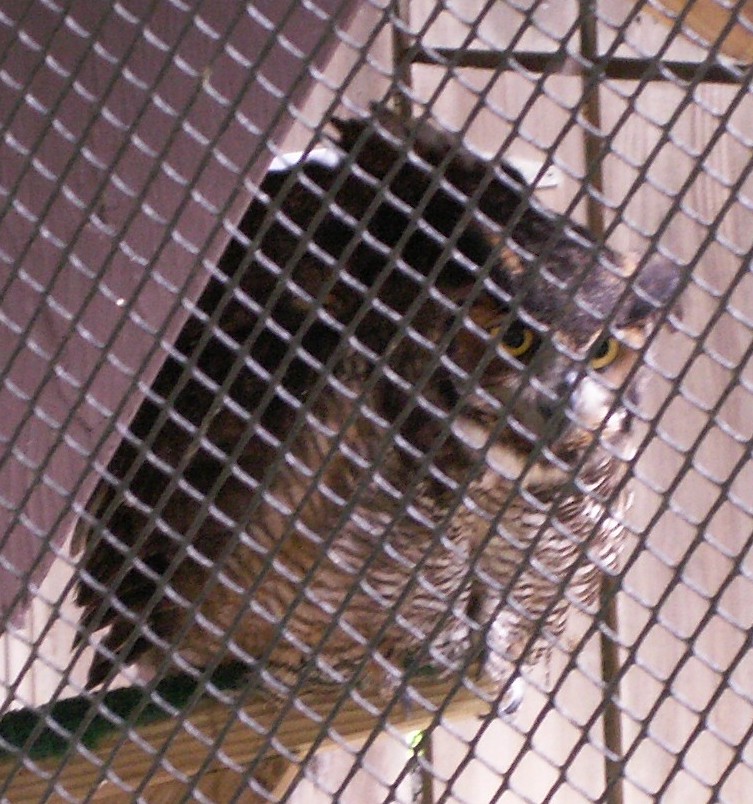
Shelby greets you as you enter the Raptor Center and she's annoyed with you (if you're a dog, for example) she is likely to puff up like she here. Shelby is a great ambassador to the world of injured big birds of prey. Her story is sad, but not that uncommon. She was caught in a leg trap, beaten, then discarded in a dumpster. Someone found her and brought her to the Carolina Raptor Center, which rehabilitates sick and injured birds. Shelby's eyes were too damaged for her to hunt in the wild, so she has a permanent home here.
The center attracts a wide range of visiors--families, scouts, bikers--and most read Shelby's story then ask "Why would anyone throw an owl in a dumpster?"
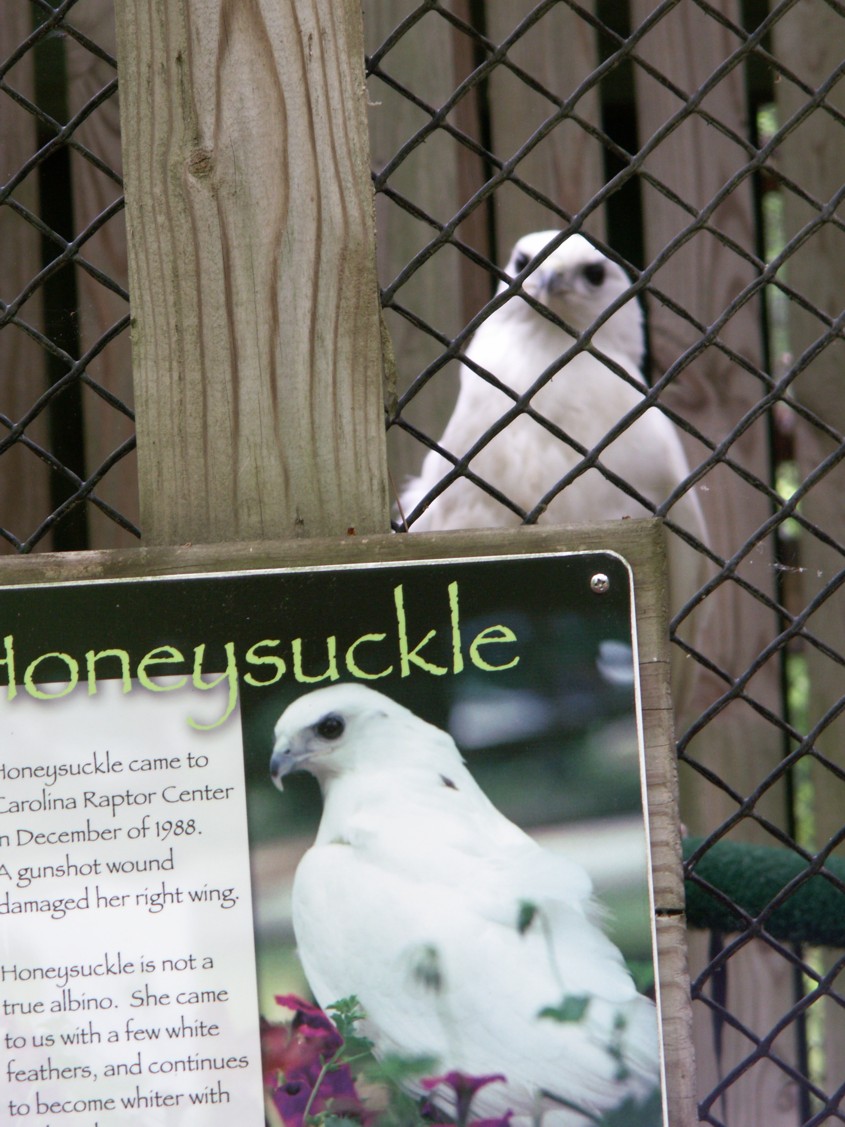
Some birds are nursed to health behind the scenes. About 27% of birds who survive won't be able to make it in the wild. So, 100 live here, including great horned owls, bald eagles, barred owls, screech owls and a part-albino red-tailed hawk.
It takes about 2 hours to see everyone. On weekends there are special shows.

Where to See Animals Down South