We've Moved!

Hi and Welcome to the AnimalTourism.com blog. But we've moved just down the street to this site, animaltourism.com/news. Please comment there.
Showing posts with label FL. Show all posts

Wednesday, May 19, 2010

Will Sea Turtles Be The Big Victims of the Gulf Oil Spill?

Kemp's ridley sea turtle
Kemp's Ridley sea turtle trudges through beach, photo by krembo1
The sea turtles in the Gulf of Mexico may turn out to be the ones in the most trouble from the Deepwater Horizon oil spill. Even though they haven't shown signs of oil, they may be ingesting it.

Dr. Mike Ziccardi, a veterinarian who runs the Oiled Wildlife Care Network and is handling all the non-bird oiled wildlife in the gulf, now says they're getting a high number of dead turtles, 156 so far. Mostly juveniles and mostly the rarest kind, Kemp's Ridley, TampaBay.com reports. The dead sea turtles "are in higher numbers than you would expect," he told Reuters.

No one is sure what killed the turtles. There was Dr. Ziccardi was initially very cautious, noting that turtles just wash up dead this time of year and that they showed no oil. Some blamed shrimpers. OnEarth, the NRDC blog, says that Sea Turtle Restoration Project (STRP) estimates fishermen kill 25,000 sea turtles each year.  And that's way down from a decade ago, before the mandated Turtle Exclusion Device, when 86,000 were wiped out.

Now Dr. Ziccardi he's contemplating something more insidious: that they are injesting the oil but it doesn't show up on the outside. "Marine mammals and sea turtles are much more likely to have less apparent external exposure and greater internal exposure than avian species," he wrote on his blog. Animals that don't show oil can have internal oil damage. Sometimes you can see it in their feces but others have "sub-apparent internal exposure." You can find that by looking for microscopic toxin damage or chemical analysis, he says.

Kemp's Ridley's are critically endangered and only found in the gulf and on the east coast. They're carnivorous bottom-feeders, exactly what you don't want to be in this oil spill. It's the smallest sea turtle, nests during the day and en masse at sites called arribadas. In 1947 42,000 nested in one day near Rancho Nuevo, Mexico. That fell to 5,00, but has climbed up to 7,866 in 2006. They nest at Padre Island, TX, too, but only 127 nests were counted in 2007.

A big set back was a 1979 oil spill in the Gulf of Mexico, the Ixtoc I,  that's a lot like Deepwater Horizon. the Blow Out Preventer failed. The spill was slow moving. Relatively few dead animals were found. Though the direct link was never found, the Times says, the population went way down.

All seven species of sea turtle are either endangered or threatened and five live in the Gulf of Mexico, the Parks Service says. The other big threat to sea turtles is people stealing the eggs and eating the females when they go ashore to lay them. It's mostly outlawed, but just this week Mexican cops caught two guys with 5,800 eggs near Acapulco.  In Denespar, Indonesia, cops confiscated 71 huge, endangered green sea turtles about to be served as food in a stall, the AP reports. The Jakarta Post says they also just caught men smuggling 12,000 turtle eggs in cigarette cartons aboard a ferry.

Looks like we might not have oiled birds being soaped up for camera, but something much slower and grimmer.

Tuesday, May 18, 2010

Your Hair Probably Isn't Going to Clean Up the Oil Spill--and Neither Is Your Dog's or Alpaca's

Hundreds of volunteers are assembling booms at Boom B Qs
Funny thing about all that hair and fur being shorn around the country to great fanfare to sop up the BP gulf oil spill: nobody wants it. Or at least the people actually cleaning up the oil say it isn't as good as the store-bought booms they're using. But that hasn't stopped people from sending it in and reporters from extensively covering the sweet but so far futile gesture.

Last week the official spill Facebook page, Deepwater Horizon Response,  put out this deeply unpopular message:
We are not using hair booms at this time but are using commercially available sorbent boom when possible. In a February 2010 NOAA field test, commercial sorbent boom absorbed more oil and much less water than hair boom. Widespread deployment of hair boom could exacerbate the debris problem. There is adequate supply of ...sorbent boom for now, but we do encourage ideas of alternative solutions by calling (281) 366-5511.
The main group amassing hair, Matter of Trust, does some amazing recycling and has been championing and testing hairmats since at least 2007. The hair, stuffed inside pantyhose, really seems to work. But even they say only the hazmat crews should install and remove the booms. They're taking the rejection graciously, but proceeding full steam ahead:
BP hasn't spent a lot of time thinking about the properties of hair, fur, wool and fleece. And they're a little busy right now.... Matter of Trust is saying officially: "At this time, we are simply providing volunteers the opportunity to make hair boom and stockpile them all along the Gulf Coast, in case BP needs them." We're calling it Plan H (H is for Hair).

But let none of that get in the way of a "local people helping in international crisis" story.

Even the Canadians and horses are getting in on it. Well after the word that booms aren't being used, alpacas are still getting shaved and National Geographic is still doing a story on it. The group collected 10,000 pounds of alpaca hair. Hair is coming from Soho, Petco, and fans of Rachel Maddow. The Miami Herald and  About.com are still pushing haircuts. ZooToo has a how-to story on donating your pet's hair. Some stories have a teeny disclaimer on the end--oh, yeah, this may not work or be used sort of thing.

All of this is a sweet gesture, like donating blood after a catastrophe. It's wonderful to see so many people worried about the turtles, pelicans, dolphins and manatees their hair might help. But is it doing any good?


Where to Go to See Wildlife
Where to Go See Wildlife Down South

RESCUE GROUPS

 PREVIOUS STORIES ON THE DEEPWATER HORIZON SPILL

Thursday, May 13, 2010

The Price of All This Cleaning Up Oiled Wildlife?

BP sign from alvez modified by animaltourism.com
Wildlife rescuers in the gulf are getting so few oiled animals they're starting to worry that the cost per animal seem ridiculous. After Exxon we had reports of "$80,000 otters." If you hear anything about a $300,000 sea gull, be skeptical.

Mike Ziccardi, a veterinarian who runs Oiled Wildlife Care Network, has been offering the most candid and complete news on the wildlife situation on their blog.  He's been bracing for both an onslaught of injured animals and a backlash against the cost of saving them. "This response is likely to be very costly when it is all said and done – especially if compared on a “per-bird” or “per-turtle/mammal” basis (or at least I hope it is, as that will imply low animal numbers)," he writes today.

In Valdez less than 5% of costs went to wildlife care, Ziccardi says. Caring for oiled wildlife is always done on the cheap, staffed by volunteers, who often sleep in their cars. And lord knows you've already heard about Dawn donating its useful soap.


In 1992 James Estes first criticized oiled wildlife rehabilitation efforts as showy and ineffective, pricing the surviving otters at $80,000 each from a total $18 million otter effort. (I'd say that you have to count the dead ones, too--even though that only brings it down to $14,500.) Later he asked "why rehabilitate oiled wildlife"? So you don't hate him, know that Estes, an adjunct professor at UC-Santa Cruz, isn't saying screw you, sea otters. He's saying the money could be better spent trying to prevent spills and shore up vulnerable populations.

In 1999 Dr. David Jessup and Dr. Jonna Mazet argued at the International Oil Spill Conference that the $80,000 figure was wildly inflated and took into account building several extremely remote care facilities from scratch. "The actual cost of collecting and caring for oiled sea otters is about $4,000 to $5,000 and marine birds about $600 to $750 [bargain!]--about one-twentieth the cost often cited from the Exxon Valdez experience," they write.

Replacement cost is another way to value animals (and other kinds of intangible losses). Luckily, the gulf doesn't have those expensive sea otters. But it does have some endangered sea turtles that should be nesting soon and manatees. People would pay a pretty penny for any of those.

But why bother saving them? Because it's the right thing to do. The question itself seems based in the reactionary view that only ecosystems and the environment matter and that it is somehow childish to value the life of an individual animal. Too many people are so afraid of being called anthropomorphic that they rush to something I would call tree-pomorphic, the assumption that other animals have no value beyond their physical properties and contribution to the environment.


Where to Go to See Wildlife
Where to Go See Wildlife Down South


 PREVIOUS STORIES ON THE DEEPWATER HORIZON SPILL

Thursday, May 06, 2010

Kenny the Facebook Goat Rescues Goat Orphan Across the Country

 A sweet sorta-rescue played out on Facebook this week: Kenny, a Florida goat spared from the butcher himself, reached out to save a Colorado goat in need. It all started as a joke, says Karen Matyjasik, who raises goats in Central Florida. But next Thursday a baby goat with nowhere to go will fly cross-country to start a new life, all thanks to Kenny's Facebook fans.

Karen says Kenny, a boer goat, was her son's FFA project last fall, but was so charismatic her friend Mary Ann got all attached. Mary Ann started a facebook page called Kenny the Social Climbing Goat, reasoning that celebrities don't get slaughtered. When FFA ended, they tutored him in wagon-pulling so he'd have another job. He collected admirers, like Dillie the Deer. He would shamelessly ask for fans: "There is a STUFFED BEAR out there with 1012 friends . What am I Chopped Liver?"

Then another friend and goat herder wrote about trying to find homes for her aging father's goats, in particular a baby with no mother. "This one showed up with no momma started sucking a little off this one, a little off this one," but no mother goat claimed her, Karen says.

Mary Ann and Karen, in the voice of Kenny, started pining for the goat they called Orphan Annie. She got Kenny to pose for a picture in front of the computer by sprinkling it with his favorite treat, Lucky Charms. "As a joke we said she could come and live on our farm," Karen says.  "It then took on a life of its own"

Kenny's fans--now over 400--tried to figure something out.  Denver's NBC TV station KKCO reported the story. "Everybody was trying to get Annie to Florida," she says. They found that Southwest wouldn't take her, but Continental would; chipped in for the ticket; and russled up a ride to the airport.


Annie is set to arrive in Florida next Thursday. Karen will see if one of her mother goats will adopt her as a daughter. Karen is not trying to exaggerate the heroism of the cause. "It's really not a super rescue," she says. While most of her goats go to FFA students and some get to become pets or milk producers, some do go to slaughter. "I can't deny it," she says. "in order for me to keep Kenny and other goats, some of them have to be sold and some of them have to be sold for that."

Meanwhile, though, she treats them well, dotes on them, really. And if Kenny finds another animal in need, he'll jump to the rescue again.


Where to Go to See Wildlife
Visit Your Local Farm Sanctuary
Read our Profile of
 Dillie the Deer


Dillie the Deer Maligned as Dangerous

Monday, May 03, 2010

Wildlife Rescuers in Gulf Overwhelmed--By Volunteers, Not Patients

San Francisco Oil Spill - Partially Oiled Gull
Oiled gull in CA in 2007 by Ingrid Taylar. Not many oiled birds seen yet in the gulf.
So far only a single bird, a Northern Gannett, has shown up oiled from the massive Deepwater Horizon spill. Wildlife rescuers and nonetheless overwhelmed--by all the untrained human volunteers.

As the potential for the spill gets bigger, the big wildlife groups are contemplating holding training classes to equip the would-be volunteers, says Kai Williams, executive director of the International Wildlife Rehabilitation Council.


Right now several groups are taking in information from potential volunteers.  The National Wildlife Federation is directing people to sign up with the Coalition to Restore Coastal Louisiana.

 "If you have the ability to restain an animal, that's going to be huge, just the basic ability to hold an animal," says Williams. "They're getting a lot of untrained people, not wildlife rehabilitators, people who have never picked up a bird."

What makes planning the response so hard is no one knows how big this still-developing catastrophe is going to be or when and where a rush of injured animals will show up. Some contemplate that the Gulf Stream could wrap it around Florida. Some worry the spill could end up bigger than Valdez. Williams notes that fewer birds live in Valdez, but there are also turtles and marine mammals to worry about.

The northern gannet is being bathed, fed electrolytes and pepto bismal, but rough weather this weekend prevented picking up more patients. A caretaker told the AP that the bird came in brown, but should be white at its current age.


Nationally, three groups are known for their training in helping animals that have gotten coated in oil.


Where to Go to See Wildlife
Where to Go See Wildlife Down South


Friday, April 30, 2010

How Will the Gulf's Dead Zone Impact the Oil Spill?

The Deepwater Horizon spill in the Gulf of Mexico may collide with an area already bedeviled by environmental catastrophe, the infamous Dead Zone--an area of essentially no life or oxygen. So what happens when an inexorable oil slick meets and an undead patch of water?

The Gulf's Dead Zone is about 6,000 to 7,000 square miles, one of the biggest in the world, Microbial Life Educational Resources of Carleton College says. It's caused by fertilizer run-off in the Mississippi overfeeding algae. Phytoplankton gobble up the algae--and all the oxygen. Scientists call the areas hypoxia--or low oxygen. They can't support life.

The oil spill so far is smaller, about 1,800 square miles. So far.

Right now the dead zone is west of the Mississippi and the oil spill is east of it. The dead zone is mainly at the bottom, which is littered with phytoplankton carcasses. The oil is on top.

But Nancy N. Rabalais, Ph.D., executive director of Louisiana Universities Marine Consortium thinks they're likely to meet.

"If the winds continue from the southeast as is common this time of year, then the surface manifestation may move to the west of the Mississippi River delta and become a surface feature of the Louisiana area of hypoxia," says

Some seem to have fantasized that the oil burn off will end up cleaning up the dead zone. Not so, says Rabalais. "The burn would reduce the more volatile and toxic components," [in the oil] she says, but not burn off the algae.

The algae isn't going to slow the oil down, she says, but the oil may slow down the production of algae:

"The movement of the oil would not be affected by where the area of low oxygen may be. Algal production if the oil were to come into the low oxygen would probably be reduced in productivity because of the proximity of the oil."


The dead zone won't necessarily have cleared out the wildlife; it's too soon to tell, she says. While the dead zone is indeed dead to most sea life like plants and fish, birds and marine mammals pass through: "The area of low oxygen does not affect birds and marine mammals because they are air breathers and the marine mammals and turtles can reach the surface of the water for atmospheric air."

The impact she expects is the oil will calm that waters of the dead zone. There will be less oxygen transfer from surface air into surface waters. The waters will stratify. The oil would cut back on the production of phytoplankton at the surface. And the oil and dead zone could pinch in on organisms caught between the top and bottom.


Perhaps the biggest impact is that the oil spill may decimate the wetlands--the wetlands the government had been building up in hopes of filtering water of fertilizers to short-circuit the dead zone. So much for that.

Wednesday, April 28, 2010

Pelicans, Otters, Manatees Could be Hurt by Deepwater Horizon Oil Spill

Deepwater Horizon oil spill seen from space over LA
Imagery courtesy of NASA Earth Observatory
Endangered sea turtles, herons, white and brown pelicans, dolphins, whales, manatees, tuna and assorted sea birds  could all be hurt by the Gulf of Mexico oil spill that is now 16 miles off the tip of Louisiana and alarming wildlife officials all the way to Florida.

The Coast Guard is burning the oil, hoping that will keep it from making landfall and destroying wetlands. I wonder if, ironically, the giant dead zone in the gulf may mean that the area the oil spill hits may be devoid of life anyway. The next step for wildlife rescuers would be to herd animals out of the area by hazing them.
 
The International Bird Rescue Research Center in Texas says they've been put on alert for the decapitated oil well, which is gushing about 1,000 barrels (42,000 US gallons) of crude daily and already can be seen from space, with a circumference of 600 miles.
If the spill stays offshore then the impact will likely be minimal to birds. Coastal birds that are highly at risk if the spill hits shore are brown and white pelicans, terns, gulls, shorebirds, skimmers and herons. Nesting and feeding areas for birds and sea turtles such as marshes and beaches could be impacted.
Loggerhead and Kemp's Ridley turtles are in the area, Live Science says. Birds are vulnerable if they ingest the oil or get coated in it. The oil removes their waterproofing, then they die of cold. In a report on dealing with oil spills, the EPA says mammals that groom themselves with their mouths, like otters, end up eating oil and getting it in their eyes. Sea otters don't live there; river otters do. No one really knows how to help marine mammals stuck in oil, they say.
Procedures for capturing, treating, and releasing animals may hurt them more than the oil does. For example, manatees are particularly susceptible to secondary fungal and bacterial infections following capture or transportation. 
Whales, dolphins, seals and manatees end up breathing hydrocarbon vapors that hurt their lungs, getting it in their eyes and nursing young eat it. Manatees summer as far west as Texas (but that's rare); a few regularly visit Mobile, AL. The biggest danger to manatees, which spend the summer as far west as Texas, may be getting hit by boats responding to the disaster.

So far the Tampa Tribune reports that the Florida Fish and Wildlife Conservation Commission hasn't found any oiled birds, but they are doing necropsies (animal autopsies) on 15 migratory birds found dead Tuesday in the Pass-a-Grille area of St. Pete Beach.


In Alabama, the Dauphin Island Sea Lab is sending boats out to test the waters and "trying to re-establish oiled bird emergency response plans that have not been exercised for many years." They fear it could be the worst Gulf oil spill ever. Coast Guard Rear Adm. Mary Landry goes even further: "If we don't secure this well, this could be one of the most significant oil spills in U.S. history."

Where the oil spill is on 4/28
Where to Go to See Animals Down South

Wednesday, April 14, 2010

Instead of Going to a Roadside Zoo, Go to the FL Rehabber Who Rescues Their Rejects

Tiger brothers rescued by Wildlife Rehab or Hernando
If you're looking for an animal attraction in central Florida that doesn't make you feel icky about how they treat the animals, check out Wildlife Rehab of Hernando. Jimmy Jablon started out taking in local native wildlife--raccoons, alligators, fox--but demand for exotic animals turned out of homes and those creepy roadside attractions.

When you go to the shelter, less than an hour north of Tampa, you'll get much closer to animals than you would in a zoo and your donation for a tour ($17.50 for adults, $8.50 for kids) will go to help maintain these animals and save others. "We let all the people that come here get close to the animals," he says. "You stand a foot from the tigers and the monkeys are on a fence next to you."

Right now Jablon could use the donations, after spending $8,000 for tests and surgery for a 160 pound lion cub that's now recuperating in his house to ward off infection. Jablon has seen so many of what he calls "photo cubs"--big cats misused to pose for cute pictures when they're young--that he recognized the syndrome. The cat had been underfed and improperly fed and her skull wasn't growing to keep up with her brain. Jablon drained more of his savings from working in the insurance business to pay the vet bills, which he had been hoping to get a break on for rescuing the animal.

Recently he did get a big break thanks to Waste Management and Wal-Mart. Rather than take the retailer's unsold meat to the landfill, Waste Management makes it available to Jablon, who otherwise would have to buy 1,000 pounds of meat a week to keep his carnivores fed. "There's nothing wrong with the meat. Sometimes it's still frozen," he says. Regulations just require removing it after so many days. He's got no such help with produce: he spends about $23,000 a year on fruits and vegetables.


All of his enclosures are about twice the size they need to be, but he wants to give the animals a decent life. He only takes in creatures that he has--or can make--room for. "If I don't I'm just putting them in the same position," he says. He just built a facility for two cats rescued from Vanishing Wildlife, which rented animals out for parties, until the state shut them down.

Native animals only stay if they can't make it in the wild and seem content there. "Don't take an animal that's always been wild and try to keep them behind bars," he warns. He'd rather euthanize the animal than keep it in misery. "If we've got an animal can't be released and it's spending 12 hours a day pacing in his cage, he's just being tormented." 

He keeps an albino raccoon named Stuart Little that wouldn't make it in the wild because predators and other raccoons would pick him out immediately. Stuart has the company of four raccoons with vision, neurological or motor problems. Jablon doesn't ever keep a solitary animal of a social species. He even bought a lemur to keep two rescues company. And he's hoping someone needs a home for a wallaby soon.

The need for an exotic sanctuary just snuck up on him. "Like everybody else, I thought there was somebody else taking care of it," he says. "There's a much bigger need than people are aware of."

He also knows that long-term he can do the most good with education. As a father of a 13-year-old girl who plays a big part in the shelter, he's especially interested in teaching kids about the right way to treat animals. "We try to grab the kids the most," he says. "They put a name or a face to an animals and later they'll say 'Oh, look out, that's a gopher tortoise, don't hit it!'"

Tuesday, March 02, 2010

Where to See Orcas Not in Captivity

Shamu Rocks
Shamu Rocks, at Orlando Sea World
courtesy of Miss 
Quarel.
Want to see a killer whale that hasn't been captured, trained to do tricks and kept in a tiny tank? You've got plenty of options other than Sea World, where their primary breeding male was involved in his third human death last week. Instead of seeing the 42 captive orcas go through their routines for your amusement, wouldn't you rather see them doing what they do naturally?


The Pacific northwest is probably the best place to see killer whales in the world. The whales hang out just to the west of the San Juan Islands in Washington state. Tour boats run to and from the San Juans from all over the region, including from Seattle 90 miles to the south.

Better yet, you can even see them from the shore. Industrious whale lover Donna Sandstrom corralled a pack of agencies to set up The Whale Trail, a series of sites where you can see whales from the shore. Behavioral biologist and author Toni Frohoff, says land-based whale watching is "the ideal form," because it doesn't disturb the whales at all. Plus, it's basically free.


The orcas can also be found up a little north in British Columbia. You can take boat trips off Vancouver Island that will let you see grizzly bears, eagles, sea lions and other kinds of whale. On the other side of Canada, Battle Harbor, Newfoundland has orca pods visit in September. Killer whales are spotted off Hokkaido, the rugged, northern island of Japan.

Orcas can be seen from every continent. Tysfjord, Norway, is the best place in Europe, according to the Complete Whale-Watching Handbook. But you might find the tours off St. David's, Wales, easier to get to. The orcas that visit Port Elizabeth, South Africa, in May are famous for eating dolphins. Playa Punta Norte in Argentina is where the whales have learned to beach themselves to attack a sea lion colony. (That's a rare occurrence, but you can see them from shore.) Japan's northern, rugged island of Hokkaido has lots of orca sightings. Orcas are known to grab stingrays from the ocean floor near Australia, where surfers have paddled around with the whales, too. With all these options who would want to sit on a bench and watch a whale forced through a hoop?

Friday, January 22, 2010

Cold Snap--Or At Least Colds--May Push Back Florida Invasives

Florida's cold snap could provide the big check on invasive species biologists have been wanting for decades. We could see less iguanas and pythons--and also fewer more beloved animals such as parrots. Even animals that didn't die in the cold could die of a cold in coming weeks.

"I expect we're going to have huge, huge mortality, maybe even in Miami itself," says Florida Fish and Wildlife Commission invasive species expert Scott Hardin. "Those that didn't die [from the cold] could easily die of a respiratory infection."

The Everglades' infamous python invaders were at least cold-stunned and perhaps hurt worse. Researchers found that 10 of 11 of the giant snakes they tracked weren't moving, Hardin said. He added that he didn't have word yet on the giant parrot colonies that live around the state, especially Miami.

Given the hurt the freezing temperatures caused Floridians, Hardin didn't want to sound too gleeful. But he so clearly was. The non-natives can push out species that naturally belong, and they've been running amok for 30-40 years, the last time Florida saw weather this harsh.

A few of the more vulnerable native animals were also hurt by the wintry blast. Hundreds of sea turtles were rescued, but hundreds more found dead, according to Hardin. The state did get to tag and collect information on lots of endangered green turtles.

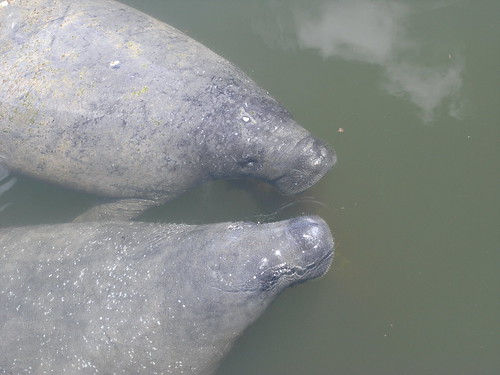
Florida got a record count of manatees (5,067) because they're easier to see when they're crowded around the warm water of power plants and natural springs. Officials warned tourists to stay away so the manatees wouldn't leave the warm areas they need to survive. And not just the big tours known for their inappropriate petting, either. Manatee advocate Tracy Colson says even kayak tour operators like hers suspended operations to let the manatees warm up.

Thursday, January 07, 2010

429 Dead Manatees found Last Year out of Population of 4,000; Only 37 Called Natural Deaths

A record 429 manatees were found dead off Florida last year out of a delicate population of just about 4,000. Could it be good news, reflecting a growing population? After all the the Florida Fish and Wildlife Commission counted a record 3,807 manatees in their aerial surveys last year.


Not so fast, says the FWC:  "The situation is not that simple. Both the carcass totals and the annual counts from statewide aerial surveys are considered minimum numbers only, and they cannot be used to calculate long-term population trends." In other words, both the 400 and 4,000 are wild-ass guesses (WAG)--though maybe scientific wild-ass guess (SWAG).

Last year was really cold, so the manatees crowded the power plants and springs like never before, making for stunning pictures (like the one here by  Tom Reinert) and high counts. But that's not a complete or accurate count. The cold was a big factor: 56 died from cold stress, more than double the five-year average.

But there were record deaths from other factors, too. The data show only 37 were found to have died of natural causes. That doesn't mean people killed all the rest. Humans were directly tied to 97 from boats, 5 from locks and gates and 7 from other human-related causes. The rest are somewhat a mystery and manatee advocates think humans are tied to many more. 114 were described as "perinatal," just meaning they were very young, and they believe many are really tied to people.

What are we doing to stop killing manatees? The Fish and Wildlife Service is thinking about expanding manatee protection areas. Predictably speed boaters hate that and so does the U.S. Navy. FWS spokesman Chuck Underwood intimated to the LA Times that any big expansion is more or less dead in the water.

Where can you can see manatees?
Where can you see more wildlife down south?

More Manatee News
Meet the Manatee profiler

Tuesday, December 22, 2009

Manatee Tours that Won't Bother the Manatees

Other marine mammals have etiquette standards. The Whale Sense or Dolphin Smart programs give tourists list of operators that play nice. But who's smart about the 3,000 manatees left in the U.S.?

As an endangered species and marine mammal, manatees area already supposed to be protected, but go on YouTube and search "manatee harassment." You'll find videos of tourists coralling and chasing manatees, separating the mom and calf and even trying to ride or kick them. It's like Crystal River, FL, tour operators live in a 1950s world where they feel entitled to sell the experience of touching, petting and scratching manatees. Do they then drive home without seatbelts into a house lined with asbestos and eat canned soup casserole for dinner? Haven't they heard that's not how you treat wild animals?


"It's this culture of everybody that come to Crystal River," says manatee advocate Tracy Colson. "It's well-advertised that this is the only place where you can touch a manatee. It's the only place in the world where you can interact with an endangered species."

Tracy, a local, started volunteering with the Crystal River Wildlife Refuge by going out to guide manatee tourists to be respectful and was so upset with what she saw she started her own company, Nature Coast Kayak Tours.  In 2007 Save the Manatee named Tracy and Steve Kingery manatee heroes for documenting manatee harassment, which kicked off a controversy and push the Fish and Wildlife Service to crack down. (Manatee advocates don't want to stop all manatee tours, just ones that annoy manatees and drive them out of the warm waters they need in the winter.)

"There's something to the swim with- programs that would be a great help to the mantee," says Colson. "If you have that magical experience, it's going to make you a strong advocate." I get as excited as anyone seeing a wild animal, so it's easy to see how some one could become over eager to make a manatee connection. But, like most animal tourists I know, I don't want to do anything that hurts the animal. So I asked Tracy to give out-of-towners some tips so we don't unwittingly help the bad guys. It can be hard to pick out a good tour because many go through the motions.

The programs that reign in whale and dolphin tours amount to this: don't bother the animals or make it look like you do in your ads. You stand still and if the animal wants to come close, it will.

TIPS ON FINDING A RESPONSIBLE TOUR
* Ask them if you're allowed to touch or approach a manatee.
* Is their website all about party and adventure?
* Do they show pictures of people petting, kissing, tickling, riding or otherwise molesting manatees?
* Look for a small operation and small boat. While it's better for whales if everyone is on one big boat, it's better for manatees if there are small boats and small groups, where the mob mentality hasn't taken over.

SOME GREAT TOURS

Manatees in Paradise
Husband and wife, Captain Mike and Stacy Dunn, help with manatee rescue and bay clean up. Their pontoon boat only holds up to six. $25 per person, plus wet suit rental. 1223 North Crystal Drive, Crystal River, FL
352-563-0865 cell 352-601-5520

Nature's Connection
Capt. Hank rides with up to 12 on 3 1/2 hour tours.
$50 including wet suit.
267 N.W. 3Rd. St. Crystal River, Fl. 34429
capthankstours@yahoo.com 352-697-0220

Aardvark’s Florida Kayak Company

Save the Manatees works with wildlife biologist 707 N Citrus Avenue, Crystal River, FL
(352) 795-5650 info@FloridaKayakCompany.com

Native Vacations comes highly recommended by Passport Magazine and manatee fans. Dedicated manatee lover Traci Wood offers private 6-hour snorkel tours ($400 for up to 4 people) or $35 (plus equipment fees) 3-hour tour.


Nature Coast Kayak Tours
Tracy Colson volunteers to clean out the waterway, rescue manatees and document manatee harassment. Her 3 1/2 hour tours are $40, including all equipment.
(352) 795-9877 or 888-795-9877 toll free
Adventure Outpost
Lars Andersen, who writes guides on paddling and the area, leads kayak tours of many waterways. $39
386-454-0611


Wild Florida Adventures
Brack Barker used to be a parks ranger and enforcement officer.

Williston, FL (352) 528-3984 Tours@wild-florida.com


Thursday, November 12, 2009

Ilya the Manatee Recovering, Impressing Ladies with His Sweetness

Ilya, the Florida manatee rescued from New York harbor two weeks ago, should be well enough to be released in the Florida Keys in about a month, says Dr. Maya Rodriguez, the veterinarian at the Miami Seaquarium, which supplied the picture of Ilya (left) swimming with his poolmate.

"We expect him to get a clean medical mill in next couple weeks," says Dr. Rodriguez. Identified by his mangled tail and white scar on his forehead, Ilya at least didn't pick up any new distinguishing scars on his journey up to Cape Cod that perplexed marine biologists. 

Stuck in the cold water of New York harbor, Ilya initially suffered cold stress, which can shut down manatees' long digestive track and immune system. He lost about 100 of his 1,200 pounds, had low blood sugar and was having trouble digesting, Dr. Rodriguez says. A video (below) of the event shows him getting wrapped in mylar survival blankets and getting spritzed with water to keep moist.

Ilya is recuperating in a 82 degree saltwater pool at the Seaquarium with an orphaned, female,  18-month-old manatee picked up in the Everglades and named Glade. Normally Dr. Rodriguez would be reluctant to put such a big male in with her but Ilya has been very gentle. "He's just a really docile manatee," Dr. Rodriguez says. 

Ilya is unusual among manatees, which normally handle food just with their prehensible lips, because he grabs with his flippers. "He's all flippers," says Dr. Rodriguez. Ilya, who touches noses with Glade, has even taught his new companion to pick up lettuce with flippers.


Since the water in Florida is still warm, Dr. Rodriguez will wait a bit to release him so he isn't tempted to head north again. Manatees need to stay in Florida (often by the warm water of hot springs or power plant outflows) over the winter but migrate in all directions away in the summer. Ilya was caught on the third attempt near the outflow of the Conoco-Phillips in the Arthur Kill, which separates New Jersey from Staten Island. 

Ilya kept coming back for the 75 degree water even though it was in a heavily industrialized area; the rest of the harbor was in the 50s. Plant workers kept a close eye out for him and alerted rescuers when he returned. The video shows the rescue workers lining up and splashing the water to goad him towards the giant net. A huge team of oil workers, volunteers from the Marine Mammal Stranding Center, local EMT divers and federal wildlife agencies pitched in to save the endangered manatee.

Wanna see a manatee at one of the places they huddle to keep warm this winter? Try these hotspots.

Tuesday, September 22, 2009

Manatees Making a Home in Mobile Bay, Alabama

We tend to think of manatees as living only in Florida and just barely hanging on there, but some exciting new research show they may be spreading to nearby Gulf states. Dr. Ruth Carmichael, senior marine scientist at the Dauphin Island Sea Lab near Mobile, AL, just tagged Alabama's first officicial manatee resident. You can call the half-ton female "Bama."

The big question is whether the endangered West Indian Manatee has been here all along, unbeknownst to people, or whether they're expanding their range. Are people seeing more manatees because they're looking? Nobody knows..  In 2007 Carmichael started the Mobile Manatees Sighting Network, which gives people a one-stop shop to call or email anytime they see a manatee. In just the first year people reported as many sightings as they had over the previous 30 years.

Carmichael hears from two types of people who live or work near the water. One has never seen them and doesn't believe they're there. The other tells her, "'yeah, my kids have been swimming with them for 30 years.'" She then tries to gently convince them not to play with the manatees. Or give them the fresh water they crave. Since the manatee's biggest enemy is boat propellers, if you teach them that it's fun or profitable to hang around people, they have a greater chance of getting hurt. And technically, if you change an endangered species' behavior, it's a federal offense. Carmichael doesn't want to play cop, but would love it if people stayed back 100 feet. "Don’t touch them, don’t water them," she says. "and for God's sake, don’t feed them."

Biologists already figured out that most of the manatees are just summering in Alabama, not moving here full-time. In 2007 they sent a clear picture of a manatee to Florida wildlife officials, who figured out from her boat scars that it was Ellie, a 30-year-old manatee who hangs around Crystal River, FL, 350 miles away and 60 miles north of Tampa. This year Carmichael managed to tag Ellie, so she'll be able to figure out where and when she migrates.

Last winter at least three manatees tried to stay over, but the bay had an early, brutal cold snap. Two died in the cold and one survived by hanging out by the warmth of a water treatment plant. The manatees here might even be coming from Mexico, not Florida, Carmichael says. There is a handy map of where they've been seen around Mobile Bay and in Mississippi  if you want to help do some spotting. (Looks like the Theodore Shipping Channel near Deer River, Meaher State Park and Terry Cove near Orange Beach.)

Carmichael estimates up to 20 manatees may be spending time in the busy, industrial bay. That's less than 1% of the U.S. population, which is thought to be about 3,000-4,000. The last time the Fish and Wildlife Service took stock of manatees in 2007, they figured the numbers were slightly up, at least in some regions. Only about 377 or 11% live in the northwest where Ellie lives, but their numbers have been growing since the 1960s; between 1986 to 2000, the population grew an estimated 4%. (The 44% of the population on the Atlantic coast grew 3.7% while the 41% in the southwest were down 1.1% just from 1995 to 2000.)


Bonus animals in the area: alligators, shorebirds and horseshoe crabs
Want to see more animals in the South?
Where are there more unusual animals like manatees?


 Photo courtesy of AngelShark