We've Moved!

Hi and Welcome to the AnimalTourism.com blog. But we've moved just down the street to this site, animaltourism.com/news. Please comment there.
Showing posts with label elk. Show all posts

Sunday, March 21, 2010

Antlering: Hunters and Wildlife Watchers Both Love Collecting Antlers

You can congratulate me now: I just received an antlering permit from Utah after passing the 2010 Antler Gathering Ethics Course. I only got 95%, but they let me redo the question I missed. As gathering antlers shed in the winter by moose, elk and deer gets more popular among both hunters and wildife watchers, states are regulating the hobby so we don't stress out the ungulates when they're practically starving. It's gotten so bad, even libertarian Wyoming has rules this year.


Utah's online "class" is really to teach you not to follow or harass the animals. They don't want people stalking  deer and elk in the winter and spring, when they could be stressed and starving. Even in a good year 40% of yearling deer and 20% of adults die, I learned. The stress of winter--low food, temperatures and light--can kill them off even into the spring. Expending energy to run away from somebody looking for antlers is the last thing they need. In a podcast, Anis Aoude, Utah's Big Game Coordinator, says he's caught people chasing animals around, waiting for their antlers.

The various species can loose antlers November through March. Aoude says shedding the antlers every year might help the animals survive because predators know that males are weak after the rut. The Utah rules say you have to have a permit to hunt for antlers in the spring; Wyoming, home of the National Elk Refuge, just bans horn hunters from December through April. If you don't manage to gather any for yourself, the Boy scouts will still gather antlers for Jackson Hole's annual antler auction and Elk Fest in May.

Where to Go to See Elk and Deer
 See More Wild Animals Out West


Monday, December 21, 2009

Get a Glimpse of Native Illinois Wildlife on their Winter Break--Join the Wildlife Prairie State Park

Just a couple hours west of Chicago a herd of bison is taking the winter off from delighting kids. Wildlife Prairie State Park--a unique combination of wildlife center, praire re-enactment and park--closes for the winter.

The animals in big herds, the elk and bison, are taken off public display to give their summer pastures a rest, says park spokesperson Kelly Stickelmaier. The enclosures (80 acres for the elk) are big enough to approximate a natural setting, but not so huge you can't see them. (Just check the park's very active flickr group and you can see how much of the animals visitors can see.)

The park's 18 bison are especially cooperative, coming up to the viewing stand, where they're fed at 1 o'clock.  "The elk are a little more persnickety, especially the boys," Stickelmaier says. Because the bison herd reproduces, the park sells off however many are born each year to keep the total at 18.

Badger at WPSP
Badger at WPSP,
originally uploaded by Mark Koonce.
I don't think I've seen another wildlife park that has badgers--and, believe me, I've looked. They've also have otters, eagles that came in through wildlife rehabilitation, skunks, bobcats and cougars.

Philantrhopist Will Rutherford started the park in 1978 mainly as a kind of rehab area for animals from the Brookfield Zoo. The park eventually shifted to native animals, then Rutherford gave the park to the state in 2000.

 Rutherford's family's Forest Park Foundation still supports the park, the Peoria Journal-Star says, but it can't make up for all the money now disgraced governor Rod Blagojevich cut from their budget. In one of his last acts, Blago used a line item veto to chop $828,000 from the Peoria park's $1.2 million budget, prompting worries it would close, according to Prairie State Outdoors. The park has come up with some creative ways to raise and save money to support their animals. You can still visit while the park is closed in winter if you become a member or rent a cottage. You can rent out a room for a business meeting or party--maybe even the one that looks out on the wolf pen. And they've even loaned out a couple bears. Certainly it's worth a visit and maybe a membership.


Join Wildlife Prairie State Park
Find other places to see wildlife in the Midwest with this AnimalTourism.com map
Where can I find the nearest buffalo herd?

Friday, January 06, 2006

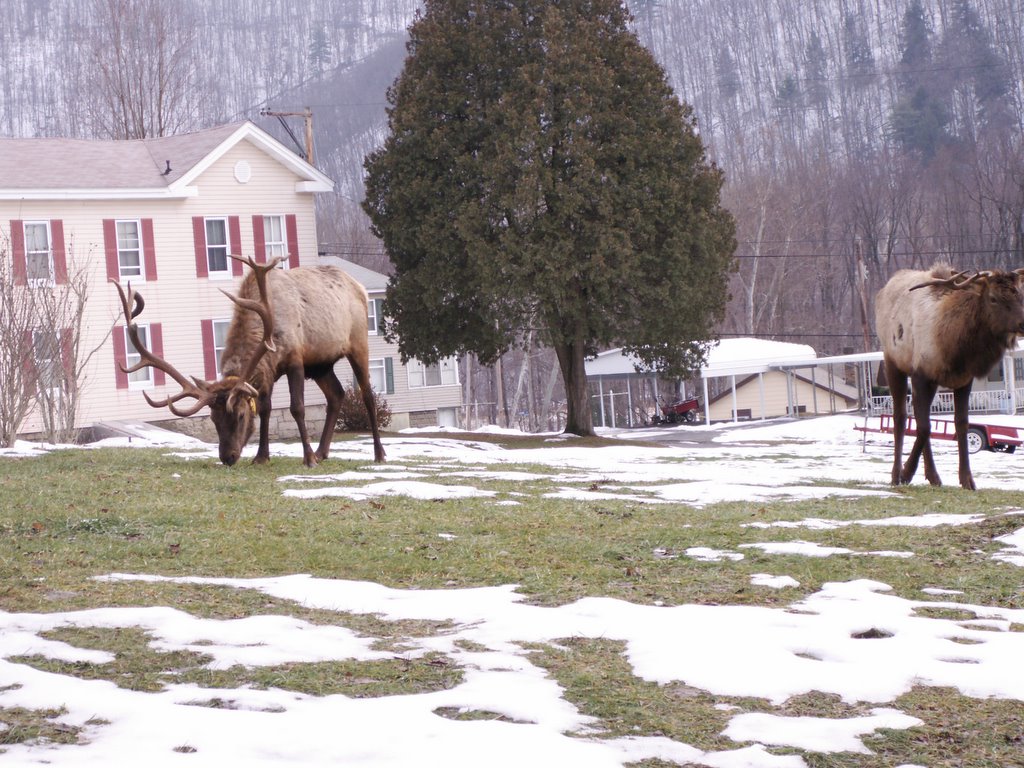
Elk Shun Official Viewing Spots for Benezette, PA, Yards

Elk Herd of Benezette, PA

The largest elk herd in the east, about 552 as of the last count in 2003, roams wild in western Pennsylvania. There are elk viewing areas around Moore Hill in Cameron County and Benezette in Elk County. The NE PA Great Outdoors provides a driving map and a brochure they'll mail you.

For travellers, the great thing is the easy access. Western Pennsylvania is where you'd want to stop overnight on the way to the midwest--it's roughly halfway and it's easily the most gorgeous area you'll see on the way. The place to see elk are less than an hour off Route 80. Probably the easiest thing is to head to Benezette. When we visited in Jan., 2006, we toured the local official viewing areas. Some you just pull off the road and watch from your car, others have elaborate blinds or seated viewing areas. We got the consolation prize of tracks, but saw no elk. The woman at the Elk View Diner told us to check out the churchyard in town. Didn't see any, but when we stopped at the Benezette Store and Restaurant, the man casually told us there were two bulls across the street. (He also said they can usually be found in town.) Sure enough two massive elk were chewing on a lawn. The owner came out and shooed them away.


That's somewhat unusual. Most are very into the elk. There are elk decorations everywhere and endless elk-themed businesses. (Wapati is the native name for elk that you'll see everywhere, too.) The man at the store said that he, and most around here, don't ever get tired of seeing the elk. There's also an Elk Farm, to visit, buy elk jerky, or stay overnight.


Many signs warn you against just stopping on the roads. The animals are gentle but do weigh up to 1,000 pounds, you're ill-advised to get out, much less approach. They'll put down their antlers towards you to tell you to buzz off. We circled around to keep seeing them and we weren't alone. They wandered across a few yards, then plopped down on an empty lot to nap.


The big tourist season for the elk is the fall rut because they're most active. The locals like the winter because you can see the elk through the trees better. As always, dusk and dawn serve as the animal rush hour and you're best bet is to try then.

The native Eastern Elk was hunted to extinction in the are area in 1867. Starting in 1913, Rocky Mountain Elk were initially wiped out, but were reintroduced from Yellowstone in 1918. Hunting nearly wiped them out again so was stopped from 1931 to 2001. A local elk authority, retired biology professors Gary Ferrence worries because the hunt, pushed by hunters as a way to cut the growth of the herd, which increasingly was butting up against human development, has already reduced the herd by 10 percent.

Where to See Neat Animals in the Northeast