We've Moved!

Hi and Welcome to the AnimalTourism.com blog. But we've moved just down the street to this site, animaltourism.com/news. Please comment there.
Showing posts with label australia. Show all posts

Saturday, April 03, 2010

Can We Call Animals Gay? How About This Otter Couple?

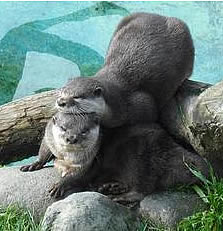
Daz and Chip, gay otters
Two male New Zealand otters who spent 15 affectionate years together at the Natureland Zoo died within an hour of each other this week. The treatment of their story is exactly what The New York Times Magazine story "Can Animals Be Gay?" out tomorrow is about. Biologists are realizing that many animal pairings are same-sex but the debate over whether to consider the animals gay has become more political than scientific.

The Times writer Jon Mooallen whimsically describes it this way:  "It may seem surprising that scientists sometimes don’t know the true sexes of the animals they spend their careers studying — that they can be tripped up in some 'Tootsie' -like farce for so long."

With Asian otters Daz and Chip, everyone knew they were male and bonded. The circumstances of their death just solidified their coupledom. When an animal pair dies so closely--like my dog Jolly did after he lost his girlfriend Shadow--how can you not acknowledge their complex emotional life? "The bottom line is that when one of them had a heart attack, it just set the other one off and he followed through," a zoo spokesman told the New Zealand Herald.

The Times story mainly follows albatrosses, who have a lot of two-mommy households, but the phenomena spans the animal kingdom. A two-mommy, one-daddy family of another albatross species in New Zealand's Taiaroa Head got lots of attention because of the gay-friendly tourist board, Mooallen says.

So back to our New Zealand gay otters.

Daz, 19, and Chip, 16, are described by their caretaker "busy, growly, bitey," but noticeably not gay in the New Zealand Herald. There were part of the zoo's captive breeding program, but the zoo is mum on their contribution. Presumably they made some contribution--willing or not--or they wouldn't have been kept in it for 15 years.

The Daily Mail describes the pair as "best friends [that] lived side-by-side for 15 years."

A local New Zealand station calls them "best friends" that were "always together," but also uses the gay couple codeword "longtime companion."

Everyone does assume Daz and Chip were a gay couple. Their story was memorialized in The Advocate and spread through twitterdom that way.

It is touching to see that these major media outlets now running an animal love story. I'm so tired of hearing people accuse themselves and others of anthropomorphism. What would be the opposite? Rockpomorphism? Treepromorphism? Why is it okay to presume that animals have no emotions or intent? We've gotten to the point at least where we accept what the handlers saw: one otter died after its "longtime companion." Now can we accept that it was its mate?


Where to go to see animals near you--gay or straight

Monday, February 22, 2010

Silly Stories in Animals This Week

Conan O'Brien finds a new way to fill time: kissing dolphins.


I didn't steal any pigs, a Chinese farmer claims. Then he opens the gate and the eight stolen pigs trudge out and home 1 km. He confessed.

A decade-long survey of ocean wildlife is almost done and boy do we have some freaky fish.


You thought making a shadow puppet of a rabbit was hard? Tens of thousands of starlings do you one better.


This is not the first time this Australian weatherman has been pinched on the bum by a bird, says the anchorman.

Sunday, February 21, 2010

Australians Geared Up For Years to Fight Japanese Whaling; Sunken Vessel Just Ticked Them Off to Do It

TITLE
,
The Australian Government collects photos for a potential court case.
When the Japanese whaling ship Shonan Maru 2 mowed down Sea Shepherd's Ady Gil they ticked off an already anti-whaling Australia. The incident seems to have pushed Australia to threaten Japan with legal action this week, but Australia has been grinding its teeth and preparing for battle for years after watching Japan flout international whaling rules off its shores. The outcome will turn on Australia's claim over its nearby waters and which international body has jurisdiction.

This week prime minister Kevin Rudd gave Japan a November deadline to cut its whaling quota to nothing. New Zealand may join the fight, too, it announced Feb. 22. Australia is holding some undoubtedly awkward talks with Japanese diplomats this weekend. Some Australians fear a court case could solidify a lack of Australian control over nearby waters.

Australians says they can head to the International Court of Justice at The Hague or the International Tribunal for the Law of the Sea in Germany to get an injunction against whaling. Japan, meanwhile, plays down the fight as "unfortunate" and threatens to appeal to the International Commission on Whaling. They banned whaling in 1986 but let Japan continue under the fig leaf of "research," even in an area Australia considers a whale sanctuary.

The first signs Australia had reached its limit were just after the Sea Shepherd's skirmishes when Bob Brown, head of the Green Party, started pushing for international court action. He called Rudd's government slumbering and wanted to haul the whalers to Australian court and give them a $3 million bill for the sunken batmobile-like craft. "Mr. Okada does not want to be confronted by the ugly reality of Japanese whaling which is opposed by 94% of Australians," Senator Brown said. "He is squibbing on whaling." (Meanwhile, Japan is holding a protester who boarded a whaling ship to present them with a bill.)

But Australia has been gearing up for this fight for years. Donald R Rothwell, a professor at Australia National University, who specializes in maritime law, did a report laying out the government's legal options. According to an Australian 7:30 news report, the four main areas of law Japan could be sued for breaking are pollution standards for the southern Ocean; safety standards; failure to tell Australia and New Zealand rescue authorities where they are in case of emergency; and refueling without an environmental impact assessment.

A couple years ago Australia sent out boats to get photographs for a potential international court case. Legitimate scientists have surveyed the area, demonstrating how real research doesn't demand slaughter. The whole world knows these research trips are really whaling ventures. More than New Zealand should be joining in; the United States should, too.

Thursday, December 10, 2009

Save Endangered Species; Make them Pets?

Tiger quoll giving tongue
Tiger quoll giving tongue,
originally uploaded by pierre poliquin.
Australian biologist Michael Archer is hellbent to stop or reverse human-caused extinctions one way another. First he tried resurrecting the Thylacine, the mascot of tragically extinct animals, using DNA from museum specimens. Now, according to Time, he's close to getting permission to let regular people keep endangered species as pets so they won't go extinct in the wild.


Archer, a professor at the School of Biological, Earth & Environmental Sciences at the University of New South Wales, has been pushing this idea to the public for a while, as this 2000 article from the Telegraph shows. He told both publications something like: "No animal that human beings have turned into a domestic pet has ever died out. It's the ones we don't value that become extinct."


In particular Archer wants to try to save the quoll, a small marsupial with the spotted coat of a fawn. Quolls eat bugs, grubs and mice, but they've been wiped out by fox and cats. Cats often carry toxoplasmosis, which makes female quolls infertile, according the Warrawong Wildlife Sanctuary, which that has been arduously them since 1986.


Predictably, as when anybody wants to try some last-chance idea to help an animal, another animal lover pops up to criticize and impede them. In this case, animal rights activists worry it will play into the hands of the pet industry. More seriously scientists worry whether people will be able to provide appropriate homes.


Captive breeding has already saved or helped many species, including the California condors, European bison and bald eagle.  The Przewalski's horse, among other animals, only survives in captivity. The Bali starling, red wolf and black-footed ferret are making their way back. (Others have experimented with the more radical back-breeding, which uses remnant animals and those in other species that look like them.) The big shift here is moving the animals from pristine, scientific, objective settings to messy, emotional homes. (Though there is talk of licensing.)


"Quails make better pets than domestic cats!" says an information sheet from Warrawong. Archer has raised quolls and gushes over the experience. Meanwhile, the several quoll species have various alarming designations from the IUCN, but there are thousands left, not just a handful, so there's still some time--and a little room to experiment with a radical idea of keeping them as pets. North America might still have a native, wild parrot if somebody had just taken on the now extinct Carolina Parakeet as a companion.


As for the Thylacine, it's been a bumpy road. The project was called off because the DNA was too ragged, but it's restarted and has made some progress with genetic mapping. Certainly saving quolls as pets would be easier than Archer's other project of resurrecting the Thylacine through DNA.

Want to see animals in the wild or in rehabilitation centers? See AnimalTourism.com

Wednesday, May 20, 2009

Australians Save 3,001 Kangaroos


An Australian court decided to end the military's plan to shoot 7,000 kangaroos on a base near Canberra. But the decision comes half-way through the program, so they've already killed 4,000 gray kangaroos. The military says the 9,000 kangaroos living in Austtralian Capitol Territory were over-grazing and destroying native grasslands.
Animal Liberation, the group that sued to stop the cull, says the science behind saving the kangaroos is flawed and that kangaroo culls are pushed by the "kangaroo industry" as a way to produce a kind of cheap, free-range 'roo meat. The meat is often contaminated and the clubbing of joeys and clumsy shooting of adults makes the Canadian baby seal-clubbing look quaint, the group says.
The local government is going to try to write some new laws and a way around the judgment so it can carry on slaughtering the kangaroos.
The case highlights the vastly different ways of viewing animals: either as populations to be managed to human desires or as individuals. I know it's supposed to be soft-minded to anthropomorphize and describe animals as unique characters. But you can't be around them without starting to think of them that way.
Think about another Australian making a decision about kangaroos at the same time. Surfer Neil McCallum saw a joey go out for an ocean swim and get caught in a riptide. He grabbed his surfboard and pushed the little kangaroo back to shore. The story made headlines around the world--not, I think, because everyone thought he was crazy to have bothered. But that's the story we'd rather hear about and rather believe about ourselves, the one where we go out and save even just one animal, no matter how pointless the gesture.