We've Moved!

Hi and Welcome to the AnimalTourism.com blog. But we've moved just down the street to this site, animaltourism.com/news. Please comment there.
Showing posts with label japan. Show all posts

Friday, April 16, 2010

DNA Reveals International Black Market for Whale Meat; Also: Horse Meat Fraud

The whale meat sold at a hipster Santa Monica sushi restaurant came from Japan, a paper in Royal Society's Biology Letters shows. The results highlight a growing body of research that shows there's a thriving international black market for whales caught both under the guise of research and bycatch.  

We all knew that the whale sushi sold in the U.S. wasn't caught off the Santa Monica pier, but we didn't know where it came from beyond the Mercedes in the parking lot. Biologists now want the normally flaccid International Whaling Commission to stand up to recalcitrant whaling countries and demand a public DNA registry of the whales they admit taking.  The database of legal whales could show just how many whales are being poached.

Charles Hableton, producer of the Cove, is the big Hollywood name on the paper and at the original sting operation, but the big academic name is C. Scott Baker, associate director of the Marine Mammal Institute at Oregon State University. Baker is a pioneer in using whalemeat DNA to show where whales were caught--often where they weren't supposed to. Some of his previous work has shown:


Baker warned at the time that this excuse of bycatch was getting out of hand. How many whales can you catch on accident? 

In response to the study, Korea  confiscated whale meat from a Japanese restaurant to see whether it had been illegally imported.

An ironic side note in the paper: the Santa Monica menu also claimed to contain horse meat, but tests showed the restaurant was just suckering their despicable patrons who wanted to eat "adventurously." The supposed horse meat was really cow.  Which begs the question: why didn't they just fake it with the whale meat, too?


See Dolphins in the Wild 
Where to Go to See Whales

Wednesday, April 07, 2010

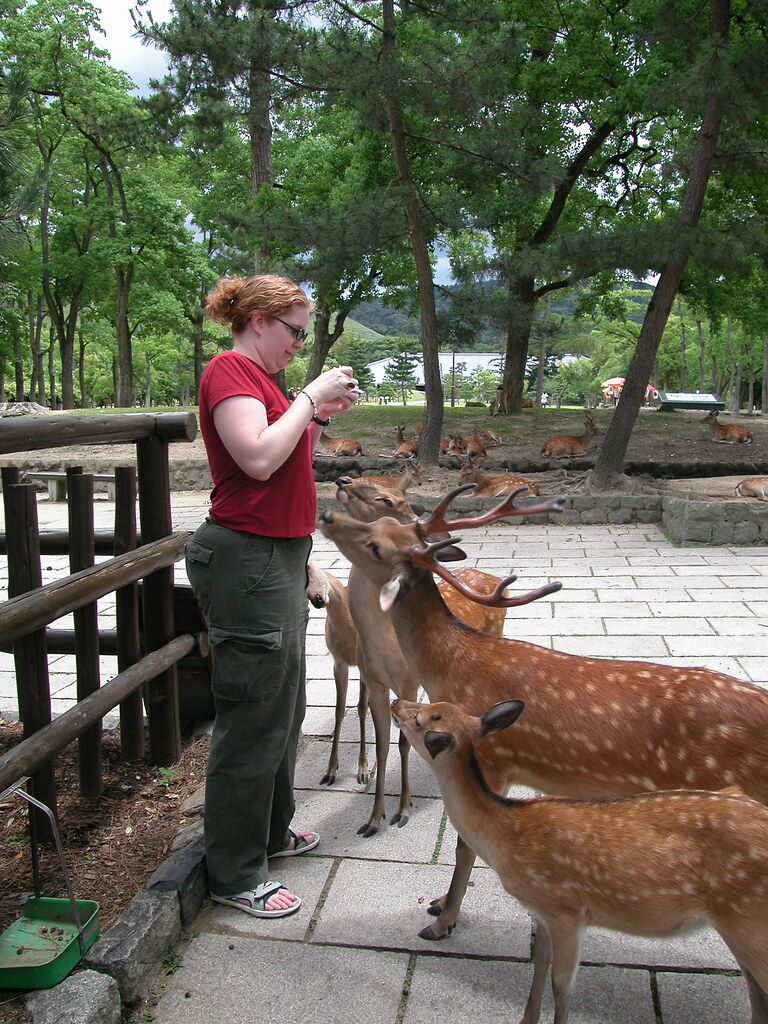
Nara, Japan, Treats its Deer Like Sacred Cows; Other Cities Worldwide Contemplate Reduction

Nara Deer Accost Tourist, by petitshoo
The sika deer in Nara, Japan, have it made: they are treated like the sacred cows of India, allowed to wander everywhere and eat pretty much whatever they want. James Dorsey writes in the LA Times that the deer have learned to bow to visitors. Vendors and vending machines sell "deer courtesy crackers" (鹿煎餅 Shika-senbei)  and outdoor restaurants provide diners with the biscuits so they can get the deer to leave them alone.

Japanese writer Noboru Ogata says that the sitka deer (Cervus nippon) have been around the Kasuga Shrine (near Osaka) since the 12th Century and were considered a good omen from the gods. Since they were literally sacred gift, people were put to death for killing them. Now they are officially a national treasure. About 1200 roam the city park. They have an annual Shika Tsuno Kiri festival to trim the deer's horns.

The Nara deer are probably some of the best treated in the world. Especially when you consider some ways people have been trying to handle their deer lately:

England: The Brits generally love their deer and even have deer parks with deer safaris. But lately they've had a bit much of them, Wildlife Extra says. Populations of all species--two native, four introduced--are on the rise. Wildlife minister Huw Irranca-Davies, declared the diminuitive muntjac deer, deer non grata. The Duke of Bedford once kept the tiny deer as pets, but, the British Deer Society says, they now roam south and central England and Wales. Here's their handy map.

Austin, TX, wants to trap deer, send them to a butcher and donate the meat to charity.

Suburban Chicago Will County wants to start allowing hunting in forest preserves.

For decades Pennsylvania managed its deer population to produce more deer to hunt. Now it wants to reduce deer numbers (and car accidents) by forcing hunters to shoot does instead of bucks. But a group of hunters objects, saying the state really has a deer shortage, Philly.com reports.

Where to Go to See Unusual Deer

Tuesday, March 09, 2010

Santa Monica Sushi Restaurant Serves Whale, Makers of The Cove Document on Way to Pick Up An Oscar

The people who made The Cove, the documentary about Japanese Dolphin slaughter that won an Academy Award Sunday, used some of the same techniques to bust a hipster Santa Monica sushi restaurant for selling whale, the New York Times reports. DNA tests confirmed that a $60 piece of sushi that The Hump sold as whale was in fact the endangered Sei Whale (Balaenoptera borealis). that $60 piece of sushi was sei whale.

DNA-testing sushi is now becoming a food investigation mainstay; it's almost as popular and fun as finding e. coli at food carts. But normally the results are the opposite: the fish is not what the restaurant says. It's a cheap substitute. In this case it was on the Omakase, or tasting menu, and the wait staff told the undercover diners they were eating whale, sometimes calling it by its Japanese name, kujira.

The food blog Shizuokasushi explains how whale is served casually in Japan, though usually sperm whales. Japan hunts about 100 sei whales a year under the guise of "research," according to the IUCN Red List.

Louie Psihoyos, photographer and director of The Cove, worked with “director of clandestine operations” Charles Hambleton, who made tiny cameras for diners to wear--once for themselves and a second time for investigators. An affadavit from investigators describes a search of the restaurant and suggests the whale may have arrived via a Mercedes parked out back.

It won't be as exciting as The Cove, but I sure hope they make video of the sting.


See Dolphins in the Wild 
Where to Go to See Whales

Monday, March 08, 2010

Will Asking People To Text for Dolphins Work Post-Haiti?

Last night dolphins near Taijii, Japan, were oblivious to the break The Cove won an Oscar. The film's hero, former Flipper trainer Ric O'Barry, has been trying to show Taijii's dolphin slaughter to the world for years, even if it meant walking around with a TV on his chest. So, it's no surprise he'd use the stage for the dolphins. O'Barry unfurled a banner saying "TEXT DOLPHIN TO 44144".

What was the reaction? Twitter immediately ricocheted the message around thousands of time--and it's still bouncing. This USAToday blogger says the sign--and its inherent naughtiness--got him to look up the film. But over at the Huffington Post, they ran a story explaining "What Happens if You Follow Ric Barry's Sign?" The answer: you're signed up for text message updates, up to 30 a month. Call me old-fashioned, but I subscribe to his blog, so that's about 30 more than I need.

The Haiti earthquake taught the public that the easiest way you can donate money to a cause is by texting a charity. I doubt that causes can ask you to just text them anymore without people worrying how much it will cost. The various charities send you back a confirmation before your cellphone carrier sends off your money, Charity Navigator explains. If you haven't done it, you won't know that.

O'Barry wants you to write a letter to Obama. Taiji was, predictably, annoyed at the win. Controversy is swirling, the LA Times says. But what else does controversy do? Before the movie Japanese fishermen killed about 2,000 - 3,000 dolphins a year in Taijii and about 18,000 to 27,000 elsewhere, the Japan Times reports. The little town is also the last known place to catch wild orcas--and where fishermen ride them "rodeo style," the Whale and Dolphin Conservation Society reports. Japan claims it's cultural imperialism to cringe at their killing of dolphins while we kill and eat cows.

The Cove has already pushed the town to halt the the dolphin slaughter for now. Expect more backlash when the film gets broader play in Japan. That'll happen with or without your text messages.

See How You Can See Dolphins in the Wild


Excerpt from the Whale and Dolphin Conservation Society 2001 report Captive Orcas: Dying to Entertain You.

Japan: 1972 - to date. 28 orcas captured, of which 19 were taken into captivity (14
are now dead, 5 survive)

To date, no marine park outside Japan has purchased orcas taken from Japanese waters. Captures for dolphinariums have been largely unregulated, being carried out by inexperienced local fishermen using two main methods - harpooning, and herding the animals into a net. Capture methods can be very crude - attempts to wrestle the whales into submission by riding them 'rodeo-style' have been reported. 

Several orcas have died shortly after capture: for example, three orcas captured off Japan in 1979 had all died within three months of capture. The better Japanese marine parks, perhaps wary of
being tainted by association with 'iruka no oikomi ryo', the annual drive fishery responsible for the slaughter of thousands of small whales and dolphins, have increasingly turned to Iceland and North America for their orcas.


However, on February 7th, 1997, a group of ten orcas - believed to be transients - were taken at Hatajiri Bay, near Taiji, Wakayama prefecture. Fishermen from the Isana Fishing Co-operative first spotted the group of orcas, including two calves, about 50km off the Japanese coast. They sent eight fast boats out to encircle the pod and, by using water bombs and banging on iron rods to create a barrage of noise, succeeded in driving the group into the bay.

Sunday, February 21, 2010

Australians Geared Up For Years to Fight Japanese Whaling; Sunken Vessel Just Ticked Them Off to Do It

TITLE
,
The Australian Government collects photos for a potential court case.
When the Japanese whaling ship Shonan Maru 2 mowed down Sea Shepherd's Ady Gil they ticked off an already anti-whaling Australia. The incident seems to have pushed Australia to threaten Japan with legal action this week, but Australia has been grinding its teeth and preparing for battle for years after watching Japan flout international whaling rules off its shores. The outcome will turn on Australia's claim over its nearby waters and which international body has jurisdiction.

This week prime minister Kevin Rudd gave Japan a November deadline to cut its whaling quota to nothing. New Zealand may join the fight, too, it announced Feb. 22. Australia is holding some undoubtedly awkward talks with Japanese diplomats this weekend. Some Australians fear a court case could solidify a lack of Australian control over nearby waters.

Australians says they can head to the International Court of Justice at The Hague or the International Tribunal for the Law of the Sea in Germany to get an injunction against whaling. Japan, meanwhile, plays down the fight as "unfortunate" and threatens to appeal to the International Commission on Whaling. They banned whaling in 1986 but let Japan continue under the fig leaf of "research," even in an area Australia considers a whale sanctuary.

The first signs Australia had reached its limit were just after the Sea Shepherd's skirmishes when Bob Brown, head of the Green Party, started pushing for international court action. He called Rudd's government slumbering and wanted to haul the whalers to Australian court and give them a $3 million bill for the sunken batmobile-like craft. "Mr. Okada does not want to be confronted by the ugly reality of Japanese whaling which is opposed by 94% of Australians," Senator Brown said. "He is squibbing on whaling." (Meanwhile, Japan is holding a protester who boarded a whaling ship to present them with a bill.)

But Australia has been gearing up for this fight for years. Donald R Rothwell, a professor at Australia National University, who specializes in maritime law, did a report laying out the government's legal options. According to an Australian 7:30 news report, the four main areas of law Japan could be sued for breaking are pollution standards for the southern Ocean; safety standards; failure to tell Australia and New Zealand rescue authorities where they are in case of emergency; and refueling without an environmental impact assessment.

A couple years ago Australia sent out boats to get photographs for a potential international court case. Legitimate scientists have surveyed the area, demonstrating how real research doesn't demand slaughter. The whole world knows these research trips are really whaling ventures. More than New Zealand should be joining in; the United States should, too.