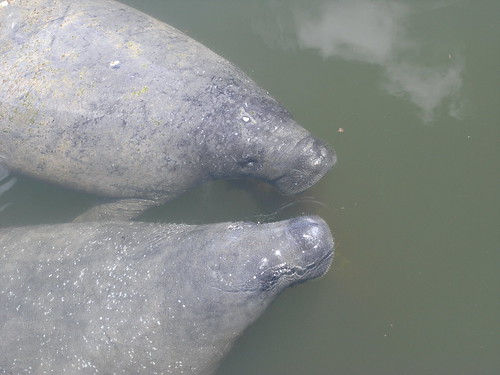
Biologists know that a handful of manatees are in the Gulf of Mexico and swimming westward--toward the massive Deepwater Horizon oil spill, but so far they have decided not to try to intervene. Mobile Bay officials may release dammed waters to push the oil away from the bay, a local scientist says.
A female manatee that spends the summer in Mobile Bay is now in Appalachicola Bay, FL, says Ruth H. Carmichael, senior marine scientist at the Dauphin Island Sea Lab, which is bracing for the oil slick. Appalachicola Bay is roughly 250 miles from Mobile--if you take the shore route. They can swim up to 45 miles a day, but 5-15 is more likely.
"I hope she finds a nice location to wait for a while," Carmichael says. "The USGS also has a few tagged manatees they know are moving this way. We are doing nothing to move or disturb the animals. Right now the oil is offshore and the manatees are in shore. We need to trust them to take care of themselves for now."
Manatees spend the winter near hot springs or power plants in Florida, but as their population has recovered, they are swimming further in the summer. A few now regularly visit Alabama and every few years a young male makes it up to New England.
"Mobile Bay is trying to arrange for discharge of dammed waters , if needed, to force water out of the Bay and keep it westward off shore," Carmichael says. "Mississippi may be in greater danger.. but it is difficult to predict what will happen. This is a terrible event. Discovering a third leak was tragic."
A stunning 400 species of birds, marine mammals, turtles, land mammals and reptiles could be hurt by the Deepwater Horizons oil spill, which is now just 6-7 miles off Louisiana. The current strong winds may blow the muck to shore by Friday morning, the latest report says.
Nola.com obtained a list of 400 species put in harm's way by the oil from the Louisiana Department of Natural Resources. Bob Marshall writes that this is a particularly horrible time for the oil spill--right when birds are migrating through or nesting. The soon-to-be oiled area is:
vital wintering or resting spot for more than 70 percent of the nation's waterfowl, is used by all 110 neo-tropical migratory songbirds, and produces 50 percent of the nation's wild shrimp crop, 35 percent of its blue claw crabs and 40 percent of its oysters. Ressearchers say 90 percent of all the marine species in the Gulf of Mexico depend on coastal estuaries at some point in their lives, and most of those estuaries are in Louisiana.
The New York Times has a great chart highlighting which species are most at risk, mostly migrating birds. The brown pelican was just removed from the endangered species list.
The Oiled Wildlife Care Network--a collection of wildlife responders across California--has sent its director down and is collecting info on volunteers. They say it's too late to train you to clean up animals but you could become a "convergent volunteer." Specialized groups or state rehabber associations do oil training seminars in preparation for a disaster like this.
The International Bird Rescue and Research Center is on alert, too. They regularly offer classes in Fairfield (northern California) and San Pedro (Southern California) for people to become volunteers.
The unified command for oiled wildlife is 800-557-1401.
The Lousiana Wildlife Rehabilitators Association directs residents to call (866) 557-1401 for the Oiled Wildlife Unified Command Center. Not sure which prefix is correct, but it's the same number.
The feds say they're setting up staging areas to protect the shoreline in Biloxi, Miss., Pensacola, Fla. Venice, La., Pascagoula, Miss., and Theodore, Ala.
Deepwater Horizon oil spill seen from space over LA
Imagery courtesy of NASA Earth Observatory
Endangered sea turtles, herons, white and brown pelicans, dolphins, whales, manatees, tuna and assorted sea birds could all be hurt by the Gulf of Mexico oil spill that is now 16 miles off the tip of Louisiana and alarming wildlife officials all the way to Florida.
The Coast Guard is burning the oil, hoping that will keep it from making landfall and destroying wetlands. I wonder if, ironically, the giant dead zone in the gulf may mean that the area the oil spill hits may be devoid of life anyway. The next step for wildlife rescuers would be to herd animals out of the area by hazing them.
The International Bird Rescue Research Center in Texas says they've been put on alert for the decapitated oil well, which is gushing about 1,000 barrels (42,000 US gallons) of crude daily and already can be seen from space, with a circumference of 600 miles.
If the spill stays offshore then the impact will likely be minimal to birds. Coastal birds that are highly at risk if the spill hits shore are brown and white pelicans, terns, gulls, shorebirds, skimmers and herons. Nesting and feeding areas for birds and sea turtles such as marshes and beaches could be impacted.
Loggerhead and Kemp's Ridley turtles are in the area, Live Science says. Birds are vulnerable if they ingest the oil or get coated in it. The oil removes their waterproofing, then they die of cold. In a report on dealing with oil spills, the EPA says mammals that groom themselves with their mouths, like otters, end up eating oil and getting it in their eyes. Sea otters don't live there; river otters do. No one really knows how to help marine mammals stuck in oil, they say.
Procedures for capturing, treating, and releasing animals may hurt them more than the oil does. For example, manatees are particularly susceptible to secondary fungal and bacterial infections following capture or transportation.
Whales, dolphins, seals and manatees end up breathing hydrocarbon vapors that hurt their lungs, getting it in their eyes and nursing young eat it. Manatees summer as far west as Texas (but that's rare); a few regularly visit Mobile, AL. The biggest danger to manatees, which spend the summer as far west as Texas, may be getting hit by boats responding to the disaster.
So far the Tampa Tribune reports that the Florida Fish and Wildlife Conservation Commission hasn't found any oiled birds, but they are doing necropsies (animal autopsies) on 15 migratory birds found dead Tuesday in the Pass-a-Grille area of St. Pete Beach.
In Alabama, the Dauphin Island Sea Lab is sending boats out to test the waters and "trying to re-establish oiled bird emergency response plans that have not been exercised for many years." They fear it could be the worst Gulf oil spill ever. Coast Guard Rear Adm. Mary Landry goes even further: "If we don't secure this well, this could be one of the most significant oil spills in U.S. history."
Florida's harsh cold spell is a bonanza for animal watchers, if not for the Florida animals themselves. Manatees are gathering around power plants and hot springs. Iguanas are dropping from trees in a kind of cold coma. Cold-stunned turtles are warming up in hotel rooms. Pythons are sunning themselves. And waterfowl are migrating down from other states, says Gary Morse, a spokesman for Florida's Fish and Wildlife Commission.
Manatees: The manatees are the ones wildlife officials are worried about. They're native, endangered and hate the cold. Sea cows need water at least 68 degrees to survive. Last year at least 56 died of cold stress, the FWC says. This year they'd like people to give them a break and back off for a bit. "They are stressed from the cold and from not eating. We advise people not to approach them in these times," Morse says. "Our mere presence as human beings can cause them to flee the very thing they need." The FWC already pulled two frigid manatees from cold water and sent to a zoo and an aquarium to warm up.
Sea Turtles: Sea Turtles often turn up at the same hot spots that draw manatees. But if they don't they become sluggish and eventually get cold-stunned and beach themselves. Rescuers are swooping in and taking them to the The Turtle Hospital on the Keys and the Georgia Sea Turtle Center have resorted to putting them up in hotel rooms and kiddie pools, respectively.
Florida wants to get rid of invasive species, especially those that were dumped into the wild as pets and pose a danger to the animals that are supposed to be there. People mostly agree--except when it comes to animals that are fun to watch. Wildlife populations are always moving and in flux, after all.
Pythons: Nobody likes pythons, which are overtaking the swamps by the thousands. Jenny Tinnell, FWC biologist, put out a statement encouraging hunting: "They may be out in the open more than before to find the warmth of the sun, and we hope hunters, in the normal course of hunting in these areas, will take advantage of the opportunity to help stop the spread of this nonnative species."
Birds: Birds that normally fly to Georgia, may have to fly to Miami to get the warmth they need this year. No one is sure what will happen to the resident monk parrots and parakeets that dot the state, either.
A record 429 manatees were found dead off Florida last year out of a delicate population of just about 4,000. Could it be good news, reflecting a growing population? After all the the Florida Fish and Wildlife Commission counted a record 3,807 manatees in their aerial surveys last year.
Not so fast, says the FWC: "The situation is not that simple. Both the carcass totals and the annual counts from statewide aerial surveys are considered minimum numbers only, and they cannot be used to calculate long-term population trends." In other words, both the 400 and 4,000 are wild-ass guesses (WAG)--though maybe scientific wild-ass guess (SWAG).
Last year was really cold, so the manatees crowded the power plants and springs like never before, making for stunning pictures (like the one here by Tom Reinert) and high counts. But that's not a complete or accurate count. The cold was a big factor: 56 died from cold stress, more than double the five-year average.
But there were record deaths from other factors, too. The data show only 37 were found to have died of natural causes. That doesn't mean people killed all the rest. Humans were directly tied to 97 from boats, 5 from locks and gates and 7 from other human-related causes. The rest are somewhat a mystery and manatee advocates think humans are tied to many more. 114 were described as "perinatal," just meaning they were very young, and they believe many are really tied to people.
What are we doing to stop killing manatees? The Fish and Wildlife Service is thinking about expanding manatee protection areas. Predictably speed boaters hate that and so does the U.S. Navy. FWS spokesman Chuck Underwood intimated to the LA Times that any big expansion is more or less dead in the water.
Other marine mammals have etiquette standards. The Whale Sense or Dolphin Smart programs give tourists list of operators that play nice. But who's smart about the 3,000 manatees left in the U.S.?
As an endangered species and marine mammal, manatees area already supposed to be protected, but go on YouTube and search "manatee harassment." You'll find videos of tourists coralling and chasing manatees, separating the mom and calf and even trying to ride or kick them. It's like Crystal River, FL, tour operators live in a 1950s world where they feel entitled to sell the experience of touching, petting and scratching manatees. Do they then drive home without seatbelts into a house lined with asbestos and eat canned soup casserole for dinner? Haven't they heard that's not how you treat wild animals?
"It's this culture of everybody that come to Crystal River," says manatee advocate Tracy Colson. "It's well-advertised that this is the only place where you can touch a manatee. It's the only place in the world where you can interact with an endangered species."
"There's something to the swim with- programs that would be a great help to the mantee," says Colson. "If you have that magical experience, it's going to make you a strong advocate." I get as excited as anyone seeing a wild animal, so it's easy to see how some one could become over eager to make a manatee connection. But, like most animal tourists I know, I don't want to do anything that hurts the animal. So I asked Tracy to give out-of-towners some tips so we don't unwittingly help the bad guys. It can be hard to pick out a good tour because many go through the motions.
The programs that reign in whale and dolphin tours amount to this: don't bother the animals or make it look like you do in your ads. You stand still and if the animal wants to come close, it will.
TIPS ON FINDING A RESPONSIBLE TOUR
* Ask them if you're allowed to touch or approach a manatee.
* Is their website all about party and adventure?
* Do they show pictures of people petting, kissing, tickling, riding or otherwise molesting manatees?
* Look for a small operation and small boat. While it's better for whales if everyone is on one big boat, it's better for manatees if there are small boats and small groups, where the mob mentality hasn't taken over.
SOME GREAT TOURS
Manatees in Paradise
Husband and wife, Captain Mike and Stacy Dunn, help with manatee rescue and bay clean up. Their pontoon boat only holds up to six. $25 per person, plus wet suit rental. 1223 North Crystal Drive, Crystal River, FL
352-563-0865 cell 352-601-5520
Nature's Connection
Capt. Hank rides with up to 12 on 3 1/2 hour tours.
$50 including wet suit.
267 N.W. 3Rd. St. Crystal River, Fl. 34429
capthankstours@yahoo.com 352-697-0220
Native Vacations comes highly recommended by Passport Magazine and manatee fans. Dedicated manatee lover Traci Wood offers private 6-hour snorkel tours ($400 for up to 4 people) or $35 (plus equipment fees) 3-hour tour.
Nature Coast Kayak Tours
Tracy Colson volunteers to clean out the waterway, rescue manatees and document manatee harassment. Her 3 1/2 hour tours are $40, including all equipment.
(352) 795-9877 or 888-795-9877 toll free Adventure Outpost
Lars Andersen, who writes guides on paddling and the area, leads kayak tours of many waterways. $39
386-454-0611
Ilya, the Florida manatee rescued from New York harbor two weeks ago, should be well enough to be released in the Florida Keys in about a month, says Dr. Maya Rodriguez, the veterinarian at the Miami Seaquarium, which supplied the picture of Ilya (left) swimming with his poolmate.
"We expect him to get a clean medical mill in next couple weeks," says Dr. Rodriguez. Identified by his mangled tail and white scar on his forehead, Ilya at least didn't pick up any new distinguishing scars on his journey up to Cape Cod that perplexed marine biologists.
Stuck in the cold water of New York harbor, Ilya initially suffered cold stress, which can shut down manatees' long digestive track and immune system. He lost about 100 of his 1,200 pounds, had low blood sugar and was having trouble digesting, Dr. Rodriguez says. A video (below) of the event shows him getting wrapped in mylar survival blankets and getting spritzed with water to keep moist.
Ilya is recuperating in a 82 degree saltwater pool at the Seaquarium with an orphaned, female, 18-month-old manatee picked up in the Everglades and named Glade. Normally Dr. Rodriguez would be reluctant to put such a big male in with her but Ilya has been very gentle. "He's just a really docile manatee," Dr. Rodriguez says.
Ilya is unusual among manatees, which normally handle food just with their prehensible lips, because he grabs with his flippers. "He's all flippers," says Dr. Rodriguez. Ilya, who touches noses with Glade, has even taught his new companion to pick up lettuce with flippers.
Since the water in Florida is still warm, Dr. Rodriguez will wait a bit to release him so he isn't tempted to head north again. Manatees need to stay in Florida (often by the warm water of hot springs or power plant outflows) over the winter but migrate in all directions away in the summer. Ilya was caught on the third attempt near the outflow of the Conoco-Phillips in the Arthur Kill, which separates New Jersey from Staten Island.
Ilya kept coming back for the 75 degree water even though it was in a heavily industrialized area; the rest of the harbor was in the 50s. Plant workers kept a close eye out for him and alerted rescuers when he returned. The video shows the rescue workers lining up and splashing the water to goad him towards the giant net. A huge team of oil workers, volunteers from the Marine Mammal Stranding Center, local EMT divers and federal wildlife agencies pitched in to save the endangered manatee.
Wanna see a manatee at one of the places they huddle to keep warm this winter? Try these hotspots.
About two years ago some local Florida manatee lovers took some disturbing video of tourists and tour guides pestering manatees. Tracy Colson and Steve Kingry posted shots on YouTube of tour guides holding manatees so that tourists could touch them. Some tourists also kicked them and tried to sit on the sea cows. Finally, about two years later, something might actually be done to protect this endangered species whose population has dwindled to about 3,000 from Florida hooligans.
Spurred on by the videos, this summer the Public Employees for Environmental Responsibility (PEER) officially asked the Fish and Wildlife Service to ban "Swim with Manatee" programs. Tourists aren't supposed to get within 50 yards of dolphins or 100 yards of whales in NOAA's (voluntary) guidelines for those tour operators. But at least there is some enforcement for whale boats. NOAA also won't let tour operators show ads that have people interacting with, chasing, petting or riding whale or dolphins in the Dolphin Sense and Whale Smart programs. So how can tours advertise swimming with the far more endangered manatee?
Before I had heard about any of this going on in Florida, I saw ads online for sleazy outfits around Cancun that advertised Swim With Manatees programs. Yuck, I thought. Don't people know that manatees (or any animals) don't want to be forced to swim with them. But I had no idea there were plenty of places in Florida getting away with it, too. Then I read an incredible story travel writer Andrew Mersmann did for Passport Magazine last year about Florida manatee tours that end up harassing manatees.
Mersmann says people in the industry know exactly which are the bad ones. He went on both to see what was really going on. The captain of one tour told the groups: “It’s a good day if you see a manatee, but it’s not a great day unless you touch one.” You are, of course, not supposed to pet the manatees any more than you're supposed to cuddle a polar bear. The difference is manatees can't fight back. And even when they try to get away, videos posted on YouTube show, the tour guides restrain them so the tourists can play.
What's wrong with swimming with manatees? Morally, if you bother manatees, they stop what they're doing. Manatees don't have frivolous hobbies; whatever they're doing, they need to do it to survive. They're an endangered species. They need to eat grass, nurse from their mothers, sleep, come up to the surface to breathe.
Legally pestering, holding, riding, kicking manatees--again, all documented--is a violation of Florida state law, the Endangered Species and the Marine Mammal Protection Act, which bans "taking" a manatee. Taking is defined doing anything on purpose or by negligence "to harass, harm, pursue, hunt, shoot, wound, kill, trap, capture, or collect, or to attempt to engage in any such conduct." It goes on to clarify that it includes "the restraint or detention of a marine mammal, no matter how temporary...causing disruption of behavioral patterns, including, but not limited to migration, breathing, nursing, breeding, feeding, or sheltering."
The Marine Mammal Commission has recommended not allowing people to approach within 10 feet of manatees. (If they come to you, that's fine. And that's exactly what skilled manatee watchers say will happend if people would just be patient.) The manatees, Mersmann writes often leave lagoons as soon as the tour boats show up.
In August the Fish and Wildlife Service basically said no to the request to ban the programs, reasoning, more or less, that harassing manatees was already illegal. And that they could only provide some protections to threatened animals and since manatees are already endangered--a notch worse--they're out of luck.
"They saw that harasment of mantees is illegal," says PEER staff attorney Christine Erickson. "What they're allowing people to do is causing harassment." So PEER is going to take the FWS to court. They want to get more sanctuaries set up and ban the swim with programs in the winter, which the manatees need to be in the warm shallow water to survive. The sanctuaries are small areas with the warmest water where manatees can go and people can't. The manatees know that and retreat there when they get tired of people. Let's hope this
Let's hope this finally means the manatees will get a break.
Ilya, the missing manatee, may be headed the wrong way--back up to New York City, instead of down south to Florida and the warm water he needs to survive. Someone saw what they thought was a manatee near Bayonne, NJ, but by the time rescuers came out, there was no animal, says Bob Schoelkopf, founding director of Brigantine's Marine Mammal Stranding Center, which would rescue Ilya if they could just find and catch him.
FWC photo by Tom Reinert
Ilya, who is 16 and known for his missing tail chunk and a white scar on his head, befuddled scientists by swimming from his native Miami all the way up to Cape Cod this summer. Now he needs to get to waters at least 68 degrees--the Carolinas at this time of year--or he could die.
The last time anyone definitely saw Ilya was when he ate a crate of lettuce from biologists outside the Conoco Phillips refinery in Linden, NJ, last Friday. Then he disappeared into the dark, cold waters of the Arthur Kill, the 10-mile tidal estuary between New Jersey and Staten Island. If that was him near Bayonne, that puts him in the Kill Van Kull, a shorter passage that's a few miles closer to the Statue of Liberty, Manhattan and the heavy traffic of the Port of Newark.
But rescuers are dubious it really was Ilya. It's not so much that they think there's a second manatee up here--though one did spend the summer in Raritan Bay. Schoelkopf says he didn't get the spotter's name (and manatee identification credentials) and the call came in eight hours after the supposed encounter. Marine creatures can just be hard to ID. "I've had Coast Guard people tell me there's a whale and calf trying to get up a waterfall and we get there and it's two logs," he says. Manatees are such a rare sight, people--especially northerners--could easily get it wrong. When seals turn up in winter, Schoelkopf says, he gets calls about "sea lions, walruses, anything."
Ilya was drawn to Linden by the plant's warm water discharge, so Schoelkopf called four power plants on the Jersey Shore to ask them to look out for Ilya. In Florida, power plants have become such a popular hang-out in the winter, biologists from Florida's Fish and Wildlife Commission use the gathering to take a census. The New Jersey plants area already on the look-out for stranded sea turtles, who are also drawn to their warm water, Schoelkopf explains. (A rare and endangered Green Sea Turtle recently turned up in Rumson with cold shock, he says.) In northern New Jersey, the Linden plant is the only one.
If anyone does see the manatee, the stranding network is ready to go with a net at a moment's notice. They have a salt water they put on the ideal manatee temperature of 74 this week just for Ilya. If they can catch him, they'll bring him to Brigantine and warm him up for a few days before getting him to Florida, probably by an awaiting Coast Guard cargo plane.
If you see the manatee, call the Marine Mammal Stranding Center's 24-hour number: (609) 266-0538. Try to take a picture and email it to mmsc@verizon.net
Ilya, the manatee that reappeared off Staten Island Thursday--way too far north for his safety--has gone missing again, thwarting any attempt to rescue him from the cold waters. Ilya ate a whole case of lettuce "and was last seen going back into the river," says Chuck Underwood, a spokesman for the U.S. Fish and Wildlife Service. "This was late yesterday afternoon, and there's been no sighting of the animal since then."
Ilya, a 16-year-old manatee distinguished by his boat scars (a white one on his head and a missing chunk of tail), surprised biologists this summer by migrating all the way up to Cape Cod from his Florida home. Now he's racing the cold weather--and seems to have been entranced by the false promise of warmth from the warm water run-off of an oil refinery in Elizabeth, NJ. The spot that he's at is warm enough, says Underwood, but the rest of the Arthur Kill tidal estuary dips below his requisite 68 degrees. That means he should be in North Carolina by now, according to NOAA's water temperature map. That's about 200 miles, or three or four days manatee travel.
Biologists figured Ilya was safely headed to warmer waters after he wasn't seen since an appearance in Milford, CT, on September 26. Then he showed up in a heavily industrial area. Underwood won't say exactly where--but it's guarded private property anyway.
The Brigantine Marine Mammal Stranding Station has plans to rescue him--if they can find him and catch him. Rescuers typically keep manatees at risk in place by offering them food and the fresh water they crave. But that sometimes has the effect of buoying their spirits so much they take off. The rescuers were put off by the bad weather Saturday--and had other rescues to do.
Ilya, the manatee who swam all the way up to Cape Cod from Florida this summer, may need to be rescued today from the stormy, cold waters off Elizabeth, NJ, U.S. Fish and Wildlife Service spokesman Chuck Underwood says. The endangered 1,000-pound manatee was positively identified yesterday from photos taken near a refinery in Elizabeth, a heavily industrial part of New York harbor near Staten Island.
For weeks biologists and manatee lovers wondered where Ilya was, hoping he was making it back down to Florida, where manatees need to spend the winter to keep warm enough. He was last seen in Milford, CT, on September 26. So, everyone figured--or at least hoped--that he would be down at least around the Carolinas by now.
Then yesterday, Underwood says, the Wildlife Service got a call: "We've got your manatee." A quick consultation with U.S. Geological Survey NOAA, which keeps an elaborate database of 2,000-some manatees known by their boating scars, confirmed it was Ilya. His run in with boats have made him easy to ID: he has a big chunk taken out of his tail and a white scar on his head. Nicole Adimey, who runs the manatee rescue and rehabilitation program says that he still is relatively lucky for a manatee: he's never before had to be brought in for treatment.
Right now the wildlife service is trying to keep Ilya in place at a private, undisclosed refinery while a Nor'easter storm blows through. He was attracted to the spot because the run-off makes it warm. It's about 70 degrees right in his microclimate, Underwood says. Meanwhile the rest of the harbor, as you can see from this water temperature map, is dipping into the 50s and 60s. They've authorized the people at the private refinery to give Ilya vegetables and a hose for fresh water in hopes that will make him stay put. They have a net and may attempt a rescue today, Underwood says.
They can move quickly because a nearby stranding network facility has a heated, in ground salt water pool available for him. They'll be able to assess his health and see if he's ready for transport back down to Florida.
taken. Although the 70-degree water around the factory run-off is warm enough, if he leaves that heated area, he'll be in trouble in the cold water nearby.
The rescues can be dangerous--mainly because by the time they are tried the manatees are usually in trouble. Last year the wildlife service captured Dennis, a smaller, weaker manatee in Dennis, MA, and trucked him down to Florida, only to have him die just as he arrived to a rescue facility. Let's hope Ilya does better.
When I heard of biologists using manatees' many boat scars to tell them apart, I pictured a fast CSI-like computer sorting flippers like fingerprints until, seconds later, MATCH flashed on the screen. Unfortunately, says wildlife biologist Cathy Beck, who runs the program for the U.S. Geological Survey, it's a lot more slow and still requires a human to make a match. (Cops say the same thing about fingerprint matching, too.)
"Years ago we looked at various software," she says. "It's way out of the kind of budget we'd ever get."
So the Geological Survey mantains a meticulous database of 2,200 known manatees known as the Manatee Photo Identification System (MIPS). Of those 300 are known to be dead. With a U.S. population roughly estimated at about 3,000 to 4,000, that could be half the population. But the facts about manatees and their populations are so uncertain that Beck doesn't like to speculate.
Instead, she's trying to make sure everything in the database is certain. So, she only allows in manatees that have at least two distinguishing features. There has to be pictures of each manatee's tail, back and each side. In theory that could be done with just four pictures, she says "but that's never happened." And then the match has to be verified by two humans. Complicating the process, manatees are constantly aquiring new injuries and changing their appearance. "We need to keep up," Beck says. "A new injury may obliterate an old feature."
At least two distinguishing features
Clear pictures of the tail, back and each side
Match verified by two humans
Wounds have to be healed because they change appearance so much
People may think they've seen their favorite manatee, but Beck demands proof: "People are always saying 'I saw so-and-so,' but I ask 'where's your picture?'"
Complicating matter, she has a number of what she calls "twins," manatees whose scars are nearly identical. Others, like Ilya, the manatee that recently trekked to Cape Cod and is--we hope--heading on his way down to Florida, ares easy to ID in photos, Beck says. Ilya has a distinctive chunk taken out of his tail and a white scar on his forehead. The head scar is handy for trackers to pick him out when he sticks his head up by docks up and down the East Coast. The fact that he visits docks, however, doesn't set him apart. Since manatees need to live on the coast, with its mix of salt, brackish and fresh water, they're naturally around docks. "That's just what manatees in Florida do," she says.
Because she only allows complete matches in the system, she has lots of photos that come in that are just sorted by body part, waiting for a match. "We may follow one animal for years and only get its back. We may follow one animal for years and only get its tail," she says. "And then we find out its the same one."
Some animals aren't spotted for a long time. Chessie, the manatee famous for migrating to New England in the 90s, hasn't been seen since 2001. But, they haven't found his carcass, either. They once had a manatee that stayed out of pictures for 14 years, then was spotted again. Manatees can live 50 or 60 years, so even the pictures she has of manatees dating back to the '70s could still be out there.
Some manatees stay out of the database by being clean of scars, while others continually get banged up. Beck has noticed that females are more apt to get entangled in fishing lines around their flippers.
And Beck is hoping to build on the database. The USGS still has thousands of pictures people send in yet to be sorted. And she'd like to track genetics, but already knows the small population is closely related. That will help eventually not only track individuals but help biologists make the population healthy.
The last time anyone saw Ilya the manatee on Sept. 25, he was hanging around the docks of Milford, CT, (the middle of the state's coast) presumably headed towards New York City and then the warm water he needs in Florida. I got to write a fun story about Ilya for New York Magazine and to talk to a bunch of manatee rescuers, identifiers and caretakers along the way.
Ilya may have already passed New York since Milford is only 60-some miles away. Manatees normally only swim about 3 mph--aside from short burst of up to 20 mph--and they sleep half the day.
If Ilya turns out to be hanging out in New England still, he's in trouble. The U.S. Fish and Wildlife Service might try to rescue him if he lingers. Last year they tried to save Dennis the manatee from Dennis, MA, by trucking him 27 hours to Florida in the back of a rental truck, surrounded by a heating blanket and medical care. He died, but Nicole Adimey, who runs the USFWS rescue program, says that he was in bad shape to start; they can truck manatees around the country. "They're pretty resiilent animals, actually," she says. They would've grabbed him sooner if he stayed in one place. Terry Clen, the Dennis harbor master, says Adimey instructed him to do what is normally forbidden with manatees: give him a hose to keep him happy and in place.
Clen says this year Ilya looked healthier and so Adimey told him to be sure the manatee didn't get food or drink so he'd keep moving. Clen says the toughest part of New York harbor (aside from the busy boat traffic) will be Hell Gate, the narrow passage to the East River with tough currents.
We only know of a handful of manatees making it through New York harbor. In 1995, biologists were so alarmed to see a manatee as far north as Chesapeake Bay they named him Chessie and flew him home. Tagged, he went up up the next two years, reaching Rhode Island and passing right by the Statue of Liberty, says Cathy Beck, a wildlife biologist who runs the manatee identification program for the USGS.
About every other year since, a manatee spotted north of the Chesapeake and all of the ones they've ID'd have been males, Beck says. In 2006, one popped up next to Chelsea Piers, then near the Tappan Zee Bridge in Westchester. Did he miss the turn for Long Island Sound? Maybe--but a manatee did make it to Cape Cod that year. And manatees have been spotted by Montauk, meaning they bypassed Manhattan.
Manatees were spotted in the Chesapeake in the 1800s, Beck says. Did they used to come here before we killed them all? Is global warming letting them push north? Are these just bachelors looking far and wide for a female? Or is Florida getting crowded with manatees because they've recovered so much? All of those are going theories, but nobody knows.
Becks, like all manatee scientists, likes to emphasize how little we know about the endangered, enigmatic species everyone loves. We don't know why they travel or how many there are--or were. We think it's 4,000 or so and numbers are up. But, Save the Manatee doesn't want anyone to get too self-congratulatory about manatee recovery.
Becks was surprised when she figured out it was Ilya heading north. She's seen pictures of him for years--all either around Miami, where he was first sighted with his mom in 1994, or more recently in the Keys. Already a boat propeller had taken a hunk of his tail. Ilya played with another manatee calf named Napolean, so a biologist who was a fan of The Man from Uncle named him Ilya. The next year he took a boat in the forehead, which left him with a white circle there. Those make him easy to identify. Biologists know he's tried to mate, says Becks. But since male manatees for a mating herd that chases a female, we don't know if he was successful.
The few manatees that have ventured north have peculiarly stopped at the same towns (Dennis, MA; Port Judith, RI, for example) and in some cases even visited the same storm drains for a freshwater drink."We're seeing them at the same places because those are the best places for manatees," says Becks--not because they're following a trail. They can detect subtle differences in how warm or salty water is. They need to live close to the shore to eat leaves and stay warm in winter. That means they're around boat docks in Florida. "It's not unusual for Ilya to come into a marina," Becks says. "That's just what manatees in Florida do."
We may never know how Ilya's journey home went. One manatee went 14 years between sightings, Beck says. Or he could pop back up at the dock he drank from in New Jersey. I hope somebody sees him soon and it's down south.
We tend to think of manatees as living only in Florida and just barely hanging on there, but some exciting new research show they may be spreading to nearby Gulf states. Dr. Ruth Carmichael, senior marine scientist at the Dauphin Island Sea Lab near Mobile, AL, just tagged Alabama's first officicial manatee resident. You can call the half-ton female "Bama."
The big question is whether the endangered West Indian Manatee has been here all along, unbeknownst to people, or whether they're expanding their range. Are people seeing more manatees because they're looking? Nobody knows.. In 2007 Carmichael started the Mobile Manatees Sighting Network, which gives people a one-stop shop to call or email anytime they see a manatee. In just the first year people reported as many sightings as they had over the previous 30 years.
Carmichael hears from two types of people who live or work near the water. One has never seen them and doesn't believe they're there. The other tells her, "'yeah, my kids have been swimming with them for 30 years.'" She then tries to gently convince them not to play with the manatees. Or give them the fresh water they crave. Since the manatee's biggest enemy is boat propellers, if you teach them that it's fun or profitable to hang around people, they have a greater chance of getting hurt. And technically, if you change an endangered species' behavior, it's a federal offense. Carmichael doesn't want to play cop, but would love it if people stayed back 100 feet. "Don’t touch them, don’t water them," she says. "and for God's sake, don’t feed them."
Biologists already figured out that most of the manatees are just summering in Alabama, not moving here full-time. In 2007 they sent a clear picture of a manatee to Florida wildlife officials, who figured out from her boat scars that it was Ellie, a 30-year-old manatee who hangs around Crystal River, FL, 350 miles away and 60 miles north of Tampa. This year Carmichael managed to tag Ellie, so she'll be able to figure out where and when she migrates.
Last winter at least three manatees tried to stay over, but the bay had an early, brutal cold snap. Two died in the cold and one survived by hanging out by the warmth of a water treatment plant. The manatees here might even be coming from Mexico, not Florida, Carmichael says. There is a handy map of where they've been seen around Mobile Bay and in Mississippi if you want to help do some spotting. (Looks like the Theodore Shipping Channel near Deer River, Meaher State Park and Terry Cove near Orange Beach.)
Carmichael estimates up to 20 manatees may be spending time in the busy, industrial bay. That's less than 1% of the U.S. population, which is thought to be about 3,000-4,000. The last time the Fish and Wildlife Service took stock of manatees in 2007, they figured the numbers were slightly up, at least in some regions. Only about 377 or 11% live in the northwest where Ellie lives, but their numbers have been growing since the 1960s; between 1986 to 2000, the population grew an estimated 4%. (The 44% of the population on the Atlantic coast grew 3.7% while the 41% in the southwest were down 1.1% just from 1995 to 2000.)