We've Moved!

Hi and Welcome to the AnimalTourism.com blog. But we've moved just down the street to this site, animaltourism.com/news. Please comment there.
Showing posts with label bird. Show all posts

Monday, May 31, 2010

Feral Parrots Land in Lower Manhattan

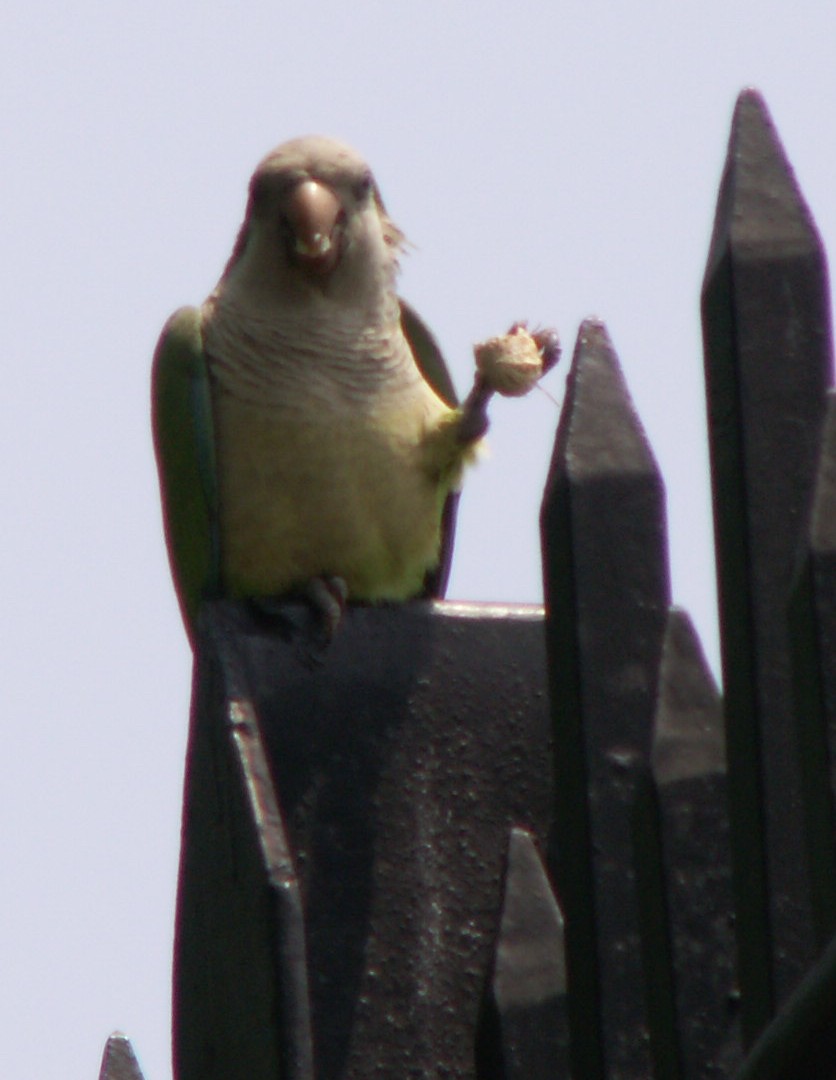
Parrot near Brooklyn College
Brooklyn, Queens and the Bronx has had colonies of parrots for a while, but now the little green birds may be starting a colony in lower Manhattan. Dennis Edge, a friendly birder who is compiling a book of his many finds around Tompkins Square Park, says he's seen at least two for a couple months in Tompkins and nearby community gardens.

It's too late to be building a nest for eggs, he says, but the birds seem to be building something--like one of their insanely huge colony nests, which can grow to the size of a smartcar. No one knows where, but once the colony gets going, it's huge and they like to build them on tall towers (or trees in a pinch), so it shouldn't be hard to fine in the East Village.

Steve Baldwin has done an amazing job tracking and advocating for the monk parakeets or Quaker parrots at BrooklynParrots.com. He gives free, frequent tours by Brooklyn College and Greenwood Cemetery. At one point he had a highly-detailed map on his site of nests around  New York City and New Jersey, but he took it down after reports of men showing up in vans and grabbing birds.

These huge nests make the parrots unpopular.
The feral parrots x are from South America, but have shown up in cities worldwide, even cold ones, usually with a myth about them escaping from an airport crate. They run into trouble for destroying crops and messing with electrical lines when they build their huge nests. But people love them. And they're an okay replacement species for the Carolina Parakeet that we Americans wiped out a century ago.

Now that red-tailed hawks are becoming commonplace, it's fun to have a new freaky species to look for.

Where to Go to See Parrots in the U.S.
Check Out BrooklynParrots.com

Thursday, May 27, 2010

Mah Wei: Tiny Chinatown Songbirds, but Not Every Day

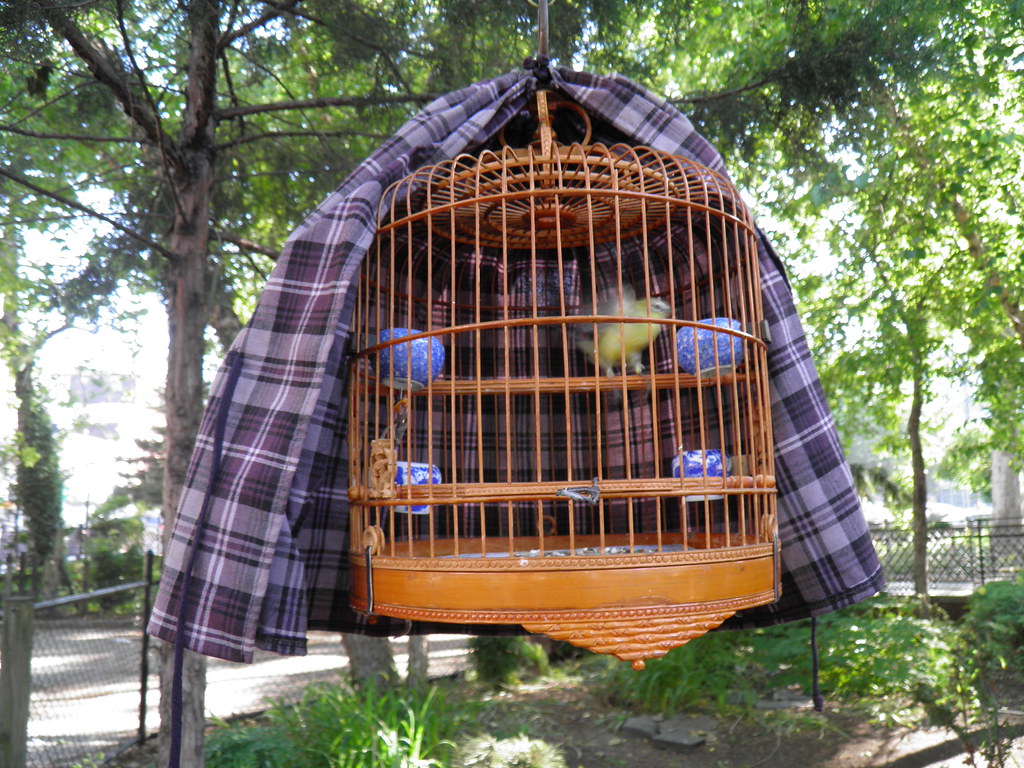
For years I've heard about a Chinatown park where old men bring their exotic birds and this morning I finally went to find it. The Wah-Mei Bird Garden in Sara Delano Roosevelt Park, just south of Delancey, can draw 40-some old Chinese men, each carrying a singing bird in an ornate cage. Or that's what I've heard. I only saw three bird guys.

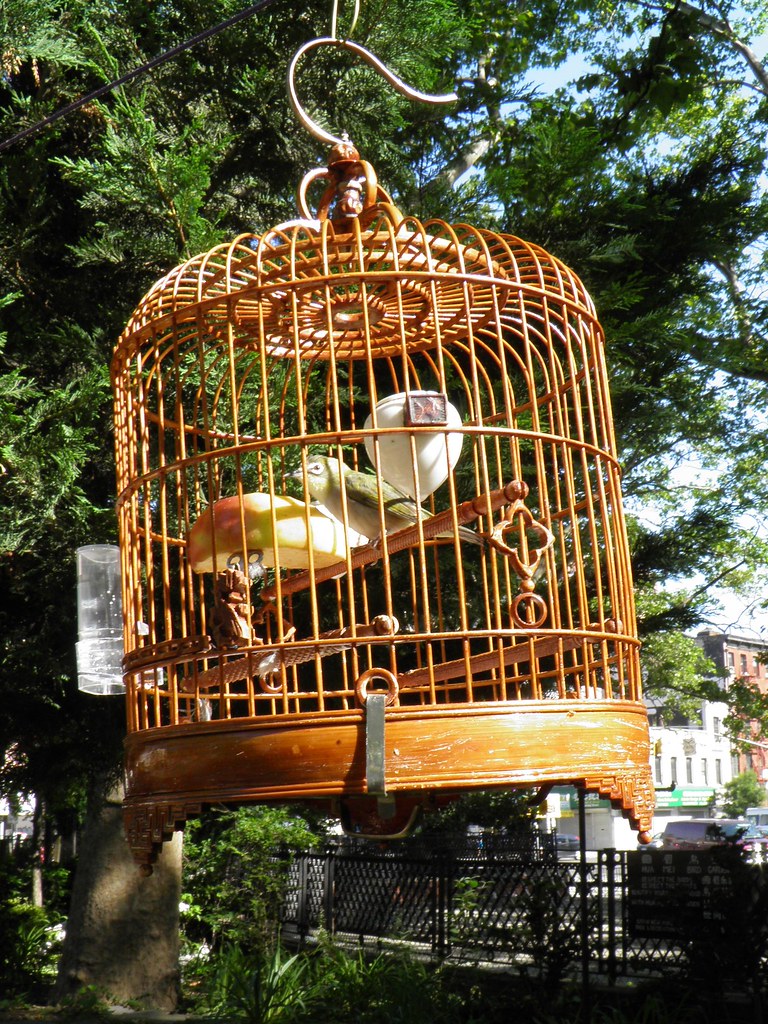
I arrived around 8, in time to see the first bird man take the flannel cloth off his cage. It must shield the bird from the city, though most of narrow Roosevelt Park itself is not much better. It's got bridge traffic on two sides and it's dark and unkempt with wavy pavement and a drugged-out man lurching around. The cages themselves are fantastically carved wood, bamboo and what looked like ivory. They hang them on a long line over a fence that encloses the official Wah-Mei Bird garden. You can hear the birds sing if you get close. Nearby, other elderly Chinese exercised with swords.

The most friendly and happy bird
The bird man schedule remains mysterious to me. I asked the men; they acted like they didn't understand me. I asked around; workers and dog walkers said it's every day around this time. (Later, I read on New York Daily Photo blog it's much busier on weekends.) Any singing bird is welcome, but the most desired are male Wah Mei (Garrulax canorus) that know lots of songs. The men who pretended not to speak English told a local guy can be had for $100 in Queens. Tracy Wong described in a NYU paper how the men get the territorial male birds to compete in singing.

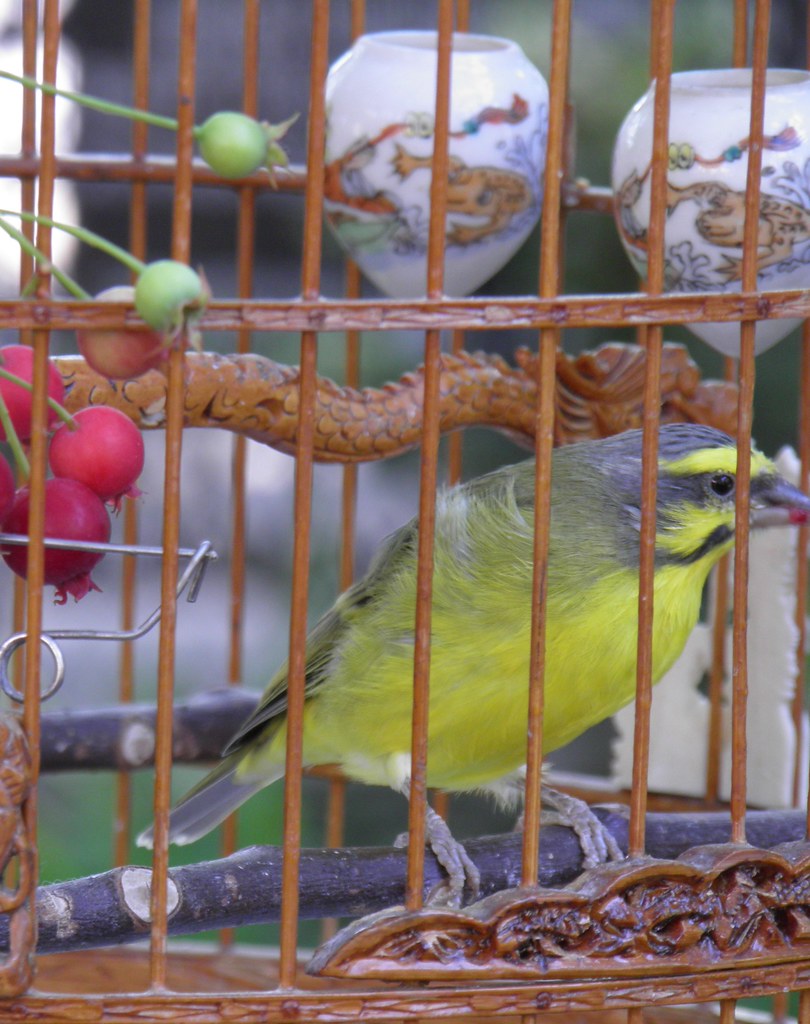
The second bird I saw, another bright yellow one in a fabulous cage that looked like it included ivory, was my favorite. He's a mimic. I whistled to him and she whistled back. And kept the tune going. He was probably annoying his owner with my tuneless notes all day. He ate from fancy porcelain jugs, too.

The third bird was probably the only one that was really a Wah Mei. CITES, which restricted its import after the bird flu outbreak, says that it's the most popular bird traded in China. Before the ban, they figured 1.8 were captured each year, with most of the females just eaten.
Probably the only real Wah Mei


Where to Go See Weird Birds

Wednesday, May 26, 2010

New Yorkers Climb Fire Escape to Rescue Baby Blue Jay

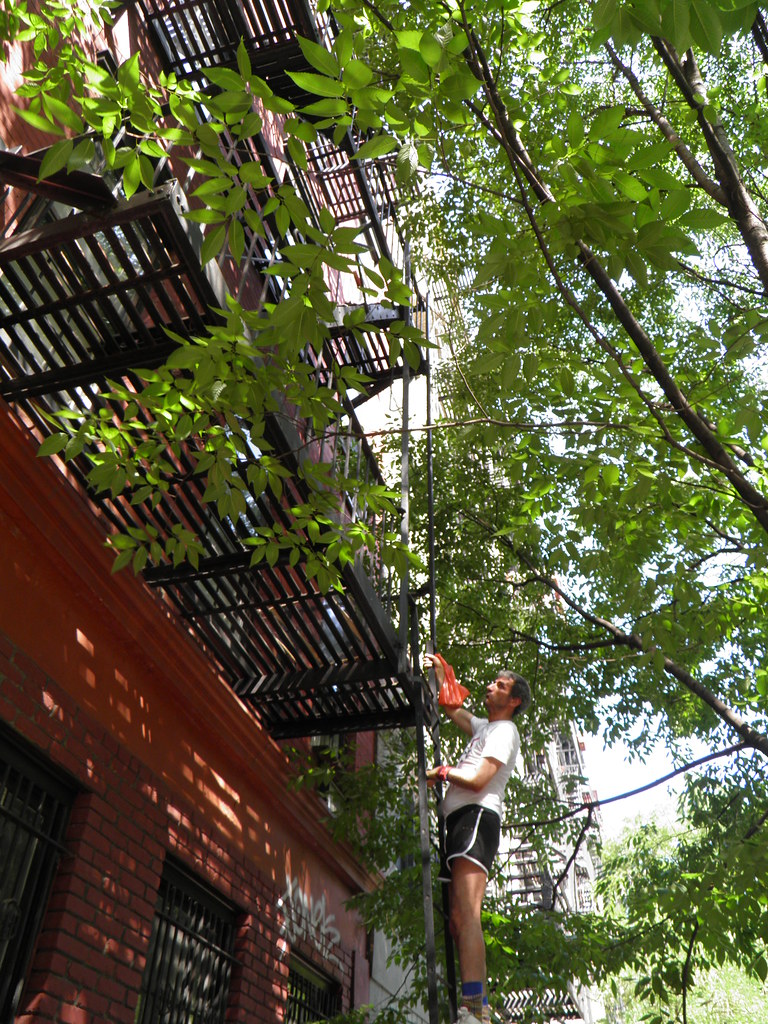
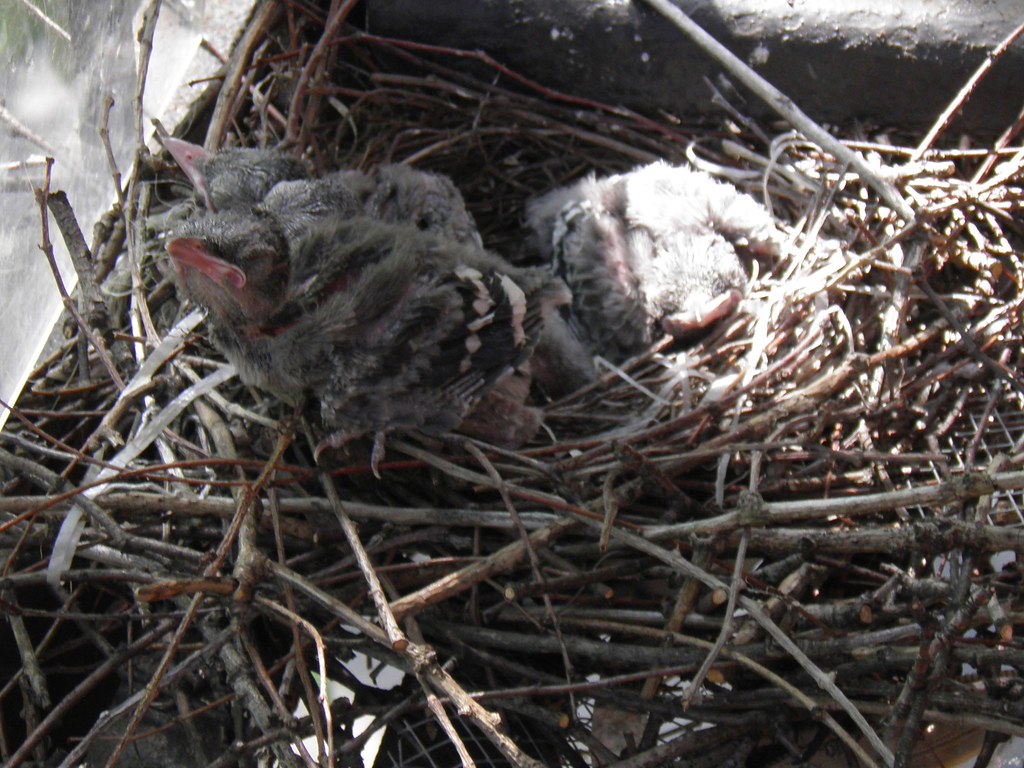
The first blue jay fledgling fell out of the nest built precariously on a New York fire escape this afternoon. It attracted a crowd of neighbors, who put it back in its nest and installed a plastic tarp under the whole set up.

Just yesterday I put up flyers explaining the blue jay babies were up there and it would be normal if they would fall out. If it were a forest instead of Fifth Street, they'd be fine. The parents would feed them for a couple days on the ground. The parents, however, made a really unfortunate real estate choice. Below their nest is sidewalk,  street and a tiny tree pit--no grass or bushes or any other baby bird amenity. And thousands of helpful New Yorkers walk by every day. Somebody would pick it up and bring it to their vet. That's what happened to a blue jay nest in the next block two years ago. The mom spent weeks looking for them.

So this afternoon I got a call about the flyer from a neighbor. The one bird on the sidewalk wasn't not fully feathered and was weak and skinny. It looked way too young to be out of the nest to me. People label New Yorkers as harsh, but soon there were six of us trying to figure out how to get the bird back on the fire escape, ringing doorbells, taping on windows.

My friend Pierre found a long board and tripped the fire escape ladder so it would fall. Generally this kind of thing is frowned upon in the city, but Pierre bravely climbed up and replaced the baby. While I was getting some clear plastic, the mother jay returned and swooped at Jonah, a 10-year-old good samaritan. Pierre and I basically lined the fire escape and left some raw peanuts for the blue jays' trouble.

So far, so good. The mom returned, ate peanuts and sat on the nest. I got a call from the people who live in the blue jay apartment. They'd been worried about the birds and didn't mind our clamoring over their fire escape.


Saturday, May 22, 2010

Jay Continutes Relentless Battle Against 3rd Floor Cat

Cat gives blue jay the bird
The eggs have hatched in the fire escape nest built by blue jays on Fifth Street in Manhattan, but that hasn't stopped the blue jay father from obsessing over a cat that lives down the block.


This video compared to the last one shows why you should use a tripod.


The tabby is no threat to him or his brood. But the blue jay is out there every afternoon that I've checked and some mornings, too.
I've also seen the cat hanging out by the window, waiting for his entertainer to show up.

I don't really understand the feeding procedure. The mother blue jay sometimes gapes for her mate. And she also picks up something from the nest and eats it herself.

Monday, May 17, 2010

Will NYC Get an Official Wildlife Care Center?

The Wild Bird Fund, which is New York City's defacto wildlife rehabilitation center, collected signatures this weekend to become the city's official place to go with injured, sick or orphaned wild birds and animals. They explained to people at a wildlife fest that New York is the only big U.S. city without a real wildlife care center.
wild bird fund is working to get a nyc wildlife rehab center

So a bunch of volunteer wildlife rehabbers have picked up the slack. Rita McMahon and Karen Heidgerd run the Wild Bird Fund though  Animal General, a vet practice that donated care for 1,146 birds and 13 mammals last year.


Theodore Roosevelet Sanctuary Hawk Talk
Hawk from Teddy Roosevelt Audubon Sanctuary
Ruby and squirrel babyA handful of other rehabbers do heroic amounts of work, too. Bobby and Kathy Horvath take the really hard cases, like coyotes and injured hawks. Vivienne Sokol is Manhattan's bird rehab expert. My friends Vicki Puluso, Chris Durham and Maura Mondrano handle squirrel cases.


Because the city is strapped, the Wild Bird fund is hoping to get a grant from Pepsi. Bobby Horvath has told me the plan got a boost after the recent coyote episode.

The New Yorkers that call me with animal troubles are usually surprised the city doesn't do anything for wild animals. Renee, a pregnant mom from outer Queens, about a day and night worrying and searching for some solution for the baby squirrels she found abandoned in her air conditioner. (I got to see them at the fest, looking plump and happy. Another rehabber, Ruby, took them in. New Yorkers see baby squirrels like unseen mythical beasts).

The finders and baby squirrels show up as if with a dowry of a cage, esbilac, dishes, blankets and nuts. Which makes me think New Yorkers would be behind getting the center going.


Donate to the Wild Bird Fund
Sign Their Petition to Get a Real NYC Rehab Center
Where to See Animals Around New York City

Saturday, May 15, 2010

Blue Jays Adapt to New York City--Sort Of

Jay is telling cat to go awayA blue jay has built a nest on the fire escape on Fifth Street in Manhattan. It's not a great spot; sooner or later the babies--in the natural course of things--end up on the ground before they learn to fly. And inevitably some well-meaning person picks them up to save them.

As if the mother blue jay doesn't have enough problems, her mate is not really contributing the to the household. Instead of getting food, he has fixated on a cat that lives in a third floor apartment down the block. The jay constantly buzzes and swoops at the cat's window, as if he's going to convince the cat to move out.


Thursday, May 13, 2010

The Price of All This Cleaning Up Oiled Wildlife?

BP sign from alvez modified by animaltourism.com
Wildlife rescuers in the gulf are getting so few oiled animals they're starting to worry that the cost per animal seem ridiculous. After Exxon we had reports of "$80,000 otters." If you hear anything about a $300,000 sea gull, be skeptical.

Mike Ziccardi, a veterinarian who runs Oiled Wildlife Care Network, has been offering the most candid and complete news on the wildlife situation on their blog.  He's been bracing for both an onslaught of injured animals and a backlash against the cost of saving them. "This response is likely to be very costly when it is all said and done – especially if compared on a “per-bird” or “per-turtle/mammal” basis (or at least I hope it is, as that will imply low animal numbers)," he writes today.

In Valdez less than 5% of costs went to wildlife care, Ziccardi says. Caring for oiled wildlife is always done on the cheap, staffed by volunteers, who often sleep in their cars. And lord knows you've already heard about Dawn donating its useful soap.


In 1992 James Estes first criticized oiled wildlife rehabilitation efforts as showy and ineffective, pricing the surviving otters at $80,000 each from a total $18 million otter effort. (I'd say that you have to count the dead ones, too--even though that only brings it down to $14,500.) Later he asked "why rehabilitate oiled wildlife"? So you don't hate him, know that Estes, an adjunct professor at UC-Santa Cruz, isn't saying screw you, sea otters. He's saying the money could be better spent trying to prevent spills and shore up vulnerable populations.

In 1999 Dr. David Jessup and Dr. Jonna Mazet argued at the International Oil Spill Conference that the $80,000 figure was wildly inflated and took into account building several extremely remote care facilities from scratch. "The actual cost of collecting and caring for oiled sea otters is about $4,000 to $5,000 and marine birds about $600 to $750 [bargain!]--about one-twentieth the cost often cited from the Exxon Valdez experience," they write.

Replacement cost is another way to value animals (and other kinds of intangible losses). Luckily, the gulf doesn't have those expensive sea otters. But it does have some endangered sea turtles that should be nesting soon and manatees. People would pay a pretty penny for any of those.

But why bother saving them? Because it's the right thing to do. The question itself seems based in the reactionary view that only ecosystems and the environment matter and that it is somehow childish to value the life of an individual animal. Too many people are so afraid of being called anthropomorphic that they rush to something I would call tree-pomorphic, the assumption that other animals have no value beyond their physical properties and contribution to the environment.


Where to Go to See Wildlife
Where to Go See Wildlife Down South


 PREVIOUS STORIES ON THE DEEPWATER HORIZON SPILL

Wednesday, May 12, 2010

Vancouver Suburb Burnaby Loves Its Crows

Burnaby Crows by Magalie L'Abbé
When crows pick a town to roost in, locals tend to react badly. They think it's spooky, worry about guano and try to do ridiculous things to drive them off--like shoot them. But one Canadian city sees it another way. Burnaby, BC, loves its crow roost. Thousands of crows have been sleeping together in the seaside town east of Vancouver since at least the 1970s.

"If you go around dusk they cover the sky," says Kelsey Downey, marketing coordinator for Tourism Burnaby. "I used to go to school right in the area and it’s a pretty amazing site."

The crows fly eastward over the city at dusk. They're more concentrated in the winter. And they tend to be seen most around Willingdon Avenue, which is an exit off Highway 1. Downey recommends checking out Still Creek Drive, which runs next to the highway.

Burnaby sticks up for their crows. Kirsten Starcher, who writes the blog Crows to Burnaby [which is really more about arts than crows] is just one of the residents who fretted when a Costco displaced one of the big roost sites in 2006 about how it would impact their crows. "It was sad to lose it," one crow fan told the Vancouver Sun at the time. Another protested on YouTube.

About 500 students each painted their own model crow for an art project Along the Flight Path, that fixed the crows to a fence.  A Vancouver tourism site boasted that the Northwestern Crow was the most conspicuous local bird and that Burnaby had "easily the most amazing gathering in the province." Crows.net says the Burnaby is "one of the most renowned crow roosts." It's great to see a town that appreciates its wildlife.

Where to Go to See Weird Birds or Unusual Bird Events
Where to See Animals Out West

Friday, May 07, 2010

Valdez: A Comparison for Wildlife

How does the Deepwater Horizon oil spill compare to the historical monster of Exxon Valdez, by which we judge all oil disasters? How long will this go on?


We went back to the records of Valdez to look at its size and what we might lay ahead.

  •  In the Valdez spill Scientific American reports that 2,000 sea otters, 302 harbor seals and about 250,000 seabirds died in the first few days. So far we have only 2 birds in care that I know of.
  •  Rescuers retrieved a total of 36,471 carcasses and captured 1,630 live birds, the IBRRC reports.
  • The Valdez spill was March 24, 1989. The last wildlife rehab center closed September 6 of that year. The Deepwater Horizon spill was on April 22, 2009. By that measure, rehabbers will be on the scene until early October.
  • By the 10th day of the Valdez oil spill, rescuers were finding 180 oiled birds per square mile, the Coast Guard reported.
  • The oil spread so far in Prince William Sound that rescuers had to set up four wildlife care centers. They've already set up three down south. There are Oiled Bird Rescue Centers in Fort Jackson, Louisiana, Theodore, Alabama and Pensacola, Florida.
  • How long will it take the wildlife to recover? Here's the really scary part. They're still digging up oil in Valdez and some species are still recovering.


Where to Go to See Wildlife
Where to Go See Wildlife Down South

RESCUE GROUPS

 PREVIOUS STORIES ON THE DEEPWATER HORIZON SPILL
 

Wednesday, May 05, 2010

Where Are All Those Oil-Soaked Birds We Were Expecting?

One peculiar thing about the Deepwater Horizon oil spill so far: hardly any wildlife covered in oil. The lack of  oiled birds has mystified rescuers and exasperated the media. TV networks are clamoring for images, showing clip files and giving the impression that tons of animals are showing up hurt. That's not so--at least not yet.

Mike Ziccardi, a vet and director of the Oiled Wildlife Care Network,  says on the OWCN blog that he got into a spat with "a fairly irate reporter from a major national news outlet" who demanded video access to the necropsy (animal autopsy) of some sea turtles. The network were desperate for dead turtle images even though the turtles didn't show initial signs of oiling and, as Ziccardi pointed out, were in found in a time and place typical of stranded turtles. (The other big threat to turtles is shrimp boats, Wallace Nichols from Grupo Tortuguero points out.)

Keith Olbmermann started a broadcast this week in ominous tone about "as dead jellyfish begin to wash up on the Mississippi coast." Dead jellyfish might be the one bright spot of the oil spill, given that the Gulf Dead Zone has caused a plague of jellyfish in the gulf.


Gulf-oil-spill-first-oiled-pelican-2010
A brown pelican is only second bird to be treated. Photo by IBRRC
Apparently California Gov. Arnold Schwarzenegger so expected oiled wildlife images that he dreamed some up. He just announced that he was withdrawing support for drilling off California's shores: "I see on TV, the birds drenched in oil, the fishermen out of work, the massive oil spill, oil slick destroying our precious ecosystem," he said at a press conference.


Both Schwartzenegger's descion and the lack of injured animals is fantastic, of course. Right now, nearly two weeks into what may be the worst oil spill in U.S. history, exactly two birds are in treatment. There's a northern gannet and this brown pelican. They're going to be media stars, these two.

Ziccardi is mystified by the lack of oiled animals. By this time in an oil spill, he says, "wildlife field operations are in full swing, the largest number of animals are being (or have been) collected, and facilities are bustling with activity." He doesn't know what to make of this lack of animal injury: "Normally I would be overjoyed at this lack of overt animal impact. No, overjoyed is a significant understatement ... but is this lull what we should expect in the days to come, or is the Sword of Damocles really about to come crashing down?"

That's a question all of us are asking. We've been told that the oil spill was on the verge of hitting the shore since last Friday morning. I'm thrilled it hasn't fouled beaches, wetlands and wildlife, but how is it not? Where is the oil going?

Ziccardi wonders if the oil dispersant chemicals are keeping the oil from the surface--where it would do the most damage to birds and marine mammals--but leaving it in the water where it will do long-term, hidden damage. Especially to clam beds. He uses my favorite word of the oil spill: BIOMAGNIFY. That means basically get eaten by the bottom of the food chain, concentrate there, then work their way up the food chain.  Kind of like mercury.

Where to Go to See Wildlife
Where to Go See Wildlife Down South

RESCUE GROUPS

 PREVIOUS STORIES ON THE DEEPWATER HORIZON SPILL

Monday, May 03, 2010

Wildlife Rescuers in Gulf Overwhelmed--By Volunteers, Not Patients

San Francisco Oil Spill - Partially Oiled Gull
Oiled gull in CA in 2007 by Ingrid Taylar. Not many oiled birds seen yet in the gulf.
So far only a single bird, a Northern Gannett, has shown up oiled from the massive Deepwater Horizon spill. Wildlife rescuers and nonetheless overwhelmed--by all the untrained human volunteers.

As the potential for the spill gets bigger, the big wildlife groups are contemplating holding training classes to equip the would-be volunteers, says Kai Williams, executive director of the International Wildlife Rehabilitation Council.


Right now several groups are taking in information from potential volunteers.  The National Wildlife Federation is directing people to sign up with the Coalition to Restore Coastal Louisiana.

 "If you have the ability to restain an animal, that's going to be huge, just the basic ability to hold an animal," says Williams. "They're getting a lot of untrained people, not wildlife rehabilitators, people who have never picked up a bird."

What makes planning the response so hard is no one knows how big this still-developing catastrophe is going to be or when and where a rush of injured animals will show up. Some contemplate that the Gulf Stream could wrap it around Florida. Some worry the spill could end up bigger than Valdez. Williams notes that fewer birds live in Valdez, but there are also turtles and marine mammals to worry about.

The northern gannet is being bathed, fed electrolytes and pepto bismal, but rough weather this weekend prevented picking up more patients. A caretaker told the AP that the bird came in brown, but should be white at its current age.


Nationally, three groups are known for their training in helping animals that have gotten coated in oil.


Where to Go to See Wildlife
Where to Go See Wildlife Down South


Thursday, April 29, 2010

Groups Recruiting Volunteers to Clean up to 400 Wildlife Species at Risk From Oil Spill

A stunning 400 species of birds, marine mammals, turtles, land mammals and reptiles could be hurt by the Deepwater Horizons oil spill, which is now just 6-7 miles off Louisiana. The current strong winds may blow the muck to shore by Friday morning, the latest report says.

Nola.com obtained a list of 400 species put in harm's way by the oil from the Louisiana Department of Natural Resources. Bob Marshall writes that this is a particularly horrible time for the oil spill--right when birds are migrating through or nesting. The soon-to-be oiled area is:

vital wintering or resting spot for more than 70 percent of the nation's waterfowl, is used by all 110 neo-tropical migratory songbirds, and produces 50 percent of the nation's wild shrimp crop, 35 percent of its blue claw crabs and 40 percent of its oysters. Ressearchers say 90 percent of all the marine species in the Gulf of Mexico depend on coastal estuaries at some point in their lives, and most of those estuaries are in Louisiana.
The New York Times has a great chart highlighting which species are most at risk, mostly migrating birds. The brown pelican was just removed from the endangered species list.

The Oiled Wildlife Care Network--a collection of wildlife responders across California--has sent its director down and is collecting info on volunteers.  They say it's too late to train you to clean up animals but you could become a "convergent volunteer." Specialized groups or state rehabber associations do oil training seminars in preparation for a disaster like this.

The International Bird Rescue and Research Center is on alert, too. They regularly offer classes in Fairfield (northern California) and San Pedro (Southern California) for people to become volunteers.

The International Bird Rescue and Research Center is on alert, too.

Audubon of Florida is recruiting volunteers for the onslaught of oiled birds to be cleaned up at the Center for Birds of Prey in Maitland, FL.

The unified command for oiled wildlife is 800-557-1401.

The Lousiana Wildlife Rehabilitators Association directs residents to call (866) 557-1401 for the Oiled Wildlife Unified Command Center. Not sure which prefix is correct, but it's the same number.

The feds say they're setting up staging areas to protect the shoreline in Biloxi, Miss., Pensacola, Fla. Venice, La., Pascagoula, Miss., and Theodore, Ala.

AnimalTourism.com: Where to Go to See Wildlife

Wednesday, April 28, 2010

Pelicans, Otters, Manatees Could be Hurt by Deepwater Horizon Oil Spill

Deepwater Horizon oil spill seen from space over LA
Imagery courtesy of NASA Earth Observatory
Endangered sea turtles, herons, white and brown pelicans, dolphins, whales, manatees, tuna and assorted sea birds  could all be hurt by the Gulf of Mexico oil spill that is now 16 miles off the tip of Louisiana and alarming wildlife officials all the way to Florida.

The Coast Guard is burning the oil, hoping that will keep it from making landfall and destroying wetlands. I wonder if, ironically, the giant dead zone in the gulf may mean that the area the oil spill hits may be devoid of life anyway. The next step for wildlife rescuers would be to herd animals out of the area by hazing them.
 
The International Bird Rescue Research Center in Texas says they've been put on alert for the decapitated oil well, which is gushing about 1,000 barrels (42,000 US gallons) of crude daily and already can be seen from space, with a circumference of 600 miles.
If the spill stays offshore then the impact will likely be minimal to birds. Coastal birds that are highly at risk if the spill hits shore are brown and white pelicans, terns, gulls, shorebirds, skimmers and herons. Nesting and feeding areas for birds and sea turtles such as marshes and beaches could be impacted.
Loggerhead and Kemp's Ridley turtles are in the area, Live Science says. Birds are vulnerable if they ingest the oil or get coated in it. The oil removes their waterproofing, then they die of cold. In a report on dealing with oil spills, the EPA says mammals that groom themselves with their mouths, like otters, end up eating oil and getting it in their eyes. Sea otters don't live there; river otters do. No one really knows how to help marine mammals stuck in oil, they say.
Procedures for capturing, treating, and releasing animals may hurt them more than the oil does. For example, manatees are particularly susceptible to secondary fungal and bacterial infections following capture or transportation. 
Whales, dolphins, seals and manatees end up breathing hydrocarbon vapors that hurt their lungs, getting it in their eyes and nursing young eat it. Manatees summer as far west as Texas (but that's rare); a few regularly visit Mobile, AL. The biggest danger to manatees, which spend the summer as far west as Texas, may be getting hit by boats responding to the disaster.

So far the Tampa Tribune reports that the Florida Fish and Wildlife Conservation Commission hasn't found any oiled birds, but they are doing necropsies (animal autopsies) on 15 migratory birds found dead Tuesday in the Pass-a-Grille area of St. Pete Beach.


In Alabama, the Dauphin Island Sea Lab is sending boats out to test the waters and "trying to re-establish oiled bird emergency response plans that have not been exercised for many years." They fear it could be the worst Gulf oil spill ever. Coast Guard Rear Adm. Mary Landry goes even further: "If we don't secure this well, this could be one of the most significant oil spills in U.S. history."

Where the oil spill is on 4/28
Where to Go to See Animals Down South
Monday, April 05, 2010

Pelicans Visit Chicagoland for Spring Break

Unison by jpmatth
White Pelicans are just about hitting their peak numbers in Chicagoland. Practically nobody saw these big white birds a decade ago. Now you can see them every spring. Now you can drive 50 minutes from downtown Chicago and found up to 250 of these huge, exotic white birds in a tiny lake in a bland exurb housing development. 

The Daily Herald highlighted Nelson Lake in the Dick Young Forest Preserve, where they've been appearing for eight years. Kane County Audubon now says now they've left Nelson Lake--which was originally created by a beaver dam--and moved to nearby Carson Slough. On April 3 birders saw 133 white pelicans in this small manmade lake in a housing development right off the Sugar Grove exit from I-88.

Prairie State Outdoors says the 30-pound birds have somehow changed their migration habit so that they are increasingly showing up in Illinois, especially near the Illinois and Mississippi Rivers. (Batavia is about 20 miles from the Illinois.) The white pelicans (also called Rough-billed Pelican (Pelecanus erythrorhynchos)) travel between the Gulf of Mexico and Canada but they only stop in northeast Illinois in the spring and only in this one area.

Kane County Audubon's Jon Duerr, who used to run the forest preserve, told WTTW says birds travel around 300 miles between breaks. They stop for a couple weeks to feed. They don't dive like brown pelicans; they work together to herd fish. The  This year they arrived March 19 and they'll probably be totally gone a month later.

Where to See Odd Birds
See More Wildlife Around Chicago
Check Out Kane County Audubon

Thursday, March 25, 2010

Everybody's Watching Molly, the San Diego Owl, Hatch Her Family

Unbeknownst to Molly, a young barn owl mother, about 2 million people are scrutinizing her egg-sitting, feeding and every move, day and night, asking questions and offering critiques about every 30 seconds. Since January, when Molly moved into a backyard owl box in San Marcos, CA, the box's landlords started adding progressively more advanced photo equipment, culminating in the live streaming camera at Ustream, which has had about 2 million views.

Viewers won't be disappointed. Molly fusses over her eggs--and now two chicks--like a Park Slope parent. She incessantly gets up to rearrange herself, providing a glimpse of the chicks. Her mate arrives just after sunset with dinner--once a whole rabbit. 

A retired couple, Carlos and Donna Royal, have been waiting for just such a visitor for years. "We have a very eco-friendly backyard; we live on an acre lot with lots of trees and plants for wildlife," they say in their Ustream profile. "We have had kestrels, bluebirds, hummingbirds, phoebes, wild ducks, killdeer and mockingbirds all nest and raise their young in our habitat. We do not have any cats or dogs to disturb the wildlife."

Carlos, a former real estate broker,  told the San Diego Union-Tribune that they put up the house two years ago, but got no tenants. Then in January a neighbor asked if they heard the owls screeching in a storm. With the help of their teenage grandson, they added a camera on the outside of the box, then an infrared camera and hooked it up to the internet. (Since Ustream is free, the whole arrangement probably only costs a less than $300.)

The Royals, who had a casual backyard blog Birds R Us before Molly, are clearly having a good time with their owl family. Back when Molly was a just a smalltime internet spectacle with 33,000 fans, they declared her "the most famous barn owl in the world." They sell Molly Merchandise. They've changed their blog profile to suit Molly. The author's occupation is listed as laying eggs, her favorite movie: The Birds.


Live TV : Ustream

Wednesday, March 24, 2010

Are Different Animals Showing Up? Or Are We Just Getting Better at Spotting Them?

When you hear a report of a unexpected animal or bird showing up someplace, is it because they really moving into new places? Or did we just become better spotters? Or maybe it was the biological authorities who became less dismissive of citizen scientists? That was the gist of what ornithologist Shibail Mitra mulled over at a lecture at the Linnean Society of New York last night.

Mitra, who a biology professor at the College of Staten Island, came down for the citizen scientists, showing through several bird species examples how official guides willfully overlooked several species--counting them as an unremarkable subspecies, invasive escaped pets or just rare lost souls. Then when a committee somewhere declared it was a legitimate species, people started reporting more of them.


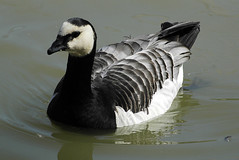
Barnacle Goose  Branta leucopsis
Courtesy of Ucumari
This bird breeds in Greenland, so its appearances early in the 20th Century were written off as escaped pets. Serious birders would put parentheses around them on their lists because they didn't really count. Now they're showing up more than once a year and records counters are accepting them.


Cackling Goose Branta hutchinsii
The Cackling Goose was dismissed as a a subspecies of the Canada Goose. So nobody counted it and it was "grossly overlooked," Mitra says. Then in 2004 the American Ornithology Union decided that this much smaller bird that breeds in the arctic and winters in the west from Oregon to Mexico really is a separate species. That manmade distinction always makes the birds more interesting to people,  Mitra says.


Arctic Tern Sterna paradisaea
Courtesy of Reders
Arctic terns were seldom recorded before the seventies by the birding authorities. They were at best a celebrity vagrant--a bird that quickly becomes the object of desire and gossip among birders. (The Central Park coywolf is certainly New York City's celebrity vagrant of the moment.) Then sub-adult Arctic terns started showing up where and when nobody expected them: on Long Island beaches in mid-summer. Not old enough to breed, these adolescents don't have to keep up with the rigorous arctic to Antarctica schedule of adults, so they visit the Moriches Inlet.

"When people did not have the predisposition to think they would find arctic terns," Mitra says, "they did not find arctic terns."

There was much grumbling in the crowd toward the arrogance and whimsy of the ornithological authorities that seem to have birders under their thumb. Assuming that we know more than we really do about the species in an area can lead to lousy identification and conservation. If you assume you know exactly what birds, plants and animals need protecting, you may only protect their specialized habitat and overlook more prosaic landscapes that will save an animal you haven't thought of 100 years from now. Of course, this kind of thinking is what leads to boring wildlife preserves, but better mundane preserves than none at all.

Where to See Wild Animals Around New York City

Monday, March 08, 2010

Improbable Battles in the Animal Kingdom this Week

Some improbable animal battles this week.
Praying Mantis v. Hummingbird
The hummingbirds in this video already hate the praying mantis. They bicker with him and kick him in the head. Their prejudice is well-founded: the mantis lunges at the bird. In slow mo, it seems like the bird gets off. But there is a long-running war and the mantis sometimes wins. The outcome is so improbable, there's a discussion on Snopes debating whether it is possible.


Shark v. Ring


Veterinarian Chip Gardener grabbed a nurse shark ensnared by a frisbee ring and freed it. Gardener was diving near the wreck “The Princess Anne” off Palm Beach with his friend John Dickinson, who joked on CBS that his focus was just framing the shot.


Chicken v. Fox
A young fox broke into a hen house in Basildon, Essex, UK, and was pecked to death by the rooster Dude and his hens Izzy, Pongo and Pecky, the Daily Mail reports. Even if he survived the bites, he would have died of embarrassment over the attack.


Friday, March 05, 2010

Hawk Expert Says Attacking CT Hawk May Have to Be Removed--or at Least Scared

The red-tailed hawk that's been swooping down on people in leafy Stonington, CT, may have to be trapped and removed, says Len Soucy, a wildlife rehabilitator, founder of New Jersey's Raptor Trust, and one of the world's most experienced  hawk experts.

"When there's a nuisance hawk, I relocate it," Soucy says, "so people don't hate all the hawks on earth because one hawk is acting foolish."

Soucy has the traps, permits and experience to trap a red-tailed hawk, but it's still a last resort. The hawk is probably protecting his territory in advance of nesting season, which starts over the next couple months, he says. He might try to condition the hawk with loud noise first, a process that can take a while work.

Birders travel great distances to see hawks, but this particular CT hawk in will come directly to you. And then he'll swoop at your head and maybe steal your hat or headphones, the Day reports. The bird has attacked five times since last summer, mostly on the cul de sac of Shawondasee Drive and Carriage Drive. The nearby Deans Mill School now has recess and gym inside, though, just in case.

Hawk attacks on people and pets may continue to rise along with the numbers of red-tailed hawks (Buteo jamaicensis) . (They're one of the many birds recovered thanks to bans on DDT and reactionary killing of birds of prey.)  Soucy says he's gotten two reports of similarly belligerent hawks in New Jersey this season. One hawk lifted a chihuahua puppy and broke his leg. The males, which are smaller, aren't the only nuisances. Often the female will join in the attacks once the chicks hatch.

"Once the chicks are hatched, you'll have a double dose." Soucy says. "They're just a pain in the ass."


See Animals in the Wild in the Northeast

Tuesday, February 23, 2010

Starlings Murmur over Brighton

In the U.S. starlings are slaughtered by the millions, but in their native England they are enjoyed as one of the most mysterious spectacles.

Nature groups give tours of the starlings, but you can just show up yourself at dusk at the Brighton Pier, where 50,000 some starlings murmur--that is, swarm in a hypnotizingly coordinated dance in an effort to evade the hawks that are trying to eat them.

The starlings have always hung around Brighton, Sussex, but moved to the pier after a big storm knocked over their favorite trees in 1987. Their supporters think that's just as well: the setting is gorgeous; the birds are safe from people; and the city is safe from guano. "You could not really have them in a more ideal spot. It is a great spectacle to have 50,000 birds in a big town wheeling about," Steve Berry from English Nature told Regency Brighton. Starlings are legally protected in the UK; their numbers have fallen 66% since the 1970s, the RSPB reports.

Starlings (Sturnus vulgaris), clever mimics with shimmering, multi-colored feathers, are treated far differently in the U.S. The 200 million that live here are treated an invasive species and pest here, topping the biological services hit list. The U.S. Department of Agriculture, improbably still in the business of mass culls of animals, especially predators, kills 1,117,000 starlings a year.

A homesick Brit, Eugene Scheiffelin, introduced 100 starlings into Central Park in 1891, hoping to enjoy every bird here that was mentioned in the works of William Shakespeare, David Ian Withers writes. Mozart had a pet starling and some people still do, the fan site Starling Talk says. Just shows you can have fun even with a common bird.


Visit Brighton suggests Brighton Pier, the Brighton Marina or West Marina for a starling show.
Where to See Animals Around Europe

Tuesday, February 02, 2010

Score One for Team Squirrel

The Tompkins Square Park squirrels bravely stand up to the new, popular red-tailed hawk pair on the Lower East Side. The hawks appearance on Saturday Night Live doesn't intimidate them, either. The squirrels know that if they are in a tree, the hawks can't swoop down and catch them.


So if the hawk lands in a tree the squirrels eagerly do their part to chase him off. They're in the anti-hawk union with crows and jays, who mob the raptors. Because they all know if they don't, the hawk will eventually catch one of them.

The squirrel can do considerable damage to a hawk by biting its feet, which may then become infected. The squirrel made the hawk uncomfortable enough to go back on its heels, change branches, then fly off. He flew to another tree, where another member of the anti-hawk union started to drive him away.
Where to See Hawks and Eagles