We've Moved!

Hi and Welcome to the AnimalTourism.com blog. But we've moved just down the street to this site, animaltourism.com/news. Please comment there.
Showing posts with label west. Show all posts

Wednesday, April 28, 2010

Western States Suffer Declining Deer Numbers, Higher Deer Tension

Mule Deer
Mule Deer by Marvin James Phelps
The southwest has a deer shortage and deer controversy.

What could be controversial, you think? We've all been told that deer cause havoc, eating forest understory, crashing into 1.5 million cars every year, which kills 150 people and costs $1.1 billion.  Many people I talk to say they approve of hunting just because it cuts down the deer population. A Responsive Management Survey found more Americans approve of hunting deer (78%) than any other animal.

A Westfield State College paper from Massachusetts paper sums up the gratitude we should feel towards hunters because they "provide a means of controlling deer populations. Without some means of restraint, there is the potential to have deer expanding into areas beyond their natural habitat. This can endanger humans as well as the deer themselves."

But in this case--as in many others--hunters want to increase the number of deer.  Nevada's mule deer numbers have been cut by half since 1988, so hunters want to start shooting coyote and mountain lion. But state game officials say that won't do any good; habitat loss is to blame for the deer decline. Tony Wasley, Nevada's mule deer specialist, told USAToday that "all the predator control in the world won't result in any benefit."

But, science be damned, the governor and the hunters he appointed on the state's wildlife commission want to shoot some varmints. Nevada Wildlife Commission Chairman Gerald Lent asked the feds to start killing predators (they said no, since there was no biological basis) and then he started a committee to restore mule deer. “The governor gave me and our commission a direct order — that he wants something done about our declining deer numbers,” Lent told the Nevada Appeal.

I think most people would be surprised that wildlife commissions' official missions are to promote hunting, not a healthy environment. But hunters seem to feel entitled to have their needs put above wildlife watchers and the general public. The same survey by Responsive Management found that the majority of hunters in New Hampshire would approve of increasing the deer and moose population even if it meant more human-moose conflicts (86%), moose-car crashes (63%), deer-car crashes (68%) and damage to crops, timber and landscaping. I wonder if Nevada will go the way of Idaho, which recently introduced skunks and badgers to kill pelicans, and bring in some other predators to kill the predators that hunters don't like.

Where to Go See Wildlife Out West
Where to Go See Deer

Saturday, April 17, 2010

Arizona Gets its First Wild Ocelot

Sky Alliance 2008 ocelot pix
For the first time ever, an ocelot has been photographed living wild in Arizona, the Sky Island Alliance announced. This small, spotted cat was previously found only in the southern tip of Texas.


The picture was dates Nov. 9, but just physically picked up from a motion-activated wildlife camera last week in Cochise County. That's in the southeast corner of Arizona. Geography buffs will notice that Arizona doesn't even touch Texas. We've got 50 miles of New Mexico in between. "This record from Arizona places ocelots over 200 miles north in latitude from where they are found in Texas," the Sky Alliance says. It looks like its also 200-plus miles west.

IUCN shows ocelots in NE Mexico only
animalfiles show them in SE & NE Mexico
This ocelot may come from a population on the other coast of Mexico. Some rangemaps out there, like this one from theanimalfiles, show the ocelot living in both northeast and northwest, Mexico, but not in between. The preeminent international authority on animal species, the IUCN Red List, shows them only in the northeast and not even touching the United States. It would be a huge boon for diversity of the species if these two prongs of the population could meet up.


Ocelots (Leopardus pardalis) are listed as endangered in both the U.S. and Mexico. They used to range up to Louisiana and Arkansas but were wiped out when farmers cleared out grasslands in the 1930s. Its other big problem is its pretty fur. The IUCN Red List says that worldwide the species is of least concern because it has a big population in Central and South America.

“This ocelot, alive in Southern Arizona, is so exciting to see, to take pride in.  We now know that these incredibly rare cats are here with us, can co-exist with us, and have done so right under our noses,” said Sky Island Alliance biologist Jessica Lamberton.

The volunteers who went out to pick up the camarea were part of Witness for Wildlife and was placed with help from Freedom to Roam, a group that works on wildlife corridors.
 

Seeing Ocelots in the U.S
They're really hard to see, but the 100-some cats that live in America are mostly concentrated in the 45,000-acre Laguna Atascosa National Wildlife Refuge, the EDF says. Texas Parks and Wildlife says they're also at the Santa Ana National Wildlife Refuge near Alamo; Bentsen-Rio Grande Valley State Park near Mission; Las Palomas Wildlife Management Area near Edinburg; and Audubon’s Sabal Palm and Grove Sanctuary near Brownsville.

Thursday, March 25, 2010

Everybody's Watching Molly, the San Diego Owl, Hatch Her Family

Unbeknownst to Molly, a young barn owl mother, about 2 million people are scrutinizing her egg-sitting, feeding and every move, day and night, asking questions and offering critiques about every 30 seconds. Since January, when Molly moved into a backyard owl box in San Marcos, CA, the box's landlords started adding progressively more advanced photo equipment, culminating in the live streaming camera at Ustream, which has had about 2 million views.

Viewers won't be disappointed. Molly fusses over her eggs--and now two chicks--like a Park Slope parent. She incessantly gets up to rearrange herself, providing a glimpse of the chicks. Her mate arrives just after sunset with dinner--once a whole rabbit. 

A retired couple, Carlos and Donna Royal, have been waiting for just such a visitor for years. "We have a very eco-friendly backyard; we live on an acre lot with lots of trees and plants for wildlife," they say in their Ustream profile. "We have had kestrels, bluebirds, hummingbirds, phoebes, wild ducks, killdeer and mockingbirds all nest and raise their young in our habitat. We do not have any cats or dogs to disturb the wildlife."

Carlos, a former real estate broker,  told the San Diego Union-Tribune that they put up the house two years ago, but got no tenants. Then in January a neighbor asked if they heard the owls screeching in a storm. With the help of their teenage grandson, they added a camera on the outside of the box, then an infrared camera and hooked it up to the internet. (Since Ustream is free, the whole arrangement probably only costs a less than $300.)

The Royals, who had a casual backyard blog Birds R Us before Molly, are clearly having a good time with their owl family. Back when Molly was a just a smalltime internet spectacle with 33,000 fans, they declared her "the most famous barn owl in the world." They sell Molly Merchandise. They've changed their blog profile to suit Molly. The author's occupation is listed as laying eggs, her favorite movie: The Birds.


Live TV : Ustream

Thursday, March 18, 2010

Hunters Jump on Probable Alaska Fatal Wolf Attack to Argue for More Hunting

A self-portrait on Candice Berner's blog
The horrible death last week of Candice Berner, an adventurous special ed teacher spending the year in remote Alaska villages, may be the first confirmed fatal attack by wolves in modern American history. Berner, 32, was attacked and partially eaten by animals March 8. Alaska wildlife officials shot two area wolves March 15 and are figuring out if they are the killers and if they have rabies, a common cause of rare wolf attacks. Hunting advocates are already jumping on the case as proof wolves are dangerous and need to be hunted.

Originally, because wolf attacks are so rare, authorities even wondered if she had died first, then been attacked. A fellow Alaska teacher said on her own blog that she couldn't believe it.

Initially, I was in shock. Wolves, seriously? My knee-jerk reaction was bullshit. I did some research, and this is only the second time in history a wolf killed a human. A bear would attack a human, not wolves. It seemed too obscure to actually be true. Sometimes, I am angry. There is a part of me that thinks there must be something more to the story, perhaps foul play. Although she was tiny (standing at 4’11 and maybe 100lbs soaking wet), she was also a hunter and a trapper.

But her  autopsy points to just to an animal attack. Wolf tracks were at the scene and the other big predator, bears, are still hibernating.


Berner usually ran an impressive six miles. She was an enthusiastic, veteran teacher, with a master's degree and many years experience in both California and Pennsylvania. Her blog Adventures of an Alaska Bush Teacher shows how excited she was to get the full Alaska experience, seeing the wildlife and learning from everyone she met. She went trapping; caught a fox, hoped to catch a wolf. She admired villagers who survived on what they fished, hunted and gathered. She went with the kids on an impromptu field trip to see a slain moose that would provide meat for the winter.

 Only in bush Alaska does a successful morning hunting equal a school wide break.  Subsistence hunting and fishing takes priority over many things including spelling tests, because it's survival.   

But she didn't care for the tourist trophy hunters.

I personally do not like the bears being shot, I think they're beautiful and amazing animals to watch.  Most hunters don't eat the meat, and only keep the fur... 

She mentions carrying bear spray when she getting two roaming village dogs to accompany her to watch out for bear and other animals.


During our run they chase away ravens, magpies and sometimes foxes. They're great company to have and I feel safer running on the trails. At the end of our run I reward them with another milk bone.

Berner's picture of her school's wolf mascot
That was in her home base of Perryville; she flew by bush plane to four other remote villages. Just that day she had landed in the 100-person Chignik Lake to teach, then went running after school. Stray dogs in Chignik Lake were known to go missing; residents blamed wolves, local TV reports. It's too bad some of Berner's dog friends weren't with her to protect her--or at least warn her. She had an iPod and may not have heard them coming until they lunged, police told her father. Even having dogs along may not have helped. Wolves are known to attack dogs and the people with them.

Hunters are already jumping on the case as an opportunity. They argue for more hunting by saying we need them to kill dangerous animals. They put themselves in the uncomfortable position of routing for animal attacks. When someone says wolf attacks are rare, Black Bear Blog, responds: "That is an outrageous statement that is simply not true." Look at all the comments from this Field and Stream report saying wolves have killed hundreds and blaming her for not carrying a gun and jogging, which can trigger prey drive. Readers on fishingbuddy castigate her father for not rushing out to slaughter the wolves with an assault weapon. 

According to the International Wolf Center, said a 2005 attack on a geology student in Saskatchewan was the first confirmed wolf attack death. Dr. L. David Mech, founder of the non-profit International Wolf Center and a wolf biologist with the United States Geological Survey said that the 2005 attack was a horrible "but one fatal wolf attack in the recorded history of North America does not warrant widespread alarm."

Her father Bob Berner, despite his horrible loss, didn't try to stir up any anti-wolf rage."They're just doing what wolves do," Berner told the Anchorage Daily News. "Their nature happened to kill my daughter, but I don't have any anger towards wolves."
Read Berner's Blog About her Adventures in Alaska


Monday, March 15, 2010

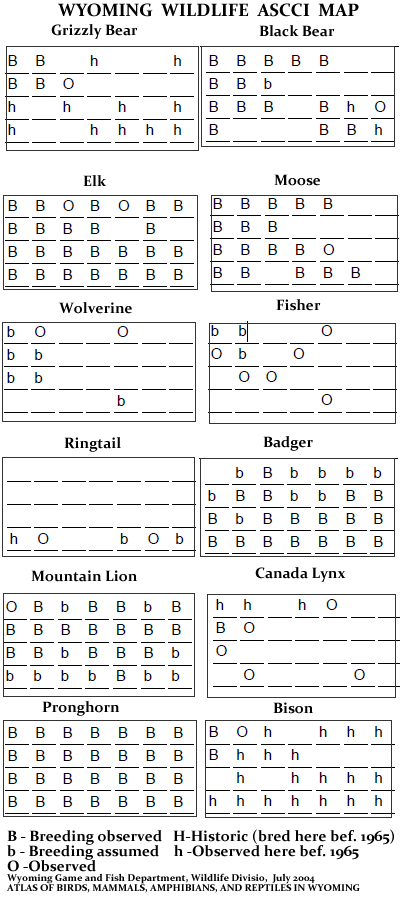
Wyoming's Wonderful ASCII Wildlife Maps

Wyoming has done something very cool for wildlife lovers. The Wyoming Game and Fish Department took advantage of their state's rectangular shape and created ASCII wildlife maps for a report, Atlas of Birds, Mammals, Amphibians, and Reptiles in Wyoming.

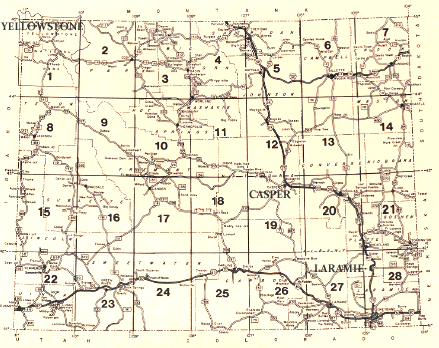
Wyomingcame up with these elegant and useful maps by dividing the perfectly rectangular state into latilongs--rectangles that cover an area of one degree of latitude by one degree of longitude. Wyoming has exactly 28 latilongs--seven across and four down.

So if you want to find out if badgers live in your area--or if badgers are very prevalent in Wyoming just look at the handy grid for your section. Laramie, you're 27. Casper, 19 is your number. And Yellowstone, you are number 1.

Where to See Wildlife Out West

Wednesday, February 10, 2010

Idaho Wolf Activist Cleverly Undermining Wolf Hunting Quota


A Wolf Smiles
Courtesy of SigmaEye
Wolf advocate Lynne Stone tried to find a way to get Idaho Fish and Game to count the wolves they shoot for killing livestock towards the hunting total. She knew where officials shot down the alpha female of the Basin Butte pack in November. So she bought a hunting tag ($11) and claimed it has her own, the Times-News of Magic Valley says, hoping it would count towards the region's total.

One more wolf claimed for the hunting total means one less wolf cold be legally shot. Not so fast, Fish and Game said. They confiscated the wolf and gave Stone a warning. Because hunters enjoy a great deal of legal protection, they had to sell her another tag. (She had asked permission beforehand to use the tag like that and only got unclear answers.)

Stone heads the Boulder White Clouds Council, which wants permanent protection for the area, so she obviously isn't going to go hunting for real. Stone is so well known in the area and the frequent subject of harassment from anti-wolf activists. Isn't it derogatory to call them anti-wolf? No, amazingly, that's what they call themselves. And they vow to eradicate the "Canadian gray wolf" like it was some illegal immigrant taking jobs away from American wolves.


Idaho hunters are about two-thirds of the way to bagging this year's quota of 220 wolves. The Sawtooth region where this wolf lived has a hunting quota of 55, with 30 already dead and 15 more allowed to be shot by March 31. This area has the biggest wolf population and legal and illegal kills. They did count one illegal kill against the quota.

At minimum they should count all the illegal kills against the quota so that legal hunters have an incentive against poachers. In a state that hunts Sandhill Crane I don't really expect much revulsion at someone hunting wolves out of season.

Stone's clever plan is more provocative because she was willing to pay to have a wolf not killed. Hunters have long claimed that they support conservation and wildlife departments through their hunting tag dollars. America's 71 million wildlife watchers far outspend versus the 12.5 million hunters, ($46 billion versus on animal watching versus $23 billion on hunting), according to the U.S. Fish and Wildlife Service.What if we all were allowed to pay $11 to save a wolf?

Idaho Wolf Population: about 800
Dead in 2009: 273
Hunted: 135
State Control Action: 87
Illegally Hunted: 13
Other (such as natural causes or car accidents): 8
Shot in Defense of Livestock: 6
Source: Idaho Fish and Game 

Where to Go to See Wolves and Coywolves Near You

Friday, February 05, 2010

Is Freedom Free? Calico Wild Horse Roundup Concludes

Early on in the controversial round up of wild horses in the Calico range north of Reno, NV, a black stallion earned the nickname Freedom when he jumped a fence and escaped. It's unclear if the Bureau of Land Management caught him, but if he made it so far, he's all set. The Bureau of Land Management says they're stopping the roundup at 1,922 mustangs instead of the 2,500 they set out to catch. In the process 30 have died.

It's not because they've had a change of heart. They fought a lawsuit to stop the roundup. They've fought activists who want to document the gather. It's just that the horses have moved off the range--as if they'd caught onto what's going on.

Craig Downer and Elyse Gardner reported on Freedom's escape on January 2 in Action for Wild Horses: "the captured band stallion, "Freedom," valiantly fought for and regained his liberty although he had to leave his family of 8 adult mares and 2 colts. Jumping a 6-foot fence and immediately thereafter breaking through a barbed wire fence and injuring himself, this was an awe-inspiring, do-or-die effort demonstrating the loathing of captivity to a wild horse and his need for freedom."

When I talked with some horse activists at a Madeleine Pickens event last month, they said they'd heard Freedom had been captured but everyone was appealing to set him free again. I haven't found anyone who knows for sure. I would like to think he made it and somehow communicated to the other horses that something bad was going on.

Where to See Wild Horses Around the World
More Stories About Wild Horses