We've Moved!

Hi and Welcome to the AnimalTourism.com blog. But we've moved just down the street to this site, animaltourism.com/news. Please comment there.
Showing posts with label tx. Show all posts

Wednesday, May 19, 2010

Will Sea Turtles Be The Big Victims of the Gulf Oil Spill?

Kemp's ridley sea turtle
Kemp's Ridley sea turtle trudges through beach, photo by krembo1
The sea turtles in the Gulf of Mexico may turn out to be the ones in the most trouble from the Deepwater Horizon oil spill. Even though they haven't shown signs of oil, they may be ingesting it.

Dr. Mike Ziccardi, a veterinarian who runs the Oiled Wildlife Care Network and is handling all the non-bird oiled wildlife in the gulf, now says they're getting a high number of dead turtles, 156 so far. Mostly juveniles and mostly the rarest kind, Kemp's Ridley, TampaBay.com reports. The dead sea turtles "are in higher numbers than you would expect," he told Reuters.

No one is sure what killed the turtles. There was Dr. Ziccardi was initially very cautious, noting that turtles just wash up dead this time of year and that they showed no oil. Some blamed shrimpers. OnEarth, the NRDC blog, says that Sea Turtle Restoration Project (STRP) estimates fishermen kill 25,000 sea turtles each year.  And that's way down from a decade ago, before the mandated Turtle Exclusion Device, when 86,000 were wiped out.

Now Dr. Ziccardi he's contemplating something more insidious: that they are injesting the oil but it doesn't show up on the outside. "Marine mammals and sea turtles are much more likely to have less apparent external exposure and greater internal exposure than avian species," he wrote on his blog. Animals that don't show oil can have internal oil damage. Sometimes you can see it in their feces but others have "sub-apparent internal exposure." You can find that by looking for microscopic toxin damage or chemical analysis, he says.

Kemp's Ridley's are critically endangered and only found in the gulf and on the east coast. They're carnivorous bottom-feeders, exactly what you don't want to be in this oil spill. It's the smallest sea turtle, nests during the day and en masse at sites called arribadas. In 1947 42,000 nested in one day near Rancho Nuevo, Mexico. That fell to 5,00, but has climbed up to 7,866 in 2006. They nest at Padre Island, TX, too, but only 127 nests were counted in 2007.

A big set back was a 1979 oil spill in the Gulf of Mexico, the Ixtoc I,  that's a lot like Deepwater Horizon. the Blow Out Preventer failed. The spill was slow moving. Relatively few dead animals were found. Though the direct link was never found, the Times says, the population went way down.

All seven species of sea turtle are either endangered or threatened and five live in the Gulf of Mexico, the Parks Service says. The other big threat to sea turtles is people stealing the eggs and eating the females when they go ashore to lay them. It's mostly outlawed, but just this week Mexican cops caught two guys with 5,800 eggs near Acapulco.  In Denespar, Indonesia, cops confiscated 71 huge, endangered green sea turtles about to be served as food in a stall, the AP reports. The Jakarta Post says they also just caught men smuggling 12,000 turtle eggs in cigarette cartons aboard a ferry.

Looks like we might not have oiled birds being soaped up for camera, but something much slower and grimmer.

Saturday, April 17, 2010

Arizona Gets its First Wild Ocelot

Sky Alliance 2008 ocelot pix
For the first time ever, an ocelot has been photographed living wild in Arizona, the Sky Island Alliance announced. This small, spotted cat was previously found only in the southern tip of Texas.


The picture was dates Nov. 9, but just physically picked up from a motion-activated wildlife camera last week in Cochise County. That's in the southeast corner of Arizona. Geography buffs will notice that Arizona doesn't even touch Texas. We've got 50 miles of New Mexico in between. "This record from Arizona places ocelots over 200 miles north in latitude from where they are found in Texas," the Sky Alliance says. It looks like its also 200-plus miles west.

IUCN shows ocelots in NE Mexico only
animalfiles show them in SE & NE Mexico
This ocelot may come from a population on the other coast of Mexico. Some rangemaps out there, like this one from theanimalfiles, show the ocelot living in both northeast and northwest, Mexico, but not in between. The preeminent international authority on animal species, the IUCN Red List, shows them only in the northeast and not even touching the United States. It would be a huge boon for diversity of the species if these two prongs of the population could meet up.


Ocelots (Leopardus pardalis) are listed as endangered in both the U.S. and Mexico. They used to range up to Louisiana and Arkansas but were wiped out when farmers cleared out grasslands in the 1930s. Its other big problem is its pretty fur. The IUCN Red List says that worldwide the species is of least concern because it has a big population in Central and South America.

“This ocelot, alive in Southern Arizona, is so exciting to see, to take pride in.  We now know that these incredibly rare cats are here with us, can co-exist with us, and have done so right under our noses,” said Sky Island Alliance biologist Jessica Lamberton.

The volunteers who went out to pick up the camarea were part of Witness for Wildlife and was placed with help from Freedom to Roam, a group that works on wildlife corridors.
 

Seeing Ocelots in the U.S
They're really hard to see, but the 100-some cats that live in America are mostly concentrated in the 45,000-acre Laguna Atascosa National Wildlife Refuge, the EDF says. Texas Parks and Wildlife says they're also at the Santa Ana National Wildlife Refuge near Alamo; Bentsen-Rio Grande Valley State Park near Mission; Las Palomas Wildlife Management Area near Edinburg; and Audubon’s Sabal Palm and Grove Sanctuary near Brownsville.

Tuesday, April 06, 2010

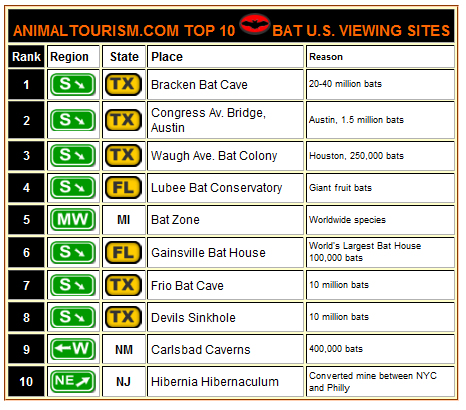
Top 10 Places in the U.S. to See Bats

AnimalTourism.com has compiled a list of the best bat-viewing sites around the country. We show you the reason for the ranking: we prefer big bat numbers, close to where people live or exotic bat species. The top 10 has at least one from each region.

Bat-viewing got its start in Austin. The city, along with  Bat Conservation International, transformed seeing bats at night from a nuisance to a major tourist attraction. Austin accidentally built itself a model bat house in the Congress Avenue Bridge and BCI stepped in to show us all how to enjoy the show. Instead of having to tear down a major bridge, Austin celebrates its bats. Mayor Lee Effingel just announced that Austin will now have an annual Night of the Bat celebration in June and he wants the bat to be the city's official animal. Adam West will appear, they're be a screening of a batman movie and BCI will have a live bat show. The great thing about Austin is, you don't even have to go out of your way to see bats; after dusk they're all over.


Texas is definitely bat central, but plenty of places around the country have great bat fly-outs. State and federal parks get in on the action with summertime dusk bat events. White-nosed syndrome has wiped out about a million bats nationwide, according to BCI. The caves in the northeast are hit especially hard, with 90% of the bats in Hibernia, NJ, wiped out, according to NJ.com. But there are still lots of bat attractions in every region of the country.
See the Full Listing of Bat-Viewing Sites Around the Country

Thursday, February 18, 2010

Jaguars, Extinct in US, Found Within 30 Miles of Border

A jaguar has been confirmed living--or at least roaming--within 30 miles of the U.S. border with Mexico. The Cougar Network, which tracks big cat sightings, sent out word that the Sky Island Alliance has two photos of jaguars eight days apart about 90 miles north of where everyone thought they lived in Sonora.

Conservation groups like the Northern Jaguar Project,  have worked for years to bring back the big, spotted cat that once ranged as far north as the Grand Canyon across California, Arizona, New Mexico, Texas, and possibly Louisiana.

The find would be significant because last year the last known U.S. jaguar died under circumstances that increasingly look dodgy. Arizona Fish and Game caught Macho B in a trap they said was for bears or cougars. They tranquilized and collared him. Days later the then-sluggish cat was euthanized. The capture and drugs may have hastened his death. Just last month investigators found that the capture was intentional, a possible felony since the jaguar (Panthera onca) is endangered.

Just last month the Fish and Wildlife service reversed a 2006 decision and determined that the jaguar deserves a critical habitat. Even the known population in the Northern Jaguar Preserve, 135 miles south of the border, is cut off by hundreds of miles from the the main population.

The motion-activated game cameras showed the jaguars from different sides, so no one is sure if it's the same cat, Sergio Avila, an alliance biologist in Tucson, told the Arizona Daily Star. A handful of jaguars have been spotted just over the U.S. border in recent decades. Where the sex was determined, it was always males, probably pioneering out to find new territories.


Carlos Elias, co-owner of El Aribabi ranch where the photos were taken, his wife and biologist Avila exploded with joy when they reviewed the pictures and found the jaguar. They "began hugging and cheering - a celebration of three years working together to preserve the excellent ecological conditions on the property so that species like the jaguar have a place to roam and thrive," the Sky Island Alliance reported.

"Our family has worked hard to restore ecological processes in this land," Elias said. "We hope this gets the attention of government agencies and foundations, so we can establish a sustainable model that protects biodiversity and supports landowners and their families at the same time."
Where to See Big Cats Around the World