We've Moved!

Hi and Welcome to the AnimalTourism.com blog. But we've moved just down the street to this site, animaltourism.com/news. Please comment there.
Showing posts with label AL. Show all posts

Wednesday, May 19, 2010

Will Sea Turtles Be The Big Victims of the Gulf Oil Spill?

Kemp's ridley sea turtle
Kemp's Ridley sea turtle trudges through beach, photo by krembo1
The sea turtles in the Gulf of Mexico may turn out to be the ones in the most trouble from the Deepwater Horizon oil spill. Even though they haven't shown signs of oil, they may be ingesting it.

Dr. Mike Ziccardi, a veterinarian who runs the Oiled Wildlife Care Network and is handling all the non-bird oiled wildlife in the gulf, now says they're getting a high number of dead turtles, 156 so far. Mostly juveniles and mostly the rarest kind, Kemp's Ridley, TampaBay.com reports. The dead sea turtles "are in higher numbers than you would expect," he told Reuters.

No one is sure what killed the turtles. There was Dr. Ziccardi was initially very cautious, noting that turtles just wash up dead this time of year and that they showed no oil. Some blamed shrimpers. OnEarth, the NRDC blog, says that Sea Turtle Restoration Project (STRP) estimates fishermen kill 25,000 sea turtles each year.  And that's way down from a decade ago, before the mandated Turtle Exclusion Device, when 86,000 were wiped out.

Now Dr. Ziccardi he's contemplating something more insidious: that they are injesting the oil but it doesn't show up on the outside. "Marine mammals and sea turtles are much more likely to have less apparent external exposure and greater internal exposure than avian species," he wrote on his blog. Animals that don't show oil can have internal oil damage. Sometimes you can see it in their feces but others have "sub-apparent internal exposure." You can find that by looking for microscopic toxin damage or chemical analysis, he says.

Kemp's Ridley's are critically endangered and only found in the gulf and on the east coast. They're carnivorous bottom-feeders, exactly what you don't want to be in this oil spill. It's the smallest sea turtle, nests during the day and en masse at sites called arribadas. In 1947 42,000 nested in one day near Rancho Nuevo, Mexico. That fell to 5,00, but has climbed up to 7,866 in 2006. They nest at Padre Island, TX, too, but only 127 nests were counted in 2007.

A big set back was a 1979 oil spill in the Gulf of Mexico, the Ixtoc I,  that's a lot like Deepwater Horizon. the Blow Out Preventer failed. The spill was slow moving. Relatively few dead animals were found. Though the direct link was never found, the Times says, the population went way down.

All seven species of sea turtle are either endangered or threatened and five live in the Gulf of Mexico, the Parks Service says. The other big threat to sea turtles is people stealing the eggs and eating the females when they go ashore to lay them. It's mostly outlawed, but just this week Mexican cops caught two guys with 5,800 eggs near Acapulco.  In Denespar, Indonesia, cops confiscated 71 huge, endangered green sea turtles about to be served as food in a stall, the AP reports. The Jakarta Post says they also just caught men smuggling 12,000 turtle eggs in cigarette cartons aboard a ferry.

Looks like we might not have oiled birds being soaped up for camera, but something much slower and grimmer.

Tuesday, May 18, 2010

Your Hair Probably Isn't Going to Clean Up the Oil Spill--and Neither Is Your Dog's or Alpaca's

Hundreds of volunteers are assembling booms at Boom B Qs
Funny thing about all that hair and fur being shorn around the country to great fanfare to sop up the BP gulf oil spill: nobody wants it. Or at least the people actually cleaning up the oil say it isn't as good as the store-bought booms they're using. But that hasn't stopped people from sending it in and reporters from extensively covering the sweet but so far futile gesture.

Last week the official spill Facebook page, Deepwater Horizon Response,  put out this deeply unpopular message:
We are not using hair booms at this time but are using commercially available sorbent boom when possible. In a February 2010 NOAA field test, commercial sorbent boom absorbed more oil and much less water than hair boom. Widespread deployment of hair boom could exacerbate the debris problem. There is adequate supply of ...sorbent boom for now, but we do encourage ideas of alternative solutions by calling (281) 366-5511.
The main group amassing hair, Matter of Trust, does some amazing recycling and has been championing and testing hairmats since at least 2007. The hair, stuffed inside pantyhose, really seems to work. But even they say only the hazmat crews should install and remove the booms. They're taking the rejection graciously, but proceeding full steam ahead:
BP hasn't spent a lot of time thinking about the properties of hair, fur, wool and fleece. And they're a little busy right now.... Matter of Trust is saying officially: "At this time, we are simply providing volunteers the opportunity to make hair boom and stockpile them all along the Gulf Coast, in case BP needs them." We're calling it Plan H (H is for Hair).

But let none of that get in the way of a "local people helping in international crisis" story.

Even the Canadians and horses are getting in on it. Well after the word that booms aren't being used, alpacas are still getting shaved and National Geographic is still doing a story on it. The group collected 10,000 pounds of alpaca hair. Hair is coming from Soho, Petco, and fans of Rachel Maddow. The Miami Herald and  About.com are still pushing haircuts. ZooToo has a how-to story on donating your pet's hair. Some stories have a teeny disclaimer on the end--oh, yeah, this may not work or be used sort of thing.

All of this is a sweet gesture, like donating blood after a catastrophe. It's wonderful to see so many people worried about the turtles, pelicans, dolphins and manatees their hair might help. But is it doing any good?


Where to Go to See Wildlife
Where to Go See Wildlife Down South

RESCUE GROUPS

 PREVIOUS STORIES ON THE DEEPWATER HORIZON SPILL

Thursday, May 13, 2010

The Price of All This Cleaning Up Oiled Wildlife?

BP sign from alvez modified by animaltourism.com
Wildlife rescuers in the gulf are getting so few oiled animals they're starting to worry that the cost per animal seem ridiculous. After Exxon we had reports of "$80,000 otters." If you hear anything about a $300,000 sea gull, be skeptical.

Mike Ziccardi, a veterinarian who runs Oiled Wildlife Care Network, has been offering the most candid and complete news on the wildlife situation on their blog.  He's been bracing for both an onslaught of injured animals and a backlash against the cost of saving them. "This response is likely to be very costly when it is all said and done – especially if compared on a “per-bird” or “per-turtle/mammal” basis (or at least I hope it is, as that will imply low animal numbers)," he writes today.

In Valdez less than 5% of costs went to wildlife care, Ziccardi says. Caring for oiled wildlife is always done on the cheap, staffed by volunteers, who often sleep in their cars. And lord knows you've already heard about Dawn donating its useful soap.


In 1992 James Estes first criticized oiled wildlife rehabilitation efforts as showy and ineffective, pricing the surviving otters at $80,000 each from a total $18 million otter effort. (I'd say that you have to count the dead ones, too--even though that only brings it down to $14,500.) Later he asked "why rehabilitate oiled wildlife"? So you don't hate him, know that Estes, an adjunct professor at UC-Santa Cruz, isn't saying screw you, sea otters. He's saying the money could be better spent trying to prevent spills and shore up vulnerable populations.

In 1999 Dr. David Jessup and Dr. Jonna Mazet argued at the International Oil Spill Conference that the $80,000 figure was wildly inflated and took into account building several extremely remote care facilities from scratch. "The actual cost of collecting and caring for oiled sea otters is about $4,000 to $5,000 and marine birds about $600 to $750 [bargain!]--about one-twentieth the cost often cited from the Exxon Valdez experience," they write.

Replacement cost is another way to value animals (and other kinds of intangible losses). Luckily, the gulf doesn't have those expensive sea otters. But it does have some endangered sea turtles that should be nesting soon and manatees. People would pay a pretty penny for any of those.

But why bother saving them? Because it's the right thing to do. The question itself seems based in the reactionary view that only ecosystems and the environment matter and that it is somehow childish to value the life of an individual animal. Too many people are so afraid of being called anthropomorphic that they rush to something I would call tree-pomorphic, the assumption that other animals have no value beyond their physical properties and contribution to the environment.


Where to Go to See Wildlife
Where to Go See Wildlife Down South


 PREVIOUS STORIES ON THE DEEPWATER HORIZON SPILL

Friday, April 30, 2010

How Will the Gulf's Dead Zone Impact the Oil Spill?

The Deepwater Horizon spill in the Gulf of Mexico may collide with an area already bedeviled by environmental catastrophe, the infamous Dead Zone--an area of essentially no life or oxygen. So what happens when an inexorable oil slick meets and an undead patch of water?

The Gulf's Dead Zone is about 6,000 to 7,000 square miles, one of the biggest in the world, Microbial Life Educational Resources of Carleton College says. It's caused by fertilizer run-off in the Mississippi overfeeding algae. Phytoplankton gobble up the algae--and all the oxygen. Scientists call the areas hypoxia--or low oxygen. They can't support life.

The oil spill so far is smaller, about 1,800 square miles. So far.

Right now the dead zone is west of the Mississippi and the oil spill is east of it. The dead zone is mainly at the bottom, which is littered with phytoplankton carcasses. The oil is on top.

But Nancy N. Rabalais, Ph.D., executive director of Louisiana Universities Marine Consortium thinks they're likely to meet.

"If the winds continue from the southeast as is common this time of year, then the surface manifestation may move to the west of the Mississippi River delta and become a surface feature of the Louisiana area of hypoxia," says

Some seem to have fantasized that the oil burn off will end up cleaning up the dead zone. Not so, says Rabalais. "The burn would reduce the more volatile and toxic components," [in the oil] she says, but not burn off the algae.

The algae isn't going to slow the oil down, she says, but the oil may slow down the production of algae:

"The movement of the oil would not be affected by where the area of low oxygen may be. Algal production if the oil were to come into the low oxygen would probably be reduced in productivity because of the proximity of the oil."


The dead zone won't necessarily have cleared out the wildlife; it's too soon to tell, she says. While the dead zone is indeed dead to most sea life like plants and fish, birds and marine mammals pass through: "The area of low oxygen does not affect birds and marine mammals because they are air breathers and the marine mammals and turtles can reach the surface of the water for atmospheric air."

The impact she expects is the oil will calm that waters of the dead zone. There will be less oxygen transfer from surface air into surface waters. The waters will stratify. The oil would cut back on the production of phytoplankton at the surface. And the oil and dead zone could pinch in on organisms caught between the top and bottom.


Perhaps the biggest impact is that the oil spill may decimate the wetlands--the wetlands the government had been building up in hopes of filtering water of fertilizers to short-circuit the dead zone. So much for that.

Wednesday, April 28, 2010

Pelicans, Otters, Manatees Could be Hurt by Deepwater Horizon Oil Spill

Deepwater Horizon oil spill seen from space over LA
Imagery courtesy of NASA Earth Observatory
Endangered sea turtles, herons, white and brown pelicans, dolphins, whales, manatees, tuna and assorted sea birds  could all be hurt by the Gulf of Mexico oil spill that is now 16 miles off the tip of Louisiana and alarming wildlife officials all the way to Florida.

The Coast Guard is burning the oil, hoping that will keep it from making landfall and destroying wetlands. I wonder if, ironically, the giant dead zone in the gulf may mean that the area the oil spill hits may be devoid of life anyway. The next step for wildlife rescuers would be to herd animals out of the area by hazing them.
 
The International Bird Rescue Research Center in Texas says they've been put on alert for the decapitated oil well, which is gushing about 1,000 barrels (42,000 US gallons) of crude daily and already can be seen from space, with a circumference of 600 miles.
If the spill stays offshore then the impact will likely be minimal to birds. Coastal birds that are highly at risk if the spill hits shore are brown and white pelicans, terns, gulls, shorebirds, skimmers and herons. Nesting and feeding areas for birds and sea turtles such as marshes and beaches could be impacted.
Loggerhead and Kemp's Ridley turtles are in the area, Live Science says. Birds are vulnerable if they ingest the oil or get coated in it. The oil removes their waterproofing, then they die of cold. In a report on dealing with oil spills, the EPA says mammals that groom themselves with their mouths, like otters, end up eating oil and getting it in their eyes. Sea otters don't live there; river otters do. No one really knows how to help marine mammals stuck in oil, they say.
Procedures for capturing, treating, and releasing animals may hurt them more than the oil does. For example, manatees are particularly susceptible to secondary fungal and bacterial infections following capture or transportation. 
Whales, dolphins, seals and manatees end up breathing hydrocarbon vapors that hurt their lungs, getting it in their eyes and nursing young eat it. Manatees summer as far west as Texas (but that's rare); a few regularly visit Mobile, AL. The biggest danger to manatees, which spend the summer as far west as Texas, may be getting hit by boats responding to the disaster.

So far the Tampa Tribune reports that the Florida Fish and Wildlife Conservation Commission hasn't found any oiled birds, but they are doing necropsies (animal autopsies) on 15 migratory birds found dead Tuesday in the Pass-a-Grille area of St. Pete Beach.


In Alabama, the Dauphin Island Sea Lab is sending boats out to test the waters and "trying to re-establish oiled bird emergency response plans that have not been exercised for many years." They fear it could be the worst Gulf oil spill ever. Coast Guard Rear Adm. Mary Landry goes even further: "If we don't secure this well, this could be one of the most significant oil spills in U.S. history."

Where the oil spill is on 4/28
Where to Go to See Animals Down South

Saturday, January 16, 2010

South Enjoys Cold Spell's Bird Bonanza; Northern Birders Screwed

Winter bird and wildlife watching leans heavily on cold pushing animals into places they can eat or just keep warm. Eagles fly south to find unfrozen rivers. Manatees (and sometimes turtles) huddle around hot springs and power plants. This super harsh weather, then, is especially bountiful for wildlife watchers--as long as you're in an area just warm enough. That's why the south, despite cold weather, is having a great season for wildlife watching while northerners have to bear trifling numbers of animals.

The eagle-watching festivals going on around the country illustrate the trend. Anthony Lawrence, director of recreation at Kentucky Dam State Resort Park says the trees are practically dripping eagles. "They're landing two by two on the ice and basically ice fishing, which you never see," he says. Same deal over in Alabama. Patti Donnelan, naturalist at Lake Guntersville, says all the known nests are active. "It seem to be a good year," she says. Up north, it's a bit slower. They've seen fewer birds this year in Keokuk, Iowa. (Though, as the midwest's biggest concentration, they've got hundreds to spare.)

But it goes beyond eagles. Up in Canada the scarcity of birds showed up in the Christmas Bird Count. ""I had a total of 14 individual birds," one biologist told the CBC. "Normally I'd have a couple of thousand of birds by that time." Birders around Ottawa also blamed a cyclical lack of seeds.

So many factors go into how many birds are found in counts, it's hard to just blame a cold spell. Anecdotally, though, Tampa saw a big bird count. Loss of habitat pushed down migratory bird numbers on the east coast 12-18%. since the '60s. And around the world birders from India to Holland to Cornwall are contemplating  the impact of climate change on bird appearances. Birds have adjusted their migration to warmer weather, but these freak cold snaps keep them on the move.

Where to See Animals Down South

Friday, January 08, 2010

20 States Host Bald Eagle Festivals; Six This Weekend. Is There A Bald Eagle Near You?

In January and February rivers freeze and bald eagles have to come down from Canada to visit us. To capitalize on the event, Audubon clubs and parks around the country hold Bald Eagle Days or Festivals to give people a chance to see our national bird in places they haven't been seen in generations. Within a couple hours of New York, Boston, Chicago and Dallas, you can see eagles.

Twenty states have bald eagle festivals, although two have cancelled this year because of the recession. The Upper Skagit Eagle Festival in WA and the CT Eagle Festival won't be held this year. The eagles still show up, you just don't get the luxury treatment, which usually entails scopes and hot chocolate. CT Audubon even still has $40 boat tours.

Current Eagle Festivals: AL, AK, AR, CO, ID, IL, IN, IA, KY, MD, NJ, NY, OK, PA, TN, TX, UT and WI


We've got six bald eagle events this weekend. We don't just have a national bald eagle day because they show up at different times around the country. The peak for eagle days is the first weekend in February, with 11 states having eagle-watching events.

See the 2010 Calendar of Eagle Events
Where to See Eagles Yearound

Tuesday, September 22, 2009

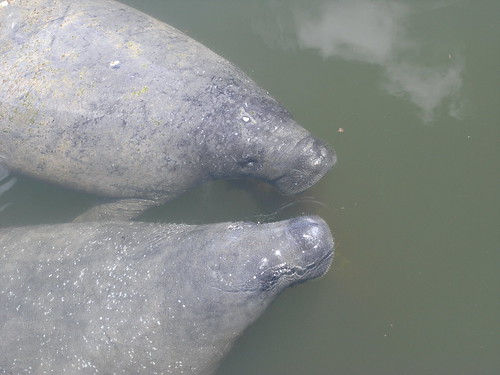
Manatees Making a Home in Mobile Bay, Alabama

We tend to think of manatees as living only in Florida and just barely hanging on there, but some exciting new research show they may be spreading to nearby Gulf states. Dr. Ruth Carmichael, senior marine scientist at the Dauphin Island Sea Lab near Mobile, AL, just tagged Alabama's first officicial manatee resident. You can call the half-ton female "Bama."

The big question is whether the endangered West Indian Manatee has been here all along, unbeknownst to people, or whether they're expanding their range. Are people seeing more manatees because they're looking? Nobody knows..  In 2007 Carmichael started the Mobile Manatees Sighting Network, which gives people a one-stop shop to call or email anytime they see a manatee. In just the first year people reported as many sightings as they had over the previous 30 years.

Carmichael hears from two types of people who live or work near the water. One has never seen them and doesn't believe they're there. The other tells her, "'yeah, my kids have been swimming with them for 30 years.'" She then tries to gently convince them not to play with the manatees. Or give them the fresh water they crave. Since the manatee's biggest enemy is boat propellers, if you teach them that it's fun or profitable to hang around people, they have a greater chance of getting hurt. And technically, if you change an endangered species' behavior, it's a federal offense. Carmichael doesn't want to play cop, but would love it if people stayed back 100 feet. "Don’t touch them, don’t water them," she says. "and for God's sake, don’t feed them."

Biologists already figured out that most of the manatees are just summering in Alabama, not moving here full-time. In 2007 they sent a clear picture of a manatee to Florida wildlife officials, who figured out from her boat scars that it was Ellie, a 30-year-old manatee who hangs around Crystal River, FL, 350 miles away and 60 miles north of Tampa. This year Carmichael managed to tag Ellie, so she'll be able to figure out where and when she migrates.

Last winter at least three manatees tried to stay over, but the bay had an early, brutal cold snap. Two died in the cold and one survived by hanging out by the warmth of a water treatment plant. The manatees here might even be coming from Mexico, not Florida, Carmichael says. There is a handy map of where they've been seen around Mobile Bay and in Mississippi  if you want to help do some spotting. (Looks like the Theodore Shipping Channel near Deer River, Meaher State Park and Terry Cove near Orange Beach.)

Carmichael estimates up to 20 manatees may be spending time in the busy, industrial bay. That's less than 1% of the U.S. population, which is thought to be about 3,000-4,000. The last time the Fish and Wildlife Service took stock of manatees in 2007, they figured the numbers were slightly up, at least in some regions. Only about 377 or 11% live in the northwest where Ellie lives, but their numbers have been growing since the 1960s; between 1986 to 2000, the population grew an estimated 4%. (The 44% of the population on the Atlantic coast grew 3.7% while the 41% in the southwest were down 1.1% just from 1995 to 2000.)


Bonus animals in the area: alligators, shorebirds and horseshoe crabs
Want to see more animals in the South?
Where are there more unusual animals like manatees?


 Photo courtesy of AngelShark