We've Moved!

Hi and Welcome to the AnimalTourism.com blog. But we've moved just down the street to this site, animaltourism.com/news. Please comment there.
Showing posts with label otter. Show all posts

Thursday, May 13, 2010

The Price of All This Cleaning Up Oiled Wildlife?

BP sign from alvez modified by animaltourism.com
Wildlife rescuers in the gulf are getting so few oiled animals they're starting to worry that the cost per animal seem ridiculous. After Exxon we had reports of "$80,000 otters." If you hear anything about a $300,000 sea gull, be skeptical.

Mike Ziccardi, a veterinarian who runs Oiled Wildlife Care Network, has been offering the most candid and complete news on the wildlife situation on their blog.  He's been bracing for both an onslaught of injured animals and a backlash against the cost of saving them. "This response is likely to be very costly when it is all said and done – especially if compared on a “per-bird” or “per-turtle/mammal” basis (or at least I hope it is, as that will imply low animal numbers)," he writes today.

In Valdez less than 5% of costs went to wildlife care, Ziccardi says. Caring for oiled wildlife is always done on the cheap, staffed by volunteers, who often sleep in their cars. And lord knows you've already heard about Dawn donating its useful soap.


In 1992 James Estes first criticized oiled wildlife rehabilitation efforts as showy and ineffective, pricing the surviving otters at $80,000 each from a total $18 million otter effort. (I'd say that you have to count the dead ones, too--even though that only brings it down to $14,500.) Later he asked "why rehabilitate oiled wildlife"? So you don't hate him, know that Estes, an adjunct professor at UC-Santa Cruz, isn't saying screw you, sea otters. He's saying the money could be better spent trying to prevent spills and shore up vulnerable populations.

In 1999 Dr. David Jessup and Dr. Jonna Mazet argued at the International Oil Spill Conference that the $80,000 figure was wildly inflated and took into account building several extremely remote care facilities from scratch. "The actual cost of collecting and caring for oiled sea otters is about $4,000 to $5,000 and marine birds about $600 to $750 [bargain!]--about one-twentieth the cost often cited from the Exxon Valdez experience," they write.

Replacement cost is another way to value animals (and other kinds of intangible losses). Luckily, the gulf doesn't have those expensive sea otters. But it does have some endangered sea turtles that should be nesting soon and manatees. People would pay a pretty penny for any of those.

But why bother saving them? Because it's the right thing to do. The question itself seems based in the reactionary view that only ecosystems and the environment matter and that it is somehow childish to value the life of an individual animal. Too many people are so afraid of being called anthropomorphic that they rush to something I would call tree-pomorphic, the assumption that other animals have no value beyond their physical properties and contribution to the environment.


Where to Go to See Wildlife
Where to Go See Wildlife Down South


 PREVIOUS STORIES ON THE DEEPWATER HORIZON SPILL

Friday, May 07, 2010

Valdez: A Comparison for Wildlife

How does the Deepwater Horizon oil spill compare to the historical monster of Exxon Valdez, by which we judge all oil disasters? How long will this go on?


We went back to the records of Valdez to look at its size and what we might lay ahead.

  •  In the Valdez spill Scientific American reports that 2,000 sea otters, 302 harbor seals and about 250,000 seabirds died in the first few days. So far we have only 2 birds in care that I know of.
  •  Rescuers retrieved a total of 36,471 carcasses and captured 1,630 live birds, the IBRRC reports.
  • The Valdez spill was March 24, 1989. The last wildlife rehab center closed September 6 of that year. The Deepwater Horizon spill was on April 22, 2009. By that measure, rehabbers will be on the scene until early October.
  • By the 10th day of the Valdez oil spill, rescuers were finding 180 oiled birds per square mile, the Coast Guard reported.
  • The oil spread so far in Prince William Sound that rescuers had to set up four wildlife care centers. They've already set up three down south. There are Oiled Bird Rescue Centers in Fort Jackson, Louisiana, Theodore, Alabama and Pensacola, Florida.
  • How long will it take the wildlife to recover? Here's the really scary part. They're still digging up oil in Valdez and some species are still recovering.


Where to Go to See Wildlife
Where to Go See Wildlife Down South

RESCUE GROUPS

 PREVIOUS STORIES ON THE DEEPWATER HORIZON SPILL
 

Wednesday, April 28, 2010

Pelicans, Otters, Manatees Could be Hurt by Deepwater Horizon Oil Spill

Deepwater Horizon oil spill seen from space over LA
Imagery courtesy of NASA Earth Observatory
Endangered sea turtles, herons, white and brown pelicans, dolphins, whales, manatees, tuna and assorted sea birds  could all be hurt by the Gulf of Mexico oil spill that is now 16 miles off the tip of Louisiana and alarming wildlife officials all the way to Florida.

The Coast Guard is burning the oil, hoping that will keep it from making landfall and destroying wetlands. I wonder if, ironically, the giant dead zone in the gulf may mean that the area the oil spill hits may be devoid of life anyway. The next step for wildlife rescuers would be to herd animals out of the area by hazing them.
 
The International Bird Rescue Research Center in Texas says they've been put on alert for the decapitated oil well, which is gushing about 1,000 barrels (42,000 US gallons) of crude daily and already can be seen from space, with a circumference of 600 miles.
If the spill stays offshore then the impact will likely be minimal to birds. Coastal birds that are highly at risk if the spill hits shore are brown and white pelicans, terns, gulls, shorebirds, skimmers and herons. Nesting and feeding areas for birds and sea turtles such as marshes and beaches could be impacted.
Loggerhead and Kemp's Ridley turtles are in the area, Live Science says. Birds are vulnerable if they ingest the oil or get coated in it. The oil removes their waterproofing, then they die of cold. In a report on dealing with oil spills, the EPA says mammals that groom themselves with their mouths, like otters, end up eating oil and getting it in their eyes. Sea otters don't live there; river otters do. No one really knows how to help marine mammals stuck in oil, they say.
Procedures for capturing, treating, and releasing animals may hurt them more than the oil does. For example, manatees are particularly susceptible to secondary fungal and bacterial infections following capture or transportation. 
Whales, dolphins, seals and manatees end up breathing hydrocarbon vapors that hurt their lungs, getting it in their eyes and nursing young eat it. Manatees summer as far west as Texas (but that's rare); a few regularly visit Mobile, AL. The biggest danger to manatees, which spend the summer as far west as Texas, may be getting hit by boats responding to the disaster.

So far the Tampa Tribune reports that the Florida Fish and Wildlife Conservation Commission hasn't found any oiled birds, but they are doing necropsies (animal autopsies) on 15 migratory birds found dead Tuesday in the Pass-a-Grille area of St. Pete Beach.


In Alabama, the Dauphin Island Sea Lab is sending boats out to test the waters and "trying to re-establish oiled bird emergency response plans that have not been exercised for many years." They fear it could be the worst Gulf oil spill ever. Coast Guard Rear Adm. Mary Landry goes even further: "If we don't secure this well, this could be one of the most significant oil spills in U.S. history."

Where the oil spill is on 4/28
Where to Go to See Animals Down South

Saturday, April 03, 2010

Can We Call Animals Gay? How About This Otter Couple?

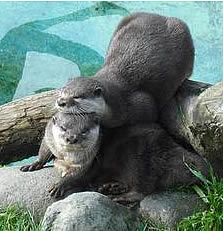
Daz and Chip, gay otters
Two male New Zealand otters who spent 15 affectionate years together at the Natureland Zoo died within an hour of each other this week. The treatment of their story is exactly what The New York Times Magazine story "Can Animals Be Gay?" out tomorrow is about. Biologists are realizing that many animal pairings are same-sex but the debate over whether to consider the animals gay has become more political than scientific.

The Times writer Jon Mooallen whimsically describes it this way:  "It may seem surprising that scientists sometimes don’t know the true sexes of the animals they spend their careers studying — that they can be tripped up in some 'Tootsie' -like farce for so long."

With Asian otters Daz and Chip, everyone knew they were male and bonded. The circumstances of their death just solidified their coupledom. When an animal pair dies so closely--like my dog Jolly did after he lost his girlfriend Shadow--how can you not acknowledge their complex emotional life? "The bottom line is that when one of them had a heart attack, it just set the other one off and he followed through," a zoo spokesman told the New Zealand Herald.

The Times story mainly follows albatrosses, who have a lot of two-mommy households, but the phenomena spans the animal kingdom. A two-mommy, one-daddy family of another albatross species in New Zealand's Taiaroa Head got lots of attention because of the gay-friendly tourist board, Mooallen says.

So back to our New Zealand gay otters.

Daz, 19, and Chip, 16, are described by their caretaker "busy, growly, bitey," but noticeably not gay in the New Zealand Herald. There were part of the zoo's captive breeding program, but the zoo is mum on their contribution. Presumably they made some contribution--willing or not--or they wouldn't have been kept in it for 15 years.

The Daily Mail describes the pair as "best friends [that] lived side-by-side for 15 years."

A local New Zealand station calls them "best friends" that were "always together," but also uses the gay couple codeword "longtime companion."

Everyone does assume Daz and Chip were a gay couple. Their story was memorialized in The Advocate and spread through twitterdom that way.

It is touching to see that these major media outlets now running an animal love story. I'm so tired of hearing people accuse themselves and others of anthropomorphism. What would be the opposite? Rockpomorphism? Treepromorphism? Why is it okay to presume that animals have no emotions or intent? We've gotten to the point at least where we accept what the handlers saw: one otter died after its "longtime companion." Now can we accept that it was its mate?


Where to go to see animals near you--gay or straight