We've Moved!

Hi and Welcome to the AnimalTourism.com blog. But we've moved just down the street to this site, animaltourism.com/news. Please comment there.
Showing posts with label new zealand. Show all posts

Saturday, April 03, 2010

Can We Call Animals Gay? How About This Otter Couple?

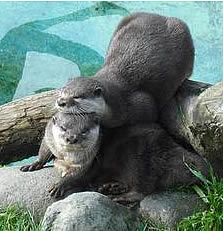
Daz and Chip, gay otters
Two male New Zealand otters who spent 15 affectionate years together at the Natureland Zoo died within an hour of each other this week. The treatment of their story is exactly what The New York Times Magazine story "Can Animals Be Gay?" out tomorrow is about. Biologists are realizing that many animal pairings are same-sex but the debate over whether to consider the animals gay has become more political than scientific.

The Times writer Jon Mooallen whimsically describes it this way:  "It may seem surprising that scientists sometimes don’t know the true sexes of the animals they spend their careers studying — that they can be tripped up in some 'Tootsie' -like farce for so long."

With Asian otters Daz and Chip, everyone knew they were male and bonded. The circumstances of their death just solidified their coupledom. When an animal pair dies so closely--like my dog Jolly did after he lost his girlfriend Shadow--how can you not acknowledge their complex emotional life? "The bottom line is that when one of them had a heart attack, it just set the other one off and he followed through," a zoo spokesman told the New Zealand Herald.

The Times story mainly follows albatrosses, who have a lot of two-mommy households, but the phenomena spans the animal kingdom. A two-mommy, one-daddy family of another albatross species in New Zealand's Taiaroa Head got lots of attention because of the gay-friendly tourist board, Mooallen says.

So back to our New Zealand gay otters.

Daz, 19, and Chip, 16, are described by their caretaker "busy, growly, bitey," but noticeably not gay in the New Zealand Herald. There were part of the zoo's captive breeding program, but the zoo is mum on their contribution. Presumably they made some contribution--willing or not--or they wouldn't have been kept in it for 15 years.

The Daily Mail describes the pair as "best friends [that] lived side-by-side for 15 years."

A local New Zealand station calls them "best friends" that were "always together," but also uses the gay couple codeword "longtime companion."

Everyone does assume Daz and Chip were a gay couple. Their story was memorialized in The Advocate and spread through twitterdom that way.

It is touching to see that these major media outlets now running an animal love story. I'm so tired of hearing people accuse themselves and others of anthropomorphism. What would be the opposite? Rockpomorphism? Treepromorphism? Why is it okay to presume that animals have no emotions or intent? We've gotten to the point at least where we accept what the handlers saw: one otter died after its "longtime companion." Now can we accept that it was its mate?


Where to go to see animals near you--gay or straight

Monday, July 27, 2009

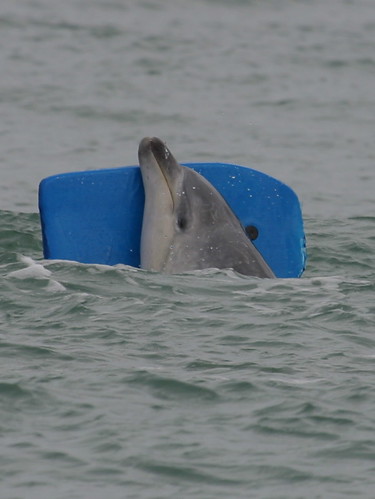
Moko, the Lonely New Zealand Dolphin Who Loved Too Much

Photo of Moko earlier this year courtesy of Chris & Lara Pawluk
Moko, a bottlenose dolphin who lives off Mahia Beach, New Zealand, is famous for being friendly to people in the water. But Sunday, she nearly loved a visitor to death. "We were playing around for a while but then when I wanted to go back in, he just wanted to keep playing. I became exhausted and started to panic," the woman told the BBC. When she screamed, a local bar owner came out in a dinghy to rescue her.

Moko is what's known as a "lone dolphin," a rare but well-documented kind of dolphin that seems to want to hang out with people. Since it's winter in New Zealand now, speculation is that she just got lonely because there aren't as many people in the water.

The standard criticism of people swimming with wild dolphins is that dolphins get annoyed or injured. But, even Project Jonah chief executive Kimberly Muncaster, who has warned people to keep their distance from the chummy 3-year-old dolphin, acknowledged that Moko actively seeks out people's attention. "Moko has undoubtedly captured the hearts of Kiwis, but she is in danger of getting hurt if she isn't treated with respect, and those seeking to get close to her are also putting themselves at risk," Muncaster warned last year.

The woman, who was too embarrassed to give her name, says Moko wasn't trying to hurt her. "I've spent quite a bit of time swimming with Moko and I'm a strong swimmer so I wasn't worried at first," she said.

Moko has been hanging around Mahia Beach for about a year and half, dragging in tourists--whiles sometimes dragging buoys out to sea for sport. "She follows boats in and out of the bay and plays havoc with my cray pots. She bunts the buoys and drags the pots together, tangling them," says Mahia local Bill Shortt. Moko also gives people presents of fish. She gained worldwide fame for saving two pygmy sperm whales.

Marine Biologist Ingrid Visser says Moko has scars from a boat propeller and fish hook and that has been the demise of many other "lone dolphins." “In some areas of the world these ‘lone’ dolphins have inhabited the area for many years," he told the Gisborne Herald. "However, it is sad to note that of the nearly 30 individual ‘lone’ dolphins which have been well documented from around the world, at least 14 have been injured or even killed as a result of interacting closely with humans."

Seems like Moko would stand a better chance against boats and fishing lines in the harbor she knows so well. I hope this incident gets more people to spend some time with her so she doesn't get lonely. It seems like a wonderful animal tourism opportunity: come see Moko, the friendly dolphin, in the low season, when she really, really wants your company.

Want to see a dolphin yourself? Here's a map I'm putting together of some (mostly US) places?
Got a suggestion for another one? Send it here.