
Think that smiling dolphin is happy to see you? Think again. If you're looking at brochures for Florida's hundreds of dolphin tours, you and the dolphin may be better off if don't fall for the smiley dolphin tour ads. That familiar pose is really a dolphin begging for food--something wild dolphins shouldn't do, says Jessica R. Powell, biologist from the National Marine Fisheries Service.
"It's a very unnatural behavior," says Powell. "You never see a wild dolphin doing this unless it's fed or conditioned to people. It's actually an indication of a number of problems" with how people are treating that dolphin.
That's why the Fisheries Service voluntary guidelines for tours, Dolphin Smart, bans the begging dolphin grin pictures in ads--along with anything else that gives you the idea you're going to be hanging out with some wild dolphins that will be thrilled to make your acquaintance. The program's main thrust is about not disturbing the dolphins. Operators go through training, learning keep respectful 50 yards from dolphins, learn signs that they're getting annoyed with you (they may "chuff"--a kind of angry dolphin huff--for example) and put their engines in neutral when a dolphin approaches. Plus, they have to teach the public about dolphins.
But teaching tourists dolphin etiquitte is a hard in market where hundreds of tours compete for tourists. Powell recently counted 107 outfits doing tours just on the west coast of Florida from Tampa south. For 66, dolphins are their primary business. The task isn't made any easier by all the programs to "swim with dolphins."
What tourists may not realize is that the dolphins in pictures smiling, dancing or hauling adults around are captive and trained. And those interactions greatly stress them, behavioral biologist Toni Frohoff has found. Frohoff, director of research at TerraMar Research and Trans-Species Institute of Learning has found that people overestimate their ability to read dolphins.
"An open jaw display might look like a laugh," she writes in Dolphin Mysteries. "but to the trained observer, this conveys agitation or aggression." Plus, they may have been caught in places like Taiji, where dolphins are also slaughtered, as The Cove showed.
Even though the ads are just a small part of the program, they're the biggest reason tour guides say no, Powell says. To display the Dolphin Smart sticker, the tour companies can't show or describe people touching, swimming or communicating with dolphins--or dolphins begging. "Typical dolphin begging behavior generally entails an animal that approaches people in a begging pose, with its head fully out of the water," the guidelines say.
Powell hopes to expand the Dolphin Smart program, which started with four Florida tour groups in the Keys in 2007, to a broader area.Preliminary research shows both the dolphins and the Dolphin Smart tours doing better. Meanwhile, before the program spreads, watch out for that smiling dolphin. It may be a sign that either the operator isn't treating dolphins right or that they're overpromising what you'll see. Either way, something to avoid.
Want to See Dolphins Around the Country?
Where Can You See More Animals in the Southeast?
Showing posts with label dolphin watching. Show all posts
Showing posts with label dolphin watching. Show all posts
Friday, October 02, 2009


Monday, July 27, 2009
Moko, the Lonely New Zealand Dolphin Who Loved Too Much
Photo of Moko earlier this year courtesy of Chris & Lara Pawluk
 Moko, a bottlenose dolphin who lives off Mahia Beach, New Zealand, is famous for being friendly to people in the water. But Sunday, she nearly loved a visitor to death. "We were playing around for a while but then when I wanted to go back in, he just wanted to keep playing. I became exhausted and started to panic," the woman told the BBC. When she screamed, a local bar owner came out in a dinghy to rescue her.
Moko is what's known as a "lone dolphin," a rare but well-documented kind of dolphin that seems to want to hang out with people. Since it's winter in New Zealand now, speculation is that she just got lonely because there aren't as many people in the water.
The standard criticism of people swimming with wild dolphins is that dolphins get annoyed or injured. But, even Project Jonah chief executive Kimberly Muncaster, who has warned people to keep their distance from the chummy 3-year-old dolphin, acknowledged that Moko actively seeks out people's attention. "Moko has undoubtedly captured the hearts of Kiwis, but she is in danger of getting hurt if she isn't treated with respect, and those seeking to get close to her are also putting themselves at risk," Muncaster warned last year.
The woman, who was too embarrassed to give her name, says Moko wasn't trying to hurt her. "I've spent quite a bit of time swimming with Moko and I'm a strong swimmer so I wasn't worried at first," she said.
Moko has been hanging around Mahia Beach for about a year and half, dragging in tourists--whiles sometimes dragging buoys out to sea for sport. "She follows boats in and out of the bay and plays havoc with my cray pots. She bunts the buoys and drags the pots together, tangling them," says Mahia local Bill Shortt. Moko also gives people presents of fish. She gained worldwide fame for saving two pygmy sperm whales.
Marine Biologist Ingrid Visser says Moko has scars from a boat propeller and fish hook and that has been the demise of many other "lone dolphins." “In some areas of the world these ‘lone’ dolphins have inhabited the area for many years," he told the Gisborne Herald. "However, it is sad to note that of the nearly 30 individual ‘lone’ dolphins which have been well documented from around the world, at least 14 have been injured or even killed as a result of interacting closely with humans."
Seems like Moko would stand a better chance against boats and fishing lines in the harbor she knows so well. I hope this incident gets more people to spend some time with her so she doesn't get lonely. It seems like a wonderful animal tourism opportunity: come see Moko, the friendly dolphin, in the low season, when she really, really wants your company.
Want to see a dolphin yourself? Here's a map I'm putting together of some (mostly US) places?
Got a suggestion for another one? Send it here.
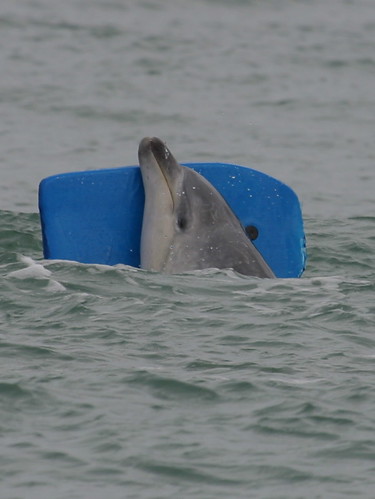 Moko, a bottlenose dolphin who lives off Mahia Beach, New Zealand, is famous for being friendly to people in the water. But Sunday, she nearly loved a visitor to death. "We were playing around for a while but then when I wanted to go back in, he just wanted to keep playing. I became exhausted and started to panic," the woman told the BBC. When she screamed, a local bar owner came out in a dinghy to rescue her.
Moko is what's known as a "lone dolphin," a rare but well-documented kind of dolphin that seems to want to hang out with people. Since it's winter in New Zealand now, speculation is that she just got lonely because there aren't as many people in the water.
The standard criticism of people swimming with wild dolphins is that dolphins get annoyed or injured. But, even Project Jonah chief executive Kimberly Muncaster, who has warned people to keep their distance from the chummy 3-year-old dolphin, acknowledged that Moko actively seeks out people's attention. "Moko has undoubtedly captured the hearts of Kiwis, but she is in danger of getting hurt if she isn't treated with respect, and those seeking to get close to her are also putting themselves at risk," Muncaster warned last year.
The woman, who was too embarrassed to give her name, says Moko wasn't trying to hurt her. "I've spent quite a bit of time swimming with Moko and I'm a strong swimmer so I wasn't worried at first," she said.
Moko has been hanging around Mahia Beach for about a year and half, dragging in tourists--whiles sometimes dragging buoys out to sea for sport. "She follows boats in and out of the bay and plays havoc with my cray pots. She bunts the buoys and drags the pots together, tangling them," says Mahia local Bill Shortt. Moko also gives people presents of fish. She gained worldwide fame for saving two pygmy sperm whales.
Marine Biologist Ingrid Visser says Moko has scars from a boat propeller and fish hook and that has been the demise of many other "lone dolphins." “In some areas of the world these ‘lone’ dolphins have inhabited the area for many years," he told the Gisborne Herald. "However, it is sad to note that of the nearly 30 individual ‘lone’ dolphins which have been well documented from around the world, at least 14 have been injured or even killed as a result of interacting closely with humans."
Seems like Moko would stand a better chance against boats and fishing lines in the harbor she knows so well. I hope this incident gets more people to spend some time with her so she doesn't get lonely. It seems like a wonderful animal tourism opportunity: come see Moko, the friendly dolphin, in the low season, when she really, really wants your company.
Want to see a dolphin yourself? Here's a map I'm putting together of some (mostly US) places?
Got a suggestion for another one? Send it here.
Subscribe to:
Posts (Atom)
