Showing posts with label boston. Show all posts
Thursday, February 04, 2010
Harp Seal Stuck On Cliff Near Salem, MA, Rescued
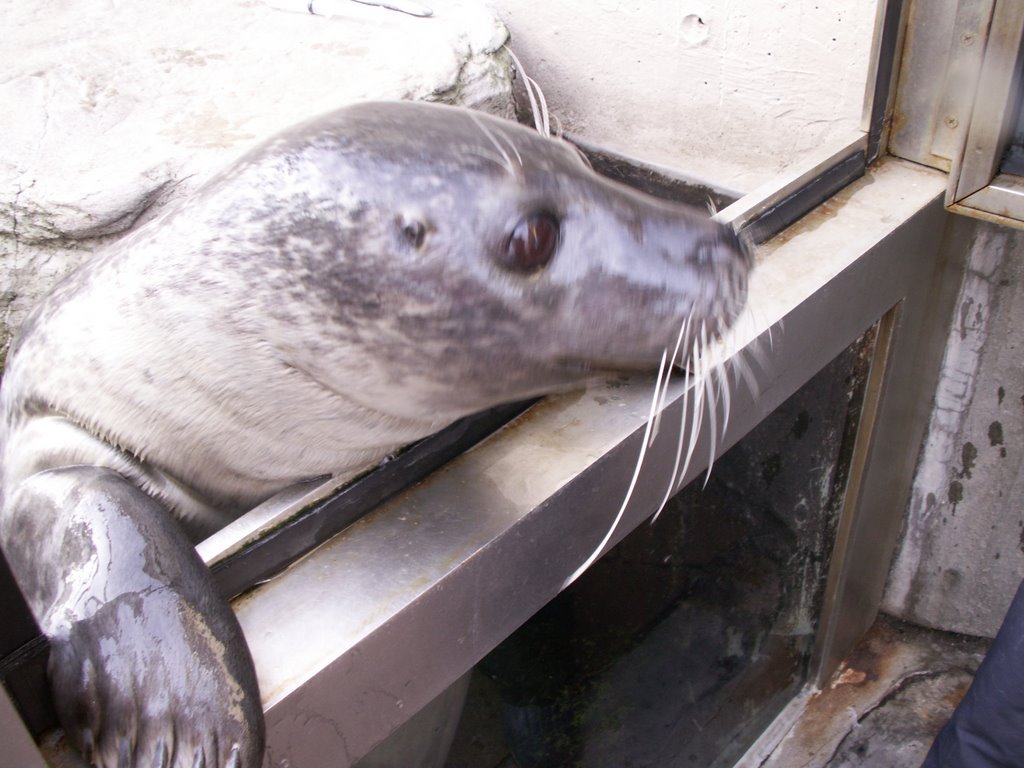
The New England Aquarium Marine Animal Rescue Team and an alert seal-loving Beverly, MA, woman saved a harp seal who got stuck in the crevice of a cliff Monday. The 50-pound, yearling female seal got stuck between rocks 20 feet above the water by the full moon high tide. Rescuers extricated the seal, who has gray mottled fur, from the rocks, checked her out and released her into Salem Sound.
The seal was first seen on the cliff Sunday by neighbor Katie Duffy. Like many people, Duffy was worried seeing a seal out of water. She called rescuers who could thought the seal was doing fine. The seal population in the U.S. seems to be on the rise, leading to seals showing up in unusual places or high numbers. Just days ago the aquarium was checking out a seal who decided to visit downtown Boston.
The next day, however, the seal has gotten herself stuck in a tiny 2-foot deep trench. Duffey again called rescuers, who came out to find the seal "in significant distress with labored breathing," according to the Aquarium. "They were initially not optimistic about the seal’s prospects." Aquarium staff Adam Kennedy and Ulrika Malone threw a blanket over her. She froze in fear and they were able to push her into a crate. When they finally got to examine her, they found she was fine. She just had some scratches.
So they carried her crate down to a beach. At first she was still too scared to move, but she got the idea and swam out while all her rescuers looked on happily.
Friday, September 11, 2009
An Easier Way to Find a Good Whale Watch on the East Coast?
Picking out a whale-friendly East Coast whale watch just got a little easier. NOAA and the Whale and Dolphin Conservation Society just started Whale Sense, a voluntary program to ensure tours from Virginia to Maine don't bother whales.The rules are complicated--more than just stay back 100 feet, though that is the basic distance. (If the whale approaches you, stay put. If it's a right whale, back off 1,500 feet.) What I found more amusing were the rules against advertising showing whale watchers touching, swimming with or even chasing the whales. Is Jerry Bruckheimer running a watch somewhere?
So far the group has signed up five companies, mainly in Massachusetts. I count at least 30 tour companies from Virginia to Maine, with 18 going to Stellwagen Bank--not included the odd charters that line the whole coast. So what about the ones not on the list?
Even Frank Kelley, operations manager for Mass Bay Lines (listed) says that right now the program is so new that you can't judge an operation for not participating. Lots of the tours work with other whale groups. For example, Bar Harbor Whale Watch Company is tied to Allied Whale. The New England Aquarium's whale watch, which I just went on, isn't part of the program yet (they're still examining the details), says spokesman Tony LaCasse. But since they already do most of it and they helped push voluntary standards decades ago, they'll probably be part of it.
When you're out on Stellwagen it's not the commercial whale watching boats you see encroaching on whales, but the tiny recreational fishing boats. Kelley says many tour operators worry that the small boats don't understand the protocols (which is elaborate when it comes to many boats wanting to see the same whales). NEAQ's LaCasses says that personally he'd like to see an enforcement presence on the water--like the Coast Guard is for boating regulations.
When I talked with marine mammal expert Toni Frohoff (she's a behavioral biologist and research director at TerraMar Research) she mentioned that generally it's better to have one big boat in the water around a whale instead of a bunch of little ones. At first that seems counterintuitive; we normally don't think of going out in a big, hulking, Hummer of a boat as being eco-friendly. But that's what it is, at least to the whales.
The tricky thing for whale watchers is picking tours that won't annoy--or hit--the whales. In Puget Sound tour boats are known to crowd the orcas, which could interfere with their eating or mating. I haven't seen that on the vast waters East Coast boats troll.
Consumers can't easily tell from an ad or website that attitude of operation. (Well, ok, I am a little skeptical when I read "Imagine the sight of dolphins dancing and frolicking right alongside The Silver Bullet. See whales surfacing and breaching...[from a] shiny, brand new 70 ft. long ocean going projectile." But most whale watches at least claim to be whale-friendly. But is that like a processed cereal labeled as organic? I hope the Whale Sense program grows and offers up an easy way for wildlife watchers to pick the responsible tours.
- Here's Where You Can Go Whale-Watching
- Want to See More Animals in the Northeast? Click Here.
Labels:
boston,
dolphin,
east coast,
humpback,
me,
new england,
NH,
NOAA,
orca,
rules,
stelllwagen,
tourism,
va,
whale,
whale watching,
wildlife watching
Wednesday, September 09, 2009
Boston Won't Make Way For Geese
Boston loves to show off its sweet, staring role in Make Way for Ducklings, the children's book that culminates in cops helping ducks across the street. They've got duckling statues, duckling contests and it is seemingly mandatory to display the book in stores. Yet the city isn't helping its non-fiction waterfowl. For nearly three decades a flock of white and gray geese have lived on the Charles River near Boston University, but their advocates say a renovation plan is pushing them out."They insist they have this beautiful park but they have no use for free animals," says Robert J. La Trémouille, a blogger who is one of the Friends of the White Geese, which is kind of the like the geese's political lobbying arm. This flock of 60-80 White China, Emden, and Toulouse geese have lots of friends and fans. La Trémouille says Bostonians have visited geese--a rare survivor on the polluted Charles--since at least 1981, when a plant got "guard geese." But some say the geese go back 60 years.

Another group, the Charles River Urban Wilds Initiative, concern themselves with the geese's day-t0-day care. Many, like Boston University writing lecturer Allison Blyer, take it on themselves to deliver healthy food (veggies, duck food) and occasional medical care. They notice individual characters and quirks. The current leader, Buddy, is about 20 years old. Pinky, pictured above, is known as a real character, sayd Blyer: "He is very bonded to us and likes to peck cameras. He also loves tomatoes, parsley, apples, saltines, and his mate, Blue." Many more casually stop by with kids--especially in gosling season--and offer leftovers.
But meanwhile, Trémouille says, those who want to keep the river area sterile put oil on the geese's eggs. (Though some say they are only target the more invasive Canada goose.) The state's Dept. of Conservation and Recreation has dug up their nesting area, put a plastic barrier by Magazine Beach and redid the area with athletic fields that rely heavily on pesticides instead of the natural landscaping the geese provide, La Trémouille says.
Nearby overly landscaped ballfields have lead to algae blooms, he says. Indeed the EPA notes the river is polluted, mainly from sewers. Some worry about the waste the geese leave behind, but that's nothing compared to the dead zone that will be produced when a power plant starts discharging hot water into the river. The state produced a master plan for the river, including Magazine Beach, which it hopes "to discourage the growth of a flock of feral geese." They want to put up signs discouraging feeding--like the alarmist warnings in Boston Common that conflate feeding birds with a human health crisis.
La Trémouille says he doesn't want to stop the renovation, just let the geese who have lived and delighted people on the Charles for generations be part of it. He hopes people will tell Gov. Deval Patrick, the DCR and local pols to let the geese stay. Doesn't seem that enjoying a flock of unusual geese should be that antithetical to enjoying a park and river.
Tuesday, September 08, 2009
NEAQ Whale Watch: Humpback Bubble Cloud Feeding off Boston?
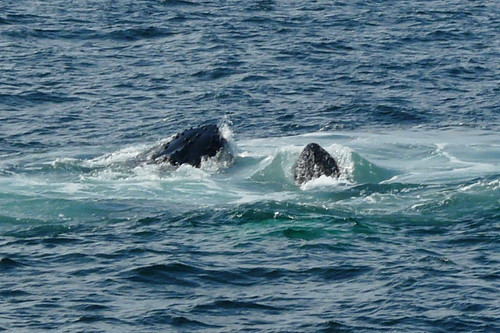
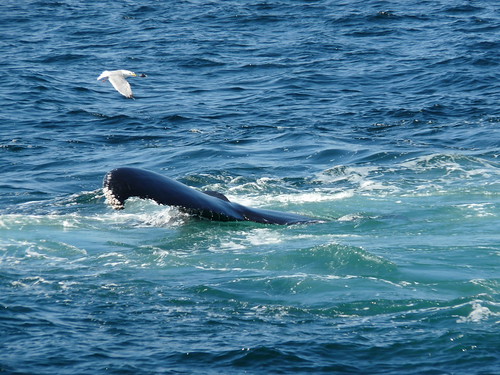
You first know you're going to see this specialized hunting technique when a huge patch of light turquoise water appears. Bubbles surface, then enormous black snouts covered with bumps (technically, tubercules or hair follicles). There's lots of jostling and swirling, then fins and finally a "whale footprint" or eerily smooth patch of sea that, we learned, whalers first thought was leaked whale oil.
I found some discussion online that humpbacks only bubble net feed off Alaska, Antarctica and west of South America. I'm not a whale expert, so I'm not sure if this is any different from what we all saw. But we clearly got to see it a few times. We had at least three whales at it, Echo, a mother; her calf, who stuck close to her; and another whale named Zooney.
The New England Aquarium has the system down to bring whales to the masses: a huge, fast catamaran whisks you an hour off-shore into Stellwagen Bank, a shallow feeding ground and sanctuary. Right from the center of Boston you can spend three hours and $40 and see one of the most active whale-watching sights in the world. Whale-watching tours from Cape Cod, Plymouth, Cape Ann, New Hampshire and Maine all head to Stellwagen. The boat's stable, so only a few get sick. You spend an hour speeding out to sea, an hour
Not in Boston? Here are a ton of great places to see whales.
More places to see animals in the Northeast.
Got suggestions for animal watching places? Tell us.
Labels:
boston,
humpback,
neaq,
northeast,
tour,
whale,
whale watching,
wildlife,
wildlife watching
Tuesday, April 04, 2006
Pay to Play with a Seal Lion in Boston
New England Aquarium, Boston, Play with Marine Mammals

The New England Aquarium lets you play with their sea lions and seals. In the last few years a number of animal rescue groups and traditional aquariums have hit on the idea of, well, basically, pimping out their animals. You pay a little extra and get a little extra contact, how much depends on how much you pay.
The New England Aquarium has two programs. For $30 you can feed seals, but for $125 you get to help feed, entertain and train sea lions, seals and maybe a large turtle.
It's a small group--just three--and the real trainers are incredibly gracious in letting you enjoy the fun part of their job. Still, I felt a little bit idiotic since it was me and two kids. (They say it's about half and half adults to kids. And that often parents bring kids, but it's obviously really for mom or dad.)
We started off with the sea lions, who are soon leaving for Brookfield Zoo in Chicago. We got to see the sea lions' kitchen and warm indoor pool. When we went outside, the sea lions, Guthrie, an 838 pound mush, and Ballou, a younger, smaller and more shy sea lion.

Guthrie watches the crowds and came by as soon as we walked in--assuming it was feeding time. We got to feel his thick wet fur, massive fins. We each put fish in his mouth, which was big but full of worn down, black teeth so not intimidating. Plus the trainers exude comfort and confidence and Guthrie is very gentle and good-natured. He gave us each a kiss--really just pressed his massive whiskered nose to our face. It was like a 30 pound dog nose that left a trail of slime. Still, very fun.
The training sessions with them are in front of the crowd, so again, a little embarrassing to have paid to the be the adult volunteer among kids, but still totally worth it.

The seals were much more shy, though very excited to get their fish.
Where to See Seals and Sea Lions in the Wild
More Ways to See Wildlife in the Northeast

The New England Aquarium lets you play with their sea lions and seals. In the last few years a number of animal rescue groups and traditional aquariums have hit on the idea of, well, basically, pimping out their animals. You pay a little extra and get a little extra contact, how much depends on how much you pay.
The New England Aquarium has two programs. For $30 you can feed seals, but for $125 you get to help feed, entertain and train sea lions, seals and maybe a large turtle.
It's a small group--just three--and the real trainers are incredibly gracious in letting you enjoy the fun part of their job. Still, I felt a little bit idiotic since it was me and two kids. (They say it's about half and half adults to kids. And that often parents bring kids, but it's obviously really for mom or dad.)
We started off with the sea lions, who are soon leaving for Brookfield Zoo in Chicago. We got to see the sea lions' kitchen and warm indoor pool. When we went outside, the sea lions, Guthrie, an 838 pound mush, and Ballou, a younger, smaller and more shy sea lion.

Guthrie watches the crowds and came by as soon as we walked in--assuming it was feeding time. We got to feel his thick wet fur, massive fins. We each put fish in his mouth, which was big but full of worn down, black teeth so not intimidating. Plus the trainers exude comfort and confidence and Guthrie is very gentle and good-natured. He gave us each a kiss--really just pressed his massive whiskered nose to our face. It was like a 30 pound dog nose that left a trail of slime. Still, very fun.
The training sessions with them are in front of the crowd, so again, a little embarrassing to have paid to the be the adult volunteer among kids, but still totally worth it.

The seals were much more shy, though very excited to get their fish.
Where to See Seals and Sea Lions in the Wild
More Ways to See Wildlife in the Northeast
Labels:
boston,
ma,
marine mammal,
ne,
neaq,
new england aquarium,
sea lion,
tour
Subscribe to:
Posts (Atom)