We've Moved!

Hi and Welcome to the AnimalTourism.com blog. But we've moved just down the street to this site, animaltourism.com/news. Please comment there.
Showing posts with label east coast. Show all posts

Wednesday, September 16, 2009

Cape Cod Shark Update: Look Further Up the Coast, Captain Says

Yesterday we reported on how the Great White Sharks that are closing beaches on Cape Cod are also drawing shark tourists. Today another seal boat captain tells us they're looking in the wrong spot.

Captain Keith Lincoln of Monomoy Island Ferry says that people are mistakenly hanging around Chatham Lighthouse since that's where the shark was first sighted by kayakers a eating a seal in August. "
That is all due to the misleading information given by the media," says Captain Keith. "Massachusetts Department of Fisheries page shows all the taggings being done three miles south of the lighthouse near the area where South Beach and South Monomoy Island attached in 2006."

Looking at the Fisheries map here, he's totally right. Excellent tip, Captain Keith. (Though they do also show pictures of sharks offshore of the lighthouse.) He also warns that even if you're in the right place, the odds of seeing a shark are pretty impossible. The tagging teams use spotters on planes and perches 35 feet out of the water.

Captain Keith reports he's "calls about seeing the sharks, which is nearly impossible to guarantee." I think the seal tourists of Cape Cod have gotten spoiled; the tour boats can guarantee sightings because they're dealing with the east coast's biggest colony of gray seals, which is somewhere around 10,000. Normally wildlife watching is no sure thing.

Captain Keith, a 20-year veteran of the seal tours, says the sharks (and attendant media frenzy) come every year. "
I think this year is a little different in that the sharks showed up in a large number all at once." The seal cruises have been popular since 1991 and continue to get more popular with a new tour company starting this year, amid the recession, Captain Keith says. "So that alone tells you people are interested in the seals." He doesn't anticipate any shark frenzy curbing enthusiasm for the seals. A bigger threat to the tours are the shifting sandbars and regulations about where they can dock, he says.

Seeing sharks is pretty iffy, but if you go out this fall, you can see lots of shorebirds like oystercatchers and sea ducks like eiders, scoters, and buffleheads. And in June, Monomoy is the Cape's best spot to see mating horseshoe crabs pile on the beach.
Overall their populations are down about 90% on Cape Cod in the last few decades, but researchers have shown that Monomoy National Wildlife Refuge has some of the highest densities left

Meanwhile, if you really want to see a shark off Cape Cod, check out this guy at Nantucket Shark Dives, who does shark dives with chum 30 miles off Nantucket and gets to see lots of blue sharks.

Where to See Seals (and maybe sharks). The tours often require a minimum group to make it worth their while to go out as their business tapers off in the fall.
Monomoy Island Ferry
Usually runs April - December
90-minute cruise
Adults $30, Kids 15 and under $25
Look for signs for the Rip Ryder
Monomoy Island Ferry and USFWS Headquarters.

Beachcomber
Chatham's Municipal Fish Pier on Shore Rd.
(508) 945-5265
Adults $27, Seniors $25, Kids 3 -15 $23, Kids under 3 are free.

Blue Claw Boat Tours
Orleans
Adults $25, Kids 12 and under $20
(508) 240-5783

From Nantucket (year-round)
Shearwater Excursions
(508) 228-7037
2.5 hours to
Muskeget Island
Town Pier in downtown Nantucket.
$90 Adults, $70 Children under 12

Tuesday, September 15, 2009

Sharks (& The East Coast's Biggest Seal Colony) Draw Tourists

When news got out that Chatham, MA's, gray seal colony--the biggest on the east coast--was drawing sharks that closed beaches, a funny thing happened. Or didn't happen. Instead of running away scared, more tourists came to this little town on Cape Cod's elbow to see some sharks, hoping for a picture, or at least a glimpse.

"It's a big draw," says Lisa Franz, executive director of the Chatham Chamber of Commerce. "We have traffic jams... People are still walking in today and saying 'Where can we see them?'"

Tony LaCasse, a former veteran Boston TV newsman, says years ago local TV news would've been filled with scared would-be swimmers. But that was before years of education that drilled home how very unlikely it is to be bitten, let alone eaten, by a great white shark in New England. (Last fatal attack: 1936) Now we get shark tourists. "It's a long way from Jaws," says LaCasse, where the premise was they couldn't possibly close the beach on the Fourth of July.

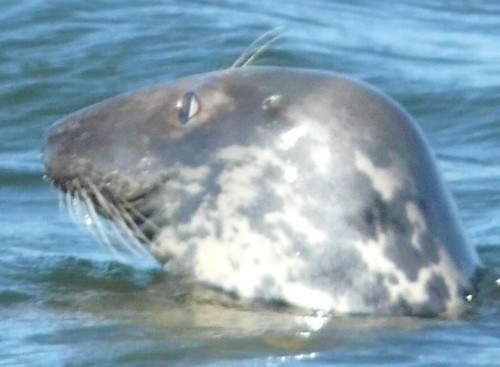
The sharks are coming because the water is (briefly) warm and because the seal population has grown unchecked--well, that is, until the sharks showed up. Seal populations were kept artificially low for decades--maybe centuries. Until the 1960s, Massachusetts even paid a bounty for each seal ("a nickel a nose" in the early 1900s). Now seals are making a comeback. Cape has the biggest population on the American east coast, with roughly 10,000 (no one's done a formal count since 1999, when it was 5,600), according to the National Marine Fisheries Service 2008 report on gray seals. A few hundred live on the islands off Maine. but the U.S. population of gray seals is dwarfed by the Canadian one: More than 200,000 on Sable Island, Nova Scotia and 20,000 on the St. Lawrence.

In August kayakers spotted a great white shark munching on a seal near Chatham Lighthouse. Five sharks were seen close enough to the shore that cautious to the shore and surfers to close beaches over Labor Day. Mind you, beaches closed two weekends earlier for strong waves and that didn't make the evening news.

So far, however, the sharks are hard to see off Cape Cod. (Though plenty of places elsewhere cater to shark tourists.) Paula St. Pierre, who has run the Beachcomber tours out of Chatham for 11 years, says she hasn't seen any of the characteristic dorsal fins herself. "I don't want to see any," she says, at least not chasing the seals. "I saw one seal out there yesterday that had a big chunk taken out and shortly afterwards expired."

If you're looking for sharks, go to their meal, the seals. Some people go to the beach by Chatham Lighthouse (where seals hang out) to try to see some fins in the water, but the best bet for seeing the most seals or maybe even a dorsal fin are the seal boats.

Even if you don't get to see a great white, you'll get surprisingly close to the seals, which often approach the tour boats, St. Pierre says. "Seals come right up to the boat," she says. "They're as curious about us as we are about them. Not only can you see them, you can smell them." When sharks appeared in the past, the seals have even turned to the seal tourists for help. "In years past seals have tried to climb in the boat," when they've been afraid of sharks in the water, St. Pierre says. She had to fight the urge to help them up like a dog.

Seal-watching has become its own mini-industry on the Cape, with Beachcombers taking out 200 people a day at the peak of summer. About a half dozen seal tour operators line the coast.

No one is sure what will happen if the seals continue to draw such large numbers of sharks. Will there be a movement to get the seals to leave? (Tricky, because of the Marine Mammal Protection Act and certainly controversial.) Will Chatham have to install shark nets like they have in Australia? Or will shark tours move in to boost the economy?

"Summer would be a whole different story," says Franz. "September, it's like whoo-hoo, we've got a good shoulder season." Meanwhile, seal and shark watchers can get shoulder season rates now. And come winter, when the seal population peaks with migrants from Canada, you can get an even better deal to see a huge seal colony.

Where to See Seals (and maybe sharks). The tours often require a minimum group to make it worth their while to go out as their business tapers off in the fall.

Beachcomber
Chatham's Municipal Fish Pier on Shore Rd.
(508) 945-5265
Adults $27, Seniors $25, Kids 3 -15 $23, Kids under 3 are free.

Monomoy Island Ferry
90-minute cruise
Adults $30, Kids 15 and under $25
Look for signs for the Rip Ryder Monomoy Island Ferry and USFWS Headquarters.

Blue Claw Boat Tours
Orleans
Adults $25, Kids 12 and under $20
(508) 240-5783

From Nantucket (year-round)
Shearwater Excursions
(508) 228-7037
2.5 hours to Muskeget Island
Town Pier in downtown Nantucket.
$90 Adults, $70 Children under 12

Friday, September 11, 2009

An Easier Way to Find a Good Whale Watch on the East Coast?

Picking out a whale-friendly East Coast whale watch just got a little easier. NOAA and the Whale and Dolphin Conservation Society just started Whale Sense, a voluntary program to ensure tours from Virginia to Maine don't bother whales.

The rules are complicated--more than just stay back 100 feet, though that is the basic distance. (If the whale approaches you, stay put. If it's a right whale, back off 1,500 feet.) What I found more amusing were the rules against advertising showing whale watchers touching, swimming with or even chasing the whales. Is Jerry Bruckheimer running a watch somewhere?

So far the group has signed up five companies, mainly in Massachusetts. I count at least 30 tour companies from Virginia to Maine, with 18 going to Stellwagen Bank--not included the odd charters that line the whole coast. So what about the ones not on the list?

Even Frank Kelley, operations manager for Mass Bay Lines (listed) says that right now the program is so new that you can't judge an operation for not participating. Lots of the tours work with other whale groups. For example, Bar Harbor Whale Watch Company is tied to Allied Whale. The New England Aquarium's whale watch, which I just went on, isn't part of the program yet (they're still examining the details), says spokesman Tony LaCasse. But since they already do most of it and they helped push voluntary standards decades ago, they'll probably be part of it.

When you're out on Stellwagen it's not the commercial whale watching boats you see encroaching on whales, but the tiny recreational fishing boats. Kelley says many tour operators worry that the small boats don't understand the protocols (which is elaborate when it comes to many boats wanting to see the same whales). NEAQ's LaCasses says that personally he'd like to see an enforcement presence on the water--like the Coast Guard is for boating regulations.

When I talked with marine mammal expert Toni Frohoff (she's a behavioral biologist and research director at TerraMar Research) she mentioned that generally it's better to have one big boat in the water around a whale instead of a bunch of little ones. At first that seems counterintuitive; we normally don't think of going out in a big, hulking, Hummer of a boat as being eco-friendly. But that's what it is, at least to the whales.

The tricky thing for whale watchers is picking tours that won't annoy--or hit--the whales. In Puget Sound tour boats are known to crowd the orcas, which could interfere with their eating or mating. I haven't seen that on the vast waters East Coast boats troll.

Consumers can't easily tell from an ad or website that attitude of operation. (Well, ok, I am a little skeptical when I read "Imagine the sight of dolphins dancing and frolicking right alongside The Silver Bullet. See whales surfacing and breaching...[from a] shiny, brand new 70 ft. long ocean going projectile." But most whale watches at least claim to be whale-friendly. But is that like a processed cereal labeled as organic? I hope the Whale Sense program grows and offers up an easy way for wildlife watchers to pick the responsible tours.