We've Moved!

Hi and Welcome to the AnimalTourism.com blog. But we've moved just down the street to this site, animaltourism.com/news. Please comment there.
Showing posts with label wildlife. Show all posts

Wednesday, November 11, 2009

Destination Wildlife: Another Must-Have Book for Wildlife Watchers

Literary agent Pamela Brodowsky people who travel to see animals will want have to dream about travel adventures. Destination Wildlife: An international site-by-site guide to the best places to experience endangered, rare and fascinating animals an their habitats gives you places and animals to aspire to see around the globe.

The book is exactly what you'd want to have on hand through a cold winter weekend when you're dreaming about where you could travel next year. You'll need some other books to get into the specifics of travel to all those destinations, but this is a nice way to browse your options. Written with the National Wildlife Federation, you can be pretty sure these are ways to see animals that aren't going to hurt or exploit them.

Brodowsky is extremely diplomatic in describing the one place in the book I'd question: the wild horses of Assateague and Chincoteague. She describes the roundup of horses, some of which will be sold, adding "Depending on your personal preference, you might want to join or avoid the pony-swim crowd." Fair enough, but I'd go further and say that many people who love wild horses would be disturbed by the round-up--especially since the horses are managed so differently on each side of the Maryland-Virginia border. The Maryland folks use the Humane Society's birth control procedures (and allow dogs); the Virginian manage the herd to sell off horses every year to support their fire department (and ban dogs from the island, even inside cars). Which would you rather support? 

I would have liked to see some glossy color pictures and maps, a fuller representation of wildlife everywhere and a greater willingness to consider places outside big national parks and sanctuaries. Animaltourism.com tries to give people practical wildlife options close to home. But we need all kinds of wildlife watchers and guides to promote sustainable, responsible wildlife watching. Brodowsky does uncover a few rare gems, like Monkeyland, a primate sanctuary in South Africa, and specific inns to stay at to see the friendly gray whales off Baja, California. I bet her book inspires lots of great adventures.

Wednesday, September 16, 2009

Cape Cod Shark Update: Look Further Up the Coast, Captain Says

Yesterday we reported on how the Great White Sharks that are closing beaches on Cape Cod are also drawing shark tourists. Today another seal boat captain tells us they're looking in the wrong spot.

Captain Keith Lincoln of Monomoy Island Ferry says that people are mistakenly hanging around Chatham Lighthouse since that's where the shark was first sighted by kayakers a eating a seal in August. "
That is all due to the misleading information given by the media," says Captain Keith. "Massachusetts Department of Fisheries page shows all the taggings being done three miles south of the lighthouse near the area where South Beach and South Monomoy Island attached in 2006."

Looking at the Fisheries map here, he's totally right. Excellent tip, Captain Keith. (Though they do also show pictures of sharks offshore of the lighthouse.) He also warns that even if you're in the right place, the odds of seeing a shark are pretty impossible. The tagging teams use spotters on planes and perches 35 feet out of the water.

Captain Keith reports he's "calls about seeing the sharks, which is nearly impossible to guarantee." I think the seal tourists of Cape Cod have gotten spoiled; the tour boats can guarantee sightings because they're dealing with the east coast's biggest colony of gray seals, which is somewhere around 10,000. Normally wildlife watching is no sure thing.

Captain Keith, a 20-year veteran of the seal tours, says the sharks (and attendant media frenzy) come every year. "
I think this year is a little different in that the sharks showed up in a large number all at once." The seal cruises have been popular since 1991 and continue to get more popular with a new tour company starting this year, amid the recession, Captain Keith says. "So that alone tells you people are interested in the seals." He doesn't anticipate any shark frenzy curbing enthusiasm for the seals. A bigger threat to the tours are the shifting sandbars and regulations about where they can dock, he says.

Seeing sharks is pretty iffy, but if you go out this fall, you can see lots of shorebirds like oystercatchers and sea ducks like eiders, scoters, and buffleheads. And in June, Monomoy is the Cape's best spot to see mating horseshoe crabs pile on the beach.
Overall their populations are down about 90% on Cape Cod in the last few decades, but researchers have shown that Monomoy National Wildlife Refuge has some of the highest densities left

Meanwhile, if you really want to see a shark off Cape Cod, check out this guy at Nantucket Shark Dives, who does shark dives with chum 30 miles off Nantucket and gets to see lots of blue sharks.

Where to See Seals (and maybe sharks). The tours often require a minimum group to make it worth their while to go out as their business tapers off in the fall.
Monomoy Island Ferry
Usually runs April - December
90-minute cruise
Adults $30, Kids 15 and under $25
Look for signs for the Rip Ryder
Monomoy Island Ferry and USFWS Headquarters.

Beachcomber
Chatham's Municipal Fish Pier on Shore Rd.
(508) 945-5265
Adults $27, Seniors $25, Kids 3 -15 $23, Kids under 3 are free.

Blue Claw Boat Tours
Orleans
Adults $25, Kids 12 and under $20
(508) 240-5783

From Nantucket (year-round)
Shearwater Excursions
(508) 228-7037
2.5 hours to
Muskeget Island
Town Pier in downtown Nantucket.
$90 Adults, $70 Children under 12

Tuesday, September 15, 2009

Sharks (& The East Coast's Biggest Seal Colony) Draw Tourists

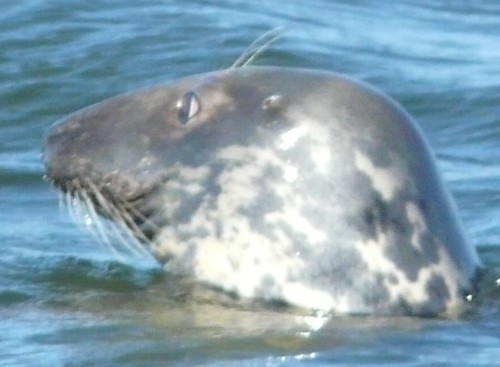
When news got out that Chatham, MA's, gray seal colony--the biggest on the east coast--was drawing sharks that closed beaches, a funny thing happened. Or didn't happen. Instead of running away scared, more tourists came to this little town on Cape Cod's elbow to see some sharks, hoping for a picture, or at least a glimpse.

"It's a big draw," says Lisa Franz, executive director of the Chatham Chamber of Commerce. "We have traffic jams... People are still walking in today and saying 'Where can we see them?'"

Tony LaCasse, a former veteran Boston TV newsman, says years ago local TV news would've been filled with scared would-be swimmers. But that was before years of education that drilled home how very unlikely it is to be bitten, let alone eaten, by a great white shark in New England. (Last fatal attack: 1936) Now we get shark tourists. "It's a long way from Jaws," says LaCasse, where the premise was they couldn't possibly close the beach on the Fourth of July.

The sharks are coming because the water is (briefly) warm and because the seal population has grown unchecked--well, that is, until the sharks showed up. Seal populations were kept artificially low for decades--maybe centuries. Until the 1960s, Massachusetts even paid a bounty for each seal ("a nickel a nose" in the early 1900s). Now seals are making a comeback. Cape has the biggest population on the American east coast, with roughly 10,000 (no one's done a formal count since 1999, when it was 5,600), according to the National Marine Fisheries Service 2008 report on gray seals. A few hundred live on the islands off Maine. but the U.S. population of gray seals is dwarfed by the Canadian one: More than 200,000 on Sable Island, Nova Scotia and 20,000 on the St. Lawrence.

In August kayakers spotted a great white shark munching on a seal near Chatham Lighthouse. Five sharks were seen close enough to the shore that cautious to the shore and surfers to close beaches over Labor Day. Mind you, beaches closed two weekends earlier for strong waves and that didn't make the evening news.

So far, however, the sharks are hard to see off Cape Cod. (Though plenty of places elsewhere cater to shark tourists.) Paula St. Pierre, who has run the Beachcomber tours out of Chatham for 11 years, says she hasn't seen any of the characteristic dorsal fins herself. "I don't want to see any," she says, at least not chasing the seals. "I saw one seal out there yesterday that had a big chunk taken out and shortly afterwards expired."

If you're looking for sharks, go to their meal, the seals. Some people go to the beach by Chatham Lighthouse (where seals hang out) to try to see some fins in the water, but the best bet for seeing the most seals or maybe even a dorsal fin are the seal boats.

Even if you don't get to see a great white, you'll get surprisingly close to the seals, which often approach the tour boats, St. Pierre says. "Seals come right up to the boat," she says. "They're as curious about us as we are about them. Not only can you see them, you can smell them." When sharks appeared in the past, the seals have even turned to the seal tourists for help. "In years past seals have tried to climb in the boat," when they've been afraid of sharks in the water, St. Pierre says. She had to fight the urge to help them up like a dog.

Seal-watching has become its own mini-industry on the Cape, with Beachcombers taking out 200 people a day at the peak of summer. About a half dozen seal tour operators line the coast.

No one is sure what will happen if the seals continue to draw such large numbers of sharks. Will there be a movement to get the seals to leave? (Tricky, because of the Marine Mammal Protection Act and certainly controversial.) Will Chatham have to install shark nets like they have in Australia? Or will shark tours move in to boost the economy?

"Summer would be a whole different story," says Franz. "September, it's like whoo-hoo, we've got a good shoulder season." Meanwhile, seal and shark watchers can get shoulder season rates now. And come winter, when the seal population peaks with migrants from Canada, you can get an even better deal to see a huge seal colony.

Where to See Seals (and maybe sharks). The tours often require a minimum group to make it worth their while to go out as their business tapers off in the fall.

Beachcomber
Chatham's Municipal Fish Pier on Shore Rd.
(508) 945-5265
Adults $27, Seniors $25, Kids 3 -15 $23, Kids under 3 are free.

Monomoy Island Ferry
90-minute cruise
Adults $30, Kids 15 and under $25
Look for signs for the Rip Ryder Monomoy Island Ferry and USFWS Headquarters.

Blue Claw Boat Tours
Orleans
Adults $25, Kids 12 and under $20
(508) 240-5783

From Nantucket (year-round)
Shearwater Excursions
(508) 228-7037
2.5 hours to Muskeget Island
Town Pier in downtown Nantucket.
$90 Adults, $70 Children under 12

Wednesday, September 09, 2009

Boston Won't Make Way For Geese

Boston loves to show off its sweet, staring role in Make Way for Ducklings, the children's book that culminates in cops helping ducks across the street. They've got duckling statues, duckling contests and it is seemingly mandatory to display the book in stores. Yet the city isn't helping its non-fiction waterfowl. For nearly three decades a flock of white and gray geese have lived on the Charles River near Boston University, but their advocates say a renovation plan is pushing them out.

"They insist they have this beautiful park but they have no use for free animals," says Robert J. La Trémouille, a blogger who is one of the Friends of the White Geese, which is kind of the like the geese's political lobbying arm. This flock of 60-80 White China, Emden, and Toulouse geese have lots of friends and fans. La Trémouille says Bostonians have visited geese--a rare survivor on the polluted Charles--since at least 1981, when a plant got "guard geese." But some say the geese go back 60 years.

Another group, the Charles River Urban Wilds Initiative, concern themselves with the geese's day-t0-day care. Many, like Boston University writing lecturer Allison Blyer, take it on themselves to deliver healthy food (veggies, duck food) and occasional medical care. They notice individual characters and quirks. The current leader, Buddy, is about 20 years old. Pinky, pictured above, is known as a real character, sayd Blyer: "He is very bonded to us and likes to peck cameras. He also loves tomatoes, parsley, apples, saltines, and his mate, Blue." Many more casually stop by with kids--especially in gosling season--and offer leftovers.

But meanwhile, Trémouille says, those who want to keep the river area sterile put oil on the geese's eggs. (Though some say they are only target the more invasive Canada goose.) The state's Dept. of Conservation and Recreation has dug up their nesting area, put a plastic barrier by Magazine Beach and redid the area with athletic fields that rely heavily on pesticides instead of the natural landscaping the geese provide, La Trémouille says.

Nearby overly landscaped ballfields have lead to algae blooms, he says. Indeed the EPA notes the river is polluted, mainly from sewers. Some worry about the waste the geese leave behind, but that's nothing compared to the dead zone that will be produced when a power plant starts discharging hot water into the river. The state produced a master plan for the river, including Magazine Beach, which it hopes "to discourage the growth of a flock of feral geese." They want to put up signs discouraging feeding--like the alarmist warnings in Boston Common that conflate feeding birds with a human health crisis.

La Trémouille says he doesn't want to stop the renovation, just let the geese who have lived and delighted people on the Charles for generations be part of it. He hopes people will tell Gov. Deval Patrick, the DCR and local pols to let the geese stay. Doesn't seem that enjoying a flock of unusual geese should be that antithetical to enjoying a park and river.

Tuesday, September 08, 2009

NEAQ Whale Watch: Humpback Bubble Cloud Feeding off Boston?

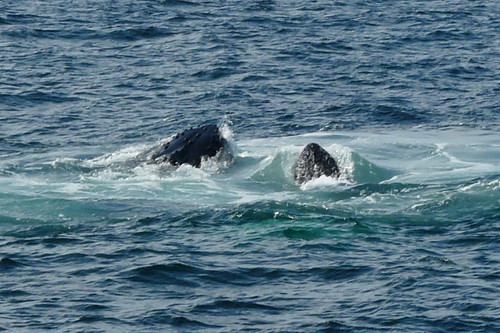
This weekend we got to see a pod of humpback whales bubble cloud feeding--that is cooperatively blowing bubbles to herd tiny fish into a concentration near the surface, then gobbling them up. The New England Aquarium's's tour brought us close enough to the whales that we could actually see, understand and anticipate what they were doing.

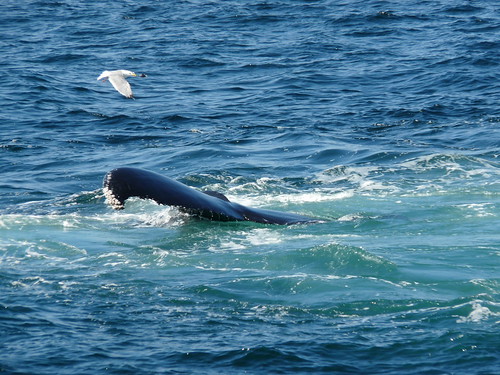
You first know you're going to see this specialized hunting technique when a huge patch of light turquoise water appears. Bubbles surface, then enormous black snouts covered with bumps (technically, tubercules or hair follicles). There's lots of jostling and swirling, then fins and finally a "whale footprint" or eerily smooth patch of sea that, we learned, whalers first thought was leaked whale oil.

I found some discussion online that humpbacks only bubble net feed off Alaska, Antarctica and west of South America. I'm not a whale expert, so I'm not sure if this is any different from what we all saw. But we clearly got to see it a few times. We had at least three whales at it, Echo, a mother; her calf, who stuck close to her; and another whale named Zooney.

The New England Aquarium has the system down to bring whales to the masses: a huge, fast catamaran whisks you an hour off-shore into Stellwagen Bank, a shallow feeding ground and sanctuary. Right from the center of Boston you can spend three hours and $40 and see one of the most active whale-watching sights in the world. Whale-watching tours from Cape Cod, Plymouth, Cape Ann, New Hampshire and Maine all head to Stellwagen. The boat's stable, so only a few get sick. You spend an hour speeding out to sea, an hour watching and an hour coming back. They sometimes see minke or fin whales, dolphins and basking sharks. A guy filming the trip for NOAA said it was the best he'd been on.

Not in Boston? Here are a ton of great places to see whales.

More places to see animals in the Northeast.

Got suggestions for animal watching places? Tell us.

Tuesday, September 01, 2009

Montana Hunts Wolves--Along with Bison and Sandhill Crane

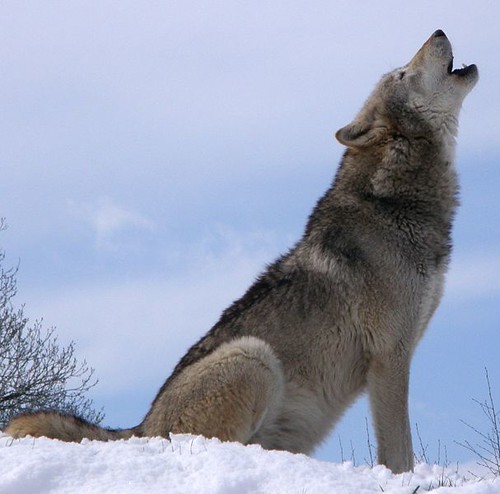
Montana will start hunting for the recovering wolf in two weeks--unless a judge steps in to stop it. The plan is to shoot 75 wolves, though by yesterday hunters had bought 9,000 permits, some just for a fun souvenir ($19 a pop.) Hunters are supposed to call in within 12 hours so Montana Fish Wildlife & Parks can call off the hunt.

That got us thinking about what other kinds of rules Montana has about hunting. Here's a sampling that will give you how hunting trumps all other concerns.


Photo Courtesy of Thomas Roche

  • Go ahead and hunt wolf pups. While you are banned from hunting lactating mountain lions, you can shoot wolves born this year. "This means you can shoot any wolf you see including pups if you so choose," notes huntwolves.com. You can't bait wolves or use electronic calls, but you can use manual or old-fashioned ones (typically calls of prey animals.) You can't use night vision or--unlike Alaska--an airplane. (Well, you can use it to spot them, but you can't shoot them till the next day.) Also, you can dump the carcass in the field, but you have to bring back the head and "evidence of sex: males: testicles; females: vulva or mammaries."
  • They hunt bison. That's right--the symbol of the west, the symbol of wasteful hunting. Apparently there was a reason for this rule: "It is unlawful to possess or transport the fetus or reproductive tissues of a bison away from the kill site." Just as Alston Chase described in Playing God in Yellowstone, they hunt them just outside the border of Yellowstone National Park.
  • They hunt Sandhill Cranes. Cranes! You get a free permit at either the Bowdoin or Medicine Lake National Wildlife Refuges or Fish, Wildlife & Parks regional headquarters. You can take up to three a day and have up to six. There's also a drawing for more convenient Sandhill crane hunting sites. According to the International Crane Foundation, their population is expanding, except where "small breeding populations can face disproportionate mortality on fall staging areas due to over-hunting."
  • They hunt swans. "Swan hunters must have, as a means of retrieving swans, a
    watercraft, a dog capable of retrieving or chest-high waders along while hunting the dikes at Freezout."
  • They hunt mountain lions--but not lynx or bobcats. "Mountain lion is excluded from being considered as “suitable for food” under big game regulations. A person that harvests a mountain lion must possess the head and hide, with evidence of sex naturally attached. The remaining carcass may be taken in possession or be left in the field."
  • They're still trapping fisher, wolverine and and marten.
  • They want an urban deer hunt.

Friday, July 10, 2009

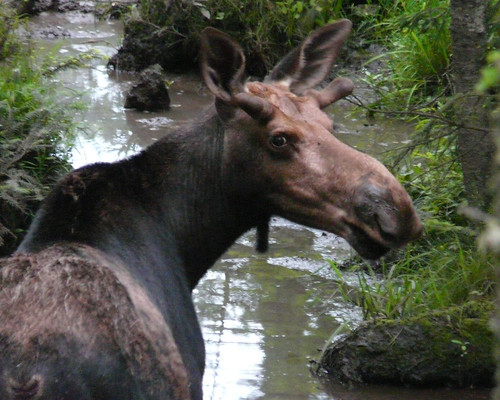
Moose Alley, NH Tips: 10 Things Locals Won't Tell You

Believe the name. When you visit Moose Alley, New Hampshire,
(not an actual town, but Route 3 north of Pittsburg up to the Canadian border) you will see moose. It's like magic; you just always see moose. I was skeptical, too--the victim of too many parks boasting of animals I would never see. But Moose Alley, way up in Coos County, has never failed me.

I kept asking the locals for moose-watching tips--since moose follow routines. Usually I got nowhere with that line of questioning--lots of encouragement to look "anywhere," "any road" at "any time." So I came up with what I would tell a friend visiting Moose Alley.


1. Look for Roadside Wallows.
Moose hang out by the side of the road to drink from ponds and puddles with salt run-off. You can spot the wallows because they tend to have trampled mud around them and a moose trail leading away from the road.


2. Look for Roadside Parking.
Where there are established wallows there is effectively wallow parking. Moose return at the same time every day. Moose watchers follow. One particularly popular wallow has a lot next to it--and still gets an overflow crowd parking on Route 3 at dusk. For that matter if you see a roadside parked car, as you will quickly figure out, it's probably your fellow moose watcher. Just ask if they've actually seen a moose there and are not just acting on a hunch that "that looks like a perfect place for a moose"--a phrase you will find yourself using repeatedly.


3. Moose also like recently cut trees.

Georgie Lyons told me that a logger off Route 26 says that a dozen moose appear in the morning when they hear him start his chainsaw. (She's in the visitor's center near Colebrook, but in the Chamber of Commerce back office. She knows everything about the area and is happy to share it.)


4. Timing matters, but not completely.
You will be exhorted to Go at Dusk and Dawn. Moose are crepuscular--meaning most active then. I've had the best luck seeing them in the hour right before dark. But they're also really active at night. A truck driver reports he recently saw 27 moose (not all at once) along a nearby road at 2 a.m. The problem with this--as with dusk--is that if you get any picture, it'll be lousy. And for that matter, you may see them during the day, too. Locals stress that they see them all times of day. I had my best sighting at 10 am. Moose's Hours Inconvenient? Go Anytime.

5. Route 3 is the best, but any area road will do.
The heart of Moose Alley is Route 3, but Routes 145, 26 and 16 all are local hotspots. So are the logging roads off Route 3, especially one marked Gate 137. For that matter, the people I talked to just said to drive any local road, especially ones bordering wilderness. The thoughtfully-built official viewing area on 26 hasn't had moose in a while, locals say. (We rented a house at a delightful Poodle Farm in Colebrook, a good mid-point.)

6. Lurk.
Once you find a moose spot, come back at the same time tomorrow. And if the moose get spooked by watchers, just sit and wait. You'll have the moose all to yourself.

7. You may not see any antlers.
First off, you're going to see more cows than bulls because the bulls are more wary. Second, the antlers fall off after the fall mating season, then resprout in early summer.


8. Your moose call is only going to work in mating season.

Moose don't just call each other to figure out where everyone's at--like some species do. They only call in season. Experienced moose hunters say it really works--and may even work a month or so after the season because some females may be late. But moose hunting seasons are timed to coincide with the rut. So you may just draw in hunters. And the moose catch on pretty quickly to the hunt and become much more cautious about people, hunting guide Larry Adair told me last year.

9. The logging drivers hate you.
They're trying to work and here we are trolling around for moose, half stopping. If you go on the logging roads, you have to be ready to get out of their way. They show their annoyance by driving fast past you.

10. The moose aren't that fond of you, either. And they really hate your dog.
Moose will run off if you get too close--or they may warn you off, but the signs may be too subtle: they raise the hackles on their rump, point ears back and lip their lips. Also, they give you a dirty look. They can bluff charge, charge for real and go out of their way to kick a dog. You car is actually a pretty good wildlife blind, especially if you've got a sun roof. Though when there's a Moose Jam, families will get out. You'll feel like a chump staying in your car. But the moose will eventually get spooked by people on foot.

For all that, it's still a thrill to get to watch one of these giant animals eat. I've been trolling likely looking bogs throughout New England and the Maritimes and Moose Alley is about the easiest place to do it.