We've Moved!

Hi and Welcome to the AnimalTourism.com blog. But we've moved just down the street to this site, animaltourism.com/news. Please comment there.
Showing posts with label crane. Show all posts

Tuesday, May 25, 2010

North Korea: Creepy to Animals, Too

What do you get for a fellow despot of an impoverished country? How about a menagerie? Conservation groups are pissed that Zimbabwe is sending North Korea a mini-menagerie--two of every species from Hwange National Park.

Somalia gave Kim Il Sung an Ass photo by (stephan)
You can only imagine how a nation that can't provide food and electricity for its own people will treat elephants and lions from Africa. Actually, you don't have to imagine. Some news reports make it seem ambiguous where they might go. But there's only one zoo in North Korea and it's totally sad, crappy, creepy and unaccredited.


Asia Times reports that a bunch of animal fighting films have come out of North Korea and pits animals against each other to fight to the death--just the kind of flick our Supreme Court endorsed.

"In all probability, North Korean leader Kim Jong-il sanctioned the filming of Fighting Animals, or at least gave it his curious approval - though there is no evidence he was directly involved despite his well-documented interest in filmmaking," the Asia Times says. "The film's producers would have needed access to rare and valuable animals and the only place in the country that holds them is the Central Zoo in Pyongyang."

The Pyongyang Central Zoo was hit by bird flu
Aside from the animal fighting scandal, Lonely Planet says all the animals at the Korea Central Zoo, also known as the Pyongyang Central Zoo, "look pretty forlorn Worst off are the big cats...kept in woefully inadequate compounds." Visitors also describe and photograph lots of cats and dogs at the zoo. Of course, North Korea has a different way to describe it: "Working people and school youth and children have a pleasant time, seeing animals associated with meaningful stories." They also report renovations.

Zimbabwe defended the deal as just a business transaction, not political. Is that better? They're selling two elephants too young to be separated from their mother for $10,000 each, $900 each giraffe, $600 per zebra and then, the AP reports, some cheap birds: $10 each for blue crane, saddle-billed stork and white pelican. The blue crane seems like a real bargain: they're listed as vulnerable on the IUCN Red List, with only 26,000 left and falling and range maps don't even show them in Zimbabwe.

Some animals do get out of North Korea. In 1995 a Siberian tiger named Rail went to the south. In 2005 Seoul got a bear and lynx--but sent in a hippo and llama.  

The only good thing that can be said of the deal is that wild animals are pretty much doomed under Mugabe anyway. Zimbabwe's Conservation Task Force explains that Mugabe didn't just take land from white farmers, he took it from parks and wildlife, too.

Where to Go See Big Cats


조선 중앙 동물원

Tuesday, April 13, 2010

Chicagoland Wildlife Refuge Could Be Chance to See Cougar, Trumpeter Swan, Cranes

This week the Fish and Wildlife Service announced they'd study a plan to start a wildlife refuge between Milwaukee and Chicago. What would the Hackmatack National Wildlife Refuge mean for wildlife watchers?
A chance to see cranes, trumpeter swan, otter, badger, coyote, deer--and possibly cougar, whooping cranes, a funny kind of squirrel and some threatened bats and turtles.


The Friends of the Hackmatack NWR  who have already been working for years to get this gonig, in part inspired by the fact that when Audubon Magazine boasted that "a wildlife refuge is located within an hour’s drive of every major metropolitan area" Chicago proved them wrong. It's the biggest city without one. This refuge takes note of the need for wildlife watching near where people live; it's designed to be within two hours of Chicago and Milwaukee. Judging by the excited email I got from my friend David Hall and others, I'd say it would be pretty popular.

Hackatack--named after the larch tree--would try to sew together the patchworkd of 88 parks and preserves already there so that wildlife can have some breathing room. The wildlife service wouldn't force anyone out, but they would offer to buy property within the refuge boundaries.

I did some research on what animals we might expect to see if we visited the refuge:


Cougar:  The Cougar Network has two confirmed sightings in the refuge area since 2008, one with physical evidence, the other verified by a qualified pro.


Trumpeter Swan
Trumpeter Swan: Maybe! This endangered native swan is already very close by in Wisconsin and has benefitted from a massive reintroduction program in Iowa. Illinois seems to be doing next to nothing for these straight-necked swans--except accidentally shooting them down south.

Bats: McHenry County has six species of bats. That includes four that Wisconsin is keeping special watch over:  Eastern Red Bat, Hoary Bat, Northern Long-eared Bat, and the Silver-haired Bat.

Whooping Cran © Luther Goldman
Cranes: Sandhill cranes definitely pass through. The site is on the flyway of the flock of 21 endangered whooping cranes that summer in Necedah National Wildlife Refuge in Wisconsin and winter in  Chassahowitzka National Wildlife Refuge. They are famously being taught the route, which makes stopovers in national wildlife refuges, by ultralight aircraft.

River Otter: Yep, it's all over Wisconsin


Franklin's Ground Squirrel © Tom Schultz
Franklin's Ground Squirrel: Wisconsin calls this a species of greatest concern. It's like a small prairie dog, but quiter and less entertaining.


Badger: Badgers are all over Wisconsin, but rarely seen.

Owls : McHenry has 13 species of owl, including the snowy owl.

Blanding's Turtle: This threatened turtle takes 17 to 20 years to reach maturity.
Blanding's Turtle


Black Bear: Probably not, says Wisconsin, who rates appearances here as rare. No way, says Illinois, who says only one black bear has been seen in the state since 1870 and they kicked that one out.

Wolf: Nope

Lynx: No way

American Marten: No, he's all the way up on Lake Superior

 Where to See More Animals Around the Midwest

Wednesday, January 27, 2010

4 Budget Cuts that Save U.S. Taxpayers $280 Million AND Help the Environment, Animals and Wildlife Watchers

President Obama wants to freeze the tiny part of the federal budget that applies to programs in the environment, parks, education and transportation. I've seen this movie before and know this political gimmick doesn't have a happy ending for wildlife. But here are four easy way to cut the federal budget by $280 million a year and help the environment, wildlife and animal watchers.

Discount Grazing on Public Lands: $121 million
Wild Horse-Roundups and Permanent Holding:  $85 million a year
Killing Coyotes, Starlings and other "Bad" Animals: $71 million a year
Rounding up Yellowstone Bison $3 million


1) Stop Cattlemen Welfare $121 million Cattlemen get to graze on federal land for about one-tenth the cost they would have to pay the private sector. This is a program both the left and right hate. The CATO Institute calls it "land-use socialism."
Cowboy on the Snow
Ranchers now pay about $1.35 per animal unit per month (AUM), compared to $13.50 in the real world. Just to break even the federal government should be charging between $7.64 and $12.26, a GAO report found. We could stop losing $121 million by charging market rates.
I'm a meat eater and amid the myriad choices of grass-fed and dry-aged, I've never gotten a special deal on federal land beef. If the massive federal lands were put on the free market, it would probably drive down costs for all ranchers--and consumers.
(Photo courtesy of Sharat Ganapati)


2) Stop rounding up wild horses : $85 million a year
We really have more wild horses in captivity that we know what to do with--about 33,000. The Bureau of Land Management started amassing mustangs under Bush, then proposed selling them to slaughter in 2005. The public was repulsed.
Each horse costs about $333 to round up (based on the $900,000 the BLM spent to catch 2,700 horses). Then it costs about $500 a year each to keep them.
But, we're still rounding up horses--another 12,000 this year. That will put nearly two-thirds of the wild horse population in federal custody at a cost of about $85 by 2012.


3) Stop Killing Coyotes and Starlings: $71 million a year
The federal government spent a stunning $71 million in FY2010 on the widely discredited science of killing 2.4 million predators and "nuisance" animals. The predators taken are quickly replaced by other animals moving into the territory. Wyoming spent $2.2 million federal tax dollars in 2007 to kill 11,000 coyotes, 300 foxes, 1,000 pigeons, 600 ravens and 55 wolves (among other animals they decided were bad).
Whether you think these animals should survive or not, you have to question whether federal tax dollars should be spent removing them.

The federal government also paid to dispatch (partial list)
1,177,00 starlings
335,000 cowbirds
90,000 coyotes
86,000 pigeons
16,000 cormorants
13,000 mourning doves
13,000 raccoons
6,000 squirrels
500 stray dogs
1,100 prairie dogs
1,110 feral cats
6,000 rabbits
876 robins (including 776 shot on purpose in Mississippi)
400 otters

344 wolves (including four critically endangered Mexican gray wolves that you are also paying the Fish and Wildlife Service to bring back)
336 cougars
84 mockingbirds
52 pelicans (including one brown pelican, then classified as endangered, intentionally shot in Florida)
43 Sandhill cranes
1 flamingo


4) Stop Rounding up Yellowstone Bison $3 million

Again, lay this one on the cattlemen. The various government agencies (parks, forest service, USDA) say they needs to limit bison because they might give a disease to 200 neighboring cattle.
"The U.S. government spends about $3 million a year to manage wild buffalo like livestock inside Yellowstone Park through its capture, quarantine, and vaccination program, all intended to prevent buffalo's natural migration to adjacent National Forest lands and on private lands where people want and respect them as wildlife," says Buffalo Field Campaign habitat coordinator Darrell Geist. He also points out that doesn't even count crop and livestock subsidies, giveaways to mining companies and gifts to
oil and gas interests. 

They could just stop giving out the money-losing grazing rights to the land in the valley. Remember, it's a money losing proposition anyway. But on top of that, we're paying to round them up and ship them off. Even though seeing bison is one of the reasons Americans like going to Yellowstone. BFC's. Habitat Coordinator Darrell Geist says they could probably buy out the cattle for about $1 million.


Where to Go to See Wolves
Places You Can See Bison

Tuesday, September 01, 2009

Montana Hunts Wolves--Along with Bison and Sandhill Crane

Montana will start hunting for the recovering wolf in two weeks--unless a judge steps in to stop it. The plan is to shoot 75 wolves, though by yesterday hunters had bought 9,000 permits, some just for a fun souvenir ($19 a pop.) Hunters are supposed to call in within 12 hours so Montana Fish Wildlife & Parks can call off the hunt.

That got us thinking about what other kinds of rules Montana has about hunting. Here's a sampling that will give you how hunting trumps all other concerns.


Photo Courtesy of Thomas Roche

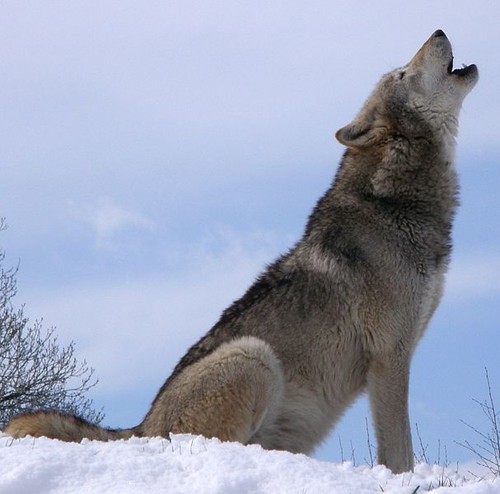
  • Go ahead and hunt wolf pups. While you are banned from hunting lactating mountain lions, you can shoot wolves born this year. "This means you can shoot any wolf you see including pups if you so choose," notes huntwolves.com. You can't bait wolves or use electronic calls, but you can use manual or old-fashioned ones (typically calls of prey animals.) You can't use night vision or--unlike Alaska--an airplane. (Well, you can use it to spot them, but you can't shoot them till the next day.) Also, you can dump the carcass in the field, but you have to bring back the head and "evidence of sex: males: testicles; females: vulva or mammaries."
  • They hunt bison. That's right--the symbol of the west, the symbol of wasteful hunting. Apparently there was a reason for this rule: "It is unlawful to possess or transport the fetus or reproductive tissues of a bison away from the kill site." Just as Alston Chase described in Playing God in Yellowstone, they hunt them just outside the border of Yellowstone National Park.
  • They hunt Sandhill Cranes. Cranes! You get a free permit at either the Bowdoin or Medicine Lake National Wildlife Refuges or Fish, Wildlife & Parks regional headquarters. You can take up to three a day and have up to six. There's also a drawing for more convenient Sandhill crane hunting sites. According to the International Crane Foundation, their population is expanding, except where "small breeding populations can face disproportionate mortality on fall staging areas due to over-hunting."
  • They hunt swans. "Swan hunters must have, as a means of retrieving swans, a
    watercraft, a dog capable of retrieving or chest-high waders along while hunting the dikes at Freezout."
  • They hunt mountain lions--but not lynx or bobcats. "Mountain lion is excluded from being considered as “suitable for food” under big game regulations. A person that harvests a mountain lion must possess the head and hide, with evidence of sex naturally attached. The remaining carcass may be taken in possession or be left in the field."
  • They're still trapping fisher, wolverine and and marten.
  • They want an urban deer hunt.