We've Moved!

Hi and Welcome to the AnimalTourism.com blog. But we've moved just down the street to this site, animaltourism.com/news. Please comment there.
Showing posts with label coyote. Show all posts

Wednesday, March 31, 2010

New York's Coywolf, Groundhog and Black Squirrel Doing Fine

The coywolf, groundhog and black squirrel we've been following have all done pretty well in the last week.

Coywolf
The coyote captured in SoHo last week (and probably the same one that's been lurking around Central Park this winter) got released in Van Cortlandt Park in the Bronx, where a pack already lives, the city's pre-eminent wildlife rehabber Bobby Horvath says. This young female may have been part of that pack, but was pushed out in mating season. Three coyotes were spotted up at Columbia University this winter.  One was hit by a car on 130th Street and another may still be out there.


Groundhog
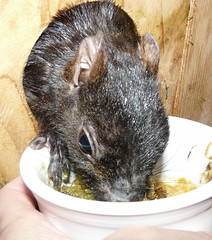
The groundhog that turned up on the street near the Soho Grand is doing fine, awaiting release into Van Cortlandt Park in the Bronx. No one is sure how the woodchuck turned up there, but the staff caught him and gave him a dog crate. Bill--as I call him, though he may well be female--turns out to be quite healthy. He enjoys apples, chestnuts and acorns, but shuns the greens he is supposed to like. Bill lunges at the cage bars when I hang around too much--proving that he's quite healthy and most likely not a misbegotten pet.

Bobby researched where groundhogs live in the city--where I'm required to release him. He only found evidence in Pelham Bay Park, Van Cortlandt and Fort Tryon. I called a parks biologist to find the best place to release him. At first he was unsure whether I'd be allowed to release him in the park at all, then confirmed I could. He suggested a nice field in Van Cortlandt.

Black Squirrel
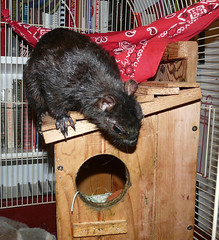
Mickey, the black squirrel who came to me with bottom teeth grown into her top gums, is getting stronger. She had a top tooth, lost it and now has one back again. She is an odd duck, preferring to throw out the padding I put in her cardboard box; most squirrels can't stuff enough junk in their makeshift houses. I got her a lovely cedar house that she repeatedly rejected. Until all of a sudden she decided she loved it and didn't want to leave. Since then she comes out only to eat--though she prefers I just hand-feed her avocado at her house door--and to pee on her roof. I take that as a sign she likes the house.


Thursday, March 25, 2010

Manhattan's Captured Coyote May Be Released in the Bronx

Photo from 1010 Wins

Cops captured a coyote in lower Manhattan Thursday and are holding the young female at least overnight. She may be released into Van Cortlandt Park as early as Friday night, people who were in on the discussions say. Right now she's sleeping off tranquilizers at Animal Care and Control.

Dumping the coyote in the Bronx may sound like Manhattan just dumping its unpleasantries in an outer borough, but there's solid reasoning to it. Most New Yorkers don't realize that Van Cortlandt and Pelham Bay Park already have coyote populations. 

No one is sure if this is the same coyote that's been hanging around Central Park the last couple months. My guess is that it is. One thing that surprised most people is that the coyote turned out to be a female. People had figured the Central Park coyote as a young male who got pushed out of his territory by dominant males in mating season.

But it does seem that the Central Park Coyote was out and about yesterday. Bruce Yolton said the Central Park coyote--who has a habit of leaving the Hallett Nature Preserve just after dusk--was seen wandering around the preserve woods at lunch yesterday. On Wednesday 1010 says the canine was spotted down near the Holland Tunnel, but evaded cops. Of all the ways a coyote could get into Manhattan, I don't think the Holland Tunnel was high on anyone's list.  Cops finally caught her Thursday in a parking lot on Canal Street near the West Side Highway, The Daily News reports.

Getting caught outside the park may be her lucky break. The Central Park may have been slated for immediate death and rabies testing  for the coyote because of the outbreak of rabies in Central Park's raccoons. The Health Department may still decide the coyote should stay in quarantine for 10 days to make sure she shows no rabies symptoms.


1010 also quotes a vet saying this is a coydog--half coyote, half dog. That's not quite right. Genetic tests on similar animals have shown they aren't "wild dog," but a mix of western coyote and the eastern wolf that was wiped out. No coywolf has successfully moved to Manhattan, but there are at least two packs in parks in the Bronx. They may move this one out, but another will be sure to try to take over the real estate again.

Where to See Wild Animals Around New York City
Read more about coywolves
Read about the coywolf from its original tracker, Urban Hawks
Check out the Eastern Coyote Research center

Saturday, March 13, 2010

Secrets of the Hallett in Central Park

The Hallett Nature Sanctuary on Central Park South been in the news this month as the daytime napping place of at least one coyote/coywolf. This four-acre island of nature is normally almost invisible to park goers, even though it's in the most popular corner of Central Park.

When the park was created this whole area was a big, smelly swamp known to carry malaria. The New York Times describes how the wealthy residents of 5th Avenue finally fixed the problem of stagnant water in their cellars. Frederick Law Olmstead drained the swamp and created the Pond, with a promintory left natural.

The pond was popular for “swan velocipede boats.” An 1887 Times story says the boats "got no rest from morning to night," as a quarter million people visited the park on the first day of spring, watched a black swan protect her nest on a rock in the Pond and observed only two prairie dogs emerge, "the most certain sign of warm weather." In the winter the crowds headed to the pond for ice skating. Trolleys used to wear a signal red ball if it was currently frozen enough to skate. The current Wollman Rink is built over a filled in section of the pond.

The preserve area has been off limits to regular New Yorkers since 1934, when it was named the Bird Sanctuary. In 1952 the Times reported:  "59TH ST. PARK LAKE TO BE RID OF FILTH; Complaints of Offensive Debris Bring Admission of 'Laxity."


Supposedly a group of teen docents from the Central Parks Conservancy gives small, regular tours. Or at least that's what NYC24 says. I did find pictures of a 2009 outing for homeschooled. I didn't see it on the conservancy's current list of tours or hear back from them yet.


Nature photographer David Liittschwager recently did a neat study of wildlife in the Hallett and several other places for National Geographic. He puts out a one square foot cube, then documents all the creatures in it. You wouldn't believe the variety of bugs that live in Manhattan leaf litter. He says in a video he knew the raccoons (more often seen in the North Woods) were in his foot because they actually moved the cube.

Thursday, March 11, 2010

Will NYC Replace Horse-Drawn Carriages With Cars Powered By Manure?

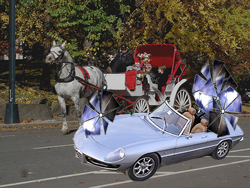
The New York City Council is holding hearings March 12 on whether to ban horse-drawn carriages and possibly replace them with classic cars powered by green energy. The city has been waffling over banning the horses since at least 1989. The Coalition to Ban Horse-Drawn Carriages says the animals shouldn't have to live in tight stalls and work in dense midtown, where they have been electrocuted and hit by cars, only to face unkown fate when they retire.

I don't have any illusions that the council is going to finally ban horses today, but the new twist is the bill "replacing horse drawn carriages with alternative fuel powered classic cars." This measure, supported by PETA, seems to have for everyone: classic cars for the old, alternative fuel for the young. If you're going to have a fanciful, anachronistic vehicle sucker tourists into rides around Central Park, why use futuristic, unspecified fuel?

Ever dour, the Coalition to Ban Horse-Drawn Carriages says the horseless carriage plan does leave one key stakeholder out: the horses. They worry that if the bill passed, it would make no provisions that the 200 or so current carriage pullers wouldn't end up at slaughter houses in Mexico or Canada, where many unwanted U.S. horses are increasingly dispatched. Right now the horse owners have to tell the city which horses they have, but but not what happened to the ones no longer there.

The coalition says their bill is the only one (of three potential laws) that makes the horse owners tell the city when they get rid of carriage horses and where they go. And the horses can only become companion animals or go to sanctuaries--not have a second career pulling carriages. Because horses are flooding sanctuaries around the country as their owners go broke, finding these fairy tale homes would be hard. So the carriage owners might have to pay for their retirement instead of just disposing of them--that makes the business a whole lot more expensive.


In Other Central Park South News...
Bruce Yolton got another neat video of the coyote heading north out the west side of the Hallett Nature Sanctuary.

Wednesday, March 03, 2010

Is the Noose Closing on the Central Park Coyote?

Update: 1010 Wins has amazing video of the coyote giving cops the slip around 23rd Street around 3 a.m. last night. That means he headed south instead of his usual north. Cops chased him--while someone shouted Let him go! Let him go! Then he was spotted heading back up to 57th Street, probably the Hallett Nature Preserve, where he's been sleeping in Central Park.

The coyote (really a coywolf) continues to prowl around Central Park, despite what he hear are efforts to trap and euthanize him. I went up to Central Park last night to catch a glimpse. I got nothing. But Bruce Yolton tracked him out of the Hallett Nature Preserve, where he sleeps during the day, and through a circuitous path of the lower park, avoiding people. I called the Department of Environmental Conservation, but so far haven't heard back about their plans.

The state DEC is trying to capture the coyote and euthanize him to test for rabies, which is infecting raccoons in the northern part of the park, one wildlife rehabilitator told us. Killing an animal is the only sure way to find out quickly whether it has rabies. Or you could just wait and see if he gets sick. This rehabber is qualified to take the coyote in for a quarantine period (10 days) so he wouldn't have to be killed, but so far the DEC hasn't given the okay. If someone just so happens to catch the coyote and bring it to the rehabber, fine. Meanwhile, another rehabber says the department is getting tired of being thwarted and may try to shoot the coyote with a tranquilizer.

Of course, no one is going to accidentally catch this coyote. I've gone up there three times at dusk, eagerly looking and only caught a glimpse of him once. I am getting to know the lone wood duck that is hanging out with mallards in the pond, I met some nice visitors from Virginia who were bemused with our excitement and I got to play with an experimental digiscoping tool: a video camera hooked up to a night vision scope by some hardware from Ace. It looks very country. I'm not sure I'll be able to focus. But you can imagine that if a coyote happened to wander into the range of my lens at the right moment, how neat that would look.

Read an interview with Coyote Tracker John Way
See Wildlife Around New York City


 Wouldn't it be nice if this were a picture of a coyote instead of a bunch of rocks?


Somebody is going into the Hallett Nature Preserve where the coyote sleeps during the day


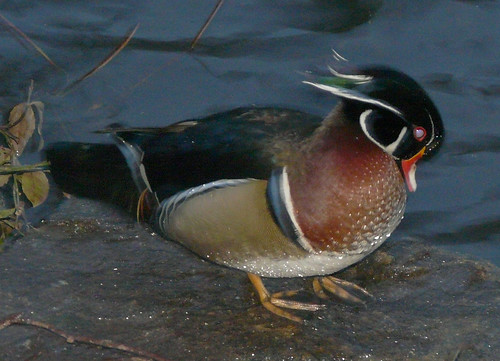
Even the feet on this wood duck are fancy. Why does he keep hanging out with the homely mallards?

Saturday, February 27, 2010

Central Park Coyote Faces Death Despite Offer of Reprieve

The coyote that's been living discreetly in Central Park for the last month is now on wildlife officials' hitlist. Fearing rabies, the Department of Environmental Conservation is trying to trap the coyote and euthanize it, wildlife rehabilitators familiar with the case say. That's too bad because local rehabbers have offered an alternative: They're willing to put the coyote in the standard 10-day quarantine, then find a suitable release site outside the city.

In the past, the DEC has trapped coyotes and at least made an effort to release them. (Hal, the 2006 coyote, died from stress, rat poison and heartworm, according to the necropsy.) What's different this time is there is widespread rabies in the raccoon population in upper Manhattan, especially the north woods of Central Park, where the coyote trots after spending the day sleeping in the isolated Hallett Nature Preserve near 57th Street and 6th Avenue.

These animals aren't exactly making a reappearance in Manhattan after being vanquished for centuries. They are a slightly different species than ever lived here before; they aren't really coyotes, which live out west, but coywolves--a hybrid of versatile, small western coyotes and the gray wolves that were hunted out of the east. Jon Way, a biologist at Eastern Coyote Research, is pushing for them to be classified as a native species since they weren't introduced by humans and are the natural product of canines evolving to survive in the habitat altered by humans.

Coywolves are now established across the eastern U.S., where they are enjoyed by some and hunted as invasive pests without limit by others. Way believes they could be the answer to the deer overpopulation problem in a way larger, warier wolves could never be. But even though coyotes have been showing up in New York City since at least 2004, there's no plan to manage them. Packs live freely in Van Cortlandt and Pelham Bay Park. The DEC is trying to catch one that shows up regularly in a Jamaica, Queens, housing project. (Long Island, of which Queens is a part, is so far the only place in the eastern U.S. not colonized by coywolves.)

This coywolf is in a complicated situation even if he's captured, safely handled, and cleared of rabies. He can't be released in the city. The DEC doesn't want him released into a park or a distant one of their districts (because he could spread disease). If he's released upstate, someone will likely just shoot him. One coyote was successfully released onto private land upstate and this is the coyote's best shot. DEC is not dead set--yet--on euthanizing the coyote. They're only working to catch him weekdays. If he gets put in an appropriate rehabber's care, he may be let be. Meanwhile, public support for the coyote may grow now that New York magazine has covered him. New Yorkers may not want a coyote hanging around Sheep Meadow, but they don't want him shot for nothing, either.

Where to See Wild Animals Around New York City

Read more about coywolves
Read about the coywolf from its original tracker, Urban Hawks
Check out the Eastern Coyote Research center

Friday, February 26, 2010

Central Park's Elusive Coywolf

Coywolf Hill
Coywolf Hill,
This is the kind of distant, lousy glimpse of the Central Park Coywolf you'll get after much effort.

In other words, he's not bothering anyone. To see much better pictures, check out Urban Hawks.
Last night I got to see a coywolf in Central Park. I went at dusk to see the coyote Bruce Yolton has been tracking at urbanhawks. After an hour of walking in the slush around the pond near 57th Street, I got to see him or her for a few minutes. So, it's not as if he's marauding joggers or stealing hot dogs from vendors. But the big question is whether somebody's going to panic and demand his capture. Or really,  knowing New York, when.

As Yolton has pointed out on Urban Hawks, his excellent photoblog of NYC wildlife, the coyote seems to be sleeping during the day in the Hallett Nature Sanctuary, the only part of the park off limits to people and dogs, which is surrounded by water and fence. Once again, I didn't have to be a good enough spotter to see the coyote in the dark, just good enough to see Yolton with his massive lens and tripod. The coyote lurked by the pond edge, then headed back up the sanctuary's hill, where he could have been seen by anybody on 57th Street. Then he gave us the slip. He's been spotted in the north end of the park, too.

This coywolf, or perhaps others, have been spotted in Manhattan all month. No one is sure how many there are and if they're still just passing through or whether they have decided to give Manhattan a go. Coywolf biologist Jon Way has documented this new predator of the east, a hybrid of extripated wolves and western coyotes, heading into downtown Boston. They're far smaller, more adaptable and accepting of humans than wolves and could be the answer to all kinds of other animal issues, like rats or deer.

Far more pass through than establish a territory, but Way thinks this one could be trying to settle here.
"Remember any habitat that doesn't have other coyotes/coywolves is available habitat and Central Park would make a fine place for a pair to establish a territory and raise pups," Way says. "I hope it happens and it's great news that people are leaving it alone."

Well, for now, they are.

Where to See Wild Animals Around New York City
Read more about coywolves
Follow Urban Hawks 
Check out the Eastern Coyote Research center

Tuesday, February 23, 2010

Coyote Filmed Playing Ice Hockey With Bottle in Central Park

Wildlife photographer Bruce Yolton, who runs the Urban Hawks blog, shot a video Monday night of a coyote (well, really a coywolf) playing hockey with an empty bottle on the pond near the southeast corner of Central Park. That's right, the coyote coyote who was up at Columbia University earlier this month maybe went further south in the park, right on the edge of midtown and the Plaza Hotel. You can see the coyote lick the bottle, as if hoping for a last drop of food. And he's close enough to the street that you can see emergency lights flashing on the ice.


Yolton is known for stalking the park at all hours and getting incredible wildlife shots--often keeping them secret for months so he doesn't attract crowds that disturb wildlife. He'd reported in early February that a coyote was in the park. He thinks this coyote may have discovered the peninsula that sticks out into the pond and is a preserve.

Often when a species is off wandering on its own, it's a young male looking for new territory. In March 2006 another young male coyote made a media spectacle of himself in Central Park; one year old Hal was finally caught, then died in captivity from a combination of stress, heartworm and rat poison. Let's hope this one quietly makes it back to the Bronx.

How You Can See Wild Animals Even in New York City

Monday, February 08, 2010

Coyotes Trot Around Columbia University; Panic Ensues

Three coyotes were spotted trotting around Columbia University in upper Manhattan this past week. The Ivy League university put out a public safety warning for all students to be on the lookout for the canines. DNAinfo says these sightings were Wednesday; Gawker puts it at Sunday.
Three animals identified as coyotes were observed in front of Lewisohn Hall [116th Street and Broadway] this morning, 911 was contacted and NYPD responded. NYPD spotted one of the animals and confirmed it was a coyote. The one coyote that was seen by NYPD and CUPS went behind the CEPSR build and it is believed exited the campus.
An additional sighting by CU facilities was called in approximately 10:00 AM this morning but was not confirmed. All members of the community are advised not to approach these animals.

There's a bit of a breathless freak-out online, but many New Yorkers have been wiser, pointing out they could help with the rat and pigeon problems. They'll figure it out and go back to New Jersey or Westchester or wherever they're from. (Columbia is within a mile or two of five smaller bridges to the Bronx.) They must be pretty unobtrusive to have made it all the way to Columbia--through some of the most densely populated areas in the country--without anybody noticing.

As a wildlife rehabber, I sometimes get calls from New Yorkers about raccoons. The raccoons aren't in distress; people just assume they must be in some kind of trouble to end up here. The research by biologist Jon Way up on Cape Cod shows how coyotes maintain their own territories, but until the find the right place, they can move great distances as transients, getting a free pass through other coyotes' turf.

The very few coyote attacks on records have mainly been on unattended children. This being New York City, people don't leave kids, pets or anything else they value unattended anyway.

Others question the NYPD's judgment that these animals were coyotes and not just stray dogs. It is hard to tell, especially from a distance. Coyotes are much more spooky; they are generally terrified of people. Their scat is often full of fur. When they run, they put their back paws in the same track as their front paws. This "direct register" track is much more tidy and efficient.

Way's research shows that the people of Morningside Heights would be far safer if those were coyotes roaming around.


 Eastern Coyote (Coywolf) facts:
    Feeds mostly on small mammals
§         Opportunistic predators – fruit to meat
§         Mice, voles, rabbits, woodchucks
§         Larger mammals where available (like deer)
    Dangerous food items
    Habitat: Rural (wilderness) to urban
§         Prefers edge habitat
§         Agricultural and suburban areas are perfect
    Provide cover and high prey numbers (edge habitat)
§         Lives in 49 of 50 U.S. states and everywhere except Long Island and offshore island.

Are Coyotes Dangerous?  Keep it in Perspective: Coyotes vs. Dogs
    4.7 million dog bites per year in U.S.
§         800,000 need medical attention
§         1,000 people per day go to ER
§         15-20 people, on average, die per year
     3-4 coyote bites in Massachusetts’ history
§         2 of 3 or 4 were rabid
§         1 fatality (in California) in recorded history in N.A.
     Dog bite losses exceed $1 billion per year
§         $345 million paid by insurance


Read an interview with John Way
See Wildlife Around New York City

(Alma Mater photo courtesy of by danamdefebbo)

Wednesday, January 27, 2010

4 Budget Cuts that Save U.S. Taxpayers $280 Million AND Help the Environment, Animals and Wildlife Watchers

President Obama wants to freeze the tiny part of the federal budget that applies to programs in the environment, parks, education and transportation. I've seen this movie before and know this political gimmick doesn't have a happy ending for wildlife. But here are four easy way to cut the federal budget by $280 million a year and help the environment, wildlife and animal watchers.

Discount Grazing on Public Lands: $121 million
Wild Horse-Roundups and Permanent Holding:  $85 million a year
Killing Coyotes, Starlings and other "Bad" Animals: $71 million a year
Rounding up Yellowstone Bison $3 million


1) Stop Cattlemen Welfare $121 million Cattlemen get to graze on federal land for about one-tenth the cost they would have to pay the private sector. This is a program both the left and right hate. The CATO Institute calls it "land-use socialism."
Cowboy on the Snow
Ranchers now pay about $1.35 per animal unit per month (AUM), compared to $13.50 in the real world. Just to break even the federal government should be charging between $7.64 and $12.26, a GAO report found. We could stop losing $121 million by charging market rates.
I'm a meat eater and amid the myriad choices of grass-fed and dry-aged, I've never gotten a special deal on federal land beef. If the massive federal lands were put on the free market, it would probably drive down costs for all ranchers--and consumers.
(Photo courtesy of Sharat Ganapati)


2) Stop rounding up wild horses : $85 million a year
We really have more wild horses in captivity that we know what to do with--about 33,000. The Bureau of Land Management started amassing mustangs under Bush, then proposed selling them to slaughter in 2005. The public was repulsed.
Each horse costs about $333 to round up (based on the $900,000 the BLM spent to catch 2,700 horses). Then it costs about $500 a year each to keep them.
But, we're still rounding up horses--another 12,000 this year. That will put nearly two-thirds of the wild horse population in federal custody at a cost of about $85 by 2012.


3) Stop Killing Coyotes and Starlings: $71 million a year
The federal government spent a stunning $71 million in FY2010 on the widely discredited science of killing 2.4 million predators and "nuisance" animals. The predators taken are quickly replaced by other animals moving into the territory. Wyoming spent $2.2 million federal tax dollars in 2007 to kill 11,000 coyotes, 300 foxes, 1,000 pigeons, 600 ravens and 55 wolves (among other animals they decided were bad).
Whether you think these animals should survive or not, you have to question whether federal tax dollars should be spent removing them.

The federal government also paid to dispatch (partial list)
1,177,00 starlings
335,000 cowbirds
90,000 coyotes
86,000 pigeons
16,000 cormorants
13,000 mourning doves
13,000 raccoons
6,000 squirrels
500 stray dogs
1,100 prairie dogs
1,110 feral cats
6,000 rabbits
876 robins (including 776 shot on purpose in Mississippi)
400 otters

344 wolves (including four critically endangered Mexican gray wolves that you are also paying the Fish and Wildlife Service to bring back)
336 cougars
84 mockingbirds
52 pelicans (including one brown pelican, then classified as endangered, intentionally shot in Florida)
43 Sandhill cranes
1 flamingo


4) Stop Rounding up Yellowstone Bison $3 million

Again, lay this one on the cattlemen. The various government agencies (parks, forest service, USDA) say they needs to limit bison because they might give a disease to 200 neighboring cattle.
"The U.S. government spends about $3 million a year to manage wild buffalo like livestock inside Yellowstone Park through its capture, quarantine, and vaccination program, all intended to prevent buffalo's natural migration to adjacent National Forest lands and on private lands where people want and respect them as wildlife," says Buffalo Field Campaign habitat coordinator Darrell Geist. He also points out that doesn't even count crop and livestock subsidies, giveaways to mining companies and gifts to
oil and gas interests. 

They could just stop giving out the money-losing grazing rights to the land in the valley. Remember, it's a money losing proposition anyway. But on top of that, we're paying to round them up and ship them off. Even though seeing bison is one of the reasons Americans like going to Yellowstone. BFC's. Habitat Coordinator Darrell Geist says they could probably buy out the cattle for about $1 million.


Where to Go to See Wolves
Places You Can See Bison

Wednesday, January 13, 2010

Enjoying Your Local Coyotes (or Coywolves)

stealth cam coyoteMy family in Illinois shares theories and gossip about the resident coyotes. Living in New York, I miss out. So I wanted to contribute to the family pastime when I visited over Christmas. The new tools this year: a game camera and Suburban Howls from John Way of the Eastern Coyote Research. The camera is great to see what's going on at night, but Way's book was exactly what we need to figure out what was going on.


My sister Mary Ann has been tracking these coyotes--really coywolfs--the longest. Like many animal-watchers, she gives them names based on their appearance or behavior, such as Fluffy, with the thick coat. Fluffy had pups this spring and in the fall a friend found the den in a thicket.

Last year I got Mary Ann a motion-activated camera designed for hunters, which she more or less ignored. Ok, she claims to have put it out but got nothing but raccoon pictures. We could see in the snow that two compost mounds were clearly high-value real estate in coyote-world. They had tons of tracks and pee. We set the camera there and got a picture the first night.

But without some knowledge of coyote world, we didn't know how to explain what was going on. That's where we really need Suburban Howls. Way does a great job of synthesizing the body of knowledge on eastern coyotes or coywolves and describing his own research and findings. We had theorized the coywolves liked the mounds either because the composting made them warm or because rodents lived inside. But Way describes how coyotes use little hills to keep a look-out.

My sister showed me the den, but we didn't see any tracks going in. Way explained that coyotes only use it for raising puppies. Otherwise they have rendezvous points, little meet-up spots, preferably in secluded woods.

coyote yawns on lake zurich
One day we saw a coyote lying dead on a highway about 6 miles away. Our first hope was that it was too far for the family pack. But Way found coyotes his adult coyotes moved "at least 10 miles a night" and occasionally even 25 miles.  But it turned out it probably wasn't one of the resident coyotes, or at least there were at least two left.

We got only tiny glimpses of our coyotes--either unsuccessfully looking for lunch on the frozen lake or sniffing around these mounds at night. But thanks to the book, we learned the basics of their family life, how pups either become helpers, staying around to raise the next litter; dispersers, taking off on their own; or "slouchers," those that stick around but don't help.

We're still learning about the local pack. After years of frustrating ignorance, Way gave us a hint of what's going on and a chance to see what it's like to track them seriously. He tells stories of tracking one coyote to near the Boston Garden and walking in on one that looked dead in winter snow, but turned out to be three canines sleeping on top of each other. He's also an inspiring advocate for people who just want to watch wild animals in a management geared almost exclusively towards hunters. I was going to give the book to my family to keep, but I like it so much I'm keeping it and getting them their own copy.

Read an interview with John Way

Friday, November 20, 2009

Meet the Coywolf, the New Canine Predator of North America

You can spend thousands of dollars watching wolves in Yellowstone or $50 - $200 to get a much closer and scientific view of the new canine species that is replacing the wolf: the coywolf. And if you'll have trouble getting to Cape Cod by dusk or dawn, you can even stay in the house of wildlife biologist Dr. Jon Way so he can take you out to see the animal he studies.

Way can take you along for field work when he's using his radio collars to track the animals that are laregely taking on the role of predator across the east, where the wolf was wiped out. He describes his accomodations as "rustic casual:" you sleep in the basement and eat with his family. But the real attraction is the coywolf  and Way, one of its strongest advocates. He is pushing to change the way the coywolf is classified and treated.

Some state wildlife agencies (in the mid-Atlantic) have been treating these coywolves, which are conspicuously larger than western coyotes, simply as an invasive species from the west. They appeared after the wolf was wiped out. Invasive (as opposed to native) means they don't belong and were introduced by humans. The invasive designation means about the only management these new coyotes get is hunting by the federal government through its controversial Wildlife Services agency. Even in states where it's not labeled invastive, there's no bag limit and long hunting seasons--something Way wants to change.

"We should not be calling this animal a coyote. This animal is really a native animal, essentially a product without human assistance," he says. "By getting rid of wolves, we clearly opened up the niche for this animal."

The evidence is showing that the coy-wolf--a term Way predicts will catch on within a year or so--is really a hybrid of the coyote and the endangered Eastern Red Wolf (Canis rufus). Those invasive-native categories have come under attack in books like Playing God in Yellowstone because they presume the American wilderness was pristine and frozen before Europeans showed up.

The coywolf has forced biologist to rethink many old classifications. They are discovering that many of the previously distinct species of wild dog may really be the same. The red wolf is being reintroduced but one of the obstacles is that the animals go out and breed with coywolves.

What we're witnessing is evolution in our lifetimes. The wolf's niche was largely wiped out by development, but a slightly different niche opened up and the coywolf filled it. The coywolf is more amenable to living near people and more flexible in its diet: it eats tiny rodents up to deer.

Eating deer may be the thing that makes the coywolf popular. Way thinks the coywolf could be the answer to the exploding deer population--if people would just let the coywolf do its job.

"The answer is right in front of our face," he says. He supports the reintroduction of the wolf, but thinks they're never going to be able to be as widespread or effective as the coywolf in modern America. Wolves won't be able to exist in suburban areas where deer generate complaints.

Way would like to end the no bag limit hunting that is keeping coywolves in check. About 400,000 coyotes are killed every year, according to a story by Mike Finkel in Audubon. "That is more than 1,000 coyotes a day -- almost a coyote a minute," Finkel writes. The federal government is, remarkably still in the business of predator eradication and its Wildlife Service division itself killed 89,300 coyotes in 2008.


The Adirondacks tourism office, for example, boasts that call coyote hunting "one of the fastest growing sports in the country." With an estimate of 20,000 to 30,000 coyotes in New York, the office pitches, "there are plenty of opportunities in the Adirondack Park." In Way's Massachusetts, last year hunters killed 442 coyotes, almost double the previous years' total.

Way wants to encourage another way to enjoy the coywolves: come out an watch them in action. Aside from his personalized treks, he hopes to open a center so people can learn and enjoy them all the time.