Update: 1010 Wins has amazing video of the coyote giving cops the slip around 23rd Street around 3 a.m. last night. That means he headed south instead of his usual north. Cops chased him--while someone shouted Let him go! Let him go! Then he was spotted heading back up to 57th Street, probably the Hallett Nature Preserve, where he's been sleeping in Central Park.
The coyote (really a coywolf) continues to prowl around Central Park, despite what he hear are efforts to trap and euthanize him. I went up to Central Park last night to catch a glimpse. I got nothing. But Bruce Yolton tracked him out of the Hallett Nature Preserve, where he sleeps during the day, and through a circuitous path of the lower park, avoiding people. I called the Department of Environmental Conservation, but so far haven't heard back about their plans.
The state DEC is trying to capture the coyote and euthanize him to test for rabies, which is infecting raccoons in the northern part of the park, one wildlife rehabilitator told us. Killing an animal is the only sure way to find out quickly whether it has rabies. Or you could just wait and see if he gets sick. This rehabber is qualified to take the coyote in for a quarantine period (10 days) so he wouldn't have to be killed, but so far the DEC hasn't given the okay. If someone just so happens to catch the coyote and bring it to the rehabber, fine. Meanwhile, another rehabber says the department is getting tired of being thwarted and may try to shoot the coyote with a tranquilizer.
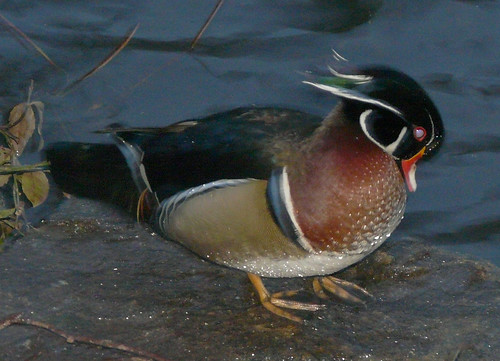
Of course, no one is going to accidentally catch this coyote. I've gone up there three times at dusk, eagerly looking and only caught a glimpse of him once. I am getting to know the lone wood duck that is hanging out with mallards in the pond, I met some nice visitors from Virginia who were bemused with our excitement and I got to play with an experimental digiscoping tool: a video camera hooked up to a night vision scope by some hardware from Ace. It looks very country. I'm not sure I'll be able to focus. But you can imagine that if a coyote happened to wander into the range of my lens at the right moment, how neat that would look.
The Fish and Wildlife Service is auctioning off 300,000 items made from wildlife to save on storage costs. Don't expect any rhino heads or elephant feet. They aren't selling anything endangered and the listings so far are pretty tame: Avon watches or Cole Haan "leather driving slippers w/ dog-faces water snake skin trim." This isn't what you fear: it's a kind of snake.
The Sage Grouse might be declared endangered by next Friday. Guess what? The Wyoming Tribune doesn't think they deserve it and thinks the 2005 decision by the Bush administration--though found tainted by politics--was just fine.
This cow in India can milk herself. She doesn't need anyone to pull on her udders, she just whizzes the milk away.
The coyote that's been living discreetly in Central Park for the last month is now on wildlifeofficials' hitlist. Fearing rabies, the Department of Environmental Conservation is trying to trap the coyote and euthanize it, wildlife rehabilitators familiar with the case say. That's too bad because local rehabbers have offered an alternative: They're willing to put the coyote in the standard 10-day quarantine, then find a suitable release site outside the city.
In the past, the DEC has trapped coyotes and at least made an effort to release them. (Hal, the 2006 coyote, died from stress, rat poison and heartworm, according to the necropsy.) What's different this time is there is widespread rabies in the raccoon population in upper Manhattan, especially the north woods of Central Park, where the coyote trots after spending the day sleeping in the isolated Hallett Nature Preserve near 57th Street and 6th Avenue.
These animals aren't exactly making a reappearance in Manhattan after being vanquished for centuries. They are a slightly different species than ever lived here before; they aren't really coyotes, which live out west, but coywolves--a hybrid of versatile, small western coyotes and the gray wolves that were hunted out of the east. Jon Way, a biologist at Eastern Coyote Research, is pushing for them to be classified as a native species since they weren't introduced by humans and are the natural product of canines evolving to survive in the habitat altered by humans.
Coywolves are now established across the eastern U.S., where they are enjoyed by some and hunted as invasive pests without limit by others. Way believes they could be the answer to the deer overpopulation problem in a way larger, warier wolves could never be. But even though coyotes have been showing up in New York City since at least 2004, there's no plan to manage them. Packs live freely in Van Cortlandt and Pelham Bay Park. The DEC is trying to catch one that shows up regularly in a Jamaica, Queens, housing project. (Long Island, of which Queens is a part, is so far the only place in the eastern U.S. not colonized by coywolves.)
This coywolf is in a complicated situation even if he's captured, safely handled, and cleared of rabies. He can't be released in the city. The DEC doesn't want him released into a park or a distant one of their districts (because he could spread disease). If he's released upstate, someone will likely just shoot him. One coyote was successfully released onto private land upstate and this is the coyote's best shot. DEC is not dead set--yet--on euthanizing the coyote. They're only working to catch him weekdays. If he gets put in an appropriate rehabber's care, he may be let be. Meanwhile, public support for the coyote may grow now that New York magazine has covered him. New Yorkers may not want a coyote hanging around Sheep Meadow, but they don't want him shot for nothing, either.
Manhattan raccoons, faced with an epidemic of rabies, are going to get trapped, vaccinated and tagged (so they don't have to go through the ordeal a second time.) There was a mild panic this winter in the city as rabies started showing up in the raccoons of Central Park and upper Manhattan.
People may have panicked more if they realized how many raccoons really live in this densely packed city. The New York City Health Department has found 49 rabid raccoons in Manhattan, mostly in the top 13 blocks of Central Park. (Oddly, the state isn't keepingup.) As a wildlife rehabber I get calls from people who just spot raccoons in the city. The raccoons are fine, but people assume something is terribly wrong if a raccoon is living here.
That's a relief to animal lovers who feared they'd just be rounded up and euthanized--an animal control strategy that usually doesn't work because new animals just move into the undefended territory.
If you go on an owl walk at dusk in summer in the North Woods of Central Park, you'll be amazed at how many raccoons you'll see. They'll be sleepily climbing out of tree cavities and holes between boulders to start their day.
American pets don't get rabies much anymore because they get vaccines. The northeast has a huge population of rabid raccoons thanks to hunters who imported them from dealers, John Hadidian, head of the Humane Society of the United State's Urban Wildlife program. The American Journal of Public Health traced the outbreak to hunters who in the late 70s illegally imported raccoons from Florida animal dealers to shoot. At the time the southeast accounted for 98% of raccoon rabies diagnoses. One quarter of shipments later studied had rabid animals.
The Chinese government now blames outbreak of pneumonic plague that killed 3 people in central Qinghai province on a dog. If I were a Chinese dog, I'd be going into hiding about now.
Beijing has a habit of mass dog culls to fix (or at least assuage anger over) health problems. In 2006, government workers beat 50,000 dogs to death in the streets after they were blamed for causing three deaths from rabies. Despite world outrage and nausea, the practice continues. In May another 20,000 dogs were brutally dispatched, some on film.
Professor Wang Hu director of the Qinghai disease control bureau told Xinhua that the first to die, a 32-year-old herdsman, had just buried his dog, who might have gotten plague from a marmot he ate.
That may all be true, but I'd bet that Beijing's desire to cast blame and their hostility to dogs may play a role. There are a couple problems with the theory. Dogs can get plague, but they usually don't get that sick from it. Pneumonic plague doesn't need to be spread by fleas and blood like bubonic plague; pneumonic plague is airborne.
Unless there are already undercover cameras in that isolated town like there were at the May dog slaughter, we probably won't find out how many dogs they kill over this.