We've Moved!

Hi and Welcome to the AnimalTourism.com blog. But we've moved just down the street to this site, animaltourism.com/news. Please comment there.
Showing posts with label hawk. Show all posts

Monday, May 17, 2010

Will NYC Get an Official Wildlife Care Center?

The Wild Bird Fund, which is New York City's defacto wildlife rehabilitation center, collected signatures this weekend to become the city's official place to go with injured, sick or orphaned wild birds and animals. They explained to people at a wildlife fest that New York is the only big U.S. city without a real wildlife care center.
wild bird fund is working to get a nyc wildlife rehab center

So a bunch of volunteer wildlife rehabbers have picked up the slack. Rita McMahon and Karen Heidgerd run the Wild Bird Fund though  Animal General, a vet practice that donated care for 1,146 birds and 13 mammals last year.


Theodore Roosevelet Sanctuary Hawk Talk
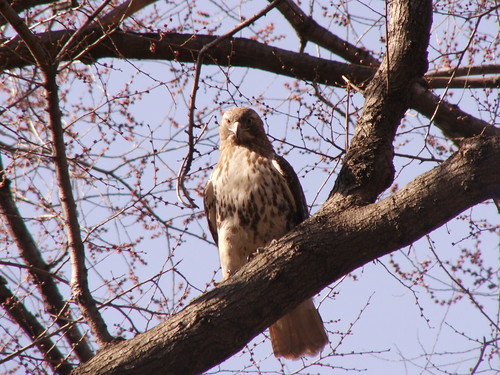
Hawk from Teddy Roosevelt Audubon Sanctuary
Ruby and squirrel babyA handful of other rehabbers do heroic amounts of work, too. Bobby and Kathy Horvath take the really hard cases, like coyotes and injured hawks. Vivienne Sokol is Manhattan's bird rehab expert. My friends Vicki Puluso, Chris Durham and Maura Mondrano handle squirrel cases.


Because the city is strapped, the Wild Bird fund is hoping to get a grant from Pepsi. Bobby Horvath has told me the plan got a boost after the recent coyote episode.

The New Yorkers that call me with animal troubles are usually surprised the city doesn't do anything for wild animals. Renee, a pregnant mom from outer Queens, about a day and night worrying and searching for some solution for the baby squirrels she found abandoned in her air conditioner. (I got to see them at the fest, looking plump and happy. Another rehabber, Ruby, took them in. New Yorkers see baby squirrels like unseen mythical beasts).

The finders and baby squirrels show up as if with a dowry of a cage, esbilac, dishes, blankets and nuts. Which makes me think New Yorkers would be behind getting the center going.


Donate to the Wild Bird Fund
Sign Their Petition to Get a Real NYC Rehab Center
Where to See Animals Around New York City

Friday, March 05, 2010

Hawk Expert Says Attacking CT Hawk May Have to Be Removed--or at Least Scared

The red-tailed hawk that's been swooping down on people in leafy Stonington, CT, may have to be trapped and removed, says Len Soucy, a wildlife rehabilitator, founder of New Jersey's Raptor Trust, and one of the world's most experienced  hawk experts.

"When there's a nuisance hawk, I relocate it," Soucy says, "so people don't hate all the hawks on earth because one hawk is acting foolish."

Soucy has the traps, permits and experience to trap a red-tailed hawk, but it's still a last resort. The hawk is probably protecting his territory in advance of nesting season, which starts over the next couple months, he says. He might try to condition the hawk with loud noise first, a process that can take a while work.

Birders travel great distances to see hawks, but this particular CT hawk in will come directly to you. And then he'll swoop at your head and maybe steal your hat or headphones, the Day reports. The bird has attacked five times since last summer, mostly on the cul de sac of Shawondasee Drive and Carriage Drive. The nearby Deans Mill School now has recess and gym inside, though, just in case.

Hawk attacks on people and pets may continue to rise along with the numbers of red-tailed hawks (Buteo jamaicensis) . (They're one of the many birds recovered thanks to bans on DDT and reactionary killing of birds of prey.)  Soucy says he's gotten two reports of similarly belligerent hawks in New Jersey this season. One hawk lifted a chihuahua puppy and broke his leg. The males, which are smaller, aren't the only nuisances. Often the female will join in the attacks once the chicks hatch.

"Once the chicks are hatched, you'll have a double dose." Soucy says. "They're just a pain in the ass."


See Animals in the Wild in the Northeast

Tuesday, February 02, 2010

Score One for Team Squirrel

The Tompkins Square Park squirrels bravely stand up to the new, popular red-tailed hawk pair on the Lower East Side. The hawks appearance on Saturday Night Live doesn't intimidate them, either. The squirrels know that if they are in a tree, the hawks can't swoop down and catch them.


So if the hawk lands in a tree the squirrels eagerly do their part to chase him off. They're in the anti-hawk union with crows and jays, who mob the raptors. Because they all know if they don't, the hawk will eventually catch one of them.

The squirrel can do considerable damage to a hawk by biting its feet, which may then become infected. The squirrel made the hawk uncomfortable enough to go back on its heels, change branches, then fly off. He flew to another tree, where another member of the anti-hawk union started to drive him away.
Where to See Hawks and Eagles

Friday, January 29, 2010

Hawk Hit By Plane Recovering From Burns

We're heard plenty about birds hitting planes since the USAIR crash into the Hudson last year. But what about birds hit by planes? An Illinois red-tailed hawk somehow got hit by a crashing private plane (or its fireball), caught fire and survived. Or at least that's the going theory of the Flint Creek Wildlife Rehabilitation Center, which took in the singed bird.

Tragically two men in their 30s died in the crash in Sugar Grove. But four people, including two kids, in a very close house survived.

Then rescuers found the bird with all its feathers burned off. They figure it's a red-tailed hawk--by far the most common hawk--and a female, the bigger of the species. But that's just a guess, the center's blog say:
Burned beyond positive species identification, Phoenix was recovered by Kane County Animal Control and was promptly transferred to Flint Creek Wildlife for emergency care. Since that time four nights ago, she has been receiving around-the-clock care for her injuries.

“When I saw the bird, I was shocked,” said Dawn Keller, the center's executive director.  “This was nothing like I’ve ever seen. It had to have been engulfed.” She only has down left and has burnt feet, throat and eyelids. Still the center will work to release her if she is able. Otherwise "Phoenix" will become an education bird.

Keller had to explain to the local media that Phoenix was not guilty of causing the crash. "The crash happened after dark, which means she was already sleeping for the night. If she got sucked into the propeller or engine, she'd be dead. She was just an innocent bystander...," Keller told the Beacon News.

Just last month the center rescued another raptor in a transportation-related mishap. A Ferruginous hawk (Buteo regalis)  rode thousands of miles on a freight train out of its range in western Canada before it was finally discovered stuck in the train's grill in Franklin Park, suburban Chicago.

Donate to Flint Creek
Where to see Hawks and Eagles

Tuesday, July 28, 2009

Is West Nile Causing NYC's Red-Tailed Hawk Boom (by Killing Crows)?

Robert DeCandido, PhD, a bird biologist who lively tours of owls and other avians in Central Park, has agreed to let me run his newsletter here. Birding Bob is always full of great information not only about New York City birds, but wildlife in general.
Photo courtesy of Flickr's Bryce Bradford
Last week's history of West Nile disease in NYC (1999-2009) prompted a few emails - folks filling in the consequences of this Asian disease post 1999. What has changed in the local environment in the last decade? Most noticeably, the American Crow population has not rebounded to pre-1999 levels, especially during the breeding season. And wintering populations of 50 or more crows in one park are unusual. Gone are the days when one could find a Great Horned Owl in many of NYCs (larger) parks by simply following the cacophony of crows surrounding the owls.


And during this same time frame, as the crows have precipitously declined as residents in NYC, the population of Red-tailed Hawks as breeders has increased exponentially. Is this simply correlation (two un-related events occurring simultaneously) or causation? Time may tell

A second noticeable change has been the decline in certain insect species - especially Tiger Swallowtail butterflies which were once common in our area in summer. There are other changes, such as a severe decline in Ring-necked Pheasants in our parks - these are verging on extinction locally...but tracing the decline of Asian pheasants to West Nile is more difficult - it might be mere correlation.

Finally, other insect species such as certain wasps that laid their eggs on the leaves of cherry trees have declined as well...but most people would not notice these even if they disappeared from our area completely.

In our Bronx neighborhood, one exotic bird species continues to increase, and is now nesting on at least a few Bronx streets. We even have them feeding in our pear trees in our yard each July-August: And while we are at it, another (native) bird has made a remarkable comeback as a breeding species since the late 1990s, particularly in Pelham Bay Park in the Bronx:
Our historical reports this week highlight a breeding pair of American Coots in Queens (2000); 70+ Cormorants in the Reservoir of Central Park (28 July 1999); and the first record of breeding Blue-grey Gnatcatchers in New York City at Pelham Bay Park (27 July 1999). Debs and I have seen families of Gnatcatchers there in July since 1999 - and Gnatcatchers have bred in at least one other NYC park (Prospect Park in Brooklyn, circa 2007). And to show that good things can still be found nearby, we include two news reports about dolphins in the Long Island Sound in late June 2009 (in Queens and the Bronx).
=====================================
Good! Here are the bird walks for this week ($5):

1. Friday, July 31st: $5. Central Park - Meet at Conservatory Garden (105th street and 5th Ave.) at 9am.

x. Saturday, August 1st: No BIRD WALK
2. Sunday, August 2nd: 9:00 am - Central Park - Meet at the usual location: the Dock on Turtle Pond at 9 am. $5.
--------------------------------------------------------------------------------------------
The fine print: Our summer walks on Sundays meet at the Dock on Turtle Pond (approximately 79th street in the middle of the park). Look for Belvedere Castle and you have found Turtle Pond. Bathrooms are located at the adjacent Delacorte Theater (Shakespeare in the Park) - and are nice. We end our weekend Central Park walks at the Boathouse at about noon. On Fridays, we meet at 9am at Conservatory Garden, 105th street and 5th Avenue (just inside the main gates). There are bathrooms open year-round at Conservatory Garden, and that is good. Easiest way to get there by subway is to take the #2 or #3 train to 110th street and Central Park north. Then walk south along the east side until you reach Conservatory Garden. You can also take the #6 train to Lexington Avenue and 103rd street. Walk west for three blocks and then north by two. Finally, buses run up Madison Avenue regularly too. If you need better directions, just email or call (718-828-8262) - especially for how to get to the meeting location of the Saturday walks.

Most bird walks last about two to three hours in Summer, but feel free to leave at anytime, we won't take it personally. We have an extra pair or two of binoculars to rent, so if you want to rent a pair, just call or email before the walk to let us know. Also, if you are thinking of purchasing new binoculars, ask us - we probably have used them, and we will let you know how to get them for the best price.
---------------------------------------------------------------------------------------------
Here is what we saw last week (selected highlights) with some anecdotal notes and observations. Not all species we saw are reported here - we list the best:

Friday, July 24th (North End Central Park) – Lately winds have been more southerly, with seasonable temperatures (low to mid 80s) and humidity levels. Migrants, which drift to our area on northwest winds, have not been as common in the latter half of July as we would hope. Nevertheless, with an intrepid crew of birders including at least two NYC school teachers, we set off to find some lost migrants in the north end of the park. Our best luck was with a bird I have seen in migration at night atop the Empire State Building (in October!) - a Belted (Eastern) Kingfisher was our best find - it flew past us in the woodlands on the north side of the "Loch." We thought we heard it at a distance, and a small nudge from the iPod (kingfisher call) immediately brought the bird to us - and it continued on its way southwest through the woods. By the way, Belted Kingfishers bred in Pelham Nay Park in the Bronx until the mid-1980s...These days they are rather uncommon migrants in our area, though 1-2 may take up residence in Central Park for several days to weeks in spring and then again beginning in late summer, but not every year. Also today we tracked down a pair of Carolina Wrens at the north end...This is very interesting to us: each year beginning in late July, there is a dispersal of Carolina Wrens into our area (perhaps even from other city parks) - and we believe some of them begin nesting in Central Park in August. We are still investigating this, and will have more to report in the coming weeks as we watch this pair at the north end. Finally, no sign of The Hairy Woodpecker pair today, nor the lone White-breasted Nuthatch we had been seeing near the Blockhouse. Our best wishes to Emily Driscoll who is off to Iceland (and Grad School at NYU in film - science documentary.

Sunday, July 26th (Central Park, Ramble area) – With the hope of late summer migrants, off to the Ramble we went. For quite a while we had to be content with a Green Heron seen at Turtle Pond by all, and a House Wren seen by two. From the terrace of Belvedere Castle we spotted not one but two flocks of migrating Red-winged Blackbirds/Common Grackles (mixed) and a female Wood Duck (Carinne Mitchell - off to Cape Cod!) in Turtle Pond. From there we headed to the Ramble in the hopes of finding one of the recently released Eastern Screech-owls (no luck but we are not worried); instead we tracked down some migrants, all in the same area: The Point. From the rocky overlook near the Oven, we pulled in two Northern Waterthrushes (Thanks Sandra Critelli), and a few House Finches feeding on the last of some Mulberries. At the end of the Point, we pulled in another Northern Waterthrush and a Yellow Warbler, a Warbling Vireo, and surprisingly, a pair of very moulty Black-capped Chickadees. At Warbler Rock, we found a just fledged Grey Catbird, and learned that the Red-bellied Woodpeckers are not as aggressive toward intruders now than they were just 2-3 weeks ago. As per the suggestion for Regina Alvarez, we looked for and found a saprophytic native wildflower that grows on its own in Central Park: Indian Pipe (Monotropa uniflora). There were many clumps of this all-white plant that gets its nutrients not from photosynthesis but rather, directly from the roots of trees, particularly oaks on whose roots it likes to grow. Look for it in the area of the bird feeders. Finally, in prior years, we would recommend viewers to head to Turtle Pond at night to see this bird. foraging along the surface for fish. This year the pond is covered with Duckweed (Lemna minor), the smallest flowering plant in the world. Instead the skimmers have shifted their nocturnal foraging to The Model Boat Pond and The Reservoir....Though you can see them until about 9am on foggy mornings there too.

Saturday, June 14, 2008

Hawks Nest on Houston Street in NYC

The NYPD took the last of the three Houston Street baby hawks into custody last night. Now all three eyasses are in the custody of wildlife rehabber and fireman Bobby Horvath, who hopes to have them back in the area within a week.
Documentary filmmaker Adam Welz did an amazing job chronicling the drama. The third hawk flew across the street ok, but ran into trouble flying back. It flew into the school building (where its nest sits on an air conditioner). The hawk tried to cling to the wall, failed, then fell to busy Houston Street.
The hawk watchers swooped in, stopped traffic and picked up the hawk in a shirt. The commotion caused a car accident. The hawk people got the hawk to the yard of the project across the street and wanted to release it. Meanwhile, somebody called 911. The cops came, took the hawk into custody. The hawk guys argued the bird should be left alone. The cops took him up to the dreaded ACC, but Bobby sprung him.

Where to See Animals Around New York City
Accesible Places To See Hawks

Friday, June 09, 2006

Dumpster Owl Serves as Greeter at Carolina Raptor Center

Carolina Raptor Center, Just N. of Charlotte, NC

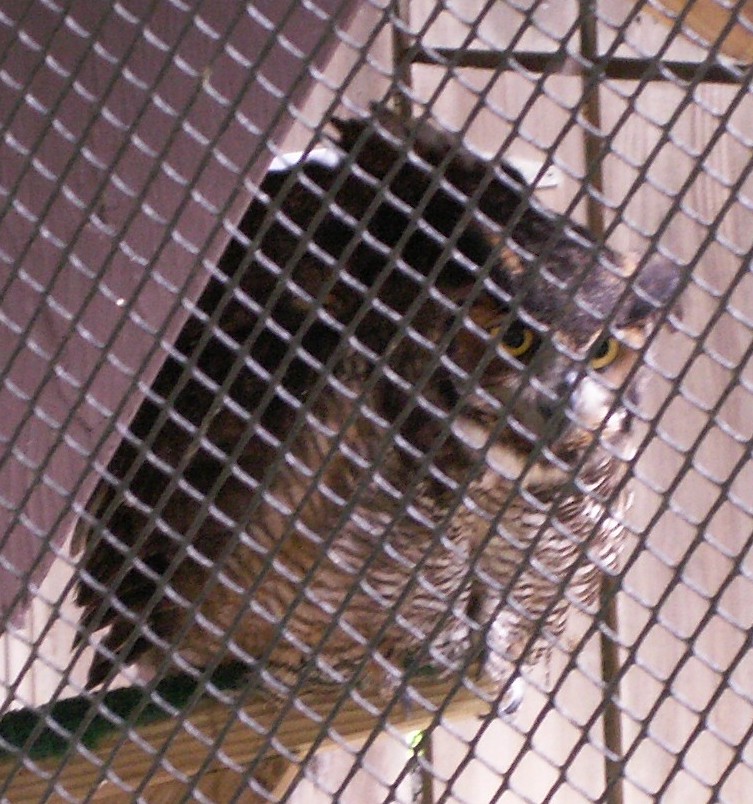
Shelby greets you as you enter the Raptor Center and she's annoyed with you (if you're a dog, for example) she is likely to puff up like she here. Shelby is a great ambassador to the world of injured big birds of prey. Her story is sad, but not that uncommon. She was caught in a leg trap, beaten, then discarded in a dumpster. Someone found her and brought her to the Carolina Raptor Center, which rehabilitates sick and injured birds. Shelby's eyes were too damaged for her to hunt in the wild, so she has a permanent home here.
The center attracts a wide range of visiors--families, scouts, bikers--and most read Shelby's story then ask "Why would anyone throw an owl in a dumpster?"
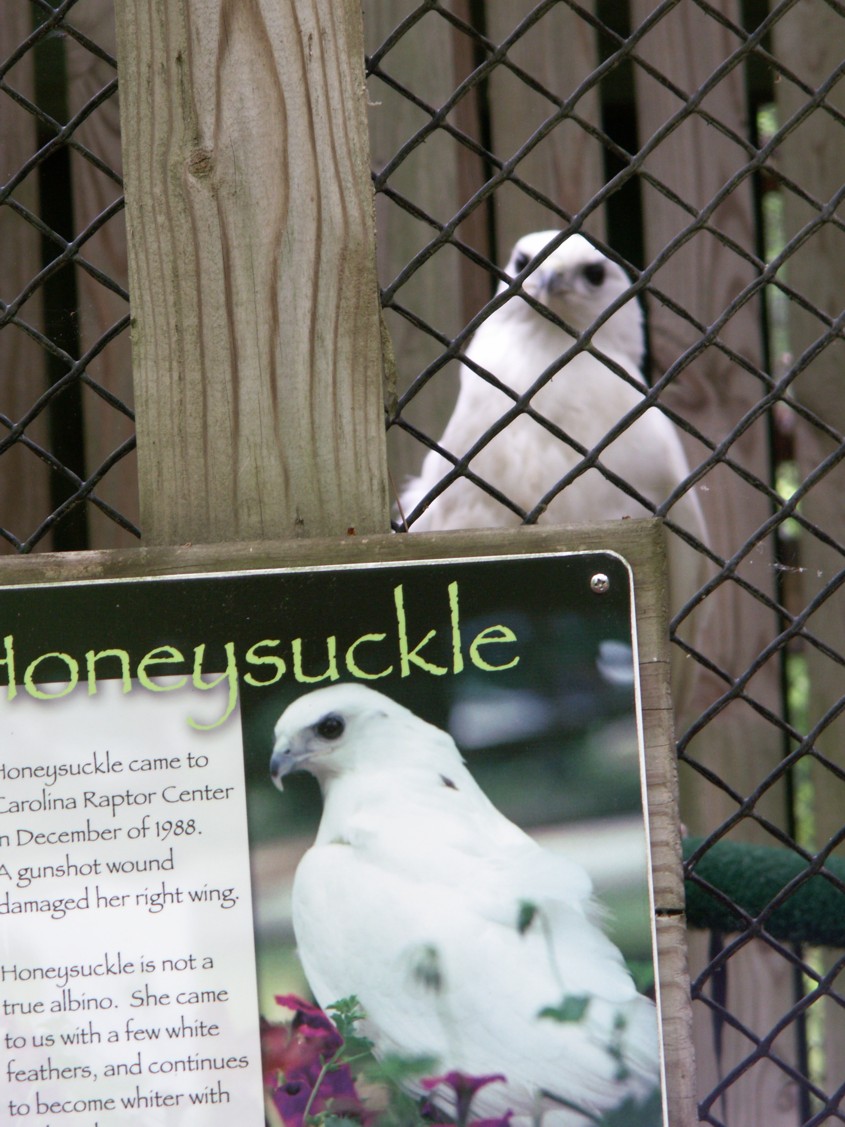
Some birds are nursed to health behind the scenes. About 27% of birds who survive won't be able to make it in the wild. So, 100 live here, including great horned owls, bald eagles, barred owls, screech owls and a part-albino red-tailed hawk.
It takes about 2 hours to see everyone. On weekends there are special shows.

Where to See Animals Down South

Wednesday, January 18, 2006

Hawks Hang on NYC Fire Escapes


Red-Tailed Hawks, Manhattan
Pale Male gets all the press, but there are now red-tailed hawks all over New York (and other cities) eating rats, pigeons and assorted small birds. According to the Parks Deptartment falconer, Pale Male, like all residents of Central Park West, is high achieving. It's a prime spot over a big park. Other hawks around the city, he says, are not as competent. They have lousy territories and a tough time building a nest.
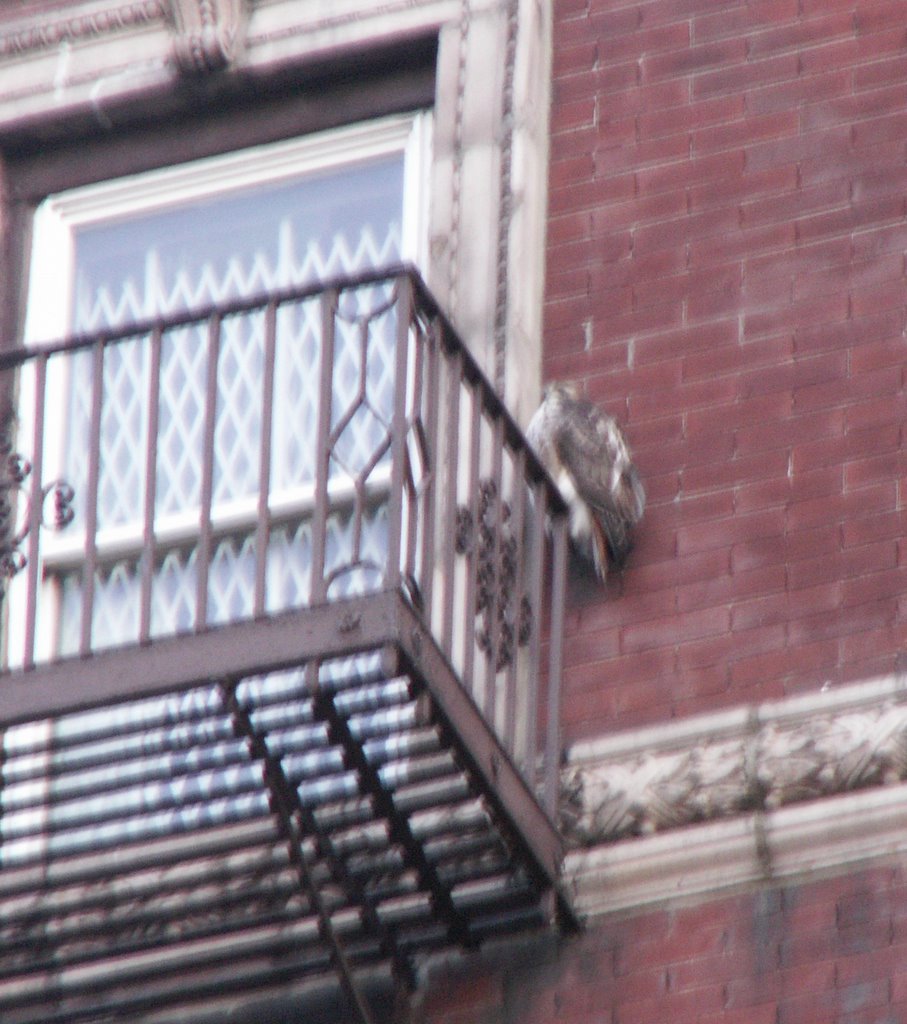
There have been two hawks who show up every winter Tompkins Square Park. This year I haven't seen them in the park, but I have seen one on the top fire escape of a building on the NE corner of 6th Street and 2nd Avenue. I've seen him at sunset and in the morning, but not everyday, so it's probably a semi-regular roost.

Where to See Neat Animals in the Northeast