We've Moved!

Hi and Welcome to the AnimalTourism.com blog. But we've moved just down the street to this site, animaltourism.com/news. Please comment there.
Showing posts with label midwest. Show all posts

Friday, April 23, 2010

Happy Joint Birthday, Indiana Wolves, Enjoy Your Frittata

Would you like to treat a wolf to a frittata? What if you know it was his birthday? And that the wolf happened to looove frittata? Indiana's Wolf Park--probably the most innovated wolf sanctuary in the country-- is having a joint birthday party for its wolves this Saturday, April 24.

All the wild canids (including coyotes and foxes) at Wolf Park breed and give birth around the same time. Last year the center, which started in 1972, started having an adorable birthday party. You can buy your favorite wolf a birthday cake (a $25 donation) and then get a picture of them devouring it.
The cakes aren't really cake, but a frittata with eggs, butter, cheese and chunks of meat, says assistant manager Dana. "The wolves don't really have much of sweet tooth," she says. They are very popular with the wolves. The human visitors enjoy the happy spectacle.

For the wolves that live in pairs or their own enclosures, delivering the cake isn't much of a problem. But some in the main pack got ripped off last year. "The trickeist ones we have are the main pack. Last year we made larger cake they could all eat. One wolf, Tristan, the alpha a the time, just ate it all and was sick afterwards with a tummy ache," Dana says. This year, they'll deliver individual cakes, which they expect the wolves to run off with.

Cake time is 2 p.m. Saturday. Since they don't want any wolves to go without, the $25 really goes to the cake fund. The park spends about $62 a day just to keep each wolf fed, happy, safe and healthy. That's about $23,000 a year per wolf, not including frittata costs.

Wolf Park: This month the center is open weekends 1-5 and on Saturday nights for a howl. In May they'll be open six days a week. General admission is $7, $5 for kids 6-13, little kids free. The howls are the same price. Joint admission is $12. They've also got photo and behavior seminars. They're a little over an hour from Indianapolis and two hours from Chicago (765) 567-2265 4004 East 800 North, Battle Ground, Ind.


Where to Go To See Wolves
See More Animals in the Midwest

Thursday, April 01, 2010

Animal April Fool's

Most of the animal-themed April Fool's jokes this year play on   our overwhelming desire to befriend, understand and get close to our animals.

Michigan's State-Sponsored Canned Deer Hunts
The Detroit Free Press was the boldest and funniest, with a plan to corral Michigan's 1.7 million deer and allow canned hunts in an effort to prevent bovine tuberculosis. "Hunters could drive to any of the eight or 10 state deer ranches after breakfast -- no more need to get up before dawn -- and be in a stand by noon. It shouldn't take more than an hour to shoot the deer and get home in time to watch the football game," a bogus biologist said. State financial crisis? Solved!


Google Translate for Animals
Google gave us a bit of wish fulfillment with Google Translate for Animals, which comes just its only marginally less amazing program to translate a ton of human languages. Hold your Google Android up to an animal and finally get to understand what they're saying. Their demonstration animals were all mushy, only offering compliments and affection. I'd have liked to see more opinionated animals, critiquing outfits, their food, their human handlers.

Montana State Flower
An outdoors writer for the Billings Gazette wrote about a  proposal to recycle all those obsolete, giant satellite dishes at camp sites, providing both shade and some controversial outdoor television enterntainment.

Nanaimo Non-Mermaid
The poor folks at the Nanaimo News on Vancouver Island no longer have a prank story about a mermaid sighting on their website. All they have is this pathetic explanation "for those who missed the clues" that wends its way to the serious point behind it all..."pollution is no laughing matter"...blah, blah, blah. This kind of thing--along with all the other hacky, humorless stories out today bemoaning that offshore oil drilling or whatever sounds like an April Fool's joke but it's serious--is exactly what gives animal lovers and environmentalists a bad name.


Who's Your Emperor Now, Mr. Penguin?
Animals make a natural subject for April Fool's Day pranks. Or so says the Museum of Hoaxes, a hoax authority quoted by the Pittsburgh Post-Gazette, though they count such innanities as calling the zoo and asking for Mr. Lion and such. Occassionally a prankster will hoax an animal, like Tokyo Ueno Zoo did in 2005, putting human emperor penguins in their place with a human-sized overlord.


Where to Go to See Weird Animals

Friday, March 26, 2010

Easter Bunny Will Leave Eggs At Wolf Park--Then Quickly Leave The Enclosure

Kailani finds goodies in an old stump.  Monty Sloan/ Wolfpark.org
The Easter Bunny visits Indiana's Wolf Park this weekend, but don't worry about his personal safety.
The park assures visitors "The Easter Bunny will hop into the wolf enclosure (the wolves will be elsewhere) and will hide Easter eggs for the wolves to find (after the Bunny leaves)." Whew!

The non-profit, educational park is really clever in coming up with events that both keep wolves busy and gently persuade the public to enjoy wolves instead of fearing them. They recently had a Twilight event, give the wolves pumpkins at Halloween, have a communal birthday party (all the wolves are born around the same time) and have overnight kids camps.

Volunteer Caity did let us in on an Easter secret: the wolves prefer other treats to the traditional colored hard-boiled eggs (just like people!). Wolves go for peeps and sausages. "The eggs are not necessarily their favorites, but they do look really cute," Caity says. The wolves catch onto the game right away. "They're very inquisitive," she says. "Some are braver than others when it comes to exploring new items, but they all  pretty quickly notice it is food."

The event, now in its eighth year, also includes Easter egg hunts for kids--no sausage included.


Where to Go To See Wolves
See More Animals in the Midwest

Thursday, March 04, 2010

Plenty of Destruction from Beaver, But Is It Pointless?

I got to see my first wild beaver in the U.S. last month outside Columbus. My family was in town for a sad occasion, the tragic hospitalization and ultimately funeral of my sister, Ellen Grubbs, who died of the flu and asthma. We spent a lot of time at the Best Western in Pickerington, waiting for good news that never came. My mountain man big brother Tom, who would get up and dawn and hike, first saw a beaver in the creek between the hotel and the Tucker Nature Preserve.

We had nothing to do but worry, so suddenly we all wanted to go see the beaver. Tom described the area as having bike paths and joggers, so I pictured it being a little too manicured. Far from it. Ellen would have thought it hysterical if she had seen us scrambling up a brush covered ledge. We kept trying to see the beaver--though not trying hard enough to get up at dawn, when you really need to be there.

For the first week all we got to see was the beaver work--huge trees knocked over and gnawed. Amazing destruction. But I'd point out in the beaver's defense, it was nothing compared to the lots cleared of trees nearby for, say, our new favorite hotel, the Target or just to look more attractive for a store. And the beaver has a way of keeping the forest fresh. Lots of animals can move into the new marshes they make. Moose--not that there are moose in Ohio--live on the new trees that grow up on the edges of these swamps. It's important to remember, reflecting on my sister Ellen, that sometimes there are hidden reasons for horrible losses. Though, I certainly haven't found one yet in losing her.


The final night we were in town--kept by a huge blizzard--we finally got to see the beaver. We went out at dusk--which I vastly prefer to dawn to see our crepuscular friends. This time it was just my brother Gary and brother-in-law John and I, so a manageable group. We first saw one for about 15 seconds: he swam, stuck his head out, then ducked under. I've gone out looking for beaver before, so considered the whole operation a huge success. A guide once told me that beaver used to work during the day but switched to staying awake at night to avoid humans.

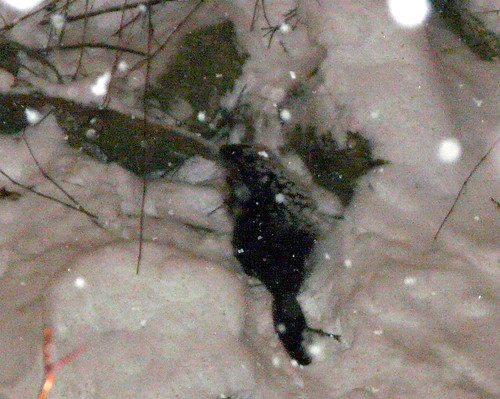
But just as we were headed back I saw a black spot on the ice, then two black blobs. For a while we couldn't tell if they were alive, then we weren't sure if it was a beaver or a muskrat. Then they got spooked and moved away. We crossed the creek, happily went through the brush, then saw them on the ice.

One could not be bothered with us. He chewed sticks sitting in a big hole in the ice. He crawled up the bank, got a fresh stick and brought it down for more comfortable chewing. The other one was more shy. Suddenly I saw something black sticking up through the ice like a jack-in-the-box. Then she saw me and descended. We got to see them from about 100 feet for about a half hour. We were all three excited. The beavers provided an excellent distraction.

Where to See Animals in the Midwest

Ohio's Department of Natural Resources lists 19 sites where people can see (or try to see) beaver:
North Chagrin Reservation
Grand River Wildlife Area
Tinkers Creek State Nature Preserve
Cuyahoga Valley National Recreation Area
Killbuck Marsh Wildlife Area
Cooper Hollow
Wildlife Area

Crooked Run Nature Preserve
Beaver Creek Wildlife Area

Hueston Woods
State Park, and Mosquito Creek

Woodbury
Salt Fork
Deer Creek
Spring Valley wildlife
Tycoon Lake

Highlandtown
Berlin Lake

Fallsville
Monroe Lake

Friday, January 29, 2010

Hawk Hit By Plane Recovering From Burns

We're heard plenty about birds hitting planes since the USAIR crash into the Hudson last year. But what about birds hit by planes? An Illinois red-tailed hawk somehow got hit by a crashing private plane (or its fireball), caught fire and survived. Or at least that's the going theory of the Flint Creek Wildlife Rehabilitation Center, which took in the singed bird.

Tragically two men in their 30s died in the crash in Sugar Grove. But four people, including two kids, in a very close house survived.

Then rescuers found the bird with all its feathers burned off. They figure it's a red-tailed hawk--by far the most common hawk--and a female, the bigger of the species. But that's just a guess, the center's blog say:
Burned beyond positive species identification, Phoenix was recovered by Kane County Animal Control and was promptly transferred to Flint Creek Wildlife for emergency care. Since that time four nights ago, she has been receiving around-the-clock care for her injuries.

“When I saw the bird, I was shocked,” said Dawn Keller, the center's executive director.  “This was nothing like I’ve ever seen. It had to have been engulfed.” She only has down left and has burnt feet, throat and eyelids. Still the center will work to release her if she is able. Otherwise "Phoenix" will become an education bird.

Keller had to explain to the local media that Phoenix was not guilty of causing the crash. "The crash happened after dark, which means she was already sleeping for the night. If she got sucked into the propeller or engine, she'd be dead. She was just an innocent bystander...," Keller told the Beacon News.

Just last month the center rescued another raptor in a transportation-related mishap. A Ferruginous hawk (Buteo regalis)  rode thousands of miles on a freight train out of its range in western Canada before it was finally discovered stuck in the train's grill in Franklin Park, suburban Chicago.

Donate to Flint Creek
Where to see Hawks and Eagles

Saturday, June 21, 2008

Chicago Finds a Feral Alligator

Yesterday Chicago Police pulled a small (five or six feet) alligator from the Chicago River on the near South Side near 37th Street.
This almost certainly was yet another example of a discarded exotic pet that some idiot thought would be cool, then threw out when they finally realized they couldn't handle it.

But that opens the big question of when it was released and how long was it able to survive in the wild in Chicago? At five feet long, that alligator is probably several years old.

Did it really survive an Illinois winter or was it released this spring? Did it find some industrial water release that keeps water warmer (the trick of some Florida manatees)? According to the Florida Museum of Natural History, alligators can tolerate limited freezing temperatures.

The alligator was captured by two great volunteers from the Chicago Herpetological Society. After tests it will go "back to the South" one of the semi-anonymous volunteers told the Sun-Times.

If it was raised as a pet I doubt it could be released in the wild. I wonder where he'll go?

The San Diego Zoo says that the American Alligator Alligator mississippiensis "was once considered endangered, but through protection plans, management, and captive propagation it has made a remarkable comeback."

Where to See Wildlife Around the Midwest