We've Moved!

Hi and Welcome to the AnimalTourism.com blog. But we've moved just down the street to this site, animaltourism.com/news. Please comment there.
Showing posts with label shark. Show all posts

Monday, March 08, 2010

Improbable Battles in the Animal Kingdom this Week

Some improbable animal battles this week.
Praying Mantis v. Hummingbird
The hummingbirds in this video already hate the praying mantis. They bicker with him and kick him in the head. Their prejudice is well-founded: the mantis lunges at the bird. In slow mo, it seems like the bird gets off. But there is a long-running war and the mantis sometimes wins. The outcome is so improbable, there's a discussion on Snopes debating whether it is possible.


Shark v. Ring


Veterinarian Chip Gardener grabbed a nurse shark ensnared by a frisbee ring and freed it. Gardener was diving near the wreck “The Princess Anne” off Palm Beach with his friend John Dickinson, who joked on CBS that his focus was just framing the shot.


Chicken v. Fox
A young fox broke into a hen house in Basildon, Essex, UK, and was pecked to death by the rooster Dude and his hens Izzy, Pongo and Pecky, the Daily Mail reports. Even if he survived the bites, he would have died of embarrassment over the attack.


Saturday, September 19, 2009

Shark Cage Dives--Right in New England

New Englanders want to see sharks; that much is clear from the way they've crowded Chatham on Cape Cod in recent weeks, hoping for a glimpse of the sharks preying on the seal colony. There were enough sharks to close some beaches, but not really enough to make shark-watching successful. Few would-be shark tourists realize that New England is starting to have a thriving shark cage-diving industry, with three tour companies, one right on Nantucket.

Bryce Rohrer led shark cave dives off South Africa, the shark cage dive Capitol of the World, then realized he could start Nantucket Shark Divers closer to home. Rohrer grew up fishing in the area, but "that slowly evolved into ditching the fishing rod for a camera." He knew there was enough sealife tantalizingly close to shore to make a good trip. "Not many people know sharks out there," he says. "It's a very attractive spot for people. The bottom line is there's a ton of wildlife around there, lots of whales, sharks, dolphins--all the things people care about."

This year he's lead some free-diving tours--no cage, no airtanks--just a snorkel. He's got a few warm, relatively shallow spots 10 to 40 miles off shore. Next year, he'll also have a shark cage, which goes in the water behind the boat. He'll let divers venture out of the cage at their own pace once they're comfortable. He also has options for people like me, who can't swim and are a little chicken; you can always just stay on the boat and see sharks from there.

He mainly sees 3-10 blue sharks, which he describes as "really inquisitive, they come right up to you." Sometimes his divers see makos, which he says have a completely different, more aggressive personality.

Yeah,  he chums the water--throws out blue fish and oil to attract sharks. The practice has gotten many shark tour operations in trouble, especially with surfers, who fear it changes sharks' behavior. But he says fishermen in the area do the same. And no one is swimming anywhere near 10-40 miles out in the ocean.

The dives can be expensive, but aren't so bad if you go in a group. Nantucket Shark Divers charges $800 for cage dives and $1,000 for open water dives up to four people. If you're not vacationing on Nantucket, there are two other shark dives in New England: Snappa Charters in Judith Point, Rhode Island and Sea Turtle Charters, which visits RI from Montauk, Long Island. Snappa offers the option of "playpen" watching: you get on a kind of safety raft for a good view, but you don't have to go in the water (rates start at $220 for divers and $170 for non-divers). Sea Turtle visits the sand sharks off Block Island, RI, and shipwrecks ($200/person).

Bonus animals: you may see whales, dolphins, sunfish, seabirds, seals and seaturtles.

Photo courtesy of Nantucket Shark Dives

Wednesday, September 16, 2009

Cape Cod Shark Update: Look Further Up the Coast, Captain Says

Yesterday we reported on how the Great White Sharks that are closing beaches on Cape Cod are also drawing shark tourists. Today another seal boat captain tells us they're looking in the wrong spot.

Captain Keith Lincoln of Monomoy Island Ferry says that people are mistakenly hanging around Chatham Lighthouse since that's where the shark was first sighted by kayakers a eating a seal in August. "
That is all due to the misleading information given by the media," says Captain Keith. "Massachusetts Department of Fisheries page shows all the taggings being done three miles south of the lighthouse near the area where South Beach and South Monomoy Island attached in 2006."

Looking at the Fisheries map here, he's totally right. Excellent tip, Captain Keith. (Though they do also show pictures of sharks offshore of the lighthouse.) He also warns that even if you're in the right place, the odds of seeing a shark are pretty impossible. The tagging teams use spotters on planes and perches 35 feet out of the water.

Captain Keith reports he's "calls about seeing the sharks, which is nearly impossible to guarantee." I think the seal tourists of Cape Cod have gotten spoiled; the tour boats can guarantee sightings because they're dealing with the east coast's biggest colony of gray seals, which is somewhere around 10,000. Normally wildlife watching is no sure thing.

Captain Keith, a 20-year veteran of the seal tours, says the sharks (and attendant media frenzy) come every year. "
I think this year is a little different in that the sharks showed up in a large number all at once." The seal cruises have been popular since 1991 and continue to get more popular with a new tour company starting this year, amid the recession, Captain Keith says. "So that alone tells you people are interested in the seals." He doesn't anticipate any shark frenzy curbing enthusiasm for the seals. A bigger threat to the tours are the shifting sandbars and regulations about where they can dock, he says.

Seeing sharks is pretty iffy, but if you go out this fall, you can see lots of shorebirds like oystercatchers and sea ducks like eiders, scoters, and buffleheads. And in June, Monomoy is the Cape's best spot to see mating horseshoe crabs pile on the beach.
Overall their populations are down about 90% on Cape Cod in the last few decades, but researchers have shown that Monomoy National Wildlife Refuge has some of the highest densities left

Meanwhile, if you really want to see a shark off Cape Cod, check out this guy at Nantucket Shark Dives, who does shark dives with chum 30 miles off Nantucket and gets to see lots of blue sharks.

Where to See Seals (and maybe sharks). The tours often require a minimum group to make it worth their while to go out as their business tapers off in the fall.
Monomoy Island Ferry
Usually runs April - December
90-minute cruise
Adults $30, Kids 15 and under $25
Look for signs for the Rip Ryder
Monomoy Island Ferry and USFWS Headquarters.

Beachcomber
Chatham's Municipal Fish Pier on Shore Rd.
(508) 945-5265
Adults $27, Seniors $25, Kids 3 -15 $23, Kids under 3 are free.

Blue Claw Boat Tours
Orleans
Adults $25, Kids 12 and under $20
(508) 240-5783

From Nantucket (year-round)
Shearwater Excursions
(508) 228-7037
2.5 hours to
Muskeget Island
Town Pier in downtown Nantucket.
$90 Adults, $70 Children under 12

Tuesday, September 15, 2009

Sharks (& The East Coast's Biggest Seal Colony) Draw Tourists

When news got out that Chatham, MA's, gray seal colony--the biggest on the east coast--was drawing sharks that closed beaches, a funny thing happened. Or didn't happen. Instead of running away scared, more tourists came to this little town on Cape Cod's elbow to see some sharks, hoping for a picture, or at least a glimpse.

"It's a big draw," says Lisa Franz, executive director of the Chatham Chamber of Commerce. "We have traffic jams... People are still walking in today and saying 'Where can we see them?'"

Tony LaCasse, a former veteran Boston TV newsman, says years ago local TV news would've been filled with scared would-be swimmers. But that was before years of education that drilled home how very unlikely it is to be bitten, let alone eaten, by a great white shark in New England. (Last fatal attack: 1936) Now we get shark tourists. "It's a long way from Jaws," says LaCasse, where the premise was they couldn't possibly close the beach on the Fourth of July.

The sharks are coming because the water is (briefly) warm and because the seal population has grown unchecked--well, that is, until the sharks showed up. Seal populations were kept artificially low for decades--maybe centuries. Until the 1960s, Massachusetts even paid a bounty for each seal ("a nickel a nose" in the early 1900s). Now seals are making a comeback. Cape has the biggest population on the American east coast, with roughly 10,000 (no one's done a formal count since 1999, when it was 5,600), according to the National Marine Fisheries Service 2008 report on gray seals. A few hundred live on the islands off Maine. but the U.S. population of gray seals is dwarfed by the Canadian one: More than 200,000 on Sable Island, Nova Scotia and 20,000 on the St. Lawrence.

In August kayakers spotted a great white shark munching on a seal near Chatham Lighthouse. Five sharks were seen close enough to the shore that cautious to the shore and surfers to close beaches over Labor Day. Mind you, beaches closed two weekends earlier for strong waves and that didn't make the evening news.

So far, however, the sharks are hard to see off Cape Cod. (Though plenty of places elsewhere cater to shark tourists.) Paula St. Pierre, who has run the Beachcomber tours out of Chatham for 11 years, says she hasn't seen any of the characteristic dorsal fins herself. "I don't want to see any," she says, at least not chasing the seals. "I saw one seal out there yesterday that had a big chunk taken out and shortly afterwards expired."

If you're looking for sharks, go to their meal, the seals. Some people go to the beach by Chatham Lighthouse (where seals hang out) to try to see some fins in the water, but the best bet for seeing the most seals or maybe even a dorsal fin are the seal boats.

Even if you don't get to see a great white, you'll get surprisingly close to the seals, which often approach the tour boats, St. Pierre says. "Seals come right up to the boat," she says. "They're as curious about us as we are about them. Not only can you see them, you can smell them." When sharks appeared in the past, the seals have even turned to the seal tourists for help. "In years past seals have tried to climb in the boat," when they've been afraid of sharks in the water, St. Pierre says. She had to fight the urge to help them up like a dog.

Seal-watching has become its own mini-industry on the Cape, with Beachcombers taking out 200 people a day at the peak of summer. About a half dozen seal tour operators line the coast.

No one is sure what will happen if the seals continue to draw such large numbers of sharks. Will there be a movement to get the seals to leave? (Tricky, because of the Marine Mammal Protection Act and certainly controversial.) Will Chatham have to install shark nets like they have in Australia? Or will shark tours move in to boost the economy?

"Summer would be a whole different story," says Franz. "September, it's like whoo-hoo, we've got a good shoulder season." Meanwhile, seal and shark watchers can get shoulder season rates now. And come winter, when the seal population peaks with migrants from Canada, you can get an even better deal to see a huge seal colony.

Where to See Seals (and maybe sharks). The tours often require a minimum group to make it worth their while to go out as their business tapers off in the fall.

Beachcomber
Chatham's Municipal Fish Pier on Shore Rd.
(508) 945-5265
Adults $27, Seniors $25, Kids 3 -15 $23, Kids under 3 are free.

Monomoy Island Ferry
90-minute cruise
Adults $30, Kids 15 and under $25
Look for signs for the Rip Ryder Monomoy Island Ferry and USFWS Headquarters.

Blue Claw Boat Tours
Orleans
Adults $25, Kids 12 and under $20
(508) 240-5783

From Nantucket (year-round)
Shearwater Excursions
(508) 228-7037
2.5 hours to Muskeget Island
Town Pier in downtown Nantucket.
$90 Adults, $70 Children under 12

Friday, August 21, 2009

Top Chefs Shun Shark Fin Soup, But You Can Still Get it Anyway

We've just had a couple big foot chefs--Alice Waters and Scott Boswell-- shun shark fin soup, but a quick check around shows it's still common in most American cities. Shame works when a celebrity chef gets linked with shark finning, the hideous way fins are hacked off a live shark, which is then thrown back to die, decimating shark populations worldwide. But what about the 56 restaurants in New York City that still serve shark fin? Or San Francisco's 69 shark fin restaurants?

A search on
New York Magazine's Menu Pages reveals how easy it is to find shark fin soup around the country. New York City has 56 restaurants serving shark fin. 35 restaurants serve shark fin soup. Three are vegetarian--meaning it's mock shark fin soup.

Not surprisingly, the biggest hunk--20--are in Chinatown.But they're all over the city, not just in restaurants only frequented by Chinese diners. Shanghai, near Macy's, serves five versions ranging from $33-$41. The Upper East Side's Our Place has a bowl for $12. A place near China Town sells it by the quart for take-out. >In Bay Ridge, Brooklyn, East Harbor Seafood Palace features a whole shark-fin soup category on its menu, with options from $55-$75.

  • San Francisco: 69 restaurants serving shark fin, 4 vegetarian
  • Los Angeles: 31 shark fin-serving restaurants. (The swanky Mr. Chow in Beverly Hills has imitation shark. Pacific Coast Highway Chinese Restaurant has a whole menu division of the real thing.)
  • Philadelphia: 11 shark fin purveyors, 4 vegetarian
  • Boston: 9 shark fin restaurants
  • Chicago: 10 shark fin restaurants, including Young's Restaurant in Wrigleyville
  • Washington, D.C.: 10 shark fin restaurants, including downtown's expensive Tony Cheng's and Wu's Garden in Vienna, which bills it as "a soup for special occasions."
  • South Florida: 6, including 2 in South Beach
Photos courtesy of the Shark Alliance. Fins on deck © Enric Sala
Here's how the vow to eschew shark fin soup usually comes about. A famous chef or restaurant gets tied to shark fin soup.
Chez Panisse's Alice Waters mentioned she'd want it as her last meal. A story about Stella! in New Orleans cites the dish. Disgust ensues. Suddenly the chef reads up on finning--the way fins are chopped off from live shark, wasting 95% of its body and contributing to the slaughter of about 100 million sharks a year. Some Atlantic populations are down 80% in the last 15 years, according to Shark Trust. (How did Waters not hear of this? Didn't she ever watch Shark Week?) Then Scott Boswell pulls the soup and Waters swears it off.)

There are movements to ban shark
finning internationally--making fishermen bring the whole shark to shore. The House passed a bill tightening U.S. restrictions, but it's waiting for the Senate. But that makes shark fishing more difficult and soup more expensive. But what will lower the demand?

Monday, August 10, 2009

60 Minutes Shoddy Shark Attack Research

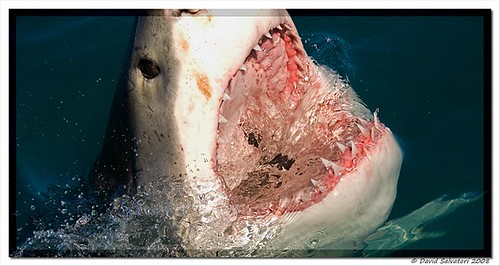
Photo of a shark on a South African tour courtesy of David Salvatori on Flickr.
Are sharks suddenly evolving into man-eaters?!
60 Minutes worries they are. Last night they updated a story on shark tourism, which they blame for sharks "becoming more dangerous."

Their proof? When they did the story in 2005, there had been six attacks off South Africa in the previous two years, three fatal. Before that Bob Simon declares shark attacks "virtually unheard of here." Really?

Look, I know the game. Reporters always have to justify a story with a news peg. But shark attacks deaths aren't one of those nebulous trends like people wearing straw hats; we know exactly how many shark attacks and deaths there are because the Global Shark Attack File keeps track.

The file doesn't show any big increase in South Africa or the world. The file shows that there was about one fatal shark attack per year in South Africa since the early 1980s. Since 60 Minutes reported on this supposed surge in shark attacks in 2005? There have been three confirmed deaths off South Africa (and two deaths where sharks might have been involved). In other words, shark deaths have been following the same pattern for three decades: about one death a year off South Africa. And worldwide it's about five a year.

You know what would've been a smart update? How about the study out just last month that tours off Hawaii aren't really effecting shark behavior?

Wednesday, August 05, 2009

SHARK WEEK: Not Just for the Discovery Channel Anymore

SHARK WEEK, which had 29 million viewers last year, is becoming some kind of international holiday. It's not just the Discovery Channel celebrating across the board with MythBusters' shark experiments and a reliving of Mike Rowe's shark Dirty Jobs. But now everyone's jumping on the SHARK WEEK bandwagon. Even the other networks.

Sharks Everywhere
Are You Smarter Than A Fifth Grader? (FOX) features a shark attack victim. Smithsonian Channel has a show on therapy for shark attack victims. The Early Show (CBS) is featuring a shark. My local PBS station had a show on a guy "with an unusual relationship with a shark." Showtime has a shark movie.

Win a Dream Date with a Shark Researcher!
The Shark Research Institute is auctioning off lunches with shark researchers around the globe, starting at $25--plus you pick up the tab for lunch. Chris "Air Jaws" Fallows is the hottie so far, but that's probably because he's throwing in a shark tour.

Dueling Petitions.
Think Shark Week is too sensational and bloody? Sign this petition of concerned scientists, surfers and other shark lovers.
Want more gore 24/7? Then this petition is for you.
Want Spain to stop finning sharks? Sign here.

European Shark Week
Just as you would expect from Europe, their Shark Week (Oct. 10-18, 2009) is short on melodrama and long on serious conservation. The Shark Alliance is asking Spain to stop chopping fins off live sharks and throwing the fish back to the ocean to bleed to death.

Monday, August 03, 2009

SHARK WEEK: What's More Dangerous than a Shark?

What could be more scary than a shark? Well, even during SHARK WEEK, pretty much anything.

Sharks kill about five people a year worldwide. The Global Shark Attack File chronicles 4,374 attacks since 1845. (They range from that first report, out of Sri Lanka, "Shark bit him in half, carrying away the lower extremities" to the trivial July 24 incident in Spain where some guy cut his foot.)

Sharks are sexier but not deadlier than:

  • The water the shark is in is thousands of times more likely to kill you than the fish. In 2006 3,600 Americans drowned. Every year 260 toddlers drown in pools.
  • Guns--just the accidental discharges--killed 642 in 2006, according to the CDC.
  • 25 kids a year still suffocate in plastic bags, the Consumer Product Safety Commission says.
  • Upholstered furniture takes out 460 Americans annually (because it catches on fire.)
  • Extension cords kill 50 people a year in the United States (again, through fire.)