We've Moved!

Hi and Welcome to the AnimalTourism.com blog. But we've moved just down the street to this site, animaltourism.com/news. Please comment there.
Showing posts with label tour. Show all posts

Wednesday, March 17, 2010

Birding Bob: The History of Ravens, Whales and Dolpins in NYC

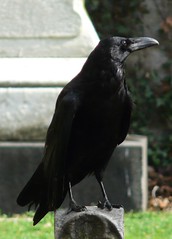
Manhattan's Samantha the Raven
Birding Bob (also known Dr. Robert DeCandido) is a biologist who leads popular and easy to understand tours in Central Park. He lets us publish his newsletter that goes out to his many fans.

With all the talk of Ravens possibly nesting in NYC (Queens), we went back into the historical record to see what we could find out about these corvids in NYC. In a dusty, yellowing journal we found a brief note published in the mid-19th century. It seems as though Ravens must have been occasional visitors to Brooklyn and Long Island back then - see below.

This week we add another bird walk to the mix: Tuesday mornings at 9am, meeting at the Boathouse (details below). Meanwhile, our NYC kestrel research is getting some attention - from outside of New York City!  And later this year, Deborah and I will have an article in a national publication about NYC Kestrels.You can find information (in 14 languages!) about NYC kestrels here.

We have some very good news to report. Our colleague Chad Seewagen (soon to be PhD) had another scientific paper published on his research here in NYC on how migrant birds fare during stopover times in New York City Parks. The research was published in the prestigious Wilson Journal of Ornithology. Congratulations Chad - may you publish many more.

Another of our bird-walkers, Bill Benish, has created an on-line guide to the largest woodpeckers in the world - here's the link to Campephilus Woodpeckers, the famous Ivorybill and all of its relatives in the same genus. 

Below we also present historical and recent reports from around the city including three species of dolphins in our waters in the East River (Manhattan) and Brooklyn (2010); a Humpback Whale (2009); Skylarks and Starlings in Brooklyn (late March 1898-99); and Ring-necked Ducks in northern New Jersey (late March 1923). And FLASH!!! Randy Schutz reports the arrival of Tree Swallows streaming over Jamaica Bay in Queens, near the Environmental Center at 8:55am on 17 March 2010.
=====================================
Good! Here are the bird walks for this week:

Friday, March 19th: 9:00am. Central Park - Meet at the entrance to Conservatory Garden (105th street and 5th Avenue) at 9 am.

Sunday, March 21st: 9:00am
- Central Park - Meet at the Boathouse at 9 am. $10 - we will be there rain or shine.

Tuesday, March 23rd: 9:00am - Central Park - Meet at the Boathouse at 9 am.
$5.
--------------------------------------------------------------------------------------------
The fine print: Our winter through spring SUNDAY walks meet at the [Loeb] Boathouse (approximately 74th street and the East Drive; the SE corner of the lake). - $5 for adults (January-February; $10 otherwise), and $5 for kids.  Easiest way to get to the Boathouse is to enter the park at 5th Avenue and 72nd street and walk west until you find the south to north road (the East Drive) that intersects the 72nd street "transverse." Then just walk north for about 1-2 minutes...Look for a small restaurant type place with chairs/tables outside - we are inside. The Boathouse opens at 8am and has coffee ($1.35), muffins and cookies ($1.75) plus sandwiches ($6) and french fries ($2) .  Bathrooms are located in two places: inside (better - because these are heated - in the bar that is adjacent to the Cafeteria where we meet); and outside - on the south side of the Boathouse. We end our weekend Central Park walks at the Boathouse at about noon.  On FRIDAYS, we meet at 9am at Conservatory Garden, 105th street and 5th Avenue (just inside the main gates).  There are bathrooms open year-round at Conservatory Garden, and that is good.  Easiest way to get there by subway is to take the #2 or #3 train to 110th street and Central Park North.  Then cross the street to Central Park and head east (to the left) toward Fifth Avenue, and then south until you reach Conservatory Garden (about a 7-10 minute walk from the train station; easy and safe).  You can also take the #6 train to Lexington Avenue and 103rd street. Walk west for three blocks and then north by two. Finally, buses run north up Madison Avenue regularly as well. Most Friday bird walks last about two to three hours in autumn-winter, but feel free to leave at anytime, we won't take it personally.  We have an extra pair or two of binoculars to rent, so if you want to rent a pair, just call or email before the walk to let us know.  Also, if you are thinking of purchasing new binoculars, ask us - we probably have used them, and we will let you know how to get them for the best price. These days we like a relatively unknown brand by the name of  Zen-Ray, specifically their 8 x 43 model.
---------------------------------------------------------------------------------------------
Here is what we saw last week (selected highlights) with some anecdotal notes and observations.  Not all species we saw are reported here - we list the best:

Friday, March 12th (North Woods) and Sunday, March 14th (Central Park, Ramble) - In last week's summary we detailed how some sparrow species were singing half-songs, and if this portended another several weeks of winter. Yes - despite our best attempts to look for birds in the rain, we had very little luck. We found Fox Sparrows and Gadwalls in different places in Central park, and by Sunday, there were many Song Sparrows in areas they had not been previously. So last week was a good one for catching up on writing scientific (and popular) articles, and getting ready for spring...more next week.
======================
Notes on Some Rare Birds in the Collection of the Long Island Historical Society. William Dutcher.

Corvus corax sinuatus. American Raven. -- One specimen in the collection. Col. Pike says: I never met with this bird. While shooting in 1836 at 'Comac Hill' my companion, Mr. George Bartlett, killed a fine specimen and I skinned it; it is the one in the collection. Philip Brasher had one in his collection that was killed in the woods near Prospect Park. (This specimen is now in the collection of the University of Vermont, Burlington, Vt., this institution having purchased the Brasher collection.) This was in 1848. These are the only specimens I have ever known to be killed on Long Island."

The Auk 10: 275-276 (1893)
================
4 March 2010 - Brooklyn, New York City: A dolphin was sighted in Newtown Creek. It may be one of the two that were seen two days ago near the Brooklyn Navy Yard. The Riverhead Foundation for Marine Research and Preservation will be monitoring the dolphin and would attempt a rescue mission if the animal seemed in distress. - Bob DiGiovanni

[These were Short-beaked Common Dolphins (Delphinus delphis), a species found within New York during the winter season along with the White-sided Dolphin (Lagenorhynchus acutus) and the Harbor Porpoise (Phocoena phocoena). The Common Dolphin was the species involved with the mass stranding event in 2007 in East Hampton, Long Island. We have been receiving reports of dolphins within the East River for the better part of the last week. Often the sighting of a lone dolphin is not a good sign. We are attempting to find out if there is food in the area. Kim Durham.]

Common Dolphin (Short-beaked)
White-sided Dolphin
Harbor Porpoise
=================================
2/25/2009 - New York Harbor, Lower Bay: The Coast Guard announced that a humpback whale became entangled in a lobster pot and netting south of the Rockaways. They set up a 500-yard safety zone around the whale, which was eight miles east of Sandy Hook, NJ, near the approach to Ambrose Channel, the head of the Hudson Canyon, and active shipping lanes. The Coast Guard Cutter Penobscot Bay and a vessel from the National Oceanic and Atmospheric Administration (NOAA) were on the scene to protect the animal. The whale, reportedly visible on the surface and breathing, according to the Coast Guard, was described as a juvenile humpback, about 25-30 feet long. - Jamie Collins, Executive Officer, USCGC Penobscot Bay

[Hudson Canyon: The post-glacial draining of pro-glacial lakes in the interior of New York State 12,500 years ago, and possibly even older glacial meltwaters, carved this magnificent underwater canyon that runs from the mouth of New York Harbor 120 miles seaward to the great abyss of the North Atlantic. This ancestral "Hudson River" is 3,600 feet deep and 5.5 miles wide in places. Tom Lake.]

2/26/2009 - New York Harbor, Lower Bay: According to the New York Times, the humpback whale entangled in fishing gear was freed this afternoon. The whale, which weighed perhaps 20 tons, was freed after an entanglement team from the Center for Coastal Studies of Gloucester, Mass., cut away the gear, which was wrapped around the whale's tail.

[It is not uncommon for humpback whales to be this close to New York Harbor. Humpbacks follow a food supply of small fish and this whale was probably one of about 900 whales in a group called the Gulf of Maine feeding component of the larger Western North Atlantic whale group. Teri Frady, NOAA.]
===========================
Notes on Brooklyn Birds (1898-99).

Skylark.
Alauda arvensis. The English Skylark is at present firmly established as a Long Island resident. Between Flatlands and Holy Cross Cemetery, and to the east of the latter, many are to be seen and beard. On March 28, 1898, while on the Neck Road, I heard for the first time the twittering, burring, continuously sustained song of this species and saw it rising gradually on fluttering wings up into the blue ether. At a later date one was heard singing continuously for eight minutes while in the air and for two minutes more after alighting on the ground. They were neither seen nor heard in September and October, though doubtless they might have been at suitable times; namely, early in the morning or in the evening. Several were beard and seen at the same time in the locality indicated above. It is likely they will later be found at other points on Long Island.

Starling. Sturnus vulgaris. About a mile in a straight line from the colony of Skylarks, I first saw the European Starling, where it was afterward seen repeatedly. Near Kensington Station someone within the present year has placed in a large tree several bird boxes, which are occupied by the Starlings. The tower of the Boys' High School in Brooklyn noted in the article referred to as occupied by these birds, still retains its attractions for them. This was probably the original nesting colony on Long Island. Another colony now occupies the steeple of a church at Bedford Avenue and Madison Street. At several points in the environs of Brooklyn the Starlings have been seen, where they were evidently visiting for the purpose of obtaining food, while at various points in the city itself they are commonly observed.

Auk 16: 190-193 (1899)
=======================
Ring-necked Duck in Northern New Jersey. -- On March 25, 1923, the writers were as usual on spring Sunday mornings on the marshes of Overpeck Creek, Bergen County, studying the waterfowl, which seem to increase in variety and abundance every year. On this particular morning nine species of Ducks were found, the commoner such as the American Merganser, Black Duck and Pintail in abundance. After practically all the Ducks had flown away, a pair of Ring-necked Ducks were found hiding in the grass on the opposite bank. Soon, however, they swam out into the creek in the full blaze of sunlight, and we watched them for half an hour as they floated on the quiet water. The drake was immediately recognizable by its dark back, and triangular shaped, puffy head, and the
female was a dark bird, without any white ring around the bill. A few minutes before we had seen a flock of Lesser Scaups at about the same relative distance, and the white backs of the males, and the white faces of the females gleamed in the sun. This species, which is well known to Griscom in life, has not been recorded from northern New Jersey. It is interesting to note that the preceding fall and winter produced an unusual number of Ring-necks from various points along the Atlantic seaboard.- Ludlow Griscom and J.M. Johnson, American Museum of Natural History.

Saturday, September 19, 2009

Shark Cage Dives--Right in New England

New Englanders want to see sharks; that much is clear from the way they've crowded Chatham on Cape Cod in recent weeks, hoping for a glimpse of the sharks preying on the seal colony. There were enough sharks to close some beaches, but not really enough to make shark-watching successful. Few would-be shark tourists realize that New England is starting to have a thriving shark cage-diving industry, with three tour companies, one right on Nantucket.

Bryce Rohrer led shark cave dives off South Africa, the shark cage dive Capitol of the World, then realized he could start Nantucket Shark Divers closer to home. Rohrer grew up fishing in the area, but "that slowly evolved into ditching the fishing rod for a camera." He knew there was enough sealife tantalizingly close to shore to make a good trip. "Not many people know sharks out there," he says. "It's a very attractive spot for people. The bottom line is there's a ton of wildlife around there, lots of whales, sharks, dolphins--all the things people care about."

This year he's lead some free-diving tours--no cage, no airtanks--just a snorkel. He's got a few warm, relatively shallow spots 10 to 40 miles off shore. Next year, he'll also have a shark cage, which goes in the water behind the boat. He'll let divers venture out of the cage at their own pace once they're comfortable. He also has options for people like me, who can't swim and are a little chicken; you can always just stay on the boat and see sharks from there.

He mainly sees 3-10 blue sharks, which he describes as "really inquisitive, they come right up to you." Sometimes his divers see makos, which he says have a completely different, more aggressive personality.

Yeah,  he chums the water--throws out blue fish and oil to attract sharks. The practice has gotten many shark tour operations in trouble, especially with surfers, who fear it changes sharks' behavior. But he says fishermen in the area do the same. And no one is swimming anywhere near 10-40 miles out in the ocean.

The dives can be expensive, but aren't so bad if you go in a group. Nantucket Shark Divers charges $800 for cage dives and $1,000 for open water dives up to four people. If you're not vacationing on Nantucket, there are two other shark dives in New England: Snappa Charters in Judith Point, Rhode Island and Sea Turtle Charters, which visits RI from Montauk, Long Island. Snappa offers the option of "playpen" watching: you get on a kind of safety raft for a good view, but you don't have to go in the water (rates start at $220 for divers and $170 for non-divers). Sea Turtle visits the sand sharks off Block Island, RI, and shipwrecks ($200/person).

Bonus animals: you may see whales, dolphins, sunfish, seabirds, seals and seaturtles.

Photo courtesy of Nantucket Shark Dives

Wednesday, September 16, 2009

Cape Cod Shark Update: Look Further Up the Coast, Captain Says

Yesterday we reported on how the Great White Sharks that are closing beaches on Cape Cod are also drawing shark tourists. Today another seal boat captain tells us they're looking in the wrong spot.

Captain Keith Lincoln of Monomoy Island Ferry says that people are mistakenly hanging around Chatham Lighthouse since that's where the shark was first sighted by kayakers a eating a seal in August. "
That is all due to the misleading information given by the media," says Captain Keith. "Massachusetts Department of Fisheries page shows all the taggings being done three miles south of the lighthouse near the area where South Beach and South Monomoy Island attached in 2006."

Looking at the Fisheries map here, he's totally right. Excellent tip, Captain Keith. (Though they do also show pictures of sharks offshore of the lighthouse.) He also warns that even if you're in the right place, the odds of seeing a shark are pretty impossible. The tagging teams use spotters on planes and perches 35 feet out of the water.

Captain Keith reports he's "calls about seeing the sharks, which is nearly impossible to guarantee." I think the seal tourists of Cape Cod have gotten spoiled; the tour boats can guarantee sightings because they're dealing with the east coast's biggest colony of gray seals, which is somewhere around 10,000. Normally wildlife watching is no sure thing.

Captain Keith, a 20-year veteran of the seal tours, says the sharks (and attendant media frenzy) come every year. "
I think this year is a little different in that the sharks showed up in a large number all at once." The seal cruises have been popular since 1991 and continue to get more popular with a new tour company starting this year, amid the recession, Captain Keith says. "So that alone tells you people are interested in the seals." He doesn't anticipate any shark frenzy curbing enthusiasm for the seals. A bigger threat to the tours are the shifting sandbars and regulations about where they can dock, he says.

Seeing sharks is pretty iffy, but if you go out this fall, you can see lots of shorebirds like oystercatchers and sea ducks like eiders, scoters, and buffleheads. And in June, Monomoy is the Cape's best spot to see mating horseshoe crabs pile on the beach.
Overall their populations are down about 90% on Cape Cod in the last few decades, but researchers have shown that Monomoy National Wildlife Refuge has some of the highest densities left

Meanwhile, if you really want to see a shark off Cape Cod, check out this guy at Nantucket Shark Dives, who does shark dives with chum 30 miles off Nantucket and gets to see lots of blue sharks.

Where to See Seals (and maybe sharks). The tours often require a minimum group to make it worth their while to go out as their business tapers off in the fall.
Monomoy Island Ferry
Usually runs April - December
90-minute cruise
Adults $30, Kids 15 and under $25
Look for signs for the Rip Ryder
Monomoy Island Ferry and USFWS Headquarters.

Beachcomber
Chatham's Municipal Fish Pier on Shore Rd.
(508) 945-5265
Adults $27, Seniors $25, Kids 3 -15 $23, Kids under 3 are free.

Blue Claw Boat Tours
Orleans
Adults $25, Kids 12 and under $20
(508) 240-5783

From Nantucket (year-round)
Shearwater Excursions
(508) 228-7037
2.5 hours to
Muskeget Island
Town Pier in downtown Nantucket.
$90 Adults, $70 Children under 12

Tuesday, September 15, 2009

Sharks (& The East Coast's Biggest Seal Colony) Draw Tourists

When news got out that Chatham, MA's, gray seal colony--the biggest on the east coast--was drawing sharks that closed beaches, a funny thing happened. Or didn't happen. Instead of running away scared, more tourists came to this little town on Cape Cod's elbow to see some sharks, hoping for a picture, or at least a glimpse.

"It's a big draw," says Lisa Franz, executive director of the Chatham Chamber of Commerce. "We have traffic jams... People are still walking in today and saying 'Where can we see them?'"

Tony LaCasse, a former veteran Boston TV newsman, says years ago local TV news would've been filled with scared would-be swimmers. But that was before years of education that drilled home how very unlikely it is to be bitten, let alone eaten, by a great white shark in New England. (Last fatal attack: 1936) Now we get shark tourists. "It's a long way from Jaws," says LaCasse, where the premise was they couldn't possibly close the beach on the Fourth of July.

The sharks are coming because the water is (briefly) warm and because the seal population has grown unchecked--well, that is, until the sharks showed up. Seal populations were kept artificially low for decades--maybe centuries. Until the 1960s, Massachusetts even paid a bounty for each seal ("a nickel a nose" in the early 1900s). Now seals are making a comeback. Cape has the biggest population on the American east coast, with roughly 10,000 (no one's done a formal count since 1999, when it was 5,600), according to the National Marine Fisheries Service 2008 report on gray seals. A few hundred live on the islands off Maine. but the U.S. population of gray seals is dwarfed by the Canadian one: More than 200,000 on Sable Island, Nova Scotia and 20,000 on the St. Lawrence.

In August kayakers spotted a great white shark munching on a seal near Chatham Lighthouse. Five sharks were seen close enough to the shore that cautious to the shore and surfers to close beaches over Labor Day. Mind you, beaches closed two weekends earlier for strong waves and that didn't make the evening news.

So far, however, the sharks are hard to see off Cape Cod. (Though plenty of places elsewhere cater to shark tourists.) Paula St. Pierre, who has run the Beachcomber tours out of Chatham for 11 years, says she hasn't seen any of the characteristic dorsal fins herself. "I don't want to see any," she says, at least not chasing the seals. "I saw one seal out there yesterday that had a big chunk taken out and shortly afterwards expired."

If you're looking for sharks, go to their meal, the seals. Some people go to the beach by Chatham Lighthouse (where seals hang out) to try to see some fins in the water, but the best bet for seeing the most seals or maybe even a dorsal fin are the seal boats.

Even if you don't get to see a great white, you'll get surprisingly close to the seals, which often approach the tour boats, St. Pierre says. "Seals come right up to the boat," she says. "They're as curious about us as we are about them. Not only can you see them, you can smell them." When sharks appeared in the past, the seals have even turned to the seal tourists for help. "In years past seals have tried to climb in the boat," when they've been afraid of sharks in the water, St. Pierre says. She had to fight the urge to help them up like a dog.

Seal-watching has become its own mini-industry on the Cape, with Beachcombers taking out 200 people a day at the peak of summer. About a half dozen seal tour operators line the coast.

No one is sure what will happen if the seals continue to draw such large numbers of sharks. Will there be a movement to get the seals to leave? (Tricky, because of the Marine Mammal Protection Act and certainly controversial.) Will Chatham have to install shark nets like they have in Australia? Or will shark tours move in to boost the economy?

"Summer would be a whole different story," says Franz. "September, it's like whoo-hoo, we've got a good shoulder season." Meanwhile, seal and shark watchers can get shoulder season rates now. And come winter, when the seal population peaks with migrants from Canada, you can get an even better deal to see a huge seal colony.

Where to See Seals (and maybe sharks). The tours often require a minimum group to make it worth their while to go out as their business tapers off in the fall.

Beachcomber
Chatham's Municipal Fish Pier on Shore Rd.
(508) 945-5265
Adults $27, Seniors $25, Kids 3 -15 $23, Kids under 3 are free.

Monomoy Island Ferry
90-minute cruise
Adults $30, Kids 15 and under $25
Look for signs for the Rip Ryder Monomoy Island Ferry and USFWS Headquarters.

Blue Claw Boat Tours
Orleans
Adults $25, Kids 12 and under $20
(508) 240-5783

From Nantucket (year-round)
Shearwater Excursions
(508) 228-7037
2.5 hours to Muskeget Island
Town Pier in downtown Nantucket.
$90 Adults, $70 Children under 12

Tuesday, September 08, 2009

NEAQ Whale Watch: Humpback Bubble Cloud Feeding off Boston?

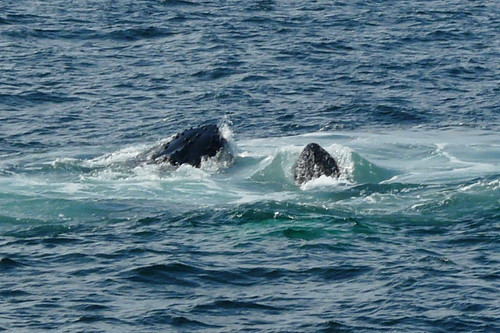
This weekend we got to see a pod of humpback whales bubble cloud feeding--that is cooperatively blowing bubbles to herd tiny fish into a concentration near the surface, then gobbling them up. The New England Aquarium's's tour brought us close enough to the whales that we could actually see, understand and anticipate what they were doing.

You first know you're going to see this specialized hunting technique when a huge patch of light turquoise water appears. Bubbles surface, then enormous black snouts covered with bumps (technically, tubercules or hair follicles). There's lots of jostling and swirling, then fins and finally a "whale footprint" or eerily smooth patch of sea that, we learned, whalers first thought was leaked whale oil.

I found some discussion online that humpbacks only bubble net feed off Alaska, Antarctica and west of South America. I'm not a whale expert, so I'm not sure if this is any different from what we all saw. But we clearly got to see it a few times. We had at least three whales at it, Echo, a mother; her calf, who stuck close to her; and another whale named Zooney.

The New England Aquarium has the system down to bring whales to the masses: a huge, fast catamaran whisks you an hour off-shore into Stellwagen Bank, a shallow feeding ground and sanctuary. Right from the center of Boston you can spend three hours and $40 and see one of the most active whale-watching sights in the world. Whale-watching tours from Cape Cod, Plymouth, Cape Ann, New Hampshire and Maine all head to Stellwagen. The boat's stable, so only a few get sick. You spend an hour speeding out to sea, an hour watching and an hour coming back. They sometimes see minke or fin whales, dolphins and basking sharks. A guy filming the trip for NOAA said it was the best he'd been on.

Not in Boston? Here are a ton of great places to see whales.

More places to see animals in the Northeast.

Got suggestions for animal watching places? Tell us.

Monday, August 17, 2009

What is Collaborative Whale-Watching and Wildlife Viewing?

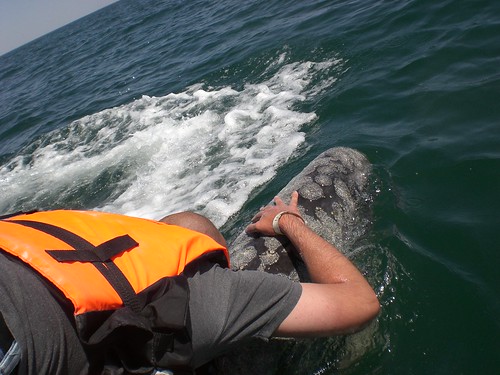
Photo of man hugging gray whale in San Ignacio Bay courtesy of Marc Uhlig of Jupiter Labs.
Biologist Toni Frohoff has a new way see whales and other wildlife: collaborative watching. That's right: she wants us to work with whales so we all get something out of the experience. Instead of just being stalkers, we'd interact on mutually agreeable terms. What Frohoff, research director at TerraMar Research and the Trans-Species Institute of Learning, is proposing is an overhaul of eco-tourism standards. She wants the whales (and other animals) to be in on it, to collaborate with the humans that want to watch them.
Sound impossible? Well, she does it all the time with gray whales in Baja California. As a behavioral biologist she made an appearance in the much-discussed New York Times Magazine story Watching Whales Watching Us. The gray whales migrate up and down the west coast, seemingly indifferent to humans, but once they reach their nursery harbors off Baja, they suddenly become curious about people. That's even more remarkable since people once slaughtered whales here--so much so the species was almost wiped out. But now they've realized people--or at least the people in these harbors--aren't throwing harpoons, they are offering hugs.

Photo of whale near row boat courtesy of FarFlungPhotos and Tarnya Hall.
What do the whales get out of it? For reasons no one can explain, they seem really into it, coming up to boats curiously and seeking out interaction, not just tolerating it.

What the whales can see is this: The whale watching boats have a code of conduct. They have a whales-only area where the whales can go for some down time. And if there are too many whale tourists in the water, they'll get called back. That's important to keep from loving the whales to death, says Frohoff, author of Dolphin Mysteries: Unlocking the Secrets of Communication and Between Species: Celebrating the Dolphin-Human Bond. Though if you're having a meaningful interaction with a whale, you'll find it difficult to leave. "It's harder than not eating ice cream," she says, "but it's necessary for us not be greedy to respect and cultivate this special inter-species bond."

What the whales can't see is the more important big picture of what the whale watchers are bringing them: peace, security and respect. The whale-watching industry is now a $2.1 billion industry worldwide. No one is sure exactly how big the rogue whale-hunting industry is, but we do know whale meat prices have sagged and the governments of Norway, Japan and Iceland have to effectively put their on welfare. The World Wildlife Foundation estimates that Japan spends $12 million a year propping up whaling; while Norway spends $500,000 to support an anemic $2 million industry.

I think eco tourists would love the idea of collaborative whale watching. Of course we want the fascination to be mutual and fair; that's human nature. I think people naturally want to give something in return if someone offers them something nice. People leave out food for birds and animals mainly for practical reasons of drawing them in close. But part of us also wants to be nice--or at least appear nice--to them. We are, in effect, paying the cardinals to show up at our feeder by putting out sunflower seeds.

Will other animals start to collaborate with us? Sure would be nice. I've had a sunfish focus his big, ghastly eye on me; squirrels look at me and bark until I figured out they were standing above a cat they wanted me to chase away; deer stare into a window at me staring at them. Of course, for every one of these delights, I've had 100 or 1,000 experiences of an animal fleeing, fearing that I'm hunting them. That is wildlife watching in the early 21st Century. It wasn't always this way. And, once we start offering animals something in return--ideally something more abstract than food--maybe we'll see it again.

Want to see some whales yourself? Here's where you can do it.


View AnimalTourism.com WHALES in a larger map

Thursday, July 30, 2009

Worldwide Whale Watch Week?

Humpback photo courtesy of Ruben Ayala, taken on Seven Seas Whale Watching based out of Gloucester, MA, in Sept., 2006.
Great Britain just got through with another Whale Week, with sightings of an impressive eight species of cetaceans--dolphins and whales. Minke and humpback whales visited Scotland. Bottlenose dolphins ventured farther south than ever; common dolphins pushed north. The event, sponsored by BG Group, so far only extends to the British Isles, but it would be great to see it expanded worldwide.

Right about now is the peak season for seeing blue whales--the largest creature on earth, ever--in one of their largest concentrations, off Santa Barbara, right outside Los Angeles. The Los Angeles Chapter of the American Cetacean Society is having its annual blue whale trip this Saturday. The southern California whale watching industry is geared more towards the spectacle of gray whales migrating up and down the coast in spring and winter. But Santa Barbara's Condor Cruises has $98 4.5 hour trips to where the blue whales and calves like to feed. Up the coast in central California, Monterey Bay Whale Watch goes out all year.

The trouble with an international Whale Watch Week would be that the peak season is different on migration routes all over the world. Oregon's Whale Watching Spoken Here has two big gray whale weeks a year: Christmas week and March 20-27. Still, summer is great time to see whales in lots of places. Cape Cod, the best whale watching spot on the East Coast, has a season from roughly July to September. Hawaii is year-round (though humpbacks are winter) and whale watch week is a fun way to let people know. We've certainly all caught on to Shark Week as the time to see sharks on the Discovery Channel (which starts Sunday). Why not whales in the water?

Want to go look for dolphins?
Want to see some whales? Here are some of the best places.


Friday, July 10, 2009

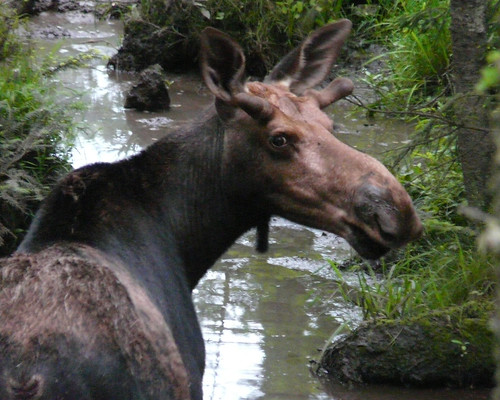
Moose Alley, NH Tips: 10 Things Locals Won't Tell You

Believe the name. When you visit Moose Alley, New Hampshire,
(not an actual town, but Route 3 north of Pittsburg up to the Canadian border) you will see moose. It's like magic; you just always see moose. I was skeptical, too--the victim of too many parks boasting of animals I would never see. But Moose Alley, way up in Coos County, has never failed me.

I kept asking the locals for moose-watching tips--since moose follow routines. Usually I got nowhere with that line of questioning--lots of encouragement to look "anywhere," "any road" at "any time." So I came up with what I would tell a friend visiting Moose Alley.


1. Look for Roadside Wallows.
Moose hang out by the side of the road to drink from ponds and puddles with salt run-off. You can spot the wallows because they tend to have trampled mud around them and a moose trail leading away from the road.


2. Look for Roadside Parking.
Where there are established wallows there is effectively wallow parking. Moose return at the same time every day. Moose watchers follow. One particularly popular wallow has a lot next to it--and still gets an overflow crowd parking on Route 3 at dusk. For that matter if you see a roadside parked car, as you will quickly figure out, it's probably your fellow moose watcher. Just ask if they've actually seen a moose there and are not just acting on a hunch that "that looks like a perfect place for a moose"--a phrase you will find yourself using repeatedly.


3. Moose also like recently cut trees.

Georgie Lyons told me that a logger off Route 26 says that a dozen moose appear in the morning when they hear him start his chainsaw. (She's in the visitor's center near Colebrook, but in the Chamber of Commerce back office. She knows everything about the area and is happy to share it.)


4. Timing matters, but not completely.
You will be exhorted to Go at Dusk and Dawn. Moose are crepuscular--meaning most active then. I've had the best luck seeing them in the hour right before dark. But they're also really active at night. A truck driver reports he recently saw 27 moose (not all at once) along a nearby road at 2 a.m. The problem with this--as with dusk--is that if you get any picture, it'll be lousy. And for that matter, you may see them during the day, too. Locals stress that they see them all times of day. I had my best sighting at 10 am. Moose's Hours Inconvenient? Go Anytime.

5. Route 3 is the best, but any area road will do.
The heart of Moose Alley is Route 3, but Routes 145, 26 and 16 all are local hotspots. So are the logging roads off Route 3, especially one marked Gate 137. For that matter, the people I talked to just said to drive any local road, especially ones bordering wilderness. The thoughtfully-built official viewing area on 26 hasn't had moose in a while, locals say. (We rented a house at a delightful Poodle Farm in Colebrook, a good mid-point.)

6. Lurk.
Once you find a moose spot, come back at the same time tomorrow. And if the moose get spooked by watchers, just sit and wait. You'll have the moose all to yourself.

7. You may not see any antlers.
First off, you're going to see more cows than bulls because the bulls are more wary. Second, the antlers fall off after the fall mating season, then resprout in early summer.


8. Your moose call is only going to work in mating season.

Moose don't just call each other to figure out where everyone's at--like some species do. They only call in season. Experienced moose hunters say it really works--and may even work a month or so after the season because some females may be late. But moose hunting seasons are timed to coincide with the rut. So you may just draw in hunters. And the moose catch on pretty quickly to the hunt and become much more cautious about people, hunting guide Larry Adair told me last year.

9. The logging drivers hate you.
They're trying to work and here we are trolling around for moose, half stopping. If you go on the logging roads, you have to be ready to get out of their way. They show their annoyance by driving fast past you.

10. The moose aren't that fond of you, either. And they really hate your dog.
Moose will run off if you get too close--or they may warn you off, but the signs may be too subtle: they raise the hackles on their rump, point ears back and lip their lips. Also, they give you a dirty look. They can bluff charge, charge for real and go out of their way to kick a dog. You car is actually a pretty good wildlife blind, especially if you've got a sun roof. Though when there's a Moose Jam, families will get out. You'll feel like a chump staying in your car. But the moose will eventually get spooked by people on foot.

For all that, it's still a thrill to get to watch one of these giant animals eat. I've been trolling likely looking bogs throughout New England and the Maritimes and Moose Alley is about the easiest place to do it.

Thursday, September 04, 2008

Whalers Try To Revive Desire For Whale Meat


The old argument for whale meat used to be that it was a cheap, familiar meat for old people who had grown up on it. Sustenance and self-sufficiency came up a lot. Now that Japan and Iceland have spurned international bans on whaling, they're hard to market whale meat to new customers.

The Wall Street Journal reported this week that in Reykjavik marketer Gunnar Bergmann Jonsson is trying to "hook" urban hipsters on whale meat by selling it in vacuum-sealed ready packs and offering recipe tips.

The Journal quotes Eva Maria Thorarinsdottir, marketing manager of Reykjavik's Elding Whale Watching saying hunting has made minke whales much shier. So all the government of Iceland's support of the nostalgic whaling industry is hurting people who are making a living on animal tourism. "Our business is much more profitable than theirs," she says.

The Washington Post says the Japanese government and pro-whaling groups spend $5 million a year for promotions like to getting school kids to try whale meat. Meanwhile, though, demand is so low that prices have fallen 20% from 1999 to 2004 ($15 a pound to $12 a pound). And they still have extra that they have to freeze.

This looks like yet another program where a government is throwing money away to support a dying industry (whaling) rather than throwing money behind a growing industry (whale watching).

Find the Best Places to Go Whale-Watching Around the World
Where to See More Animals in Europe

Tuesday, June 05, 2007

Parrots Flock to Brooklyn College

Brooklyn Parrots
Brooklyn College and Green-Wood Cemetery, Brooklyn, NY


Saturday we went on Steve Baldwin's excellent and amusing tour of the wild parrots of Brooklyn. We met near Brooklyn College and he wended our way through college buildings to the soccer field, where the parrots live in sofa-sized nests in the lights. Unlike many wildlife tours, where you're lucky to catch a glimpse, the parrots here are readily available for your viewing. And you're allowed to feed them. Bring some birdseed, Baldwin suggests.


The birds--bright green and a little smaller than pigeons--will happily eat birdseed and peanuts off the ground. You'll get to see the boys squawk a little over the turf. They swoop in and out of the giant nest and around the neighborhood.

Baldwin has some good insights into the parrots behavior. As New Yorkers, he says, they're wary of strangers. (Which is smart because some idiots captured a bunch of the monk parrots last year to breed and sell as pets.)


The old urban legend is that the parrots, which have been around here, in Chicago, and now 14 states, escaped from a crate at the airport. Baldwin has a new, plausible twist to the story: mob workers are responsible for the release here and around the country. They would open every crate and skim a bit off of whatever was inside for themselves. But when they opened these crates, some flew out. This story seems to explain so many escapees from airports around the country.

After a tour of Brooklyn College, Baldwin took us to Green-Wood Cemetery, where the parrots have driven out some nuisance pigeons that used to nest in the historic entrance gate. The Brooklyn College neighborhood is pretty used to seeing green birds flying around. Since Green-Wood constantly attracts new visitors, we saw many more passerby shocked and delighted by the parrots.

Where To See Wildlife Around New York City
Where Else You Can Find Feral Parrots

Tuesday, April 04, 2006

Pay to Play with a Seal Lion in Boston

New England Aquarium, Boston, Play with Marine Mammals


The New England Aquarium lets you play with their sea lions and seals. In the last few years a number of animal rescue groups and traditional aquariums have hit on the idea of, well, basically, pimping out their animals. You pay a little extra and get a little extra contact, how much depends on how much you pay.
The New England Aquarium has two programs. For $30 you can feed seals, but for $125 you get to help feed, entertain and train sea lions, seals and maybe a large turtle.
It's a small group--just three--and the real trainers are incredibly gracious in letting you enjoy the fun part of their job. Still, I felt a little bit idiotic since it was me and two kids. (They say it's about half and half adults to kids. And that often parents bring kids, but it's obviously really for mom or dad.)
We started off with the sea lions, who are soon leaving for Brookfield Zoo in Chicago. We got to see the sea lions' kitchen and warm indoor pool. When we went outside, the sea lions, Guthrie, an 838 pound mush, and Ballou, a younger, smaller and more shy sea lion.

Guthrie watches the crowds and came by as soon as we walked in--assuming it was feeding time. We got to feel his thick wet fur, massive fins. We each put fish in his mouth, which was big but full of worn down, black teeth so not intimidating. Plus the trainers exude comfort and confidence and Guthrie is very gentle and good-natured. He gave us each a kiss--really just pressed his massive whiskered nose to our face. It was like a 30 pound dog nose that left a trail of slime. Still, very fun.
The training sessions with them are in front of the crowd, so again, a little embarrassing to have paid to the be the adult volunteer among kids, but still totally worth it.

The seals were much more shy, though very excited to get their fish.


Where to See Seals and Sea Lions in the Wild
More Ways to See Wildlife in the Northeast