We've Moved!

Hi and Welcome to the AnimalTourism.com blog. But we've moved just down the street to this site, animaltourism.com/news. Please comment there.
Showing posts with label gray whale. Show all posts

Friday, May 14, 2010

Chukotkans Gobble 419 Pounds of Gray Whale Each Year According to Russia's 140 Whale a Year Quota

A gray whale illegally harpooned off by the Makah tribe in Washington
Do the Chukotka people really each eat 419 pounds of gray whale each year? That's what the Russian government is asking the world to believe as it asks the International Whaling Commission to extend its absurd "subsistence" quota of 140 gray whales for the Chukotka people.

They're the ones Sarah Palin can see from her house; Chukotka is a peninsula of Russia on the Bering Sea. Only one-third of the tiny population of Chukotka (53,000) is native. That means 18,000 people are supposed to be eating 140 whales that each weigh 27,6,00 to 36,000 kg  (59,000 to 79,000 pounds).  That amounts to a stunning 466 pounds of whale per person.

What about bones? Ok, soft tissue makes up 90% of a whale's weight. That's still an amazing 419 pounds per native person. Could anyone eat 18 ounces of whale every single day, all year? Absurd. By contrast, Americans--not known for our tiny appetites--eat 222 pounds of meat a year, up from 144 in 1950.

A while back the Chukotka were caught using their sustenance meat to feed fox on fur farms--which still managed to be unprofitable. A gray whale with a Russian harpoon washed up in California in March. Russia is required to report whales that get away, but never mentioned this one. Gray whale meat with evidence of harpoons has shown up in Japanese markets, according to Oregon State University.

In June The International Whaling Commission, which wants to legalize whale hunting again, is set to consider a proposal to allow the 140 whale a year habit to continue for a decade. Russia has even argued that they would really like 350 whales--even though they are now eating more whale than ever. Whale used to account for 50% of their meat in 1985; now it's 90%.

The western gray whale population is about 26,000; this is the one that migrates to Chukotka. No one thinks they mix with the eastern population, which is only about 130--even though no one is supposed to be hunting it--and lives in an area where it's disturbed by Russian oil drilling. Now California whale watchers are saying that their whales may not be as secure; numbers are mysteriously dropping. Could it have anything to do with where they spend the winter?

About 10% of gray whales are what biologists call "stinky." Stinky whales are inedible. Dogs won't even eat them and if you do eat them, you'll get sick. V. Ilyashenko writes: 
hunters state that sometimes they can identify “stinky” whales in the ocean, if the wind blows from the spout toward the whaling boat. In some hunting areas, the hunters have estimated that up to ten percent of the whales are “stinky” in a given year. Skilled hunters do not attempt to kill “stinky whales”. Nevertheless, several “stinky whales” are struck and landed in most years. In some years up to 10 “stinky” whales were harvested. Sometimes the “stinky” whale odor appears only during cutting up the whale or only while cooking whale meat.
Stinky whales have been noticed since the 60s and it's no surprise that their numbers are increasing. They're evolving a defense mechanism. The stinkier they are, the safer they are from whalers. If they can pass on their propensity to stinkiness, they're really have something. The stinky factor alone should push the IWC to make the Russians find another food source.


In other gray whale news, Lilly, a gray whale freed from fishing lines in Dana Point, still lingers and looks sickly

Tuesday, May 11, 2010

Meditteranean Gray Whale: Explorer or Lone Lost Soul

Gray whale from Israel Marine Mammal Research and Assistance Center
A lone gray whale showed up in the Mediterranean Sea this week. Biologists are baffled. Gray whales haven't been seen on this side of the Atlantic for centuries. Is this bad news--just a lone whale hundreds of miles off track? Or good news--a lone explorer, trying out a new migration oute--or, really, an ancient one?

The Israel Marine Mammal Research and Assistance Center verified it as definitely a gray whale. Biologist are betting on the lone lost soul explanation. NOAA's Phillip Clapham of  told Discovery that either "there has been a relict population in the North Atlantic that no one has noticed (virtually impossible), or (more likely) that this whale came down through the ice-free Northwest Passage and is now hopelessly lost."

I'd like to think there's a third possibility: the whale is forging a new route. Maybe in response to the whaling pressure it still faces in Asia. Migration routes aren't stagnant. Animal populations are constantly changing, usually led by a lone male branching out looking for a mate. Marine biologists used to think the manatees that migrate up the east coast were lost, so they'd catch them and haul them down to Florida. Now they realize it's just what they do.

There used to be four populations of gray whales, Jim Darling notes. Two--the ones one the east and west shores of the North Atlantic--are dead.

Two populations survive--on the east and west of the Pacific. The one that hugs the North American coast has been protected since 1947 and now is about 20,000. They thrive, delighting whale watchers with their friendly overtures towards boaters. Gray whales used to roam Florida to New England. Imagine the kind of animal tourism attraction we're missing. Right in Florida we'd probably have the same magical, close-up whale watching experience people now trek to Baja to get.

The Asian population is anemic--only 100 to 200. Even though nobody is supposed to be hunting it. And no one is sure if the two populations touch.


Where to Go to See Whales

Wednesday, March 17, 2010

Birding Bob: The History of Ravens, Whales and Dolpins in NYC

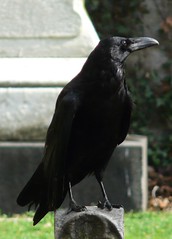
Manhattan's Samantha the Raven
Birding Bob (also known Dr. Robert DeCandido) is a biologist who leads popular and easy to understand tours in Central Park. He lets us publish his newsletter that goes out to his many fans.

With all the talk of Ravens possibly nesting in NYC (Queens), we went back into the historical record to see what we could find out about these corvids in NYC. In a dusty, yellowing journal we found a brief note published in the mid-19th century. It seems as though Ravens must have been occasional visitors to Brooklyn and Long Island back then - see below.

This week we add another bird walk to the mix: Tuesday mornings at 9am, meeting at the Boathouse (details below). Meanwhile, our NYC kestrel research is getting some attention - from outside of New York City!  And later this year, Deborah and I will have an article in a national publication about NYC Kestrels.You can find information (in 14 languages!) about NYC kestrels here.

We have some very good news to report. Our colleague Chad Seewagen (soon to be PhD) had another scientific paper published on his research here in NYC on how migrant birds fare during stopover times in New York City Parks. The research was published in the prestigious Wilson Journal of Ornithology. Congratulations Chad - may you publish many more.

Another of our bird-walkers, Bill Benish, has created an on-line guide to the largest woodpeckers in the world - here's the link to Campephilus Woodpeckers, the famous Ivorybill and all of its relatives in the same genus. 

Below we also present historical and recent reports from around the city including three species of dolphins in our waters in the East River (Manhattan) and Brooklyn (2010); a Humpback Whale (2009); Skylarks and Starlings in Brooklyn (late March 1898-99); and Ring-necked Ducks in northern New Jersey (late March 1923). And FLASH!!! Randy Schutz reports the arrival of Tree Swallows streaming over Jamaica Bay in Queens, near the Environmental Center at 8:55am on 17 March 2010.
=====================================
Good! Here are the bird walks for this week:

Friday, March 19th: 9:00am. Central Park - Meet at the entrance to Conservatory Garden (105th street and 5th Avenue) at 9 am.

Sunday, March 21st: 9:00am
- Central Park - Meet at the Boathouse at 9 am. $10 - we will be there rain or shine.

Tuesday, March 23rd: 9:00am - Central Park - Meet at the Boathouse at 9 am.
$5.
--------------------------------------------------------------------------------------------
The fine print: Our winter through spring SUNDAY walks meet at the [Loeb] Boathouse (approximately 74th street and the East Drive; the SE corner of the lake). - $5 for adults (January-February; $10 otherwise), and $5 for kids.  Easiest way to get to the Boathouse is to enter the park at 5th Avenue and 72nd street and walk west until you find the south to north road (the East Drive) that intersects the 72nd street "transverse." Then just walk north for about 1-2 minutes...Look for a small restaurant type place with chairs/tables outside - we are inside. The Boathouse opens at 8am and has coffee ($1.35), muffins and cookies ($1.75) plus sandwiches ($6) and french fries ($2) .  Bathrooms are located in two places: inside (better - because these are heated - in the bar that is adjacent to the Cafeteria where we meet); and outside - on the south side of the Boathouse. We end our weekend Central Park walks at the Boathouse at about noon.  On FRIDAYS, we meet at 9am at Conservatory Garden, 105th street and 5th Avenue (just inside the main gates).  There are bathrooms open year-round at Conservatory Garden, and that is good.  Easiest way to get there by subway is to take the #2 or #3 train to 110th street and Central Park North.  Then cross the street to Central Park and head east (to the left) toward Fifth Avenue, and then south until you reach Conservatory Garden (about a 7-10 minute walk from the train station; easy and safe).  You can also take the #6 train to Lexington Avenue and 103rd street. Walk west for three blocks and then north by two. Finally, buses run north up Madison Avenue regularly as well. Most Friday bird walks last about two to three hours in autumn-winter, but feel free to leave at anytime, we won't take it personally.  We have an extra pair or two of binoculars to rent, so if you want to rent a pair, just call or email before the walk to let us know.  Also, if you are thinking of purchasing new binoculars, ask us - we probably have used them, and we will let you know how to get them for the best price. These days we like a relatively unknown brand by the name of  Zen-Ray, specifically their 8 x 43 model.
---------------------------------------------------------------------------------------------
Here is what we saw last week (selected highlights) with some anecdotal notes and observations.  Not all species we saw are reported here - we list the best:

Friday, March 12th (North Woods) and Sunday, March 14th (Central Park, Ramble) - In last week's summary we detailed how some sparrow species were singing half-songs, and if this portended another several weeks of winter. Yes - despite our best attempts to look for birds in the rain, we had very little luck. We found Fox Sparrows and Gadwalls in different places in Central park, and by Sunday, there were many Song Sparrows in areas they had not been previously. So last week was a good one for catching up on writing scientific (and popular) articles, and getting ready for spring...more next week.
======================
Notes on Some Rare Birds in the Collection of the Long Island Historical Society. William Dutcher.

Corvus corax sinuatus. American Raven. -- One specimen in the collection. Col. Pike says: I never met with this bird. While shooting in 1836 at 'Comac Hill' my companion, Mr. George Bartlett, killed a fine specimen and I skinned it; it is the one in the collection. Philip Brasher had one in his collection that was killed in the woods near Prospect Park. (This specimen is now in the collection of the University of Vermont, Burlington, Vt., this institution having purchased the Brasher collection.) This was in 1848. These are the only specimens I have ever known to be killed on Long Island."

The Auk 10: 275-276 (1893)
================
4 March 2010 - Brooklyn, New York City: A dolphin was sighted in Newtown Creek. It may be one of the two that were seen two days ago near the Brooklyn Navy Yard. The Riverhead Foundation for Marine Research and Preservation will be monitoring the dolphin and would attempt a rescue mission if the animal seemed in distress. - Bob DiGiovanni

[These were Short-beaked Common Dolphins (Delphinus delphis), a species found within New York during the winter season along with the White-sided Dolphin (Lagenorhynchus acutus) and the Harbor Porpoise (Phocoena phocoena). The Common Dolphin was the species involved with the mass stranding event in 2007 in East Hampton, Long Island. We have been receiving reports of dolphins within the East River for the better part of the last week. Often the sighting of a lone dolphin is not a good sign. We are attempting to find out if there is food in the area. Kim Durham.]

Common Dolphin (Short-beaked)
White-sided Dolphin
Harbor Porpoise
=================================
2/25/2009 - New York Harbor, Lower Bay: The Coast Guard announced that a humpback whale became entangled in a lobster pot and netting south of the Rockaways. They set up a 500-yard safety zone around the whale, which was eight miles east of Sandy Hook, NJ, near the approach to Ambrose Channel, the head of the Hudson Canyon, and active shipping lanes. The Coast Guard Cutter Penobscot Bay and a vessel from the National Oceanic and Atmospheric Administration (NOAA) were on the scene to protect the animal. The whale, reportedly visible on the surface and breathing, according to the Coast Guard, was described as a juvenile humpback, about 25-30 feet long. - Jamie Collins, Executive Officer, USCGC Penobscot Bay

[Hudson Canyon: The post-glacial draining of pro-glacial lakes in the interior of New York State 12,500 years ago, and possibly even older glacial meltwaters, carved this magnificent underwater canyon that runs from the mouth of New York Harbor 120 miles seaward to the great abyss of the North Atlantic. This ancestral "Hudson River" is 3,600 feet deep and 5.5 miles wide in places. Tom Lake.]

2/26/2009 - New York Harbor, Lower Bay: According to the New York Times, the humpback whale entangled in fishing gear was freed this afternoon. The whale, which weighed perhaps 20 tons, was freed after an entanglement team from the Center for Coastal Studies of Gloucester, Mass., cut away the gear, which was wrapped around the whale's tail.

[It is not uncommon for humpback whales to be this close to New York Harbor. Humpbacks follow a food supply of small fish and this whale was probably one of about 900 whales in a group called the Gulf of Maine feeding component of the larger Western North Atlantic whale group. Teri Frady, NOAA.]
===========================
Notes on Brooklyn Birds (1898-99).

Skylark.
Alauda arvensis. The English Skylark is at present firmly established as a Long Island resident. Between Flatlands and Holy Cross Cemetery, and to the east of the latter, many are to be seen and beard. On March 28, 1898, while on the Neck Road, I heard for the first time the twittering, burring, continuously sustained song of this species and saw it rising gradually on fluttering wings up into the blue ether. At a later date one was heard singing continuously for eight minutes while in the air and for two minutes more after alighting on the ground. They were neither seen nor heard in September and October, though doubtless they might have been at suitable times; namely, early in the morning or in the evening. Several were beard and seen at the same time in the locality indicated above. It is likely they will later be found at other points on Long Island.

Starling. Sturnus vulgaris. About a mile in a straight line from the colony of Skylarks, I first saw the European Starling, where it was afterward seen repeatedly. Near Kensington Station someone within the present year has placed in a large tree several bird boxes, which are occupied by the Starlings. The tower of the Boys' High School in Brooklyn noted in the article referred to as occupied by these birds, still retains its attractions for them. This was probably the original nesting colony on Long Island. Another colony now occupies the steeple of a church at Bedford Avenue and Madison Street. At several points in the environs of Brooklyn the Starlings have been seen, where they were evidently visiting for the purpose of obtaining food, while at various points in the city itself they are commonly observed.

Auk 16: 190-193 (1899)
=======================
Ring-necked Duck in Northern New Jersey. -- On March 25, 1923, the writers were as usual on spring Sunday mornings on the marshes of Overpeck Creek, Bergen County, studying the waterfowl, which seem to increase in variety and abundance every year. On this particular morning nine species of Ducks were found, the commoner such as the American Merganser, Black Duck and Pintail in abundance. After practically all the Ducks had flown away, a pair of Ring-necked Ducks were found hiding in the grass on the opposite bank. Soon, however, they swam out into the creek in the full blaze of sunlight, and we watched them for half an hour as they floated on the quiet water. The drake was immediately recognizable by its dark back, and triangular shaped, puffy head, and the
female was a dark bird, without any white ring around the bill. A few minutes before we had seen a flock of Lesser Scaups at about the same relative distance, and the white backs of the males, and the white faces of the females gleamed in the sun. This species, which is well known to Griscom in life, has not been recorded from northern New Jersey. It is interesting to note that the preceding fall and winter produced an unusual number of Ring-necks from various points along the Atlantic seaboard.- Ludlow Griscom and J.M. Johnson, American Museum of Natural History.

Thursday, January 28, 2010

Set out on the Whale Trail: See Orcas from the Shore in Washington State

People may have heard of watching orcas off San Juan Islands,  but Donna Sandstrom wants everyone to realize whales are all over the coastal waters of Washington State, including the Salish Sea. For the last two years she's been working with seven government groups pulling together The Whale Trail, 15 spots where people can see whales from the shore.

Aside from Lime Kiln Point State Park, which bills itself as the best shore-based whale-watching site in the whole world, the Whale Trail reaches up to Vancouver and down to coastal La Push, where the Quileute Nation welcomes the gray whales when they return from their migration to Mexico.


"They could go extinct in 100 years and that's heartbreaking to me," she says. "We are right at the intersection of whether they make it or not." Yet down the coast from the San Juans people in her native Seattle are largely oblivious to the presence of killer whales, Orcinus orca right outside their doors. "It always makes me a little sad that people are surprised whales are here," she says.

Now they'll be able to look up public places where they can see whales from public land--which means the viewing is free for people, environmentally low impact and no hassle for whales. Tour operators, sensing the project will just spur more interest, even helped set it up. Behavioral biologist and author Toni Frohoff, has called land-based whale watching "the ideal form," noting that it works so well in the area "because it gets so deep right off" the shore.

Sandstrom pulled together what she calls a dream team of area whale experts, many of whom she met when they cooperated to rescue Springer, a calf separated from her mother. They pulled together a list of places people could visit where there was a "reasonable chance of viewing whales" at least part of the year.

All of the invited spots said yes. The idea of organizing the spots "seems like its latent in the air," she says. Oregon has organized Whale Spoken Here sites along its coast. Labrador and Newfoundland provide a neat map of boat and shore-based sites. But those were largely government projects that had tourism in mind. Sandstrom's project is more focused on the community--getting people to enjoy and understand their wildlife. "To me it's all about local community," she says. "These are communities who want to be part of this."

Each spot will get signs detailing what people can expect to see in the area and when. The focus is on killer whales, but gray whales, seals and sea lions won't be neglected. Eventually they'd like to train volunteers in each spot.  

The inspiration was the Mission Bell trail in her native California, but the resulting Whale Trail is, I think, even better. The whales are alive and the whale trail will grow as more people figure it out.

Check out the Whale Trail  
Find More Places to See Whales

Monday, August 17, 2009

What is Collaborative Whale-Watching and Wildlife Viewing?

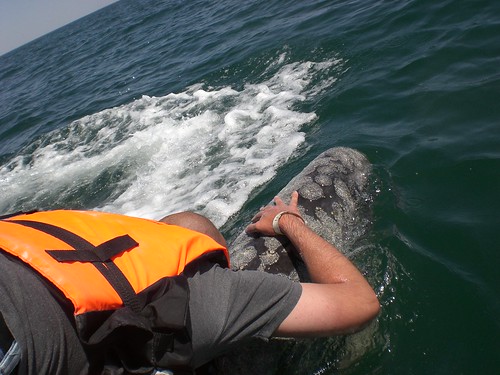
Photo of man hugging gray whale in San Ignacio Bay courtesy of Marc Uhlig of Jupiter Labs.
Biologist Toni Frohoff has a new way see whales and other wildlife: collaborative watching. That's right: she wants us to work with whales so we all get something out of the experience. Instead of just being stalkers, we'd interact on mutually agreeable terms. What Frohoff, research director at TerraMar Research and the Trans-Species Institute of Learning, is proposing is an overhaul of eco-tourism standards. She wants the whales (and other animals) to be in on it, to collaborate with the humans that want to watch them.
Sound impossible? Well, she does it all the time with gray whales in Baja California. As a behavioral biologist she made an appearance in the much-discussed New York Times Magazine story Watching Whales Watching Us. The gray whales migrate up and down the west coast, seemingly indifferent to humans, but once they reach their nursery harbors off Baja, they suddenly become curious about people. That's even more remarkable since people once slaughtered whales here--so much so the species was almost wiped out. But now they've realized people--or at least the people in these harbors--aren't throwing harpoons, they are offering hugs.

Photo of whale near row boat courtesy of FarFlungPhotos and Tarnya Hall.
What do the whales get out of it? For reasons no one can explain, they seem really into it, coming up to boats curiously and seeking out interaction, not just tolerating it.

What the whales can see is this: The whale watching boats have a code of conduct. They have a whales-only area where the whales can go for some down time. And if there are too many whale tourists in the water, they'll get called back. That's important to keep from loving the whales to death, says Frohoff, author of Dolphin Mysteries: Unlocking the Secrets of Communication and Between Species: Celebrating the Dolphin-Human Bond. Though if you're having a meaningful interaction with a whale, you'll find it difficult to leave. "It's harder than not eating ice cream," she says, "but it's necessary for us not be greedy to respect and cultivate this special inter-species bond."

What the whales can't see is the more important big picture of what the whale watchers are bringing them: peace, security and respect. The whale-watching industry is now a $2.1 billion industry worldwide. No one is sure exactly how big the rogue whale-hunting industry is, but we do know whale meat prices have sagged and the governments of Norway, Japan and Iceland have to effectively put their on welfare. The World Wildlife Foundation estimates that Japan spends $12 million a year propping up whaling; while Norway spends $500,000 to support an anemic $2 million industry.

I think eco tourists would love the idea of collaborative whale watching. Of course we want the fascination to be mutual and fair; that's human nature. I think people naturally want to give something in return if someone offers them something nice. People leave out food for birds and animals mainly for practical reasons of drawing them in close. But part of us also wants to be nice--or at least appear nice--to them. We are, in effect, paying the cardinals to show up at our feeder by putting out sunflower seeds.

Will other animals start to collaborate with us? Sure would be nice. I've had a sunfish focus his big, ghastly eye on me; squirrels look at me and bark until I figured out they were standing above a cat they wanted me to chase away; deer stare into a window at me staring at them. Of course, for every one of these delights, I've had 100 or 1,000 experiences of an animal fleeing, fearing that I'm hunting them. That is wildlife watching in the early 21st Century. It wasn't always this way. And, once we start offering animals something in return--ideally something more abstract than food--maybe we'll see it again.

Want to see some whales yourself? Here's where you can do it.


View AnimalTourism.com WHALES in a larger map