A jaguar has been confirmed living--or at least roaming--within 30 miles of the U.S. border with Mexico. The Cougar Network, which tracks big cat sightings, sent out word that the Sky Island Alliance has two photos of jaguars eight days apart about 90 miles north of where everyone thought they lived in Sonora.
Conservation groups like the Northern Jaguar Project, have worked for years to bring back the big, spotted cat that once ranged as far north as the Grand Canyon across California, Arizona, New Mexico, Texas, and possibly Louisiana.
The find would be significant because last year the last known U.S. jaguar died under circumstances that increasingly look dodgy. Arizona Fish and Game caught Macho B in a trap they said was for bears or cougars. They tranquilized and collared him. Days later the then-sluggish cat was euthanized. The capture and drugs may have hastened his death. Just last month investigators found that the capture was intentional, a possible felony since the jaguar (Panthera onca) is endangered.
Just last month the Fish and Wildlife service reversed a 2006 decision and determined that the jaguar deserves a critical habitat. Even the known population in the Northern Jaguar Preserve, 135 miles south of the border, is cut off by hundreds of miles from the the main population.
The motion-activated game cameras showed the jaguars from different sides, so no one is sure if it's the same cat, Sergio Avila, an alliance biologist in Tucson, told the Arizona Daily Star. A handful of jaguars have been spotted just over the U.S. border in recent decades. Where the sex was determined, it was always males, probably pioneering out to find new territories.
Carlos Elias, co-owner of El Aribabi ranch where the photos were taken, his wife and biologist Avila exploded with joy when they reviewed the pictures and found the jaguar. They "began hugging and cheering - a celebration of three years working together to preserve the excellent ecological conditions on the property so that species like the jaguar have a place to roam and thrive," the Sky Island Alliance reported.
"Our family has worked hard to restore ecological processes in this land," Elias said. "We hope this gets the attention of government agencies and foundations, so we can establish a sustainable model that protects biodiversity and supports landowners and their families at the same time."
Where to See Big Cats Around the World
Showing posts with label mexico. Show all posts
Thursday, February 18, 2010
Monday, August 17, 2009
What is Collaborative Whale-Watching and Wildlife Viewing?
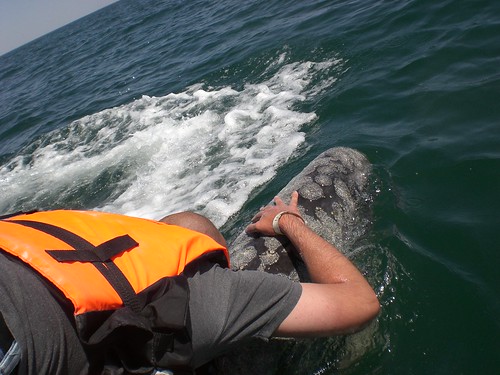
Photo of man hugging gray whale in San Ignacio Bay courtesy of Marc Uhlig of Jupiter Labs.
Biologist Toni Frohoff has a new way see whales and other wildlife: collaborative watching. That's right: she wants us to work with whales so we all get something out of the experience. Instead of just being stalkers, we'd interact on mutually agreeable terms. What Frohoff, research director at TerraMar Research and the Trans-Species Institute of Learning, is proposing is an overhaul of eco-tourism standards. She wants the whales (and other animals) to be in on it, to collaborate with the humans that want to watch them.
Sound impossible? Well, she does it all the time with gray whales in Baja California. As a behavioral biologist she made an appearance in the much-discussed New York Times Magazine story Watching Whales Watching Us. The gray whales migrate up and down the west coast, seemingly indifferent to humans, but once they reach their nursery harbors off Baja, they suddenly become curious about people. That's even more remarkable since people once slaughtered whales here--so much so the species was almost wiped out. But now they've realized people--or at least the people in these harbors--aren't throwing harpoons, they are offering hugs.
Photo of whale near row boat courtesy of FarFlungPhotos and Tarnya Hall.
What do the whales get out of it? For reasons no one can explain, they seem really into it, coming up to boats curiously and seeking out interaction, not just tolerating it.
What the whales can see is this: The whale watching boats have a code of conduct. They have a whales-only area where the whales can go for some down time. And if there are too many whale tourists in the water, they'll get called back. That's important to keep from loving the whales to death, says Frohoff, author of Dolphin Mysteries: Unlocking the Secrets of Communication and Between Species: Celebrating the Dolphin-Human Bond. Though if you're having a meaningful interaction with a whale, you'll find it difficult to leave. "It's harder than not eating ice cream," she says, "but it's necessary for us not be greedy to respect and cultivate this special inter-species bond."
What the whales can't see is the more important big picture of what the whale watchers are bringing them: peace, security and respect. The whale-watching industry is now a $2.1 billion industry worldwide. No one is sure exactly how big the rogue whale-hunting industry is, but we do know whale meat prices have sagged and the governments of Norway, Japan and Iceland have to effectively put their on welfare. The World Wildlife Foundation estimates that Japan spends $12 million a year propping up whaling; while Norway spends $500,000 to support an anemic $2 million industry.
I think eco tourists would love the idea of collaborative whale watching. Of course we want the fascination to be mutual and fair; that's human nature. I think people naturally want to give something in return if someone offers them something nice. People leave out food for birds and animals mainly for practical reasons of drawing them in close. But part of us also wants to be nice--or at least appear nice--to them. We are, in effect, paying the cardinals to show up at our feeder by putting out sunflower seeds.
Will other animals start to collaborate with us? Sure would be nice. I've had a sunfish focus his big, ghastly eye on me; squirrels look at me and bark until I figured out they were standing above a cat they wanted me to chase away; deer stare into a window at me staring at them. Of course, for every one of these delights, I've had 100 or 1,000 experiences of an animal fleeing, fearing that I'm hunting them. That is wildlife watching in the early 21st Century. It wasn't always this way. And, once we start offering animals something in return--ideally something more abstract than food--maybe we'll see it again.
Want to see some whales yourself? Here's where you can do it.
View AnimalTourism.com WHALES in a larger map
Sound impossible? Well, she does it all the time with gray whales in Baja California. As a behavioral biologist she made an appearance in the much-discussed New York Times Magazine story Watching Whales Watching Us. The gray whales migrate up and down the west coast, seemingly indifferent to humans, but once they reach their nursery harbors off Baja, they suddenly become curious about people. That's even more remarkable since people once slaughtered whales here--so much so the species was almost wiped out. But now they've realized people--or at least the people in these harbors--aren't throwing harpoons, they are offering hugs.
Photo of whale near row boat courtesy of FarFlungPhotos and Tarnya Hall.
What the whales can see is this: The whale watching boats have a code of conduct. They have a whales-only area where the whales can go for some down time. And if there are too many whale tourists in the water, they'll get called back. That's important to keep from loving the whales to death, says Frohoff, author of Dolphin Mysteries: Unlocking the Secrets of Communication and Between Species: Celebrating the Dolphin-Human Bond. Though if you're having a meaningful interaction with a whale, you'll find it difficult to leave. "It's harder than not eating ice cream," she says, "but it's necessary for us not be greedy to respect and cultivate this special inter-species bond."
What the whales can't see is the more important big picture of what the whale watchers are bringing them: peace, security and respect. The whale-watching industry is now a $2.1 billion industry worldwide. No one is sure exactly how big the rogue whale-hunting industry is, but we do know whale meat prices have sagged and the governments of Norway, Japan and Iceland have to effectively put their on welfare. The World Wildlife Foundation estimates that Japan spends $12 million a year propping up whaling; while Norway spends $500,000 to support an anemic $2 million industry.
I think eco tourists would love the idea of collaborative whale watching. Of course we want the fascination to be mutual and fair; that's human nature. I think people naturally want to give something in return if someone offers them something nice. People leave out food for birds and animals mainly for practical reasons of drawing them in close. But part of us also wants to be nice--or at least appear nice--to them. We are, in effect, paying the cardinals to show up at our feeder by putting out sunflower seeds.
Will other animals start to collaborate with us? Sure would be nice. I've had a sunfish focus his big, ghastly eye on me; squirrels look at me and bark until I figured out they were standing above a cat they wanted me to chase away; deer stare into a window at me staring at them. Of course, for every one of these delights, I've had 100 or 1,000 experiences of an animal fleeing, fearing that I'm hunting them. That is wildlife watching in the early 21st Century. It wasn't always this way. And, once we start offering animals something in return--ideally something more abstract than food--maybe we'll see it again.
Want to see some whales yourself? Here's where you can do it.
View AnimalTourism.com WHALES in a larger map
Labels:
baja,
collaborative wildlife watching,
gray,
gray whale,
mexico,
toni frohoff,
tour,
whale,
whale watching
Friday, August 22, 2008
Mexico trying to save the last 150 vaquita porpoises
Mexico just announced it would spend $16 million to get fishermen in the Bay of California to learn not to catch the vaquita porpoise, which is down to only about 150 animals. A website dedicated to saving the vaquita estimates 39 to 84 die each year in nets.
There are so few left that some have even argued they're extinct, so why bother trying to save them? The Vaquita Marina group says people still do see them--and catch them in nets--so they know there are still some around. They've even come up with a handy map of vaquita sightings.
They say that the cartoon-faced porpoise "can not be easily observed, since it flees when boats appear and remains under the water for several minutes without having to come out to breathe."
Go to the Best Places to See Anaimals in California
Where to See Dolphins

If there really are 150 left, the program amounts to $10,000 per vaquita--and a good example of how expensive it is to save a species if we let it dwindle so low. What they'll actually be spending the money on, according to Discovery News, is paying fisherman $4,500 not to fish in the reserve, $30,000 to learn safer techniques and $60,000 to turn in their boat and quit fishing.
Labels:
baja,
ca,
dolphin,
endangered species,
latam,
marine mammal,
mexico,
porpoise,
vaquita
Subscribe to:
Posts (Atom)