When I was in Germany a few weeks ago I got to visit Saarbrücken Wildpark, which confused me. In the middle of a forest were huge pens for native animals. No addmission charge, just come on in, enjoy the animals or the woods. I wondered how this place could survive if the animals weren't producing food.
"By the way, the animals are not supposed to be eaten!" says Michael Wagner, head of Saarbrucken's forestry department. All the Germans I mentioned this to were equally appalled at my assumption.
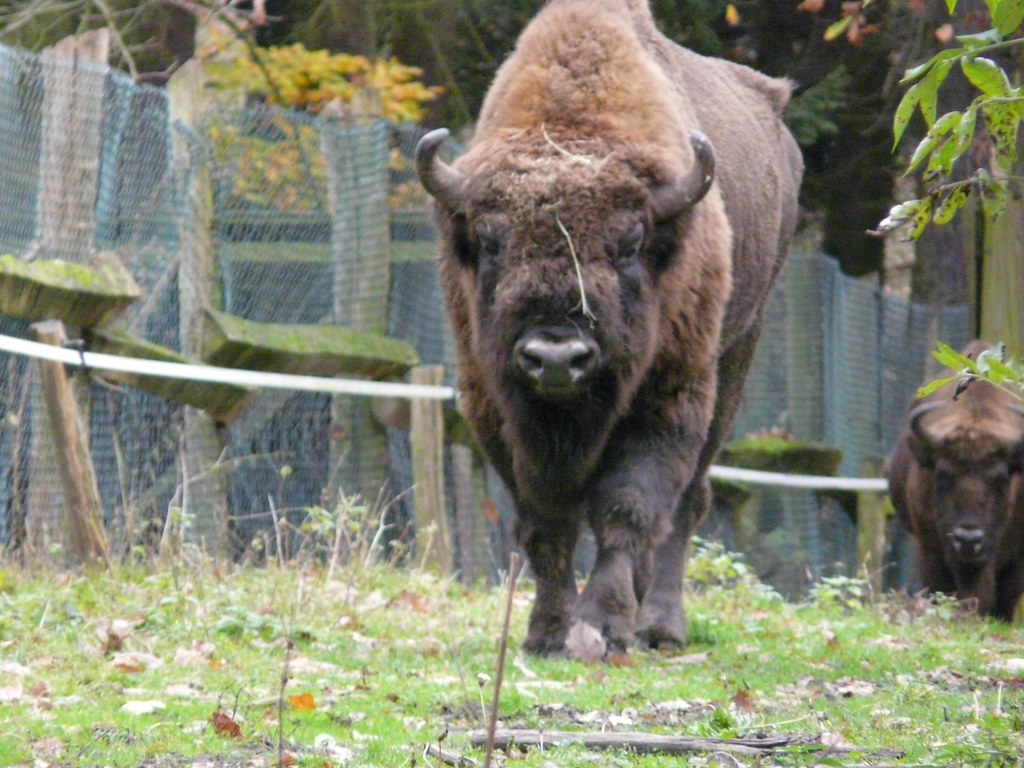
The animals are there neither to be rescued nor eaten, but just for people to enjoy. "The Wildpark is intended as a greenbelt recreation area for the citizens of Saarbrücken, especially for families with children," he says. They also have a geology-themed trail. Even though the center isn't set up specifically for animal welfare, they do sometimes take in a few orphans, Wagner says. And they are part of the important project to recover the wisent. Only one herd of the European bison was left in the Polish woods after World War II, but there are now several thousand because of an elaborately managed breeding exchange program across Europe.
View Animaltourism.com Europe in a larger map
It's fantastic that Germans and other Europeans have recognized that native animals in their natural environment (or a close enough approximation) are just fun to see. I wish we had wildparks here. The wildparks are all over the place. ZooInfos lists 144 native wildlife parks in Germany; 29 in Austria and 16 in Switzerland.
The wildparks each have their own quirky history shaped by historical events and people who either wanted to hunt or preserve a species (or both). Many started as private hunting preserves of the wealthy, then after a war, revolution or gift, they fell to public hands.
France has parc animaler (animal parks), but it doesn't seem like there are as many (ZoosInfo lists only 15). This Safari Train one lets people see bison and ostrich on the range, then buy their meat.
I'm still a little confused by the new categories. There are zoos, tierparks (translation: zoo), wildparks and native wildlife parks. They have deer parks and vogelpark (birds). And then all kinds of specialty wildparks:
The Neanderthal Wildpark features wisent and two other animals that people have tried to breed back from extinction, the auloch (a primitive cattle breed) and the tarpan (a horse ancestor).
Wildparks like these show that people would love to go see native animals if given the chance.
See more animals in Europe
Showing posts with label germany. Show all posts
Sunday, December 06, 2009
Sunday, November 29, 2009
Hamburg's Swan Boats Escort Birds to Warm Winter Pond
Every winter since 1674, Hamburg's full-time "swan father" has taken care of its flock of 120 mute swans (Cygnus olor). The current swan father, Olaf Nieß, uses blue motorboats loaded with hay to ferry the flock to a pond that's kept free of ice. The city also gives the Hamburg Schwanenwesen winter food and even their own website, too.
The idea goes back to a myth that as long as one swan lived in Hamburg the city would prosper.
Olaf Nieß, who inherited the job from his father, learned that he only has to move the young, difficult swans. The rest know the routine. When he shows up with his blue boats labelled in emergency services type lettering " Schwan" (swan) on Schwanenvesen (Swan Boat), they go to their winter place. He catches the unccoperative swan over two or three days, tying their feet with a velcro strap and laying them gently on the straw. The swans stay in Eppendorfer Mill Pond, which the city keeps from freezing over by pumping the warmer water from the bottom to the top. Other migrating geese stop by, too. They forage a little for themselves, but the city makes sure they have grain. Then in March, when the main water area is ice free again.
Olaf Nieß told the Hamburg Morgen Post that the flock stays at about 120 because some chicks naturally die off. Some swans do get removed--but just to be sent as goodwill gifts around the world. The only real trouble the swans face is flying into buildings or run-ins with traffic or fishing nets and hooks. The swans often pick unusual places around the city--windowboxes, traffic islands, tugboats and highrise terraces. The city also has a nice animal rescue and rehabilitation service that raises 300-500 birds a year--not just swans, but all types of birds.
It's great to see a city appreciate its waterfowl--instead of putting up signs forbidding anyone from feeding them, as has become the trend.
Find more places to see birds and animals in Europe
Photo courtesy of Qiao-Da-Ye
Monday, November 16, 2009
German Wild Parks: Part Zoo, Part Sanctuary, Part Walk in the Woods
But then when we got to the cafeteria there were signs and a brochure boasting of "wildsalmi" and how great it is that they let animals live wild until they die.
So were these animals here going to be eaten? Were they rescued from injury? Or were they just here for a pleasant show? The answer is probably the last one, as near as I can gather so far. The couple Germans I've talked to were adamant that the animals at wildparks aren't eaten. They didn't know about rescue. As a small-time wildlife rehabber, I'd think the parks would be the perfect place for injured, orphaned or diseased animals that couldn't survive in the wild.
They seem to be a unique German--or maybe European--tradition going back decades. This one was built in 1929. German friends say they went as kids. That explains why the extraordinarily helpful train clerk in the Saarbrucken station practically tried to talk me out of going, noting that there were certain hours to go "if you want a pony ride."
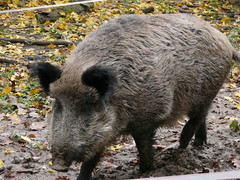
Europeans may be bored with their fallow deer and wild boars, but I've never seen them. I couldn't have been more delighted with the native European animals they had there. The wild boars were the animals most interesting to me, even though they mainly just napped in the mud. There were both red and fallow deer. I tried to use my knowledge of German from 99 Luft Balloons to ask a helpful worker which these were. And then I learned that that luft means air, not red. Plus they have wisent (Bison bonsasus a smaller, endangered European version of the bison), which are breeding. I'd like to figure out if the young wisent are part of the captive breeding program that is returning the wisent to the wild. The wisent ignored us at one end of their ample enclosure but came rushing over at the other end. I think it was the piles of acorns at our feet they were after. I obliged--after all, you're allowed to feed the animals here, a huge difference from U.S. wildlife facilities.
What's peculiar is I wrote to some German tourism office before we left asking about chances to see wild animals. One wrote back that the Rhine isn't known for fallow deer; it's known for wine. Gee, thanks. I think these sleepy wildparks would be a big hit with American tourists if they knew they were there.
Got any information on wildparks--or other good places to see animals in Europe? Let me know, so I can map them at animaltourism.com.
Labels:
attraction,
deer,
europe,
fallow deer,
germany,
wild boar,
wildpark
Subscribe to:
Posts (Atom)