We've Moved!

Hi and Welcome to the AnimalTourism.com blog. But we've moved just down the street to this site, animaltourism.com/news. Please comment there.
Showing posts with label deer. Show all posts

Thursday, May 20, 2010

Real Life "Fox and Hound" Story at UK Wildlife and Farm Sanctuary

A rescued fox cub and a dog bred to kill foxes are becoming friends at a hotel/wildlife sanctuary in Cornwall. The Gwel an Mor had already turned wildlife rescue into an eco-attraction at its lodge. Then animal wrangler Gary Zammit heard a fox cub crying in the field. He worried his own dog would attack the cub, but instead they've become wrestling buddies (and UK media celebrities).
 
The fox, now called Copper, and dog  Jack now play constantly, when they're not being featured on the BBC or the Telegraph or other outlets. Actually, it's their pictures of rassling that have become so popular. "They just play fight there's never any malice in it," says Zammit. Jack is a lurcher--a kind of greyhoundish mixed breed popular in the British Isles, but obscure in the U.S.--a dog traditionally used to hunt rabbit and fox.

The story is like a real life Fox and the Hound, in which a fox cub is raised by a hunter and befriends his hound. I forget the rest of the story, but I remember crying over the book as a kid. Copper isn't going to end up hunted; he'll get to live at Gwel an mor, where guests are lead on wildlife walks to try to spot wild foxes and badgers.


Zammit makes a point of telling the press that the fox cub was crying there for two days. That means he didn't just rush in and scoop it up while its mother was off hunting. He knew to wait to be sure she wasn't coming back.

Gwel an Mor itself is interesting: they're a luxury spa/lodge that also rescues wildlife. They have a fancy restaurant and rooms start around  $1,100 a week in the summer. It seems like it would be like going to the Cornish equivalent of a jungle lodge, with nightly safaris to see the local wildlife. "We will look for badgers, owls, deer and foxes close by to the holiday lodges. If the wild foxes don’t show up, don’t worry as you will be sure to meet our own rescued foxes, Todd and Sonny," their website says. "We have all sorts of other rescued wildlife coming in all the time so who knows what other wonderful creatures you might meet on the wildlife experience." 

Where to Go to See Wolves (and some other wild canids)
Where to Go See Wild Animals in Europe

Wednesday, April 28, 2010

Western States Suffer Declining Deer Numbers, Higher Deer Tension

Mule Deer
Mule Deer by Marvin James Phelps
The southwest has a deer shortage and deer controversy.

What could be controversial, you think? We've all been told that deer cause havoc, eating forest understory, crashing into 1.5 million cars every year, which kills 150 people and costs $1.1 billion.  Many people I talk to say they approve of hunting just because it cuts down the deer population. A Responsive Management Survey found more Americans approve of hunting deer (78%) than any other animal.

A Westfield State College paper from Massachusetts paper sums up the gratitude we should feel towards hunters because they "provide a means of controlling deer populations. Without some means of restraint, there is the potential to have deer expanding into areas beyond their natural habitat. This can endanger humans as well as the deer themselves."

But in this case--as in many others--hunters want to increase the number of deer.  Nevada's mule deer numbers have been cut by half since 1988, so hunters want to start shooting coyote and mountain lion. But state game officials say that won't do any good; habitat loss is to blame for the deer decline. Tony Wasley, Nevada's mule deer specialist, told USAToday that "all the predator control in the world won't result in any benefit."

But, science be damned, the governor and the hunters he appointed on the state's wildlife commission want to shoot some varmints. Nevada Wildlife Commission Chairman Gerald Lent asked the feds to start killing predators (they said no, since there was no biological basis) and then he started a committee to restore mule deer. “The governor gave me and our commission a direct order — that he wants something done about our declining deer numbers,” Lent told the Nevada Appeal.

I think most people would be surprised that wildlife commissions' official missions are to promote hunting, not a healthy environment. But hunters seem to feel entitled to have their needs put above wildlife watchers and the general public. The same survey by Responsive Management found that the majority of hunters in New Hampshire would approve of increasing the deer and moose population even if it meant more human-moose conflicts (86%), moose-car crashes (63%), deer-car crashes (68%) and damage to crops, timber and landscaping. I wonder if Nevada will go the way of Idaho, which recently introduced skunks and badgers to kill pelicans, and bring in some other predators to kill the predators that hunters don't like.

Where to Go See Wildlife Out West
Where to Go See Deer

Wednesday, April 07, 2010

Nara, Japan, Treats its Deer Like Sacred Cows; Other Cities Worldwide Contemplate Reduction

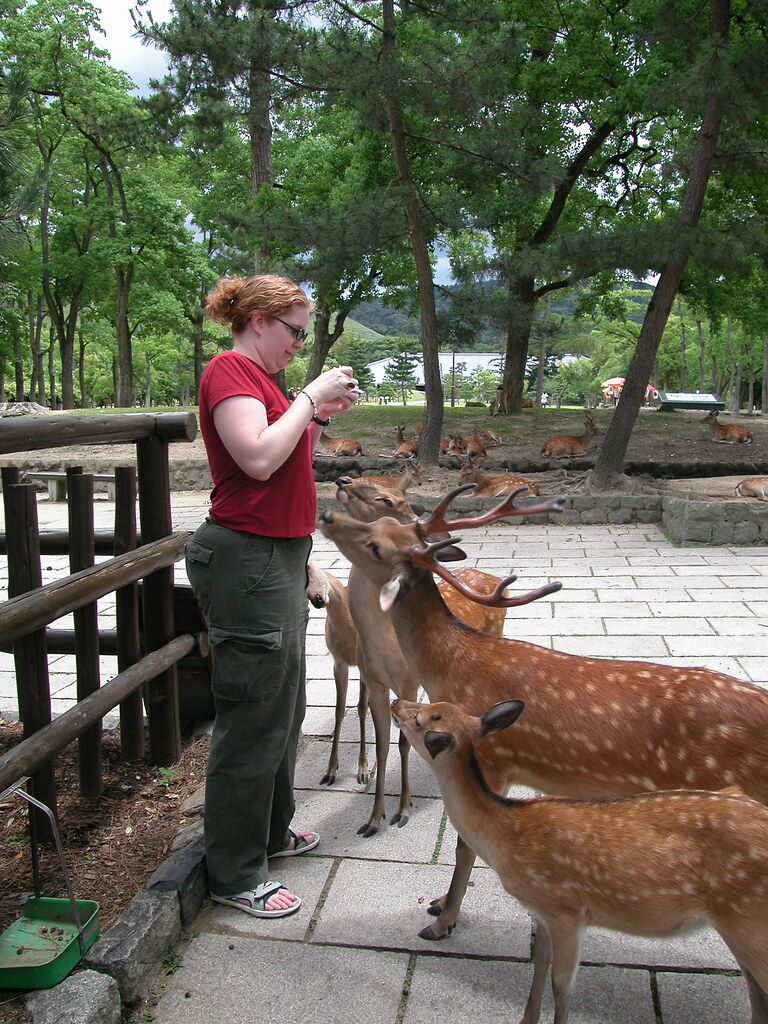
Nara Deer Accost Tourist, by petitshoo
The sika deer in Nara, Japan, have it made: they are treated like the sacred cows of India, allowed to wander everywhere and eat pretty much whatever they want. James Dorsey writes in the LA Times that the deer have learned to bow to visitors. Vendors and vending machines sell "deer courtesy crackers" (鹿煎餅 Shika-senbei)  and outdoor restaurants provide diners with the biscuits so they can get the deer to leave them alone.

Japanese writer Noboru Ogata says that the sitka deer (Cervus nippon) have been around the Kasuga Shrine (near Osaka) since the 12th Century and were considered a good omen from the gods. Since they were literally sacred gift, people were put to death for killing them. Now they are officially a national treasure. About 1200 roam the city park. They have an annual Shika Tsuno Kiri festival to trim the deer's horns.

The Nara deer are probably some of the best treated in the world. Especially when you consider some ways people have been trying to handle their deer lately:

England: The Brits generally love their deer and even have deer parks with deer safaris. But lately they've had a bit much of them, Wildlife Extra says. Populations of all species--two native, four introduced--are on the rise. Wildlife minister Huw Irranca-Davies, declared the diminuitive muntjac deer, deer non grata. The Duke of Bedford once kept the tiny deer as pets, but, the British Deer Society says, they now roam south and central England and Wales. Here's their handy map.

Austin, TX, wants to trap deer, send them to a butcher and donate the meat to charity.

Suburban Chicago Will County wants to start allowing hunting in forest preserves.

For decades Pennsylvania managed its deer population to produce more deer to hunt. Now it wants to reduce deer numbers (and car accidents) by forcing hunters to shoot does instead of bucks. But a group of hunters objects, saying the state really has a deer shortage, Philly.com reports.

Where to Go to See Unusual Deer

Thursday, April 01, 2010

Animal April Fool's

Most of the animal-themed April Fool's jokes this year play on   our overwhelming desire to befriend, understand and get close to our animals.

Michigan's State-Sponsored Canned Deer Hunts
The Detroit Free Press was the boldest and funniest, with a plan to corral Michigan's 1.7 million deer and allow canned hunts in an effort to prevent bovine tuberculosis. "Hunters could drive to any of the eight or 10 state deer ranches after breakfast -- no more need to get up before dawn -- and be in a stand by noon. It shouldn't take more than an hour to shoot the deer and get home in time to watch the football game," a bogus biologist said. State financial crisis? Solved!


Google Translate for Animals
Google gave us a bit of wish fulfillment with Google Translate for Animals, which comes just its only marginally less amazing program to translate a ton of human languages. Hold your Google Android up to an animal and finally get to understand what they're saying. Their demonstration animals were all mushy, only offering compliments and affection. I'd have liked to see more opinionated animals, critiquing outfits, their food, their human handlers.

Montana State Flower
An outdoors writer for the Billings Gazette wrote about a  proposal to recycle all those obsolete, giant satellite dishes at camp sites, providing both shade and some controversial outdoor television enterntainment.

Nanaimo Non-Mermaid
The poor folks at the Nanaimo News on Vancouver Island no longer have a prank story about a mermaid sighting on their website. All they have is this pathetic explanation "for those who missed the clues" that wends its way to the serious point behind it all..."pollution is no laughing matter"...blah, blah, blah. This kind of thing--along with all the other hacky, humorless stories out today bemoaning that offshore oil drilling or whatever sounds like an April Fool's joke but it's serious--is exactly what gives animal lovers and environmentalists a bad name.


Who's Your Emperor Now, Mr. Penguin?
Animals make a natural subject for April Fool's Day pranks. Or so says the Museum of Hoaxes, a hoax authority quoted by the Pittsburgh Post-Gazette, though they count such innanities as calling the zoo and asking for Mr. Lion and such. Occassionally a prankster will hoax an animal, like Tokyo Ueno Zoo did in 2005, putting human emperor penguins in their place with a human-sized overlord.


Where to Go to See Weird Animals

Sunday, March 21, 2010

Antlering: Hunters and Wildlife Watchers Both Love Collecting Antlers

You can congratulate me now: I just received an antlering permit from Utah after passing the 2010 Antler Gathering Ethics Course. I only got 95%, but they let me redo the question I missed. As gathering antlers shed in the winter by moose, elk and deer gets more popular among both hunters and wildife watchers, states are regulating the hobby so we don't stress out the ungulates when they're practically starving. It's gotten so bad, even libertarian Wyoming has rules this year.


Utah's online "class" is really to teach you not to follow or harass the animals. They don't want people stalking  deer and elk in the winter and spring, when they could be stressed and starving. Even in a good year 40% of yearling deer and 20% of adults die, I learned. The stress of winter--low food, temperatures and light--can kill them off even into the spring. Expending energy to run away from somebody looking for antlers is the last thing they need. In a podcast, Anis Aoude, Utah's Big Game Coordinator, says he's caught people chasing animals around, waiting for their antlers.

The various species can loose antlers November through March. Aoude says shedding the antlers every year might help the animals survive because predators know that males are weak after the rut. The Utah rules say you have to have a permit to hunt for antlers in the spring; Wyoming, home of the National Elk Refuge, just bans horn hunters from December through April. If you don't manage to gather any for yourself, the Boy scouts will still gather antlers for Jackson Hole's annual antler auction and Elk Fest in May.

Where to Go to See Elk and Deer
 See More Wild Animals Out West


Tuesday, January 26, 2010

Dillie the Deer Maligned as Dangerous

Since Dillie the deer has gotten a lot of press, her human mom, vet Dr. Melanie Butera, has gotten a lot of grief.   The panic runs the gamut from worrying Dillie is plotting murder to fretting the GPS collar might suffocate her.

"It seems like the hunters are the ones that get the most upset," says Dr. Butera. On Friday's Bill O'Reilly show Alisyn Camerota, one of Fox's blond correspondents, picked the Butera family as the stupidest thing of the week. "Haven't we all learned," Camerota said, "that when you live with a domesticated wild animal, one day it wakes up and eats you."

Hasn't Camerota learned that an animals can't be both domesticated and wild? That there's a difference between carnivores and herbivores? Or even that this particular deer was farm-bred? Maybe Keith Olbermann, a big fan of deer--or at least security videos of deer invading stores--will respond.

"I wondered how she is going to to kill me. Is she going to apply for an American Express card and get on the Home Shopping Network and order a machete?" asked  Dr. Butera.

Not that we're fans of pet deer. Dillie is an exception because she was born on a farm (not in the wild), raised by an experienced wildlife vet, who has a huge enclosure for her. Plus, she close the house (particularly the guest bedroom) over the barn. You can see what she's up to on the Dillie cam.

Ohio has about 1,000 deer farms, which have lots of rules because of CWD. A Mennonite who sells big bucks to canned hunts couldn't make money off Dillie and didn't want to spend money to save her. Yet, he did bring the tiny fawn to Dr. Butera in the middle of the night to save her after the doe rejected her.

Dillie is nearly blind, which makes her more dependent and docile. Dillie is not without mischief, however. She once stood on her hind legs to get flowers off the top of the fridge and regularly knocks over beverages in a quest for ice. But about the biggest problem she causes is that she makes the dog jealous for attention.

Or See Where You Can See Special Deer

Thursday, January 14, 2010

Dillie, the Ohio House Deer, Defies Odds

Don't try this at home: an Ohio family is living with a deer.  This is not the typical story we hear nearly every day: an animal person takes in an animal they are unprepared to manage and tragedy ensues for one or both. The characters and species change; the results are monotonous. This month we saw the Canadian guy killed by his pet tigers and the death of Michael Jackson's former giraffes. Miraculously, this isn't one of those stories.

Dillie the deer was rescued by someone who knew what she was doing. Dr. Melanie Butera (Dillie's human mom) is a vet who does a lot of  wildlife work. Dillie's deer mom rejected her because she was sickly and had cataracts. That means she wasn't brought in for the usual wrong reason: somebody finds a fawn alone in the woods and doesn't realize its mom is just out eating.

 Dillie was born on a Canton area deer farm. (Ohio has tons of farmed deer, whose purpose ranges from being pet, bred, eaten or the target of a canned hunt.) The farmer saw Dillie's deer mom, busy with two robust other triplets, push Dillie aside. Ohio has elaborate rules banning the miscegenation of wild and farm deer, so she couldn't go free--even if she were capable. As she's hand-raised and nearly blind, she's not. She's afraid of local deer and thwarted plans to raise her in the barn by being terrified of a horse's snort.

Then Dr. Butera went to extraordinary lengths to give her a good life, with her own room, fenced yard, Zoombak GPS collar and bed privledges and rose treats. She regards Lady as her (dog) mom and initally tried to nurse off the standard poodle.  "Vets all over the world are probably saying, ‘That’s no big deal; I have a giraffe in my basement,’ ” Dr. Butera told the Canton Rep.


Dillie has a webcam. When I looked at it she was standing on her bed. The dog was lying on the foot of the bed. The wall was decorated with letters spelling out "DILLIES."  How many times have you looked at an animal webcam and seen an empty nest or barren habitat? Well, Dillie delivers. It's nice to hear once about someone going the extra mile for an animal and it not ending in conflict or death.

Map of Places to See Animals in the Wild and in Wildlife Rehabilitation Facilities in the Midwest

Friday, November 20, 2009

Meet the Coywolf, the New Canine Predator of North America

You can spend thousands of dollars watching wolves in Yellowstone or $50 - $200 to get a much closer and scientific view of the new canine species that is replacing the wolf: the coywolf. And if you'll have trouble getting to Cape Cod by dusk or dawn, you can even stay in the house of wildlife biologist Dr. Jon Way so he can take you out to see the animal he studies.

Way can take you along for field work when he's using his radio collars to track the animals that are laregely taking on the role of predator across the east, where the wolf was wiped out. He describes his accomodations as "rustic casual:" you sleep in the basement and eat with his family. But the real attraction is the coywolf  and Way, one of its strongest advocates. He is pushing to change the way the coywolf is classified and treated.

Some state wildlife agencies (in the mid-Atlantic) have been treating these coywolves, which are conspicuously larger than western coyotes, simply as an invasive species from the west. They appeared after the wolf was wiped out. Invasive (as opposed to native) means they don't belong and were introduced by humans. The invasive designation means about the only management these new coyotes get is hunting by the federal government through its controversial Wildlife Services agency. Even in states where it's not labeled invastive, there's no bag limit and long hunting seasons--something Way wants to change.

"We should not be calling this animal a coyote. This animal is really a native animal, essentially a product without human assistance," he says. "By getting rid of wolves, we clearly opened up the niche for this animal."

The evidence is showing that the coy-wolf--a term Way predicts will catch on within a year or so--is really a hybrid of the coyote and the endangered Eastern Red Wolf (Canis rufus). Those invasive-native categories have come under attack in books like Playing God in Yellowstone because they presume the American wilderness was pristine and frozen before Europeans showed up.

The coywolf has forced biologist to rethink many old classifications. They are discovering that many of the previously distinct species of wild dog may really be the same. The red wolf is being reintroduced but one of the obstacles is that the animals go out and breed with coywolves.

What we're witnessing is evolution in our lifetimes. The wolf's niche was largely wiped out by development, but a slightly different niche opened up and the coywolf filled it. The coywolf is more amenable to living near people and more flexible in its diet: it eats tiny rodents up to deer.

Eating deer may be the thing that makes the coywolf popular. Way thinks the coywolf could be the answer to the exploding deer population--if people would just let the coywolf do its job.

"The answer is right in front of our face," he says. He supports the reintroduction of the wolf, but thinks they're never going to be able to be as widespread or effective as the coywolf in modern America. Wolves won't be able to exist in suburban areas where deer generate complaints.

Way would like to end the no bag limit hunting that is keeping coywolves in check. About 400,000 coyotes are killed every year, according to a story by Mike Finkel in Audubon. "That is more than 1,000 coyotes a day -- almost a coyote a minute," Finkel writes. The federal government is, remarkably still in the business of predator eradication and its Wildlife Service division itself killed 89,300 coyotes in 2008.


The Adirondacks tourism office, for example, boasts that call coyote hunting "one of the fastest growing sports in the country." With an estimate of 20,000 to 30,000 coyotes in New York, the office pitches, "there are plenty of opportunities in the Adirondack Park." In Way's Massachusetts, last year hunters killed 442 coyotes, almost double the previous years' total.

Way wants to encourage another way to enjoy the coywolves: come out an watch them in action. Aside from his personalized treks, he hopes to open a center so people can learn and enjoy them all the time.

Monday, November 16, 2009

German Wild Parks: Part Zoo, Part Sanctuary, Part Walk in the Woods

Last week I got to visit the Saarbrucken Wildpark, but I'm still not completely sure what I saw. There's no exact translation for "Wildpark," but these little nature attractions are all over Germany. Native animals--wild boars, fallow deer, red deer, bison --and farm animals like goats roamed in huge pens in the woods.

But then when we got to the cafeteria there were signs and a brochure boasting of "wildsalmi" and how great it is that they let animals live wild until they die.

So were these animals here going to be eaten? Were they rescued from injury? Or were they just here for a pleasant show?  The answer is probably the last one, as near as I can gather so far. The couple Germans I've talked to were adamant that the animals at wildparks aren't eaten. They didn't know about rescue. As a small-time wildlife rehabber, I'd think the parks would be the perfect place for injured, orphaned or diseased animals that couldn't survive in the wild.

They seem to be a unique German--or maybe European--tradition going back decades. This one was built in 1929. German friends say they went as kids. That explains why the extraordinarily helpful train clerk in the Saarbrucken station practically tried to talk me out of going, noting that there were certain hours to go "if you want a pony ride."


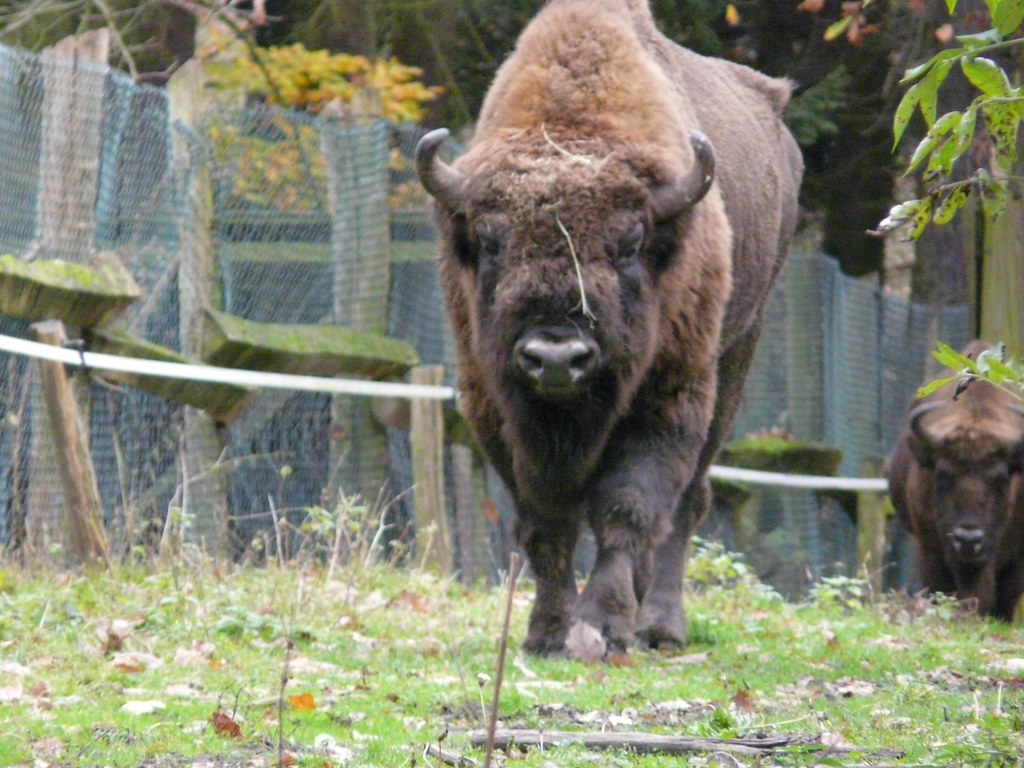
Europeans may be bored with their fallow deer and wild boars, but I've never seen them. I couldn't have been more delighted with the native European animals they had there. The wild boars were the animals most interesting to me, even though they mainly just napped in the mud. There were both red and fallow deer. I tried to use my knowledge of German from 99 Luft Balloons to ask a helpful worker which these were. And then I learned that that luft means air, not red. Plus they have wisent (Bison bonsasus a smaller, endangered European version of the bison), which are breeding. I'd like to figure out if the young wisent are part of the captive breeding program that is returning the wisent to the wild. The wisent ignored us at one end of their ample enclosure but came rushing over at the other end. I think it was the piles of acorns at our feet they were after. I obliged--after all, you're allowed to feed the animals here, a huge difference from U.S. wildlife facilities.

What's peculiar is I wrote to some German tourism office before we left asking about chances to see wild animals. One wrote back that the Rhine isn't known for fallow deer; it's known for wine. Gee, thanks. I think these sleepy wildparks would be a big hit with American tourists if they knew they were there.

Got any information on wildparks--or other good places to see animals in Europe? Let me know, so I can map them at animaltourism.com.

Wednesday, July 29, 2009

Which Animal to Blame for Lyme Disease? Not Deer

I'm in my third week of antibiotics after returning from a trip from New Hampshire with a textbook bullseye surrounding a tick bite. Which animal should I blame?

The New York Times let five biologists and entomologists debate the issue. The first guy out, Thomas Mather, professor of public health entomology, gave the answer that has become commonly lore: deer. The premise: Deer populations have risen along with lyme disease cases.

But then other scientists basically cast some reasonable doubt on the case against the deer. Ixodes scapularis, commonly known as deer ticks, bear ticks or black-legged ticks, can pick up the bacteria that causes lyme disease from a whole range of animals, not just its namesake. The American Lyme Disease Foundation calls deer this species' "preferred host" but notes that mice are the primary carriers of the disease, which can also be spread via birds, dogs, cats, horses, squirrels and other small mammals.

Richard S. Ostfeld, of the Cary Institute of Ecosystem Studies, notes that the incidence of lyme disease and deer don't correspond, but that acorn crops (which feed white-footed mice) do. William L. Krinsky, entomologist at Yale's Peabody Museum, says we don't have enough data to understand how much blame rodents and deer should get.

Interestingly, two species come out as heroes. Bard biology professor Felicia Keesing cites the Virginia opossum (Didelphis virginiana) as the under appreciated fighter of lyme disease; these guys attract and kill ticks by the thousands. Ostfeld gives some credit to owl, who eat the mice, who carry the disease.
Why is it important which species is to blame? Because when people think deer are to blame, they want to get rid of them. I have a reasonable, educated friend who supports getting rid of deer on Long Island because she's afraid of lyme disease. Lyme disease--along with car crashes and eaten gardens, are used to drum up support for deer hunts. If white-tailed deer had any kind of PR muscle, they'd follow the example of pig farmers after the outbreak of swine flu--sorry H1N1--and lobby for changing the deer tick's name.

Monday, January 05, 2009

Deer still exciting to some


When I was a kid, seeing deer was considered rare and lucky. Driving in the carpool to school in the morning, we'd look out over a field automatically, hoping for a glimpse. But the deer population has grown so much many people consider them a nuisance. They eat garden plants and get hit by cars, causing $1 billion in damages, according to the Institute for Highway Safety.

I've come close to hitting a couple myself driving on the Blue Ridge Parkway. But I am still excited to see them around.

This year for the first time ever my mom, who has been living in her house in Des Plaines, Illinois since the 1960s, had deer in her yard. It was a family, we think: a buck, a doe and two fawns. We figured we would never get deer because there's a big fence. They just jumped right over. They ate Rose of Sharon blossoms and corn and apples that are normally out for squirrels.

No matter how far you travel to see an unusual animal, there's always a unique pleasure of seeing a animal up close in a familiar setting.

Friday, June 13, 2008

Unicorn Deer in Italy


A unicorn-like deer is drawing animal tourists to the the Italian Center for Natural Sciences (Centro di Scienze Natural) outside Prato, which is in turn outside Florence.

The unicorn is really a male one-year-old Roe deer, so don't expect to see rainbows and sparkles behind him. His twin has the regular two antler.

The deer has some kind of genetic flaw, but it's even special in that. The AP's Marta Falconi reports that even deer with one antler tend to have it on one side. Plus, this guy's antler looks like a little horn.

The center seems to be handling the occassion with smile. They named him Unicorn. And the director Gilberto Tozzi says: "This is fantasy becoming reality."

Where Else to See Wildlife in Europe
Where You Can See Deer and Elk


View Larger Map