We've Moved!

Hi and Welcome to the AnimalTourism.com blog. But we've moved just down the street to this site, animaltourism.com/news. Please comment there.
Showing posts with label politics. Show all posts

Wednesday, April 28, 2010

Western States Suffer Declining Deer Numbers, Higher Deer Tension

Mule Deer
Mule Deer by Marvin James Phelps
The southwest has a deer shortage and deer controversy.

What could be controversial, you think? We've all been told that deer cause havoc, eating forest understory, crashing into 1.5 million cars every year, which kills 150 people and costs $1.1 billion.  Many people I talk to say they approve of hunting just because it cuts down the deer population. A Responsive Management Survey found more Americans approve of hunting deer (78%) than any other animal.

A Westfield State College paper from Massachusetts paper sums up the gratitude we should feel towards hunters because they "provide a means of controlling deer populations. Without some means of restraint, there is the potential to have deer expanding into areas beyond their natural habitat. This can endanger humans as well as the deer themselves."

But in this case--as in many others--hunters want to increase the number of deer.  Nevada's mule deer numbers have been cut by half since 1988, so hunters want to start shooting coyote and mountain lion. But state game officials say that won't do any good; habitat loss is to blame for the deer decline. Tony Wasley, Nevada's mule deer specialist, told USAToday that "all the predator control in the world won't result in any benefit."

But, science be damned, the governor and the hunters he appointed on the state's wildlife commission want to shoot some varmints. Nevada Wildlife Commission Chairman Gerald Lent asked the feds to start killing predators (they said no, since there was no biological basis) and then he started a committee to restore mule deer. “The governor gave me and our commission a direct order — that he wants something done about our declining deer numbers,” Lent told the Nevada Appeal.

I think most people would be surprised that wildlife commissions' official missions are to promote hunting, not a healthy environment. But hunters seem to feel entitled to have their needs put above wildlife watchers and the general public. The same survey by Responsive Management found that the majority of hunters in New Hampshire would approve of increasing the deer and moose population even if it meant more human-moose conflicts (86%), moose-car crashes (63%), deer-car crashes (68%) and damage to crops, timber and landscaping. I wonder if Nevada will go the way of Idaho, which recently introduced skunks and badgers to kill pelicans, and bring in some other predators to kill the predators that hunters don't like.

Where to Go See Wildlife Out West
Where to Go See Deer

Monday, April 12, 2010

Actual White Elephant Becomes High Maintenance Burden to Burmese Farmers

The 2003 white elephant Rati Malar
Boy, some elephant handler in Myanmar must regret that day in January when he saw a white elephant. The handler told forest officials and eventually the military junta came to look for the animal that has mystical powers in local culture and Buddhism. Now, the Independent reports, the 50 soldiers have conscripted tons of local, forcing them to abandon their families and farms in search of the talisman of prosperity and power.

I wonder if because of this ordeal the Burmese will take the western meaning of "white elephant" as an overly demanding luxury item.

This white elephant is wily in addition to being sacred. It was first sighted in 2008, but no one was able to catch it then, either.  White animals can either be leucistic (fur or skin is white, but eyes  normal) or albino (white skin, red eyes, and often vision and sunburn problems).

In a previous white elephant situation in 2001, many locals speculated that a white elephant claimed by the junta was really an imposter, a pedestrian grey elephant that had undergone some kind of makeover at "an elephant-shed at Athak-naing-ra village" and renamed appropriately, Naringara News reported.  The Independent says that elephant eventually "fell out of favor" along with the government it was supposed to be lucky to. No word on where it went; it's not like washed up white elephants can just get some low-key gig in the hinterlands.

The other elephants in Burma don't get nearly the love his white one does. An elephant advocacy group, EleAid says that there are maybe 5,000 wild elephants left in the country and probably more kept in captivity, working in logging, tourism or sacred ceremonies.  The IUCN Red List says the Asian elephant is endangered and has a "a wide, but highly fragmented, distribution in Myanmar." If they catch this white elephant, it will be treated like royalty, with jewels and fancy dishes. Of course, that's the human idea of fun; the elephant would rather just hang out with its herd.


Wednesday, March 17, 2010

Why is the Guy Who Promoted Horse Slaughter Recommending NY Stop Spay-Neuter?

Jolly, a handsome, neutered dog
New York State is about to cut off spay-neuter funds. It's a short-sighted idea that leads to more strays and more government spending--like stopping vaccines to save a few bucks. Who would propose such a change? How about Patrick Hooker, a guy who got into the office lobbying pro-horse slaughter, pro veal and is generally not so keen on animal welfare.

Right now the change is buried on page 171 of a nearly 600-page state budget, billed deceptively as "dog licensing reform." Search for spay or neuter. You won't find it. I don't know much about the byzantine Albany budget process, so I turned to the Times Union, where Brad Shear wrote an excellent column explaining that the provision was recommended by the Commissioner of Agriculture and Markets, Patrick Hooker and already approved by David Patterson. In 2008 the embattled governor, he notes, "stole $1 million from the fund and put it in the general fund."

Hooker got the job in 2007 after working for 16 years as a lobbyist for the New York Farm Bureau. His state bio says he was the "farm advocacy organization's top lobbyist, serving as Director of the Public Policy Division." He's also a hunter and maple syrup producer. The Daily News reports he gets a $1,622 farm subsidy himself.

While Hooker was the chief lobbyist for the Farm Bureau, it was fighting for horse slaughter and against bills that would outlaw the practice. The only reason New York didn't ban horse slaughter was that the Farm Bureau energetically opposed it, Deborah Glick told WNYT. He's spoken out for foie gras. The bureau worked against applying the same environmental and immigration laws to farmers that others face. The bureau likes to say it wants rules that are "size-neutral"--code for supporting big factory farms. They're against laws for minimum cage sizes. Generally, the agency where Hooker directed policy came down opposed to most animal welfare laws, as if they were some crazy idea of meddling cityfolk.


Hooker also worked for upstate Republican John Randy Kuhl. Kuhl was famous for wanting rural western New York to secede from the rest of the state. (That's a switch: the city has long wanted to brush off the upstate huckleberries and their $11 billion drain on our taxes.) Now he is also famous as the guy who lost to ticklemonster Eric Massa.

People in New York City have paid little attention to the way Albany runs the ag department. Until now. Just last year food activists complained the chairman of the Assembly's agriculture committee was too cozy with the farm bureau, too. Just how did these guys who support just about every anti-animal initiative going start running dog policy for New York state?


The state suspended its stressed and underfunded low-cost spay-neuter program in October. In New York state when you get a dog license, you pay $3 extra if your dog isn't spayed or neutered. (And until recently, if your dog was neutered you were supposed to get a notary to certify that--a higher expense.) Your community has to spend it on spay-neuter. I've already been all over the issue of how this is absurdly low. It needs to be about 10-30 times higher to  incentivize people to neuter their dogs. Instead we may get an even more backwards policy that would feel right at home in the rural south, where dog populations and animal cruelty go unchecked.

Spay-neuter programs aren't just more humane, they save a ton of tax dollars. One study showed that New Jersey saved $2.2 million over 6 years with a subsidized neuter program because they didn't have to kill as many dogs in shelters. It's also safer for people: dogs are more aggressive if they aren't fixed and intact dogs  cause 95% of fatal attacks.


It's absurd that New York state treats pets as agricultural products. I'd imagine that Elliot Spitzer appointed Hooker to seem bi-partisan and to make rural voters happy. Hooker's certainly in touch with what upstate farmers want. But he's not qualified to oversee dogs for the rest of us.


Where to Go to See Dog Events Unrelated to Breeding

Friday, March 12, 2010

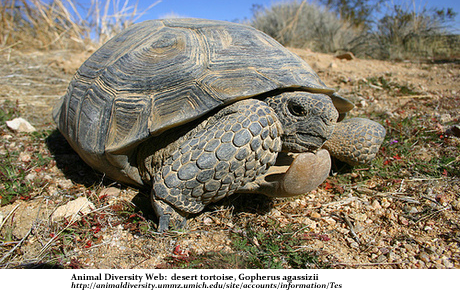
Is the Desert Tortoise the New Spotted Owl?

Republicans have a new animal to hate as a liberal mascot: the threatened desert tortoise. Energy entrepreneurs want to put solar plants in the seemingly barren deserts of the southwest, especially on cheap government land. But conservation groups say this is the last hold-out of what they call a charismatic animal that used to all the way to Los Angeles.

Early settlers could have found as many as 1,000 turtles per square mile. That means if you had a football field with endzones, you'd probably find a couple of them. The uselessness of this land is what makes it so wonderful for the tortoises, which have been decimated by cattle grazing, auto accidents, off-roading, an illness caught from released pets,  rattlesnake roundups and just general development. It's also what seems to infuriate conservatives, who don't want this animal--which you can barely see because it spends 95% of its life underground--messing up the first decent attempts at massive solar plants.


"If we cannot put solar power plants in the Mojave desert, I don't know where the hell we can put it," California Governor Arnold Schwarzenegger asked. Heavy equipment would crush the underground dwellers. If you move them, they try to go back to their old home and get eaten by coyotes. The Army tried to move about 1,000 of them when it expanded Fort Irwin and it was a disaster.

So far there isn't an overall policy, so we're likely to see these skirmishes  with every one of hundreds of projects. On March 10, Pacific Energy and Gas signed a contract to buy energy from Desert Sunlight Solar. The big deal so far was Brightsource, which got a federal loan guarantee after scaling back its project. Its five page press release on the  guarantee does not once mention the tortoise--which says a lot about the bitterness of the dispute. And their plant would only require moving 25 animals--2.5% of the number the army was going to.


Diane Feinstein adding some land to national parks and putting restrictions on hundreds of thousands of other acres to save the tortoise. In return she would speed up the approval process for solar plants. Michael Balchunas, in great article explaining the epic battle for Sunpluggers, says her plan would only impact about 10% of California's 200 proposed solar plants, but there is a larger cultural issue between those who think of the desert as a fragile eco-wonder and those who experience it as a "rough-and-tumble terrain in which people live and work, direct heirs to the no-nonsense settlers of earlier centuries."

I don't know if Feinstein's plan is the right one, but until there's a plan, the tortoise is going to be the new spotted owl.


Where to See Turtles

Tortoise Fun Facts:

The California Turtle and Tortoise Club, which has been working to educated the public and conserve habitat for the 290 species of turtle (they live in water) and tortoise (the ones that live on land) since 1964.

The U.S. Geological Survey just made a 30-minute online movie, The Heat is On: Desert Tortoises and Survival, to explain why the tortoise is in such trouble.