We've Moved!

Hi and Welcome to the AnimalTourism.com blog. But we've moved just down the street to this site, animaltourism.com/news. Please comment there.
Showing posts with label ny. Show all posts

Monday, May 31, 2010

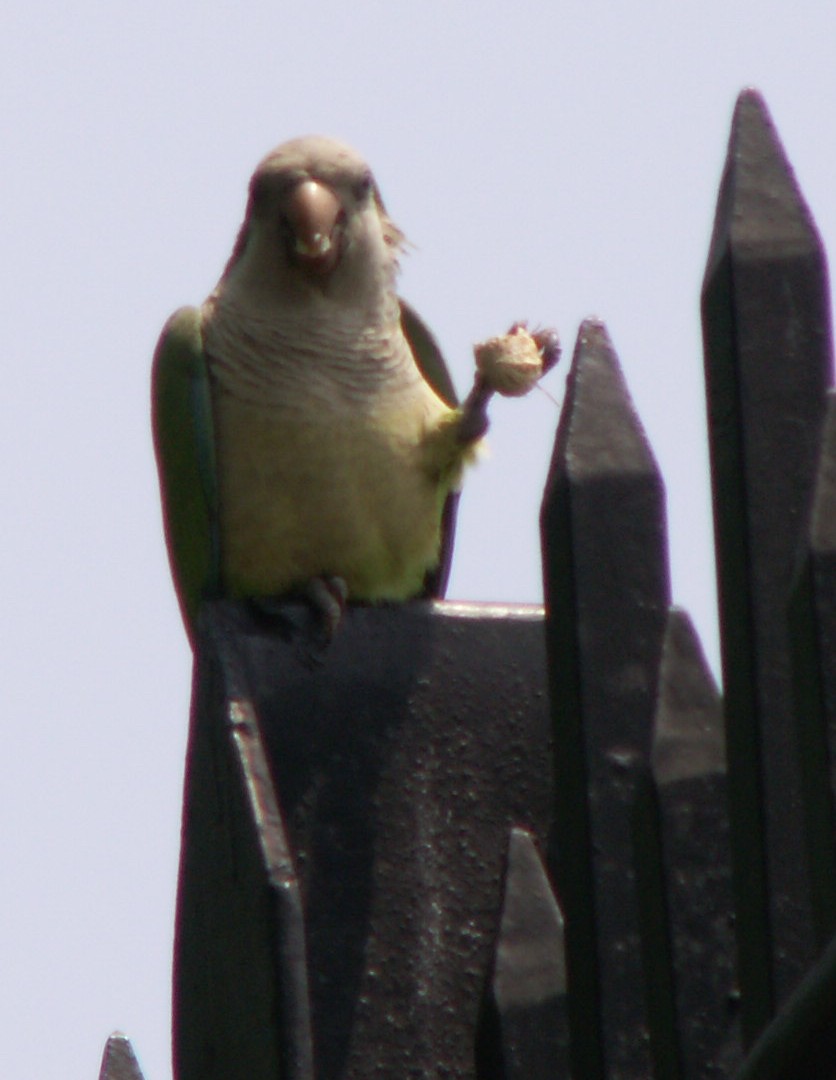
Feral Parrots Land in Lower Manhattan

Parrot near Brooklyn College
Brooklyn, Queens and the Bronx has had colonies of parrots for a while, but now the little green birds may be starting a colony in lower Manhattan. Dennis Edge, a friendly birder who is compiling a book of his many finds around Tompkins Square Park, says he's seen at least two for a couple months in Tompkins and nearby community gardens.

It's too late to be building a nest for eggs, he says, but the birds seem to be building something--like one of their insanely huge colony nests, which can grow to the size of a smartcar. No one knows where, but once the colony gets going, it's huge and they like to build them on tall towers (or trees in a pinch), so it shouldn't be hard to fine in the East Village.

Steve Baldwin has done an amazing job tracking and advocating for the monk parakeets or Quaker parrots at BrooklynParrots.com. He gives free, frequent tours by Brooklyn College and Greenwood Cemetery. At one point he had a highly-detailed map on his site of nests around  New York City and New Jersey, but he took it down after reports of men showing up in vans and grabbing birds.

These huge nests make the parrots unpopular.
The feral parrots x are from South America, but have shown up in cities worldwide, even cold ones, usually with a myth about them escaping from an airport crate. They run into trouble for destroying crops and messing with electrical lines when they build their huge nests. But people love them. And they're an okay replacement species for the Carolina Parakeet that we Americans wiped out a century ago.

Now that red-tailed hawks are becoming commonplace, it's fun to have a new freaky species to look for.

Where to Go to See Parrots in the U.S.
Check Out BrooklynParrots.com

Thursday, May 27, 2010

Mah Wei: Tiny Chinatown Songbirds, but Not Every Day

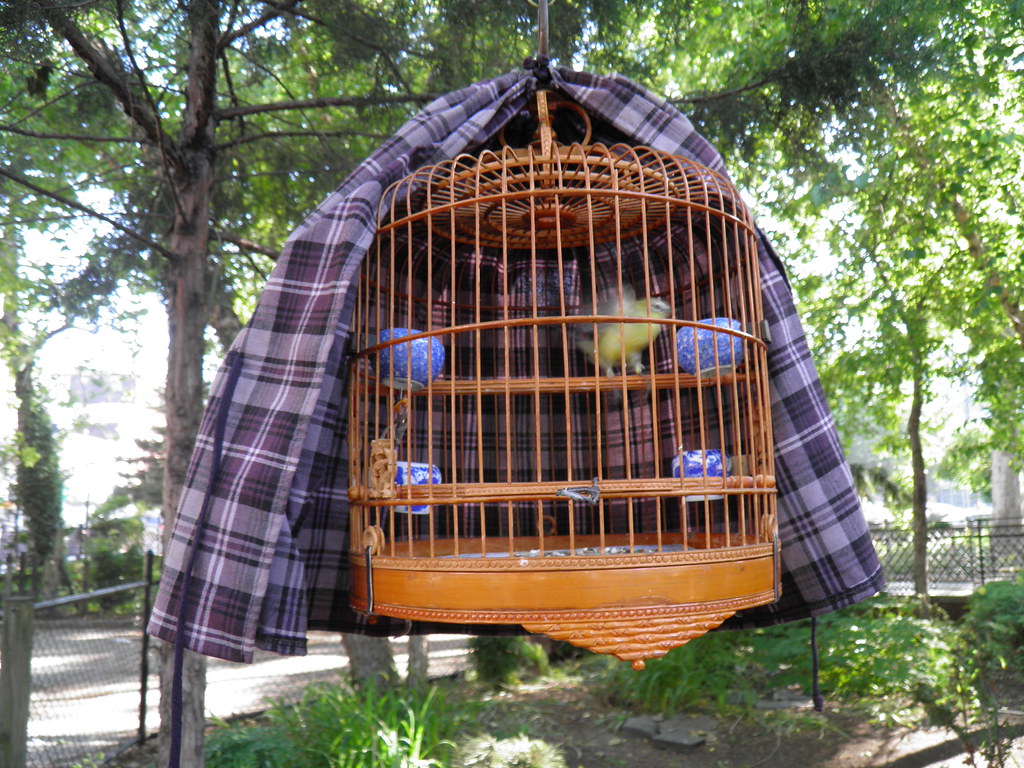
For years I've heard about a Chinatown park where old men bring their exotic birds and this morning I finally went to find it. The Wah-Mei Bird Garden in Sara Delano Roosevelt Park, just south of Delancey, can draw 40-some old Chinese men, each carrying a singing bird in an ornate cage. Or that's what I've heard. I only saw three bird guys.

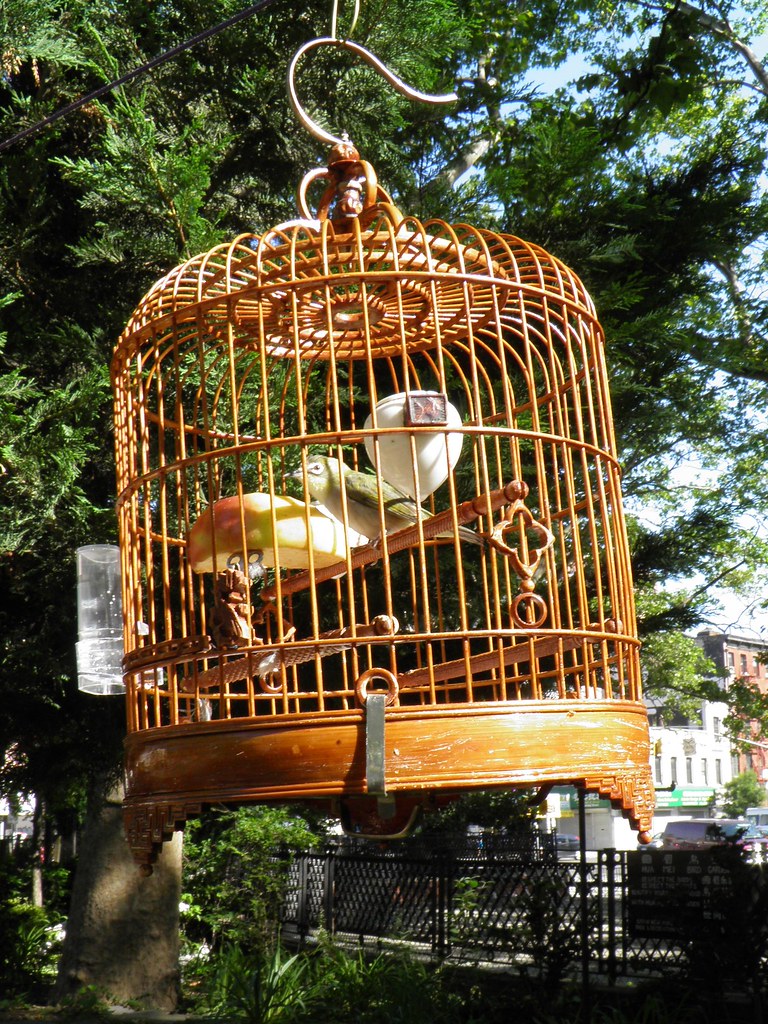
I arrived around 8, in time to see the first bird man take the flannel cloth off his cage. It must shield the bird from the city, though most of narrow Roosevelt Park itself is not much better. It's got bridge traffic on two sides and it's dark and unkempt with wavy pavement and a drugged-out man lurching around. The cages themselves are fantastically carved wood, bamboo and what looked like ivory. They hang them on a long line over a fence that encloses the official Wah-Mei Bird garden. You can hear the birds sing if you get close. Nearby, other elderly Chinese exercised with swords.

The most friendly and happy bird
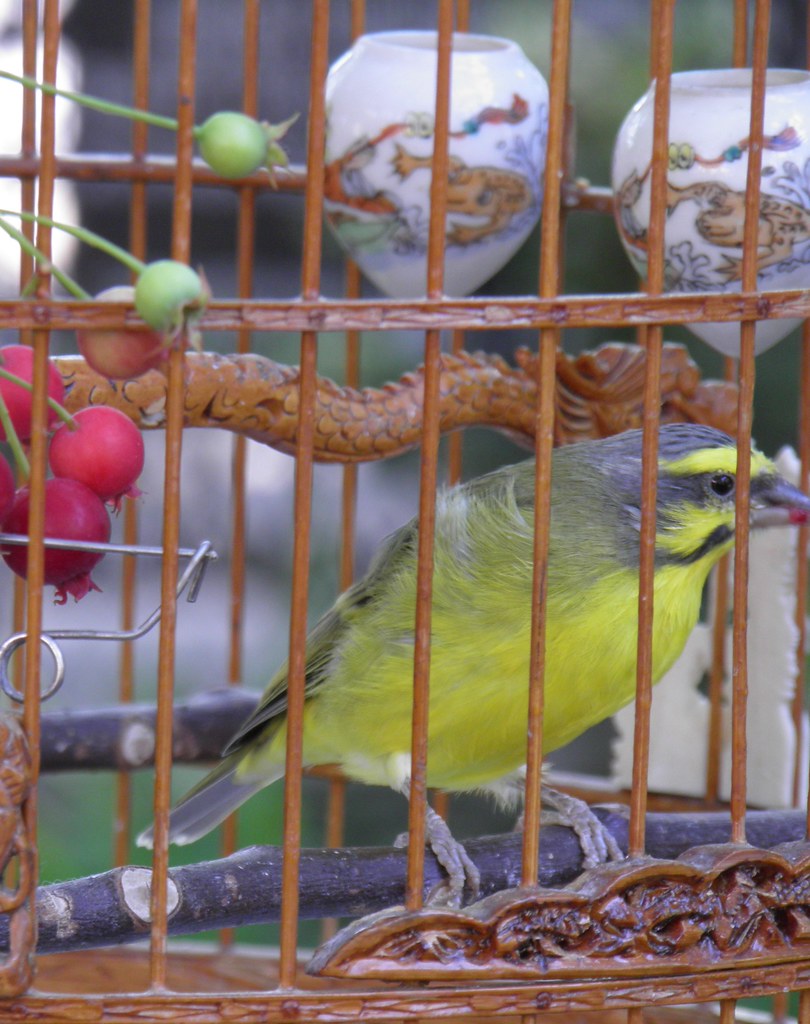
The bird man schedule remains mysterious to me. I asked the men; they acted like they didn't understand me. I asked around; workers and dog walkers said it's every day around this time. (Later, I read on New York Daily Photo blog it's much busier on weekends.) Any singing bird is welcome, but the most desired are male Wah Mei (Garrulax canorus) that know lots of songs. The men who pretended not to speak English told a local guy can be had for $100 in Queens. Tracy Wong described in a NYU paper how the men get the territorial male birds to compete in singing.

The second bird I saw, another bright yellow one in a fabulous cage that looked like it included ivory, was my favorite. He's a mimic. I whistled to him and she whistled back. And kept the tune going. He was probably annoying his owner with my tuneless notes all day. He ate from fancy porcelain jugs, too.

The third bird was probably the only one that was really a Wah Mei. CITES, which restricted its import after the bird flu outbreak, says that it's the most popular bird traded in China. Before the ban, they figured 1.8 were captured each year, with most of the females just eaten.
Probably the only real Wah Mei


Where to Go See Weird Birds

Wednesday, May 26, 2010

New Yorkers Climb Fire Escape to Rescue Baby Blue Jay

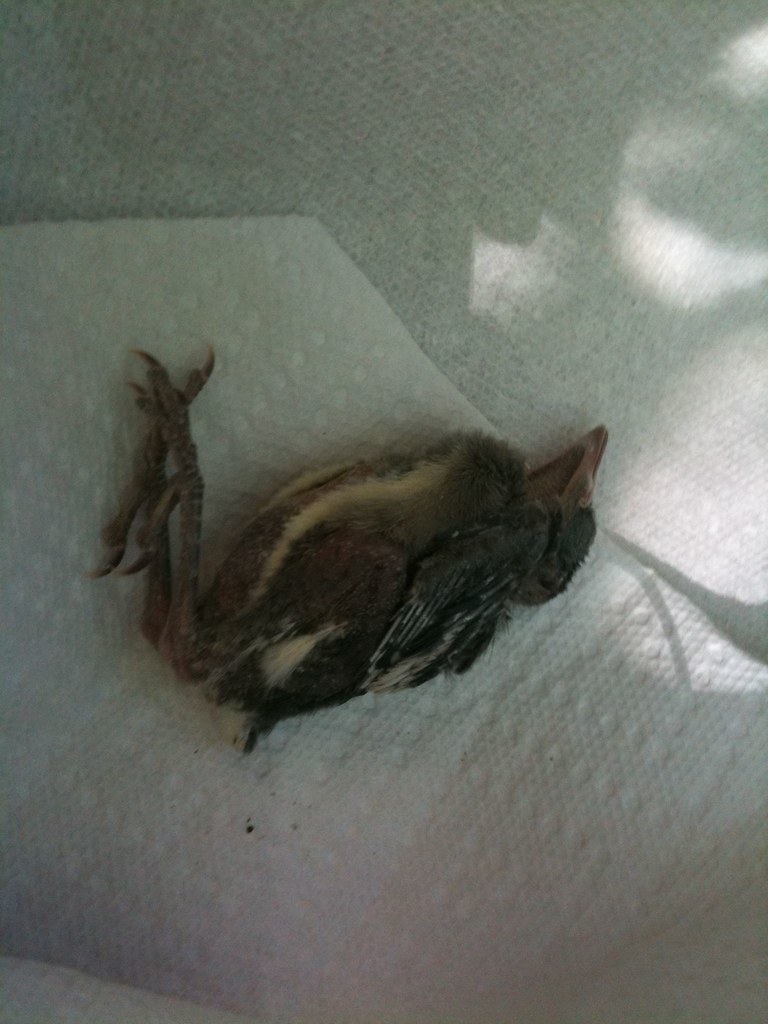
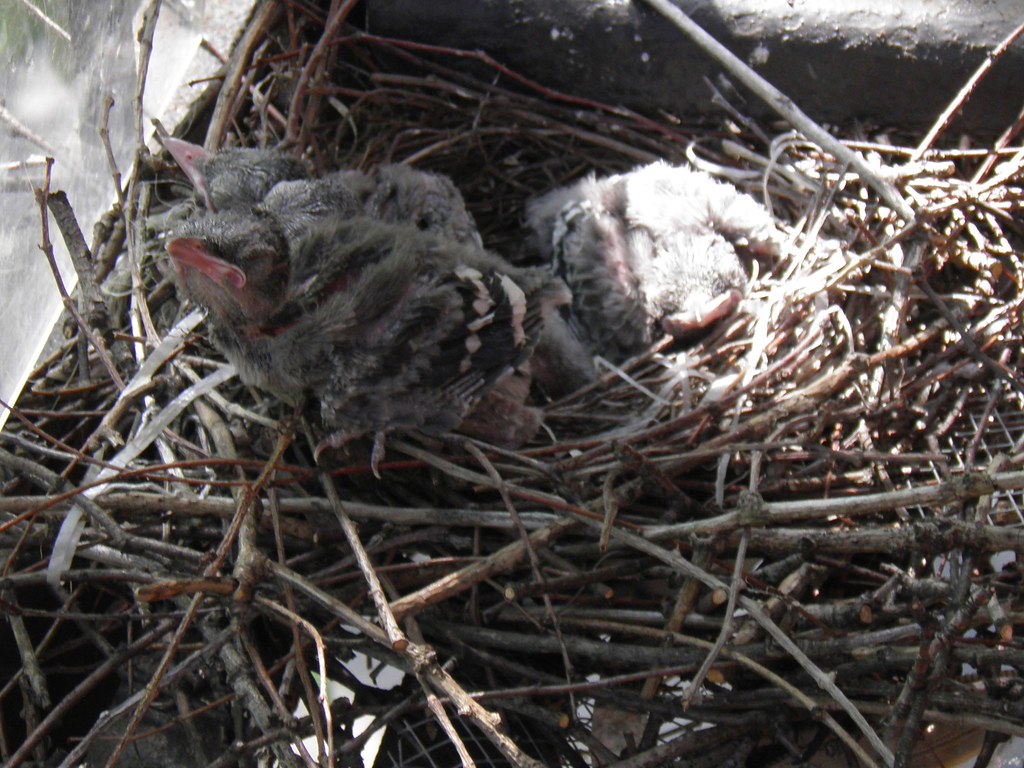
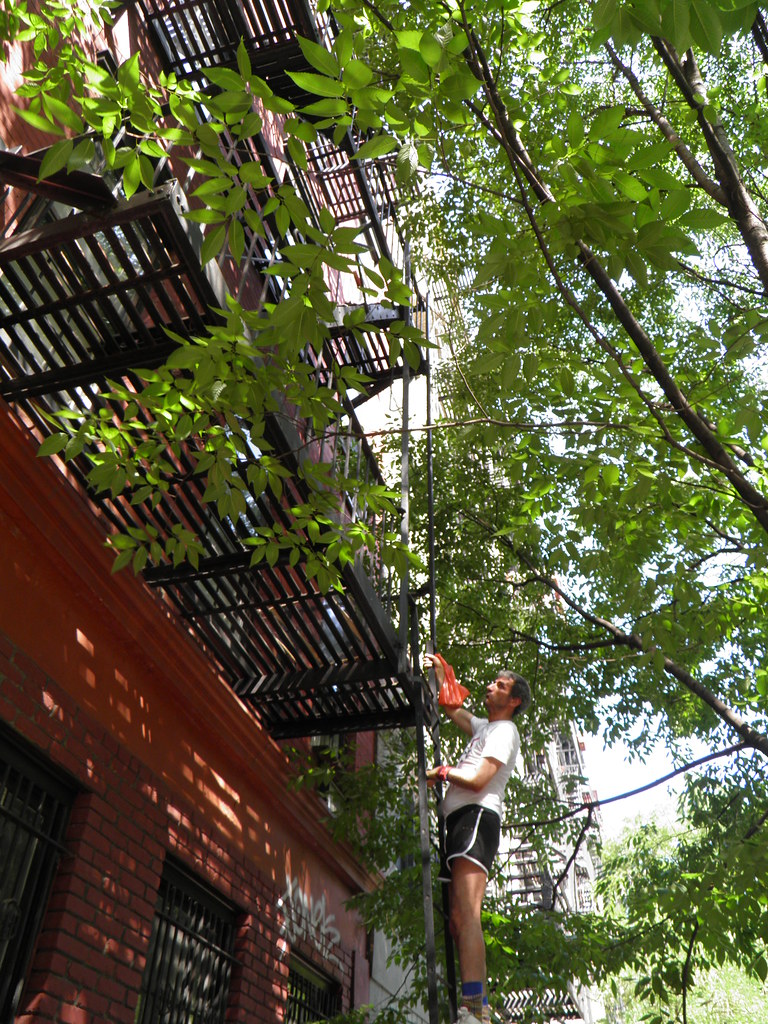
The first blue jay fledgling fell out of the nest built precariously on a New York fire escape this afternoon. It attracted a crowd of neighbors, who put it back in its nest and installed a plastic tarp under the whole set up.

Just yesterday I put up flyers explaining the blue jay babies were up there and it would be normal if they would fall out. If it were a forest instead of Fifth Street, they'd be fine. The parents would feed them for a couple days on the ground. The parents, however, made a really unfortunate real estate choice. Below their nest is sidewalk,  street and a tiny tree pit--no grass or bushes or any other baby bird amenity. And thousands of helpful New Yorkers walk by every day. Somebody would pick it up and bring it to their vet. That's what happened to a blue jay nest in the next block two years ago. The mom spent weeks looking for them.

So this afternoon I got a call about the flyer from a neighbor. The one bird on the sidewalk wasn't not fully feathered and was weak and skinny. It looked way too young to be out of the nest to me. People label New Yorkers as harsh, but soon there were six of us trying to figure out how to get the bird back on the fire escape, ringing doorbells, taping on windows.

My friend Pierre found a long board and tripped the fire escape ladder so it would fall. Generally this kind of thing is frowned upon in the city, but Pierre bravely climbed up and replaced the baby. While I was getting some clear plastic, the mother jay returned and swooped at Jonah, a 10-year-old good samaritan. Pierre and I basically lined the fire escape and left some raw peanuts for the blue jays' trouble.

So far, so good. The mom returned, ate peanuts and sat on the nest. I got a call from the people who live in the blue jay apartment. They'd been worried about the birds and didn't mind our clamoring over their fire escape.


Sunday, May 23, 2010

Wild Squirrel Invades Squirrel Rehab Room

The last time cheeky wild Mommy Squirrel came inside my apartment and somehow got Mickey, the squirrel recovering from a malocclusion, to bust out of her cage, there was some question as to why I didn't get pictures. At the time, it seemed like an emergency. 


Today I left the office for two minutes and came back to find Mommy Squirrel in my chair. So I grabbed the camera to see what Mickey would do. She came out and deliberately ate in front of Mommy Squirrel, but then seemingly ignored her. My dog Jolly would do give dogs who barked at him a kind of I can't see you kind of nonchalance.

I hope it's not any kind of Mickey's disability that she actually can't see the invading squirrel. I suspect Mickey is like my mom: she only pretends to be oblivious, but is on top of everything going on.


Where to go to See Interesting Squirrels
Where to See Wildlife in New York

Saturday, May 22, 2010

Jay Continutes Relentless Battle Against 3rd Floor Cat

Cat gives blue jay the bird
The eggs have hatched in the fire escape nest built by blue jays on Fifth Street in Manhattan, but that hasn't stopped the blue jay father from obsessing over a cat that lives down the block.


This video compared to the last one shows why you should use a tripod.


The tabby is no threat to him or his brood. But the blue jay is out there every afternoon that I've checked and some mornings, too.
I've also seen the cat hanging out by the window, waiting for his entertainer to show up.

I don't really understand the feeding procedure. The mother blue jay sometimes gapes for her mate. And she also picks up something from the nest and eats it herself.

Monday, May 17, 2010

Will NYC Get an Official Wildlife Care Center?

The Wild Bird Fund, which is New York City's defacto wildlife rehabilitation center, collected signatures this weekend to become the city's official place to go with injured, sick or orphaned wild birds and animals. They explained to people at a wildlife fest that New York is the only big U.S. city without a real wildlife care center.
wild bird fund is working to get a nyc wildlife rehab center

So a bunch of volunteer wildlife rehabbers have picked up the slack. Rita McMahon and Karen Heidgerd run the Wild Bird Fund though  Animal General, a vet practice that donated care for 1,146 birds and 13 mammals last year.


Theodore Roosevelet Sanctuary Hawk Talk
Hawk from Teddy Roosevelt Audubon Sanctuary
Ruby and squirrel babyA handful of other rehabbers do heroic amounts of work, too. Bobby and Kathy Horvath take the really hard cases, like coyotes and injured hawks. Vivienne Sokol is Manhattan's bird rehab expert. My friends Vicki Puluso, Chris Durham and Maura Mondrano handle squirrel cases.


Because the city is strapped, the Wild Bird fund is hoping to get a grant from Pepsi. Bobby Horvath has told me the plan got a boost after the recent coyote episode.

The New Yorkers that call me with animal troubles are usually surprised the city doesn't do anything for wild animals. Renee, a pregnant mom from outer Queens, about a day and night worrying and searching for some solution for the baby squirrels she found abandoned in her air conditioner. (I got to see them at the fest, looking plump and happy. Another rehabber, Ruby, took them in. New Yorkers see baby squirrels like unseen mythical beasts).

The finders and baby squirrels show up as if with a dowry of a cage, esbilac, dishes, blankets and nuts. Which makes me think New Yorkers would be behind getting the center going.


Donate to the Wild Bird Fund
Sign Their Petition to Get a Real NYC Rehab Center
Where to See Animals Around New York City

Tuesday, May 04, 2010

Looks Like We'll Be Blessed With a Few More Baby Squirrels

brooklyn babiesGot three more baby squirrels yesterday. More victims of a squirrel mother's inappropriate urban housing choices. A very sweet family in Mill Basin, Brooklyn, discovered them in squatting in their air conditioner vent. The mother squirrel bit the man, grabbed one of her four babies and ran off. Renee, the human mother of the house sat up all night with worry, leaving the squirrels wrapped for warmth but available for the mother to take. Squirrel mom returned, but didn't take the babies.

I'm full up with squirrels, so my fellow rehabber friend Vicki is coming to the rescue and taking them tonight. They're all boys, all healthy, still with their eyes closed. One is a screamer.

Brooklyn BabyThe adolescent squirrels were highly interested in the new arrivals. Or at least the formula-filled syringe I was feeding them with.

Flying Squirrel
Flying Squirrel! Grover jumps around the cage while Baby Ruth plays with a paper towel.
Mickey, meanwhile, showed absolutely no interest. She did harumph around the cage--her signal that she has noticed that I have come into the room yet not delivered her food yet. I had been thinking Mickey was nearing ready to get released back to the Queens community garden where she lived before, with the possibility of recatching her if we needed to trim her teeth. She's definitely got two top teeth back, but they're crooked. But the Horvaths--way more experienced and licensed rehabbers than I--think she won't make it and offered her a permanent home with the other animals they've rescued.

Mickey eats breakfastMore than her malocclusion issue, they don't think she's "wild up enough." There's something just off about her. She's never tried to bite me. I've clipped her teeth, bathed her, pulled her out of her house, tried to get her to take care of orphans. I deserved to be bitten. She doesn't take an interest in her grooming or housekeeping like a proper squirrel. Even the adolescents are already stuffing their box with papertowels. I hope for Mickey's sake there's something I've missed that they can do. Meanwhile, she's really lucky to get the offer.
Where to Go to See Unusual Squirrels


Read where Mickey came from

Tuesday, April 27, 2010

How Many Baby Squirrels in This Adorable Pile?

The baby squirrels have learned to nap in a hammock. Can you guess how many of the babies are huddled together? (answer at bottom)

At first Baby Ruth was shy and would have been sulking in the corner. Here she's at the bottom of the pile. I do hear some grumbling from the pile. It's not always Ruth crying; it's usually just that Alvin is roughhousing with his sisters. They have all gotten the hang of the hammock, which I just put up today.

 Alvin eats breakfast in bed.

Baby Ruth and Benji thinking: why is there not a nipple attached to that camera?

Baby Ruth experiments with almonds.
 Meanwhile, in the fortress of solitude on the other side of the room, Mickey is making some serious progress. For the last couple days she's eaten nuts. That means she's feeling more comfortable with her teeth. She still can't crack nuts--let's not get carried away. But once I open them for her, she eats them. I hope this means she'll be able to go back home soon, though I will miss her.


Read where Mickey came from


Answer: All four.

Monday, April 26, 2010

Squirrel Takes Rightful Place as NYC Parks Mascot

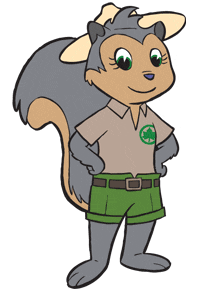
The New York City Parks Department named Pearl the Squirrel its official mascot, finally giving the city's most popular rodent some due. Last February we lobbied  for a squirrel for the high profile post, lest parks end up with those peculiar garbage can characters. (Ok, those turn out to be for recycling.)

Professional illustrator Adam Koford created Pearl the Squirrel on his kids' suggestion. Koford, who lives in Utah, is more known for his comic strip Laugh-Out-Loud Cats on Hobotopia. Parks Commissioner Adrian Benepe says Pearl will be the Smokey the Bear of urban parks. Asylum reports she's already attained a Betty Boop-like aura among furries, who fetishize anybody in a mascot costume. 

Right now I've got one squirrel eating sunflower seeds outside on my Manhattan window sill between chasing pigeons away and inside  four baby squirrels and one adult with malocclusion in my care as a wildlife rehabber, so it's no surprise I think of squirrels as the perfect emblem for urban wildlife. 

New York City squirrels are different. They're semi-dependent on people, so they'll go right up to parks visitors. The smaller the park, the pushier the squirrel. Every time I pass through City Hall Park some European or Japanese tourists have cornered some squirrel for a photo op, paying for the picture in nuts. They defend their trees against red-tailed hawks and sometimes live in subsidized housing. Suburban squirrels don't have that kind of Moxie.

New York City Squirrel Tips Americans are more fascinated by our black squirrels (try Stuyvesant Town if you want to see one); they're just a color variant of grays, like how Labrador retrievers come in chocolate, yellow and black. New York City has three species of squirrel: gray, fox and flying. (There used to be at least one red squirrel in Central Park, too.) The fox squirrels are the ones with the golden bellies. The flying squirrels used to be much more common; now they're seen just occasionally at dusk in Inwood or Alley Pond Nature Center.

Where to Go to See Unusual Squirrels
Where to Find Wild Animals in NYC

Friday, April 09, 2010

Doomed Baby Humpback Shot in the Hamptons

Wildlife officials decided early on that a baby humpback  beached in the Hamptons was doomed have finally shot it to death, days after it was found and started drawing sympathetic crowds. The whale created a weird whale-watching spectacle with hundreds visiting Main Beach in East Hampton for a curious, sad vigil. Everyone wanted to find some way to save the whale, but without its mother or some supersized facility, it wouldn't work.

Euthanizing the whale didn't go too smoothly: the New York Post denies it died.  The Huffington Post says it died overnight. Gothamist quotes subscription-required Newsday saying shots rang out. But an earlier story says they were using darts, not some kind of Old Yeller euthanasia pistol. Carissa Katz writes in The East Hampton Star that they used a highly specialized kind of dart to deliver an overdose of sedatives, first Wednesday, then again on Thursday:
The darts the system uses are designed to go through the whale’s blubber and into muscle. The whale is estimated to weigh about 10,000 pounds. The amount of the drug needed to sedate an animal that size is “enough to kill 100 people,” [David Morin, a marine mammal biologist with the National Oceanographic and Atmospheric Administration] said. 

Whale beaching is still a mystery. They'll do a necropsy--the animal equivalent of an autopsy. The Sag Harbor Express said earlier in the week that they'll do the necropsy on site and probably bury it there, too.It may be the whale was sick or injured. Or it could have lost its mother, whom it needs for milk. Even the wolf-killing, Sarah Palin-loving state of Alaska says humans are usually somehow to blame for humpback whale deaths--either through fishing line entanglements, boat collisions or toxins.

The Riverhead Foundation says they handled 40 cetacean (which includes dolphins, porpoises and whales) strandings in 2008.

Where to Go to See Whales
Where to See Animals Around New York City

Sunday, April 04, 2010

FDNY Saves Three Baby Squirrels

Yesterday Queens fireman Ralph Longo, was putting out a car fire and through all the smoke and fire extinguisher fog, he saw something tiny and gray move . He found four baby squirrels and pulled them out of the wreck.

One of the babies died, but the men at the Ladder 129 washed the three squirrel survivors and put them in a box with papertowels. Longo looked at the list of New York state wildlife rehabbers and called me. Then, after working all day Longo drove into Manhattan and with his girlfriend, dropped them off with me. All in all a nice piece of rescuing by the FDNY. Is there anything these guys don't do?

Firefighter Longo and his girlfriend feed a rescued squirrel
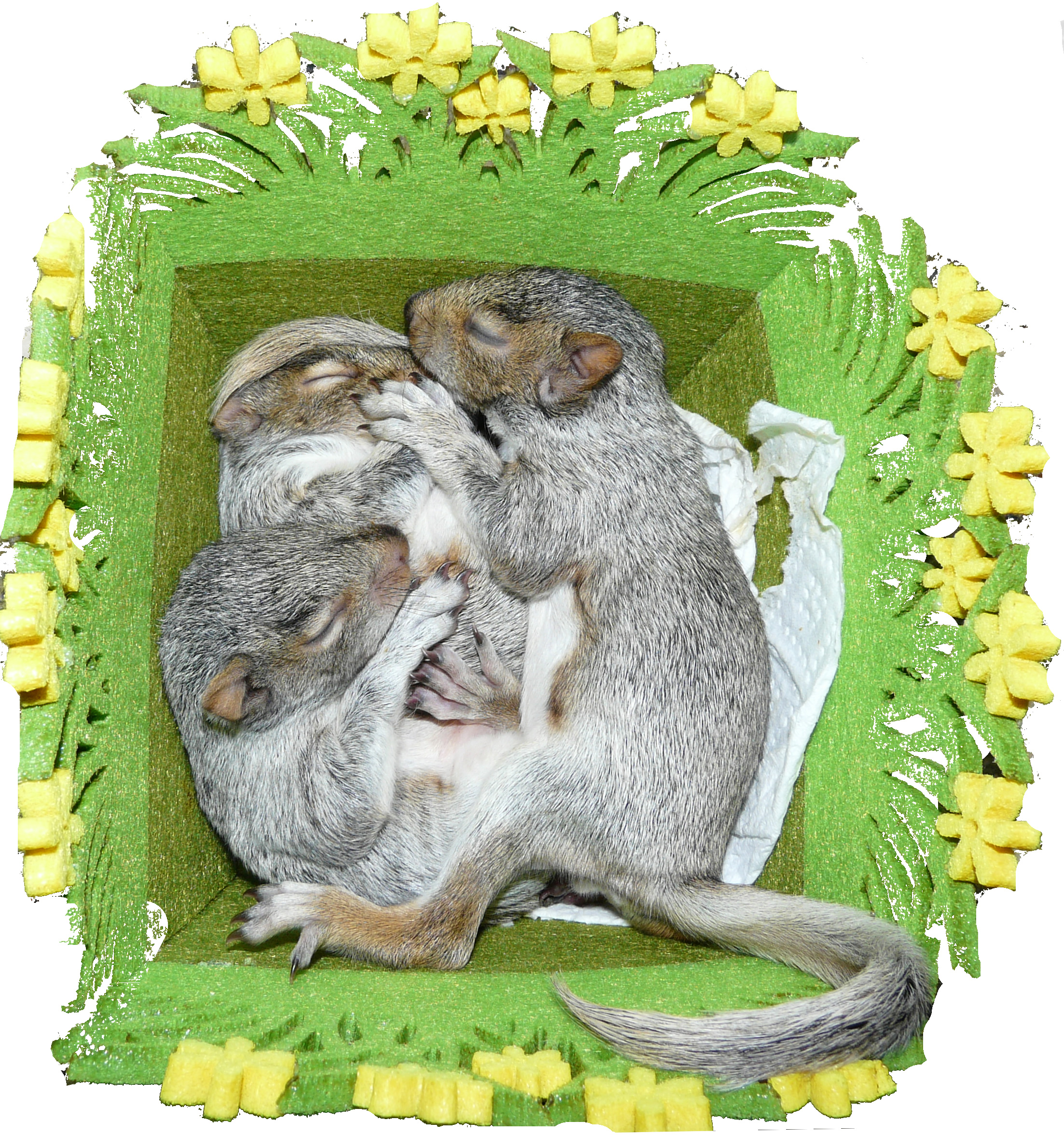
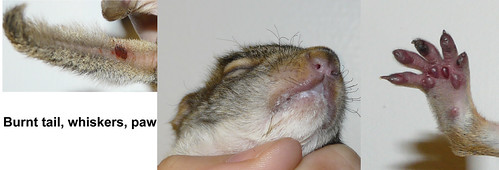
Two have slight burns. The one boy has it the worst: a burned spot on his tail and singed whiskers. Longo's girlfriend specializes in the care of human burn victims and mentioned that when they see a person with burnt eyebrows, they assume there's been smoke inhalation. One of the two sisters has a burnt paw. But, they all seem healthy. They have fur, but they're eyes are still closed, so I'd guess they're about four weeks old. They have diarrhea--not unusual after a diet change. I put them in a cat carrier over a heating pad overnight. They were scrambling all around until I put them in this Easter basket-like box. They settled down to snuggle in these Anne Geddes-like pose.

Presumably about a month ago their mother thought she was being crafty and built a nest in the car, then yesterday she chewed some wires in some other scheme and started the fire. Longo never found the enterpreneurial mother squirrel, so I'd guess she got out fine.

Longo's rescue of the squirrel babies will also help Mickey, the friendly, black adult female squirrel I'm treating for a malocclusion. Mickey had babies last year, Peter, the guy who brought her in from the community garden, says. The baby squirrels will do better raised by a real squirrel. Mickey, who barely comes out of her house now, will have something to do. If she ever comes out of her house and finds them. So far she has studiously ignored them. When she comes out to eat I'll repossess her house and --with some supervision--see if she has any interest.


Where to Go to See Unusual Squirrels

Friday, April 02, 2010

Bill the SoHo Groundhog Released into the Bronx

Bill the SoHo groundhog is now Van Cortlandt Bill. The grumpy little woodchuck was found mysteriously wandering around West Broadway in lower Manhattan a few days ago. The workers at the SoHo Grand did a great job of catching him (no easy thing to do)  and finding a wildlife rehabilitator (me).

Normally wildlife rehabbers take in animals that are injured, orphaned or sick. Bill was just in the wrong place, somehow transplanted to a neighborhood of concrete by humans. He was fine--aside from being ticked off at being in a cage. He enjoyed the apples, chestnuts and acorns I gave him, but let me know he had big teeth and knew how to use them. I just needed to find the right place to release him. In New York wildlife rehabbers are supposed to release the animal the region where you found it--in this case New York City.

With the help of the city's most prolific rehabber Bobby Horvath, I found  David Kunstler, the wildlife manager for Van Cortlandt and Pelham Bay Parks in the Bronx. Groundhogs are found in both parks (and also Fort Tryon and Staten Island). Kunstler recommended Vault Hill, where the parks department is restoring a meadow.

Bill got very excited as soon as he realized he was near the wild. He tried to chew through the carrier bars. When I opened the door, he sat there stunned for a minute, but then happily took off.


Monday, March 29, 2010

Groundhog Takes Manhattan

The entertaining part of being a wildlife rehabilitator--aside from aside from all that helping animals whose lives have been thrown off course by humans--is the crazy phone calls. Right in Manhattan I've gotten calls about "a bird someone told me is an eagle," a baby skunk, a few possums, a handful of raccoons and pretty much every baby bird one neighbor ever sees. Today I got call from the SoHo Grand--a hotel more known for celebrities than wildlife--about a groundhog they found out on West Broadway.

In what little experience I have, I have learned that New Yorkers do not know their animals. Every call I get for a baby squirrel, I fear I am going to pick up a rat. But, much to my amazement, tonight I have a Manhattan groundhog sitting in a dog crate in my living room, awaiting release.

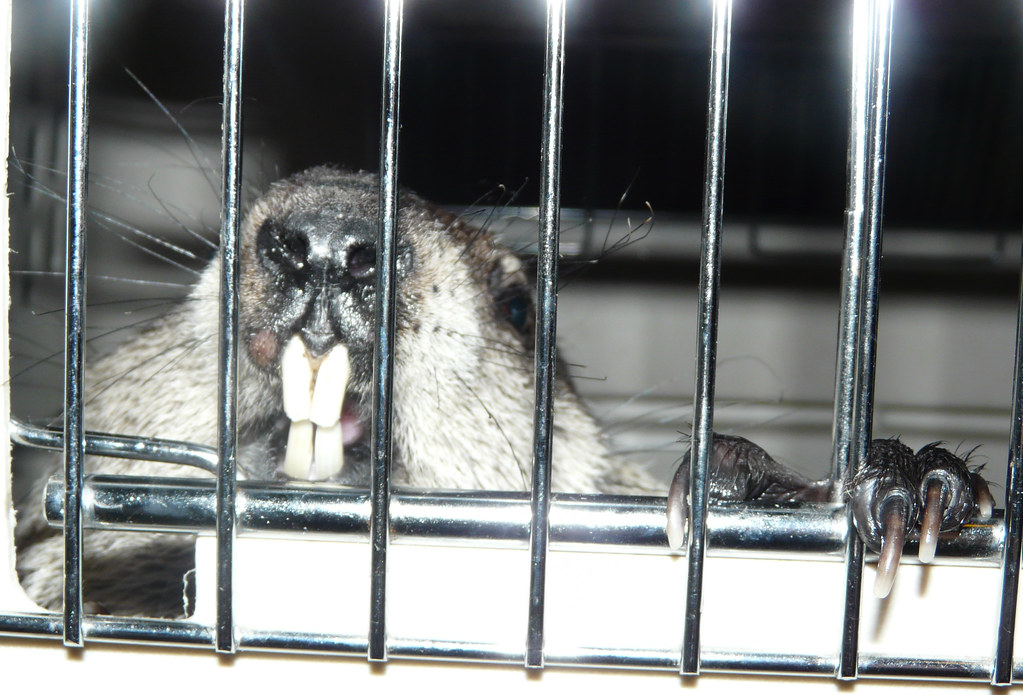
The people at the SoHo Grand couldn't have been nicer--to me or the marmot. They captured her (or him) off the street, despite the animal's screaming, because they figured leaving her there would be cruel. (They used to call them whistle pigs.) They gave her a nice crate, water, carrots and apples. Their theory was that she climbed into somebody's trunk, then unwittingly stowed away into Manhattan. There was some speculation that she had somehow escaped a Chinatown kitchen. Groundhogs can move faster than you think, but I doubt one could make its way into Manhattan like the coyote.

I talked to Bobby Horvath, the kindest and most experienced wildlife rehabber in New York. He was surprised the groundhog let itself be caught. "Picture a squirrel, times 10," he said, describing the difficulty of catching one without equipment. Bobby suggested I keep her till the rain stops in a day, just to be sure she's okay, while he figures out a decent release site. Meanwhile, I put a plate of food in her cage. She sat on it. I looked at her near the bars. She lunged at me. I think she'll be fine.


Where to See Wild Animals Around New York City

Thursday, March 25, 2010

Manhattan's Captured Coyote May Be Released in the Bronx

Photo from 1010 Wins

Cops captured a coyote in lower Manhattan Thursday and are holding the young female at least overnight. She may be released into Van Cortlandt Park as early as Friday night, people who were in on the discussions say. Right now she's sleeping off tranquilizers at Animal Care and Control.

Dumping the coyote in the Bronx may sound like Manhattan just dumping its unpleasantries in an outer borough, but there's solid reasoning to it. Most New Yorkers don't realize that Van Cortlandt and Pelham Bay Park already have coyote populations. 

No one is sure if this is the same coyote that's been hanging around Central Park the last couple months. My guess is that it is. One thing that surprised most people is that the coyote turned out to be a female. People had figured the Central Park coyote as a young male who got pushed out of his territory by dominant males in mating season.

But it does seem that the Central Park Coyote was out and about yesterday. Bruce Yolton said the Central Park coyote--who has a habit of leaving the Hallett Nature Preserve just after dusk--was seen wandering around the preserve woods at lunch yesterday. On Wednesday 1010 says the canine was spotted down near the Holland Tunnel, but evaded cops. Of all the ways a coyote could get into Manhattan, I don't think the Holland Tunnel was high on anyone's list.  Cops finally caught her Thursday in a parking lot on Canal Street near the West Side Highway, The Daily News reports.

Getting caught outside the park may be her lucky break. The Central Park may have been slated for immediate death and rabies testing  for the coyote because of the outbreak of rabies in Central Park's raccoons. The Health Department may still decide the coyote should stay in quarantine for 10 days to make sure she shows no rabies symptoms.


1010 also quotes a vet saying this is a coydog--half coyote, half dog. That's not quite right. Genetic tests on similar animals have shown they aren't "wild dog," but a mix of western coyote and the eastern wolf that was wiped out. No coywolf has successfully moved to Manhattan, but there are at least two packs in parks in the Bronx. They may move this one out, but another will be sure to try to take over the real estate again.

Where to See Wild Animals Around New York City
Read more about coywolves
Read about the coywolf from its original tracker, Urban Hawks
Check out the Eastern Coyote Research center

Wednesday, March 24, 2010

Are Different Animals Showing Up? Or Are We Just Getting Better at Spotting Them?

When you hear a report of a unexpected animal or bird showing up someplace, is it because they really moving into new places? Or did we just become better spotters? Or maybe it was the biological authorities who became less dismissive of citizen scientists? That was the gist of what ornithologist Shibail Mitra mulled over at a lecture at the Linnean Society of New York last night.

Mitra, who a biology professor at the College of Staten Island, came down for the citizen scientists, showing through several bird species examples how official guides willfully overlooked several species--counting them as an unremarkable subspecies, invasive escaped pets or just rare lost souls. Then when a committee somewhere declared it was a legitimate species, people started reporting more of them.


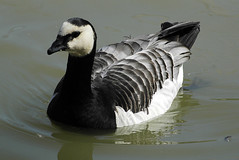
Barnacle Goose  Branta leucopsis
Courtesy of Ucumari
This bird breeds in Greenland, so its appearances early in the 20th Century were written off as escaped pets. Serious birders would put parentheses around them on their lists because they didn't really count. Now they're showing up more than once a year and records counters are accepting them.


Cackling Goose Branta hutchinsii
The Cackling Goose was dismissed as a a subspecies of the Canada Goose. So nobody counted it and it was "grossly overlooked," Mitra says. Then in 2004 the American Ornithology Union decided that this much smaller bird that breeds in the arctic and winters in the west from Oregon to Mexico really is a separate species. That manmade distinction always makes the birds more interesting to people,  Mitra says.


Arctic Tern Sterna paradisaea
Courtesy of Reders
Arctic terns were seldom recorded before the seventies by the birding authorities. They were at best a celebrity vagrant--a bird that quickly becomes the object of desire and gossip among birders. (The Central Park coywolf is certainly New York City's celebrity vagrant of the moment.) Then sub-adult Arctic terns started showing up where and when nobody expected them: on Long Island beaches in mid-summer. Not old enough to breed, these adolescents don't have to keep up with the rigorous arctic to Antarctica schedule of adults, so they visit the Moriches Inlet.

"When people did not have the predisposition to think they would find arctic terns," Mitra says, "they did not find arctic terns."

There was much grumbling in the crowd toward the arrogance and whimsy of the ornithological authorities that seem to have birders under their thumb. Assuming that we know more than we really do about the species in an area can lead to lousy identification and conservation. If you assume you know exactly what birds, plants and animals need protecting, you may only protect their specialized habitat and overlook more prosaic landscapes that will save an animal you haven't thought of 100 years from now. Of course, this kind of thinking is what leads to boring wildlife preserves, but better mundane preserves than none at all.

Where to See Wild Animals Around New York City

Birding Bob; Northern Saw-whet Owl Stops in Central Park; Woodcocks in the East Village

Dr. Robert "Birding Bob" DeCandido leads birding tours around New York City. Usually he takes people to see owls in Central Park, which he helped reintroduce. He lets us run his newsletter here. This week he saw a northern Saw-whet owl in Central Park and the carcass of a woodcock.


Northern Saw-Whet Owl, by Richard Leche


The carcasses are in bloom! Yellow and purple and some white - or so it was on Sunday when we were in for other surprises as well. On our walks, we were able to provide discussions of the age of migrating Saw-whet Owls (including photos by Debs), American Woodcocks and more in Central Park in the last several days - by our group. We think with birds...and to find them, we have to think like birds too.

Our historical notes include a NYC area summary of the spring season - 1920. Today, our observations show that many bird species are arriving earlier than in the past. Why? We will leave it to others to explain. In the meantime, we document the changes, and provide the historical record for comparison. We also provide the first records of breeding Tree Swallows in our area. Now they are common breeders at Jamaica Bay and elsewhere on Long Island - but not 90 years ago!

Not had enough of us yet? Beginning the first week of April, our Sunday and Tuesday walks will begin meeting at the Dock on Turtle Pond.
=====================================
Good! Here are the bird walks for this week:

Friday, March 26th: 9:00am. Central Park - Meet at the entrance to Conservatory Garden (105th street and 5th Avenue)
Sunday, March 28th: 9:00am
- Central Park - Meet at the Boathouse $10 -  rain or shine.
Tuesday, March 30th: 9:00am - Central Park - Meet at the Boathouse
$5.
--------------------------------------------------------------------------------------------
The fine print: Our early spring SUNDAY walks meet at the [Loeb] Boathouse (approximately 74th street and the East Drive; the SE corner of the lake). - $10 for adults, and $5 for kids.  Easiest way to get to the Boathouse is to enter the park at 5th Avenue and 72nd street and walk west until you find the south to north road (the East Drive) that intersects the 72nd street "transverse." Then just walk north for about 1-2 minutes...Look for a small restaurant type place with chairs/tables outside - we are inside. 
On FRIDAYS, we meet at 9am at Conservatory Garden, 105th street and 5th Avenue (just inside the main gates). Easiest way to get there by subway is to take the #2 or #3 train to 110th street and Central Park North.  Then cross the street to Central Park and head east (to the left) toward Fifth Avenue, and then south until you reach Conservatory Garden (about a 7-10 minute walk from the train station; easy and safe).   Most Friday bird walks last about two to three hours in autumn-winter, but feel free to leave at anytime, we won't take it personally.  We have an extra pair or two of binoculars to rent, so if you want to rent a pair, just call or email before the walk to let us know.  Also, if you are thinking of purchasing new binoculars, ask us - we probably have used them, and we will let you know how to get them for the best price. These days we like a relatively unknown brand by the name of  Zen-Ray, specifically their 8 x 43 model.

---------------------------------------------------------------------------------------------
Here is what we saw last week (selected highlights) with some anecdotal notes and observations.  Not all species we saw are reported here - we list the best:

Friday, March 19th - we found two significant occurrences today, one common - an abundance of Dark-eyed Juncos in Central Park, and even Madison Square Park on 23rd street (thanks Sandra). Juncos on the move turning up everywhere - they were mostly gone from CP by Tuesday (23 March). The second, a most unusual spring migrant in New York City - a Northern Saw-whet Owl. Here is the owl after a squirrel had flushed it from its perch in an evergreen cedar halfway down the "Point" in the Ramble:

Debs, wanting to know more about the age/sex of this owl asked some questions of the local owl experts, Trudy Battaly and Drew Panko. They have been banding and tracking these little owls in NYC and Westchester County Parks. Debs wanted to know why (when she greatly enlarged the photo) the edges on all the primary/secondary feathers were very worn. Drew and Trudy emailed back that this is most likely a bird in its second calendar year (SY).  In other words it is an owl that was hatched last summer (2009).  These young birds make up the bulk of the migrants since they outnumber adults. Juvenile feathers of saw-whets wear out faster than adult feathers, and that is exactly what can be seen in enlarged images - the feathers are very uniformly worn suggesting that the feathers are all the same age. Trudy went on to write: "I think we are near the end of their [Saw-whet Owl] spring migration, and yours is most likely a SY female who is not in too big a rush to get back because she knows there is a male already on territory waiting for a female to fly by."

OK let's tell that story with photos. Here is a photo of another SY Saw-whet Owl - note how all the feathers look the same.

On the other hand, here's an After Second Year (ASY) saw-whet, in February.  Note the three different types of feathers (= ages) in the wings:

Banding birds allows you to see much more - ultimately to think about birds. That is why precise age/sex identification is important - it leads to thinking.
--
Sunday, March 21st (Central Park, Ramble) - I was sitting in the Boathouse with Dan Silbert on this lovely mild and sunny Sunday. He casually remarked that he had just returned from Death Valley. To which someone replied: "I hope it wasn't too serious and you are better now." :-) Right about then, some whisperings began that Deborah Allen had a woodcock in her pocket. This turned out to be true - Ed Simon had given her a dead one, that he had found on Third Avenue and Tenth Street. (Frank Rutella had found another approx. ten days earlier, about 40th street also on the East Side.) Deborah took the woodcock and did a feather demonstration with it - she could age/sex this bird. The very russet (almost orange color) suggested adult male, and the width of the three outer primaries confirmed it. Why? The males use the narrow primaries to make the winnowing sound during aerial courtship displays.

Not to forget other birds we headed off to the Ramble. Here we noted good numbers of Northern Flickers (new arrivals). Isaiah Wender found a male Wood Duck perched, where else, in a tree above us...and then he added Golden-crowned Kinglet, Song Sparrow, Black-capped Chickadee and a number of others. Jack Walsh found us a Red-tailed Hawk in flight. Others were contributing too: Eastern Towhee at the feeders; two Brown Thrashers at the Maintenance Meadow; two Red-breasted Nuthatches; a Yellow-bellied Sapsucker (male); Cedar Waxwings (flock); Swamp Sparrow (Emilie) and many others. Easily the best day of the year. And one other important spring sighting: Yellow and Purple Carcasses were in bloom everywhere. Dan Silbert, based upon his visit to Death Valley, identified them immediately. He and I are like psychedelic Turkey Vultures when it comes to blooming carcasses. We zeroed in on them...and await everyone else to join us next week.

Tuesday, March 23rd (Central Park, Ramble) - Anders, Tom and I wandered about the middle of the Park. Our most exciting sightings were the young Sharp-shinned Hawk chasing a Red-bellied Woodpecker; a female Hairy Woodpecker (there is a male at the north end; the pair tried to nest last year); a pair of Wood Ducks in a tree; and a diving large falcon, probably Peregrine in the area of the Great Lawn. Otherwise it was a bit breezy and surely cold. We recalled the 70 degree temps of last week - and lamented the real spring of the present.
======================
THE SEASON XIX. February 15 to April 15, 1920

New York Region.—The last half of February saw an increase in Redpolls, now in considerable flocks, but they soon disappeared again. There seems also to have been a flight of Long-eared Owls at
this time, noted at Amityville, Douglaston, Staten Island, Englewood, and the vicinity of Plainfield. February 23 a number of Evening Grosbeaks were found in a patch of red cedar woods at  Amityville, Long Island, feeding on cedar berries. With them were many Goldfinches, some Red Crossbills, and a few Purple Finches The Evening Grosbeak has been reported repeatedly from Douglaston, Long Island (G. C. Fisher), last seen April 10 and likely still around. The attraction here seems to be the fruit of the hackberry.

More than in the New Jersey direction, late February and the very first of March usually find an increase of scattered Robins on Long Island. We have been at times in doubt as to whether these birds are arrivals from the South or have been driven in from southern New England where, at that date, the Robin is generally present in considerable flocks. This year these early Robins were less than usually noticeable on the Island, an indication that they are southern birds, as late winter birds from the North of all species were more than usually represented.

The spring was late in putting in an appearance with its first migrants from the South. The entire absence, during the very end of winter, of Song Sparrows at Garden City, Long Island, made it possible
to determine when the first individuals returned, March 12. Fox Sparrow and Grackle were present here for the first time on March 14, the Grackles being about two weeks later than their usual arrival,
the end of February. The first unquestioned increase in Meadowlarks came on the 21st and they became common on the 24th. The Flicker put in an appearance on the 28th, and Chipping Sparrows only on April 7 this year, although they had been reported from the New York Region a few days previous. Up the Hudson, vicinity of Rhinebeck and Poughkeepsie, data compiled by M. S. Crosby shows the earliest arrivals to have been delayed: Fox Sparrow, March 14; Grackle and Song Sparrow, March 15; Robin, March 2. The next lot of birds were, however, as early as one could expect them: Phoebe, March 23; Flicker and Cowbird; March 26: Chipping Sparrow and Tree Swallow, April 3; Barn Swallow, April 11; Louisiana Waterthrush, April 12; etc.

Reports from New Jersey indicate retarded migration, though by April 1 spring arrivals were about 'on time'; and a better showing than usual of the less-abundant Ducks. At Englewood, Rough-legged
Hawk, March 21, Golden-eye Duck and Tree Sparrow, April 11, are late dates obtained by L. Griscom, who also reports the Hooded Merganser, Baldpate, Blue-winged Teal, and Ruddy Duck from there. C. H. Rogers and W. DeW. Miller found the Baldpate, Green-winged Teal, and Pintail at South River, April 4.

A Blue-gray Gnatcatcher was noted in Prospect Park on April 7 by R. Friedmann, and the record corroborated by a number of Brooklyn observers who found it there again April 12 and 14. The occurrence of this species north of its regular range at so early a date is doubtless correlated with the fact that, like other southern species, its regular spring migration comes early.

J. T. Nichols, New York City.
Wednesday, March 17, 2010

Why is the Guy Who Promoted Horse Slaughter Recommending NY Stop Spay-Neuter?

Jolly, a handsome, neutered dog
New York State is about to cut off spay-neuter funds. It's a short-sighted idea that leads to more strays and more government spending--like stopping vaccines to save a few bucks. Who would propose such a change? How about Patrick Hooker, a guy who got into the office lobbying pro-horse slaughter, pro veal and is generally not so keen on animal welfare.

Right now the change is buried on page 171 of a nearly 600-page state budget, billed deceptively as "dog licensing reform." Search for spay or neuter. You won't find it. I don't know much about the byzantine Albany budget process, so I turned to the Times Union, where Brad Shear wrote an excellent column explaining that the provision was recommended by the Commissioner of Agriculture and Markets, Patrick Hooker and already approved by David Patterson. In 2008 the embattled governor, he notes, "stole $1 million from the fund and put it in the general fund."

Hooker got the job in 2007 after working for 16 years as a lobbyist for the New York Farm Bureau. His state bio says he was the "farm advocacy organization's top lobbyist, serving as Director of the Public Policy Division." He's also a hunter and maple syrup producer. The Daily News reports he gets a $1,622 farm subsidy himself.

While Hooker was the chief lobbyist for the Farm Bureau, it was fighting for horse slaughter and against bills that would outlaw the practice. The only reason New York didn't ban horse slaughter was that the Farm Bureau energetically opposed it, Deborah Glick told WNYT. He's spoken out for foie gras. The bureau worked against applying the same environmental and immigration laws to farmers that others face. The bureau likes to say it wants rules that are "size-neutral"--code for supporting big factory farms. They're against laws for minimum cage sizes. Generally, the agency where Hooker directed policy came down opposed to most animal welfare laws, as if they were some crazy idea of meddling cityfolk.


Hooker also worked for upstate Republican John Randy Kuhl. Kuhl was famous for wanting rural western New York to secede from the rest of the state. (That's a switch: the city has long wanted to brush off the upstate huckleberries and their $11 billion drain on our taxes.) Now he is also famous as the guy who lost to ticklemonster Eric Massa.

People in New York City have paid little attention to the way Albany runs the ag department. Until now. Just last year food activists complained the chairman of the Assembly's agriculture committee was too cozy with the farm bureau, too. Just how did these guys who support just about every anti-animal initiative going start running dog policy for New York state?


The state suspended its stressed and underfunded low-cost spay-neuter program in October. In New York state when you get a dog license, you pay $3 extra if your dog isn't spayed or neutered. (And until recently, if your dog was neutered you were supposed to get a notary to certify that--a higher expense.) Your community has to spend it on spay-neuter. I've already been all over the issue of how this is absurdly low. It needs to be about 10-30 times higher to  incentivize people to neuter their dogs. Instead we may get an even more backwards policy that would feel right at home in the rural south, where dog populations and animal cruelty go unchecked.

Spay-neuter programs aren't just more humane, they save a ton of tax dollars. One study showed that New Jersey saved $2.2 million over 6 years with a subsidized neuter program because they didn't have to kill as many dogs in shelters. It's also safer for people: dogs are more aggressive if they aren't fixed and intact dogs  cause 95% of fatal attacks.


It's absurd that New York state treats pets as agricultural products. I'd imagine that Elliot Spitzer appointed Hooker to seem bi-partisan and to make rural voters happy. Hooker's certainly in touch with what upstate farmers want. But he's not qualified to oversee dogs for the rest of us.


Where to Go to See Dog Events Unrelated to Breeding

Birding Bob: The History of Ravens, Whales and Dolpins in NYC

Manhattan's Samantha the Raven
Birding Bob (also known Dr. Robert DeCandido) is a biologist who leads popular and easy to understand tours in Central Park. He lets us publish his newsletter that goes out to his many fans.

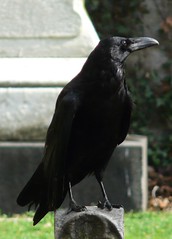
With all the talk of Ravens possibly nesting in NYC (Queens), we went back into the historical record to see what we could find out about these corvids in NYC. In a dusty, yellowing journal we found a brief note published in the mid-19th century. It seems as though Ravens must have been occasional visitors to Brooklyn and Long Island back then - see below.

This week we add another bird walk to the mix: Tuesday mornings at 9am, meeting at the Boathouse (details below). Meanwhile, our NYC kestrel research is getting some attention - from outside of New York City!  And later this year, Deborah and I will have an article in a national publication about NYC Kestrels.You can find information (in 14 languages!) about NYC kestrels here.

We have some very good news to report. Our colleague Chad Seewagen (soon to be PhD) had another scientific paper published on his research here in NYC on how migrant birds fare during stopover times in New York City Parks. The research was published in the prestigious Wilson Journal of Ornithology. Congratulations Chad - may you publish many more.

Another of our bird-walkers, Bill Benish, has created an on-line guide to the largest woodpeckers in the world - here's the link to Campephilus Woodpeckers, the famous Ivorybill and all of its relatives in the same genus. 

Below we also present historical and recent reports from around the city including three species of dolphins in our waters in the East River (Manhattan) and Brooklyn (2010); a Humpback Whale (2009); Skylarks and Starlings in Brooklyn (late March 1898-99); and Ring-necked Ducks in northern New Jersey (late March 1923). And FLASH!!! Randy Schutz reports the arrival of Tree Swallows streaming over Jamaica Bay in Queens, near the Environmental Center at 8:55am on 17 March 2010.
=====================================
Good! Here are the bird walks for this week:

Friday, March 19th: 9:00am. Central Park - Meet at the entrance to Conservatory Garden (105th street and 5th Avenue) at 9 am.

Sunday, March 21st: 9:00am
- Central Park - Meet at the Boathouse at 9 am. $10 - we will be there rain or shine.

Tuesday, March 23rd: 9:00am - Central Park - Meet at the Boathouse at 9 am.
$5.
--------------------------------------------------------------------------------------------
The fine print: Our winter through spring SUNDAY walks meet at the [Loeb] Boathouse (approximately 74th street and the East Drive; the SE corner of the lake). - $5 for adults (January-February; $10 otherwise), and $5 for kids.  Easiest way to get to the Boathouse is to enter the park at 5th Avenue and 72nd street and walk west until you find the south to north road (the East Drive) that intersects the 72nd street "transverse." Then just walk north for about 1-2 minutes...Look for a small restaurant type place with chairs/tables outside - we are inside. The Boathouse opens at 8am and has coffee ($1.35), muffins and cookies ($1.75) plus sandwiches ($6) and french fries ($2) .  Bathrooms are located in two places: inside (better - because these are heated - in the bar that is adjacent to the Cafeteria where we meet); and outside - on the south side of the Boathouse. We end our weekend Central Park walks at the Boathouse at about noon.  On FRIDAYS, we meet at 9am at Conservatory Garden, 105th street and 5th Avenue (just inside the main gates).  There are bathrooms open year-round at Conservatory Garden, and that is good.  Easiest way to get there by subway is to take the #2 or #3 train to 110th street and Central Park North.  Then cross the street to Central Park and head east (to the left) toward Fifth Avenue, and then south until you reach Conservatory Garden (about a 7-10 minute walk from the train station; easy and safe).  You can also take the #6 train to Lexington Avenue and 103rd street. Walk west for three blocks and then north by two. Finally, buses run north up Madison Avenue regularly as well. Most Friday bird walks last about two to three hours in autumn-winter, but feel free to leave at anytime, we won't take it personally.  We have an extra pair or two of binoculars to rent, so if you want to rent a pair, just call or email before the walk to let us know.  Also, if you are thinking of purchasing new binoculars, ask us - we probably have used them, and we will let you know how to get them for the best price. These days we like a relatively unknown brand by the name of  Zen-Ray, specifically their 8 x 43 model.
---------------------------------------------------------------------------------------------
Here is what we saw last week (selected highlights) with some anecdotal notes and observations.  Not all species we saw are reported here - we list the best:

Friday, March 12th (North Woods) and Sunday, March 14th (Central Park, Ramble) - In last week's summary we detailed how some sparrow species were singing half-songs, and if this portended another several weeks of winter. Yes - despite our best attempts to look for birds in the rain, we had very little luck. We found Fox Sparrows and Gadwalls in different places in Central park, and by Sunday, there were many Song Sparrows in areas they had not been previously. So last week was a good one for catching up on writing scientific (and popular) articles, and getting ready for spring...more next week.
======================
Notes on Some Rare Birds in the Collection of the Long Island Historical Society. William Dutcher.

Corvus corax sinuatus. American Raven. -- One specimen in the collection. Col. Pike says: I never met with this bird. While shooting in 1836 at 'Comac Hill' my companion, Mr. George Bartlett, killed a fine specimen and I skinned it; it is the one in the collection. Philip Brasher had one in his collection that was killed in the woods near Prospect Park. (This specimen is now in the collection of the University of Vermont, Burlington, Vt., this institution having purchased the Brasher collection.) This was in 1848. These are the only specimens I have ever known to be killed on Long Island."

The Auk 10: 275-276 (1893)
================
4 March 2010 - Brooklyn, New York City: A dolphin was sighted in Newtown Creek. It may be one of the two that were seen two days ago near the Brooklyn Navy Yard. The Riverhead Foundation for Marine Research and Preservation will be monitoring the dolphin and would attempt a rescue mission if the animal seemed in distress. - Bob DiGiovanni

[These were Short-beaked Common Dolphins (Delphinus delphis), a species found within New York during the winter season along with the White-sided Dolphin (Lagenorhynchus acutus) and the Harbor Porpoise (Phocoena phocoena). The Common Dolphin was the species involved with the mass stranding event in 2007 in East Hampton, Long Island. We have been receiving reports of dolphins within the East River for the better part of the last week. Often the sighting of a lone dolphin is not a good sign. We are attempting to find out if there is food in the area. Kim Durham.]

Common Dolphin (Short-beaked)
White-sided Dolphin
Harbor Porpoise
=================================
2/25/2009 - New York Harbor, Lower Bay: The Coast Guard announced that a humpback whale became entangled in a lobster pot and netting south of the Rockaways. They set up a 500-yard safety zone around the whale, which was eight miles east of Sandy Hook, NJ, near the approach to Ambrose Channel, the head of the Hudson Canyon, and active shipping lanes. The Coast Guard Cutter Penobscot Bay and a vessel from the National Oceanic and Atmospheric Administration (NOAA) were on the scene to protect the animal. The whale, reportedly visible on the surface and breathing, according to the Coast Guard, was described as a juvenile humpback, about 25-30 feet long. - Jamie Collins, Executive Officer, USCGC Penobscot Bay

[Hudson Canyon: The post-glacial draining of pro-glacial lakes in the interior of New York State 12,500 years ago, and possibly even older glacial meltwaters, carved this magnificent underwater canyon that runs from the mouth of New York Harbor 120 miles seaward to the great abyss of the North Atlantic. This ancestral "Hudson River" is 3,600 feet deep and 5.5 miles wide in places. Tom Lake.]

2/26/2009 - New York Harbor, Lower Bay: According to the New York Times, the humpback whale entangled in fishing gear was freed this afternoon. The whale, which weighed perhaps 20 tons, was freed after an entanglement team from the Center for Coastal Studies of Gloucester, Mass., cut away the gear, which was wrapped around the whale's tail.

[It is not uncommon for humpback whales to be this close to New York Harbor. Humpbacks follow a food supply of small fish and this whale was probably one of about 900 whales in a group called the Gulf of Maine feeding component of the larger Western North Atlantic whale group. Teri Frady, NOAA.]
===========================
Notes on Brooklyn Birds (1898-99).

Skylark.
Alauda arvensis. The English Skylark is at present firmly established as a Long Island resident. Between Flatlands and Holy Cross Cemetery, and to the east of the latter, many are to be seen and beard. On March 28, 1898, while on the Neck Road, I heard for the first time the twittering, burring, continuously sustained song of this species and saw it rising gradually on fluttering wings up into the blue ether. At a later date one was heard singing continuously for eight minutes while in the air and for two minutes more after alighting on the ground. They were neither seen nor heard in September and October, though doubtless they might have been at suitable times; namely, early in the morning or in the evening. Several were beard and seen at the same time in the locality indicated above. It is likely they will later be found at other points on Long Island.

Starling. Sturnus vulgaris. About a mile in a straight line from the colony of Skylarks, I first saw the European Starling, where it was afterward seen repeatedly. Near Kensington Station someone within the present year has placed in a large tree several bird boxes, which are occupied by the Starlings. The tower of the Boys' High School in Brooklyn noted in the article referred to as occupied by these birds, still retains its attractions for them. This was probably the original nesting colony on Long Island. Another colony now occupies the steeple of a church at Bedford Avenue and Madison Street. At several points in the environs of Brooklyn the Starlings have been seen, where they were evidently visiting for the purpose of obtaining food, while at various points in the city itself they are commonly observed.

Auk 16: 190-193 (1899)
=======================
Ring-necked Duck in Northern New Jersey. -- On March 25, 1923, the writers were as usual on spring Sunday mornings on the marshes of Overpeck Creek, Bergen County, studying the waterfowl, which seem to increase in variety and abundance every year. On this particular morning nine species of Ducks were found, the commoner such as the American Merganser, Black Duck and Pintail in abundance. After practically all the Ducks had flown away, a pair of Ring-necked Ducks were found hiding in the grass on the opposite bank. Soon, however, they swam out into the creek in the full blaze of sunlight, and we watched them for half an hour as they floated on the quiet water. The drake was immediately recognizable by its dark back, and triangular shaped, puffy head, and the
female was a dark bird, without any white ring around the bill. A few minutes before we had seen a flock of Lesser Scaups at about the same relative distance, and the white backs of the males, and the white faces of the females gleamed in the sun. This species, which is well known to Griscom in life, has not been recorded from northern New Jersey. It is interesting to note that the preceding fall and winter produced an unusual number of Ring-necks from various points along the Atlantic seaboard.- Ludlow Griscom and J.M. Johnson, American Museum of Natural History.

Thursday, March 11, 2010

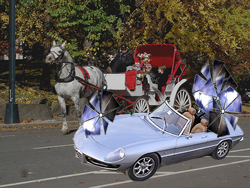
Will NYC Replace Horse-Drawn Carriages With Cars Powered By Manure?

The New York City Council is holding hearings March 12 on whether to ban horse-drawn carriages and possibly replace them with classic cars powered by green energy. The city has been waffling over banning the horses since at least 1989. The Coalition to Ban Horse-Drawn Carriages says the animals shouldn't have to live in tight stalls and work in dense midtown, where they have been electrocuted and hit by cars, only to face unkown fate when they retire.

I don't have any illusions that the council is going to finally ban horses today, but the new twist is the bill "replacing horse drawn carriages with alternative fuel powered classic cars." This measure, supported by PETA, seems to have for everyone: classic cars for the old, alternative fuel for the young. If you're going to have a fanciful, anachronistic vehicle sucker tourists into rides around Central Park, why use futuristic, unspecified fuel?

Ever dour, the Coalition to Ban Horse-Drawn Carriages says the horseless carriage plan does leave one key stakeholder out: the horses. They worry that if the bill passed, it would make no provisions that the 200 or so current carriage pullers wouldn't end up at slaughter houses in Mexico or Canada, where many unwanted U.S. horses are increasingly dispatched. Right now the horse owners have to tell the city which horses they have, but but not what happened to the ones no longer there.

The coalition says their bill is the only one (of three potential laws) that makes the horse owners tell the city when they get rid of carriage horses and where they go. And the horses can only become companion animals or go to sanctuaries--not have a second career pulling carriages. Because horses are flooding sanctuaries around the country as their owners go broke, finding these fairy tale homes would be hard. So the carriage owners might have to pay for their retirement instead of just disposing of them--that makes the business a whole lot more expensive.


In Other Central Park South News...
Bruce Yolton got another neat video of the coyote heading north out the west side of the Hallett Nature Sanctuary.