We've Moved!

Hi and Welcome to the AnimalTourism.com blog. But we've moved just down the street to this site, animaltourism.com/news. Please comment there.
Showing posts with label humpback. Show all posts

Friday, April 09, 2010

Doomed Baby Humpback Shot in the Hamptons

Wildlife officials decided early on that a baby humpback  beached in the Hamptons was doomed have finally shot it to death, days after it was found and started drawing sympathetic crowds. The whale created a weird whale-watching spectacle with hundreds visiting Main Beach in East Hampton for a curious, sad vigil. Everyone wanted to find some way to save the whale, but without its mother or some supersized facility, it wouldn't work.

Euthanizing the whale didn't go too smoothly: the New York Post denies it died.  The Huffington Post says it died overnight. Gothamist quotes subscription-required Newsday saying shots rang out. But an earlier story says they were using darts, not some kind of Old Yeller euthanasia pistol. Carissa Katz writes in The East Hampton Star that they used a highly specialized kind of dart to deliver an overdose of sedatives, first Wednesday, then again on Thursday:
The darts the system uses are designed to go through the whale’s blubber and into muscle. The whale is estimated to weigh about 10,000 pounds. The amount of the drug needed to sedate an animal that size is “enough to kill 100 people,” [David Morin, a marine mammal biologist with the National Oceanographic and Atmospheric Administration] said. 

Whale beaching is still a mystery. They'll do a necropsy--the animal equivalent of an autopsy. The Sag Harbor Express said earlier in the week that they'll do the necropsy on site and probably bury it there, too.It may be the whale was sick or injured. Or it could have lost its mother, whom it needs for milk. Even the wolf-killing, Sarah Palin-loving state of Alaska says humans are usually somehow to blame for humpback whale deaths--either through fishing line entanglements, boat collisions or toxins.

The Riverhead Foundation says they handled 40 cetacean (which includes dolphins, porpoises and whales) strandings in 2008.

Where to Go to See Whales
Where to See Animals Around New York City

Friday, September 11, 2009

An Easier Way to Find a Good Whale Watch on the East Coast?

Picking out a whale-friendly East Coast whale watch just got a little easier. NOAA and the Whale and Dolphin Conservation Society just started Whale Sense, a voluntary program to ensure tours from Virginia to Maine don't bother whales.

The rules are complicated--more than just stay back 100 feet, though that is the basic distance. (If the whale approaches you, stay put. If it's a right whale, back off 1,500 feet.) What I found more amusing were the rules against advertising showing whale watchers touching, swimming with or even chasing the whales. Is Jerry Bruckheimer running a watch somewhere?

So far the group has signed up five companies, mainly in Massachusetts. I count at least 30 tour companies from Virginia to Maine, with 18 going to Stellwagen Bank--not included the odd charters that line the whole coast. So what about the ones not on the list?

Even Frank Kelley, operations manager for Mass Bay Lines (listed) says that right now the program is so new that you can't judge an operation for not participating. Lots of the tours work with other whale groups. For example, Bar Harbor Whale Watch Company is tied to Allied Whale. The New England Aquarium's whale watch, which I just went on, isn't part of the program yet (they're still examining the details), says spokesman Tony LaCasse. But since they already do most of it and they helped push voluntary standards decades ago, they'll probably be part of it.

When you're out on Stellwagen it's not the commercial whale watching boats you see encroaching on whales, but the tiny recreational fishing boats. Kelley says many tour operators worry that the small boats don't understand the protocols (which is elaborate when it comes to many boats wanting to see the same whales). NEAQ's LaCasses says that personally he'd like to see an enforcement presence on the water--like the Coast Guard is for boating regulations.

When I talked with marine mammal expert Toni Frohoff (she's a behavioral biologist and research director at TerraMar Research) she mentioned that generally it's better to have one big boat in the water around a whale instead of a bunch of little ones. At first that seems counterintuitive; we normally don't think of going out in a big, hulking, Hummer of a boat as being eco-friendly. But that's what it is, at least to the whales.

The tricky thing for whale watchers is picking tours that won't annoy--or hit--the whales. In Puget Sound tour boats are known to crowd the orcas, which could interfere with their eating or mating. I haven't seen that on the vast waters East Coast boats troll.

Consumers can't easily tell from an ad or website that attitude of operation. (Well, ok, I am a little skeptical when I read "Imagine the sight of dolphins dancing and frolicking right alongside The Silver Bullet. See whales surfacing and breaching...[from a] shiny, brand new 70 ft. long ocean going projectile." But most whale watches at least claim to be whale-friendly. But is that like a processed cereal labeled as organic? I hope the Whale Sense program grows and offers up an easy way for wildlife watchers to pick the responsible tours.

Tuesday, September 08, 2009

NEAQ Whale Watch: Humpback Bubble Cloud Feeding off Boston?

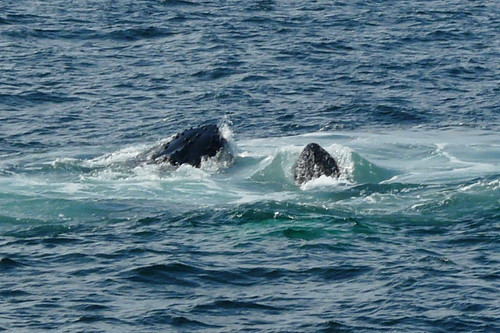
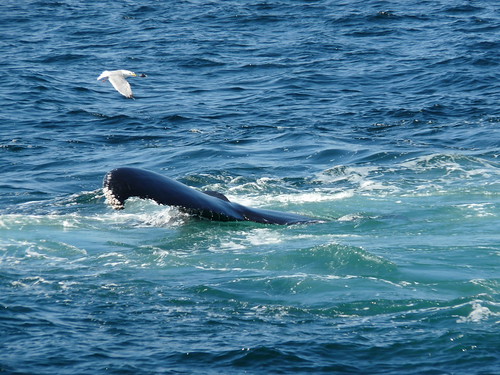
This weekend we got to see a pod of humpback whales bubble cloud feeding--that is cooperatively blowing bubbles to herd tiny fish into a concentration near the surface, then gobbling them up. The New England Aquarium's's tour brought us close enough to the whales that we could actually see, understand and anticipate what they were doing.

You first know you're going to see this specialized hunting technique when a huge patch of light turquoise water appears. Bubbles surface, then enormous black snouts covered with bumps (technically, tubercules or hair follicles). There's lots of jostling and swirling, then fins and finally a "whale footprint" or eerily smooth patch of sea that, we learned, whalers first thought was leaked whale oil.

I found some discussion online that humpbacks only bubble net feed off Alaska, Antarctica and west of South America. I'm not a whale expert, so I'm not sure if this is any different from what we all saw. But we clearly got to see it a few times. We had at least three whales at it, Echo, a mother; her calf, who stuck close to her; and another whale named Zooney.

The New England Aquarium has the system down to bring whales to the masses: a huge, fast catamaran whisks you an hour off-shore into Stellwagen Bank, a shallow feeding ground and sanctuary. Right from the center of Boston you can spend three hours and $40 and see one of the most active whale-watching sights in the world. Whale-watching tours from Cape Cod, Plymouth, Cape Ann, New Hampshire and Maine all head to Stellwagen. The boat's stable, so only a few get sick. You spend an hour speeding out to sea, an hour watching and an hour coming back. They sometimes see minke or fin whales, dolphins and basking sharks. A guy filming the trip for NOAA said it was the best he'd been on.

Not in Boston? Here are a ton of great places to see whales.

More places to see animals in the Northeast.

Got suggestions for animal watching places? Tell us.

Thursday, July 30, 2009

Worldwide Whale Watch Week?

Humpback photo courtesy of Ruben Ayala, taken on Seven Seas Whale Watching based out of Gloucester, MA, in Sept., 2006.
Great Britain just got through with another Whale Week, with sightings of an impressive eight species of cetaceans--dolphins and whales. Minke and humpback whales visited Scotland. Bottlenose dolphins ventured farther south than ever; common dolphins pushed north. The event, sponsored by BG Group, so far only extends to the British Isles, but it would be great to see it expanded worldwide.

Right about now is the peak season for seeing blue whales--the largest creature on earth, ever--in one of their largest concentrations, off Santa Barbara, right outside Los Angeles. The Los Angeles Chapter of the American Cetacean Society is having its annual blue whale trip this Saturday. The southern California whale watching industry is geared more towards the spectacle of gray whales migrating up and down the coast in spring and winter. But Santa Barbara's Condor Cruises has $98 4.5 hour trips to where the blue whales and calves like to feed. Up the coast in central California, Monterey Bay Whale Watch goes out all year.

The trouble with an international Whale Watch Week would be that the peak season is different on migration routes all over the world. Oregon's Whale Watching Spoken Here has two big gray whale weeks a year: Christmas week and March 20-27. Still, summer is great time to see whales in lots of places. Cape Cod, the best whale watching spot on the East Coast, has a season from roughly July to September. Hawaii is year-round (though humpbacks are winter) and whale watch week is a fun way to let people know. We've certainly all caught on to Shark Week as the time to see sharks on the Discovery Channel (which starts Sunday). Why not whales in the water?

Want to go look for dolphins?
Want to see some whales? Here are some of the best places.