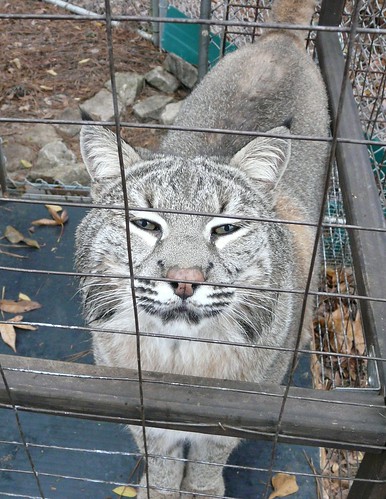
Last night on 60 Minutes Lesley Stahl went to see the Frozen Zoo, the Audubon Nature Institute's Species Survival Center. The center is doing fascinating. historic, ground-breaking work storing the DNA of threatened species and even producing clones of endangered African wildcats. What was missing from the story, however, was a closer look at the context in which the center operates. If Stahl and 60 Minutes had asked the following questions, the piece might not have been as much of an inane exercise.
Who's paying for all this?
The nonprofit Audubon Nature Institute grew out of a once ailing, old New Orleans institution. They're not related to the Audubon Club. ANI runs a zoo, insectarium and Imax theatre. So are they supporting the whole $43 million operation (including the $2.5 million it costs to save endangered species) by creeping out kids with bugs and selling zoo T-shirts? If so, that would be quite a feat and worth knowing. Too bad Stahl didn't ask.
The issue is important because in 2007 the Washington Post's Philip Kennicott pointed out ANI's ties to big oil, raising the possibility it used Chevron money to make a lame Katrina Imax movie that doesn't mention oil's role in destroying wetlands. (No way, say the film-maker and Audubon: Chevron was just ordered by a court to funnel cash to an environmental cause and they chose this one.)
According to finances posted online, the operation just about breaks even (a loss of $187,000 in 2008, the latest year available). Unless you count capital expenses. Which the center curiously doesn't. And they're huge: $41 million, most of which went to insectarium. The center is supported by its own foundation, which was worth $30 million in 2007, according to Guidestar. It got some federal money from helping save the whooping crane and a little bug money Terminix. And it pays longtime New Orleans politician Ron Forman about $500,000 a year (as of their latest filings)--though that's down from the $700,000 he got in 2000.
Frankly, the work is so important I might not mind if the center raised money by selling zoo T-shirt to strippers who entice people to gamble, smoke and drink candy-flavored liquor. But I'd want to know.
What about the Thylacine? Who cares about Wooly Mammoths? When are you going to bring us a a Thylacine?
The Thylacine is the emblem of a species that was allowed to go extinct in modern times. So why are we talking about the wooly mammoth?
The Thylacine, also known as the Tasmanian Tiger, was an Australian striped marsupial went extinct so recently (1933) there's video of it on YouTube. Some Australians debate whether some might still exist on Tasmania. Meanwhile, the Australian Museum has been working on bringing it back from extinction for years using the same idea Audubon is talking about: taking DNA from museum specimens. So why aren't these two working together?
Is this part of some international movement to make a library of animal DNA?
Because the Animal Gene Storage Resource Center of Australia seems to be doing the same exact thing. And Advanced Cell Technology also bred an endangered Javan Bentang in a cow. None of that takes away from the great stuff ANI is doing, but I'd like to hear where they fit in.
Why skin cells?
Why is ANI concentrating on skins cells instead of blood or gametes? Is skin better? Or are they really gearing up for using skin from old museum cells?
Why don't those guys burying seeds in the arctic give you some storage space?
The Global Crop Diversity Trust runs an arctic bunker for seeds, which 60 Minutes covered in 2008. And it's way better funded and advanced with a bunker set to survive disaster. Wouldn't that be a safer place to put endnagered DNA than New Orleans? Aren't animals more important?
Instead we get these questions:
So it's really more like an ark than a zoo?
Stahl points out. Brilliant observation. Like it was in the BBC's 2005 headline on the place. Those canisters of liquid nitrogen wouldn't be much fun to look.
After bringing up the way distant possibility of rewriting DNA to meet our criteria, Stahl then asks, with great surprise, if they could possibly CLONE the extinct or endangered species.
Ok, cloning is like photo-copying. It already exists. It's no longer science fiction. It's here. So why be shocked? And why throw in this idea of editing DNA, which still is science fiction, and not be shocked? If she's going to ask questions like this, they may as well send Andy Rooney out on science stories.
Showing posts with label endangered. Show all posts
Monday, January 11, 2010
Tuesday, January 05, 2010
Eagle Season Begins in Illinois
When I grew up in Illinois, seeing a bald eagle would have been impossible or at least fantastic. On January 2, my family and I drove just two hours outside Chicago and got to see seven bald eagles fishing on the Illinois River by Starved Rock State Park. More regular guests, jaded by appearances of over 100 eagles, walked away disappointed. We couldn't have been more delighted.
Now Illinois brags that it has the most bald eagles of any (continential) state. Alaska blows everybody away with 50% of the world's population of 70,000, according to Bald Eagle Info. Haliaeetus leucocephalus only lives in North America and Ireland. The bird was upgraded from endangered to threatened in 1995, then totally bumped off the endangered species list in 2007, thanks largely to cracking down on poachers and DDT. The IUCN, which rates how vulnerable animals are, now dismissively says the bald eagle is of "least concern."
The Mississippi River is where most Illinois eagles hang out and where most eagle-watching hotspots are, but Starved Rock is by far the closest place to Chicagoland. The number of eagles that visit the area has been climbing steadily since people started counting 15 years ago and no one knows how high it might go. (The eagle population is thought to have once been 100,000.)
Kevin Eubank, the head ranger at the dam where you do most eagle viewing, says the numbers hit a peak last February with 115. They're coming down from Wisconsin and Canada, attracted by the open water the dam creates so they can fish. They strongly prefer fish, but Eubank says they've been seen eating roadkill deer, too. The jumping Asian carp are too big for them, he says. Which is a shame: how much would you like to see a bunch of eagles snatching invasive jumping fish from the water? During the day the eagles have a favorite tree on an island in the river, leading to some surreal photos of a tree full of eagles. At night they roost in the park's canyon's to get shelter from the wind.
"The colder the weather, the better," says Eubank. Well, then, it looks like it's going to be another great bald eagle season.
More places to see eagles
See more animals around Illinois and the Midwest
STARVED ROCK EAGLE OPTIONS:
OUTDOOR: You can see the eagles from Starved Rock itself, but that's up a lot of icy stairs outside. It's still worth it, though. An eagle cirlced right over us. From the visitor's center, you can walk out to the river on flat ground and see the eagles on their favorite tree.
INDOOR/OUTDOOR: You have indoor/outdoor options at both the park lodge or the closest and most ideal place, the Illinois Waterway Visitors Center, which has two stories of windows and outdoor decks. Don't go to the 1930s lodge first; with its fireplaces, 1930s log ceiling and Irish coffee, you'll never want to go out in the cold.
TROLLEY: The park runs a trolley tour a few days a week. The big appeal here is that you're in a heated box--though it was cancelled the day we went.
EAGLE WEEKEND: Thousands of people turn out for the runs Eagle Watch Weekend that IlIllinois Audubon runs. This year it's Jan. 23-24. TIP: you can see as many eagles and avoid the crowds if you go during the week in late January or early February.
Bonus species: Cooper's hawk, tons of migrating geese, deer
Bonus Goofy YouTube Video: Let the Eagle Sour
Now Illinois brags that it has the most bald eagles of any (continential) state. Alaska blows everybody away with 50% of the world's population of 70,000, according to Bald Eagle Info. Haliaeetus leucocephalus only lives in North America and Ireland. The bird was upgraded from endangered to threatened in 1995, then totally bumped off the endangered species list in 2007, thanks largely to cracking down on poachers and DDT. The IUCN, which rates how vulnerable animals are, now dismissively says the bald eagle is of "least concern."
The Mississippi River is where most Illinois eagles hang out and where most eagle-watching hotspots are, but Starved Rock is by far the closest place to Chicagoland. The number of eagles that visit the area has been climbing steadily since people started counting 15 years ago and no one knows how high it might go. (The eagle population is thought to have once been 100,000.)
Kevin Eubank, the head ranger at the dam where you do most eagle viewing, says the numbers hit a peak last February with 115. They're coming down from Wisconsin and Canada, attracted by the open water the dam creates so they can fish. They strongly prefer fish, but Eubank says they've been seen eating roadkill deer, too. The jumping Asian carp are too big for them, he says. Which is a shame: how much would you like to see a bunch of eagles snatching invasive jumping fish from the water? During the day the eagles have a favorite tree on an island in the river, leading to some surreal photos of a tree full of eagles. At night they roost in the park's canyon's to get shelter from the wind.
"The colder the weather, the better," says Eubank. Well, then, it looks like it's going to be another great bald eagle season.
More places to see eagles
See more animals around Illinois and the Midwest
STARVED ROCK EAGLE OPTIONS:
OUTDOOR: You can see the eagles from Starved Rock itself, but that's up a lot of icy stairs outside. It's still worth it, though. An eagle cirlced right over us. From the visitor's center, you can walk out to the river on flat ground and see the eagles on their favorite tree.
INDOOR/OUTDOOR: You have indoor/outdoor options at both the park lodge or the closest and most ideal place, the Illinois Waterway Visitors Center, which has two stories of windows and outdoor decks. Don't go to the 1930s lodge first; with its fireplaces, 1930s log ceiling and Irish coffee, you'll never want to go out in the cold.
TROLLEY: The park runs a trolley tour a few days a week. The big appeal here is that you're in a heated box--though it was cancelled the day we went.
EAGLE WEEKEND: Thousands of people turn out for the runs Eagle Watch Weekend that IlIllinois Audubon runs. This year it's Jan. 23-24. TIP: you can see as many eagles and avoid the crowds if you go during the week in late January or early February.
Bonus species: Cooper's hawk, tons of migrating geese, deer
Bonus Goofy YouTube Video: Let the Eagle Sour
Labels:
bald,
bird,
eagle,
endangered,
Haliaeetus,
IL,
leucocephalus,
prey,
winter
Tuesday, December 22, 2009
Manatee Tours that Won't Bother the Manatees
Crystal River 2009, Kevin provides a belly rub (dogs of the sea) ,
originally uploaded by Kevin King.
As an endangered species and marine mammal, manatees area already supposed to be protected, but go on YouTube and search "manatee harassment." You'll find videos of tourists coralling and chasing manatees, separating the mom and calf and even trying to ride or kick them. It's like Crystal River, FL, tour operators live in a 1950s world where they feel entitled to sell the experience of touching, petting and scratching manatees. Do they then drive home without seatbelts into a house lined with asbestos and eat canned soup casserole for dinner? Haven't they heard that's not how you treat wild animals?
"It's this culture of everybody that come to Crystal River," says manatee advocate Tracy Colson. "It's well-advertised that this is the only place where you can touch a manatee. It's the only place in the world where you can interact with an endangered species."
Tracy, a local, started volunteering with the Crystal River Wildlife Refuge by going out to guide manatee tourists to be respectful and was so upset with what she saw she started her own company, Nature Coast Kayak Tours. In 2007 Save the Manatee named Tracy and Steve Kingery manatee heroes for documenting manatee harassment, which kicked off a controversy and push the Fish and Wildlife Service to crack down. (Manatee advocates don't want to stop all manatee tours, just ones that annoy manatees and drive them out of the warm waters they need in the winter.)
"There's something to the swim with- programs that would be a great help to the mantee," says Colson. "If you have that magical experience, it's going to make you a strong advocate." I get as excited as anyone seeing a wild animal, so it's easy to see how some one could become over eager to make a manatee connection. But, like most animal tourists I know, I don't want to do anything that hurts the animal. So I asked Tracy to give out-of-towners some tips so we don't unwittingly help the bad guys. It can be hard to pick out a good tour because many go through the motions.
The programs that reign in whale and dolphin tours amount to this: don't bother the animals or make it look like you do in your ads. You stand still and if the animal wants to come close, it will.
TIPS ON FINDING A RESPONSIBLE TOUR
* Ask them if you're allowed to touch or approach a manatee.
* Is their website all about party and adventure?
* Do they show pictures of people petting, kissing, tickling, riding or otherwise molesting manatees?
* Look for a small operation and small boat. While it's better for whales if everyone is on one big boat, it's better for manatees if there are small boats and small groups, where the mob mentality hasn't taken over.
SOME GREAT TOURS
Manatees in Paradise
Husband and wife, Captain Mike and Stacy Dunn, help with manatee rescue and bay clean up. Their pontoon boat only holds up to six. $25 per person, plus wet suit rental. 1223 North Crystal Drive, Crystal River, FL
352-563-0865 cell 352-601-5520
Nature's Connection
Capt. Hank rides with up to 12 on 3 1/2 hour tours.
$50 including wet suit.
267 N.W. 3Rd. St. Crystal River, Fl. 34429
capthankstours@yahoo.com 352-697-0220
Aardvark’s Florida Kayak Company
Save the Manatees works with wildlife biologist 707 N Citrus Avenue, Crystal River, FL
(352) 795-5650 info@FloridaKayakCompany.com
Native Vacations comes highly recommended by Passport Magazine and manatee fans. Dedicated manatee lover Traci Wood offers private 6-hour snorkel tours ($400 for up to 4 people) or $35 (plus equipment fees) 3-hour tour.
Nature Coast Kayak Tours
Tracy Colson volunteers to clean out the waterway, rescue manatees and document manatee harassment. Her 3 1/2 hour tours are $40, including all equipment.
(352) 795-9877 or 888-795-9877 toll free
Adventure Outpost
Lars Andersen, who writes guides on paddling and the area, leads kayak tours of many waterways. $39
386-454-0611
Wild Florida Adventures
Brack Barker used to be a parks ranger and enforcement officer.
Williston, FL (352) 528-3984 Tours@wild-florida.com
Labels:
endangered,
FL,
fws,
manatee,
marine mammal
Monday, September 07, 2009
Happy Thylacine Day!
It's not only Labor Day, it's Thylacine Day! Australia has a day to pay attention to threatened species, marking the sad anniversary of the death of the last Thylacine.The Thylacine, or Tasmanian Tiger, is a creature so odd-looking you would think it was a cryptozoology hoax if there weren't so much evidence it really existed. Thylacinus cynocephalus is a striped, marsupial carnivore that looks like a zebra - shiba inu mix. The Tassie Tiger was wiped out from Australia 3,000 years ago, but survived on Tasmania until shortly after people showed up. Sheep farmers killed them off, shooting the last wild one in 1930. On this day in 1936 the last Thylacine died in Hobart Zoo.
But since then people have said they've seen Thylacines in remote Tasmania and in Australia. Chris Rehberg's blog Where Light Meets Dark put together a fantastic map of all the
sightings here since the supposed extinction. Motion-activated cameras have turned up nothing. Yet. An effort to clone the Thylacine from cells of a preserved fetus have also been failures. So far. (And people who think the Thylacine is still out there don't want it cloned.)
I went to see Jane Goodall speak about her new book, Hope for Animals and Their World: How Endangered Species Are Being Rescued from the Brink, which is about how passionate biologists are rescuing or rediscovering animals on the edge of extinction. (Rehberg calls the study of extinct animals Eclipsazoology.) It'd be great if the Thylacine, instead of being known as yet another example of humans wiping out a species for convenience, instead gets know for being brought back.
View Larger Map
Labels:
cryptozoology,
endangered,
jane goodall,
marsupial,
species,
tassie tiger,
thylacine
Tuesday, September 01, 2009
Montana Hunts Wolves--Along with Bison and Sandhill Crane
That got us thinking about what other kinds of rules Montana has about hunting. Here's a sampling that will give you how hunting trumps all other concerns.
Photo Courtesy of Thomas Roche
- Go ahead and hunt wolf pups. While you are banned from hunting lactating mountain lions, you can shoot wolves born this year. "This means you can shoot any wolf you see including pups if you so choose," notes huntwolves.com. You can't bait wolves or use electronic calls, but you can use manual or old-fashioned ones (typically calls of prey animals.) You can't use night vision or--unlike Alaska--an airplane. (Well, you can use it to spot them, but you can't shoot them till the next day.) Also, you can dump the carcass in the field, but you have to bring back the head and "evidence of sex: males: testicles; females: vulva or mammaries."
- They hunt bison. That's right--the symbol of the west, the symbol of wasteful hunting. Apparently there was a reason for this rule: "It is unlawful to possess or transport the fetus or reproductive tissues of a bison away from the kill site." Just as Alston Chase described in Playing God in Yellowstone, they hunt them just outside the border of Yellowstone National Park.
- They hunt Sandhill Cranes. Cranes! You get a free permit at either the Bowdoin or Medicine Lake National Wildlife Refuges or Fish, Wildlife & Parks regional headquarters. You can take up to three a day and have up to six. There's also a drawing for more convenient Sandhill crane hunting sites. According to the International Crane Foundation, their population is expanding, except where "small breeding populations can face disproportionate mortality on fall staging areas due to over-hunting."
- They hunt swans. "Swan hunters must have, as a means of retrieving swans, a
watercraft, a dog capable of retrieving or chest-high waders along while hunting the dikes at Freezout." - They hunt mountain lions--but not lynx or bobcats. "Mountain lion is excluded from being considered as “suitable for food” under big game regulations. A person that harvests a mountain lion must possess the head and hide, with evidence of sex naturally attached. The remaining carcass may be taken in possession or be left in the field."
- They're still trapping fisher, wolverine and and marten.
- They want an urban deer hunt.
Labels:
animal,
crane,
endangered,
hunting,
mt,
swan,
wildlife,
wildlife watching,
wolf
Wednesday, March 04, 2009
Really Rare Jaguar Euthanized
Arizona Game and Fish had to euthanize a jaguar they caught and collared just a couple weeks ago. We've known jaguars were back in the U.S. since the mid-1990s from pictures on motion-detector cameras. But this was the first time North America's only roaring big cat had been caught in the U.S. And it was by accident--they laid out leg snares for bears and mountain lions. So they'd seen this guy, known as Macho B, for a long time. In fact, he was the oldest jaguar in the wild.
The department made a big show of not telling where this cat was caught. But, given that it took them 13 years to capture this one, I don't really imagine anyone trying to do it in a day on a lark. Since they describe the area as southwest of Tuscon and fitted the collar with a device to go off over the border, I would assume the area was right around Nogales--where the department shows a bear population on their map.
The biologists noticed the jaguar not moving, so they recaptured him and noticed that he'd lost a lot of weight. Tests showed severe kidney failure, something they think takes weeks not just days. But the first blood samples they took from Macho B were only for DNA use, they say, so they won't be able to tell how sick he was when they caught him the first time.
I would think that it would be an incredible coincidence if this wise old cat's death and its collaring happened within two weeks of each other. I don't think there's anything the biologists could have done that would have caused kidney failure. (Though catching an animal in a leg snare wouldn't help.) I think it's more likely that the cat was weakened and that's why he somehow missed one of these traps that he'd been avoiding for all these years.
Macho B was one of only two individuals they knew about in Arizona. The population in northern Mexico is still illegally hunt and caught and is cut off from the rest of the jaguar population. The border fence threatens to divide the territory further--maybe leaving no jaguars on our side. So it would be an incredible feat to get them re-established.
Labels:
AZ,
big cat,
endangered,
jaguar,
macho b,
wildlife management
Monday, October 06, 2008
More Than One-Third of Mammal Species In Jeopardy
International Union for Conservation of Nature (IUCN) announced its new Red List today, showing that mammals on earth are in real trouble. We now have 5,487 mammal species. That's down 76 (or 1.3%) since 1500.
But we know that 1,141 mammal species are officially endangered and at risk of becoming extinct. That's more than 20% of our mammals. But there's another problem: we can't even find enough another 836 mammals to figure out their status. They're listed as "data deficient."
“The reality is that the number of threatened mammals could be as high as 36 percent,” says Jan Schipper, of Conservation International who wrote about the findings in the magazine Science.
About 3.4% of mammal species fall into the worst category, Critically Endangered.
They're not all charismatic megafauna. A lot of the animals in trouble are bats and mice.
But one critically endangered is the Iberian Lynx (Lynx pardinus). There's less than 200 left because it eats the European Rabbit (Oryctolagus cuniculus), which is also disappearing.
Best Places to See Wild Cats
Where to See Animals in Europe
But we know that 1,141 mammal species are officially endangered and at risk of becoming extinct. That's more than 20% of our mammals. But there's another problem: we can't even find enough another 836 mammals to figure out their status. They're listed as "data deficient."
“The reality is that the number of threatened mammals could be as high as 36 percent,” says Jan Schipper, of Conservation International who wrote about the findings in the magazine Science.
About 3.4% of mammal species fall into the worst category, Critically Endangered.
They're not all charismatic megafauna. A lot of the animals in trouble are bats and mice.
But one critically endangered is the Iberian Lynx (Lynx pardinus). There's less than 200 left because it eats the European Rabbit (Oryctolagus cuniculus), which is also disappearing.
Best Places to See Wild Cats
Where to See Animals in Europe
Labels:
endangered,
endangered species,
esa,
marine mammal
Subscribe to:
Posts (Atom)