
About two years ago some local Florida manatee lovers took some disturbing video of tourists and tour guides pestering manatees. Tracy Colson and Steve Kingry posted shots on YouTube of tour guides holding manatees so that tourists could touch them. Some tourists also kicked them and tried to sit on the sea cows. Finally, about two years later, something might actually be done to protect this endangered species whose population has dwindled to about 3,000 from Florida hooligans.
Spurred on by the videos, this summer the Public Employees for Environmental Responsibility (PEER) officially asked the Fish and Wildlife Service to ban "Swim with Manatee" programs. Tourists aren't supposed to get within 50 yards of dolphins or 100 yards of whales in NOAA's (voluntary) guidelines for those tour operators. But at least there is some enforcement for whale boats. NOAA also won't let tour operators show ads that have people interacting with, chasing, petting or riding whale or dolphins in the Dolphin Sense and Whale Smart programs. So how can tours advertise swimming with the far more endangered manatee?
Before I had heard about any of this going on in Florida, I saw ads online for sleazy outfits around Cancun that advertised Swim With Manatees programs. Yuck, I thought. Don't people know that manatees (or any animals) don't want to be forced to swim with them. But I had no idea there were plenty of places in Florida getting away with it, too. Then I read an incredible story travel writer Andrew Mersmann did for Passport Magazine last year about Florida manatee tours that end up harassing manatees.
Mersmann says people in the industry know exactly which are the bad ones. He went on both to see what was really going on. The captain of one tour told the groups: “It’s a good day if you see a manatee, but it’s not a great day unless you touch one.” You are, of course, not supposed to pet the manatees any more than you're supposed to cuddle a polar bear. The difference is manatees can't fight back. And even when they try to get away, videos posted on YouTube show, the tour guides restrain them so the tourists can play.
What's wrong with swimming with manatees? Morally, if you bother manatees, they stop what they're doing. Manatees don't have frivolous hobbies; whatever they're doing, they need to do it to survive. They're an endangered species. They need to eat grass, nurse from their mothers, sleep, come up to the surface to breathe.
Legally pestering, holding, riding, kicking manatees--again, all documented--is a violation of Florida state law, the Endangered Species and the Marine Mammal Protection Act, which bans "taking" a manatee. Taking is defined doing anything on purpose or by negligence "to harass, harm, pursue, hunt, shoot, wound, kill, trap, capture, or collect, or to attempt to engage in any such conduct." It goes on to clarify that it includes "the restraint or detention of a marine mammal, no matter how temporary...causing disruption of behavioral patterns, including, but not limited to migration, breathing, nursing, breeding, feeding, or sheltering."
The Marine Mammal Commission has recommended not allowing people to approach within 10 feet of manatees. (If they come to you, that's fine. And that's exactly what skilled manatee watchers say will happend if people would just be patient.) The manatees, Mersmann writes often leave lagoons as soon as the tour boats show up.
In August the Fish and Wildlife Service basically said no to the request to ban the programs, reasoning, more or less, that harassing manatees was already illegal. And that they could only provide some protections to threatened animals and since manatees are already endangered--a notch worse--they're out of luck.
"They saw that harasment of mantees is illegal," says PEER staff attorney Christine Erickson. "What they're allowing people to do is causing harassment." So PEER is going to take the FWS to court. They want to get more sanctuaries set up and ban the swim with programs in the winter, which the manatees need to be in the warm shallow water to survive. The sanctuaries are small areas with the warmest water where manatees can go and people can't. The manatees know that and retreat there when they get tired of people. Let's hope this
Let's hope this finally means the manatees will get a break.
Showing posts with label esa. Show all posts
Showing posts with label esa. Show all posts
Monday, October 26, 2009


Monday, October 06, 2008
More Than One-Third of Mammal Species In Jeopardy
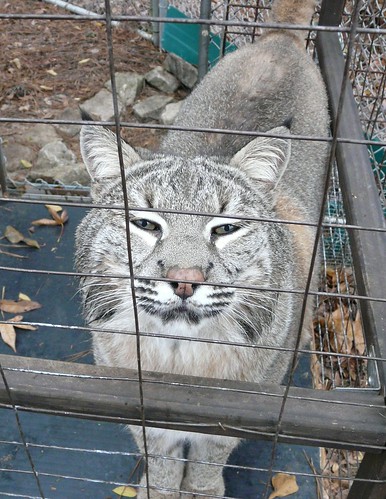
But we know that 1,141 mammal species are officially endangered and at risk of becoming extinct. That's more than 20% of our mammals. But there's another problem: we can't even find enough another 836 mammals to figure out their status. They're listed as "data deficient."
“The reality is that the number of threatened mammals could be as high as 36 percent,” says Jan Schipper, of Conservation International who wrote about the findings in the magazine Science.
About 3.4% of mammal species fall into the worst category, Critically Endangered.
They're not all charismatic megafauna. A lot of the animals in trouble are bats and mice.
But one critically endangered is the Iberian Lynx (Lynx pardinus). There's less than 200 left because it eats the European Rabbit (Oryctolagus cuniculus), which is also disappearing.
Best Places to See Wild Cats
Where to See Animals in Europe
Friday, August 15, 2008
Here's How To Comment on the Softening of the Endangered Species Act
 The Bush administration is making a last minute attempt to plunder the Endangered Species Act before they leave office. The Associated Press dug up a draft copy of new proposed rules that would eliminate the need to consult with scientists about whether major construction projects would impact any endangered species. Like taking all those animals off the list wasn't enough, huh?
They're just changing the rules, so Congress doesn't even need to approve. Instead they have to let the public comment--but not actually listen to it. The San Francisco Gate reports that they've even stopped accepting emails. And cut the comment period from 90 to 30 days, says gristmill.
Just try to find a way to comment on the proposal. I couldn't find it anywhere in the Fish and Wildlife Service page. Not even their page just on endangered species. To find it, I had to use the document number from the National Wildlife Federation. Here's the magic word you need to know: "50 CFR part 402". That's the only way you're going to find it. Here's the official proposal online.
And here's their instructions on how to submit a comment. Now it's confusing because first they tell you where to comment, then they tell you they won't accept your email.
If they do take it, here's the place to submit a comment on 50 CFR part 402. I tried it and it seems to work.
And here are their ambiguous instructions:
Submit your comments or materials concerning this proposed
rule in one of the following ways:
(1) Through the Federal eRulemaking Portal at http://frwebgate.access.gpo.gov/cgi-bin/leaving.cgi?from=leavingFR.html&log=linklog&to=http://www.regulations.gov.
Follow the instructions on the Web site for submitting comments.
(2) By U.S. mail or hand-delivery to Public Comment Processing,
Attention: 1018-AT50, Division of Policy and Directives Management,
U.S. Fish and Wildlife Service, 4401 North Fairfax Drive, Suite 222,
Arlington, VA 22203.
We will not accept e-mail or faxes. We will post all comments on
http://frwebgate.access.gpo.gov/cgi-bin/leaving.cgi?from=leavingFR.html&log=linklog&to=http://www.regulations.gov. This generally means that we will post any
personal information you provide us (see the Public Comments section
below for more information).
Subscribe to:
Posts (Atom)
