We've Moved!

Hi and Welcome to the AnimalTourism.com blog. But we've moved just down the street to this site, animaltourism.com/news. Please comment there.
Showing posts with label book. Show all posts

Wednesday, February 17, 2010

Spoiler Alert: Don't Dread The Ending in Koontz's Dog Biography

Why didn't anybody tell me that Dean Koontz  after my dog is such a big animal advocate? My sister Karen gave me his book A Big, Little Life after my dog Jolly died. I dreaded reading it, knowing that all dog stories have sad endings. What I didn't expect was that it was both a delightful biography of an exceptional dog, Trixie Koontz, and an aggressive argument for the case that animals are mysterious, wondrous creatures worthy of respect and compassion.

Yes, this novel is just more anecdotal evidence that dogs have complex minds and spirits and not just motivated to eat and survive like some kind of algae. I'm tired of hearing about how animal lovers anthropomorphize from people who would have us believe dogs are closer to corn stalks than to humans. They overlook the vast sums of evidence to the contrary and as Koontz succinctly derides them, are "invariably dogless."

Koontz once included a description of a guide dog from Canine Companions for Independence in book Midnight. The group reached out to him and he and his wife started visiting and supporting the place. Finally they adopted Trixie, who had to cut her guiding career short because of a bad knee. Any guide dog is exceptional--the human equivalent of a PhD--but Koontz delighted in Trixie's spiritual as well as intellectual strength. While sick in the hospital, Trixie visited the cages of other animals in distress. Like many dogs, she was a discerning judge of character, both human and canine. She mourned the passing of friends and, Koontz argues, knew she was about to die and accepted her death with grace.

Once into the book I enjoyed hearing about Trixie and knew I didn't have to fear the ending and the grief it would re-open. The Koontz's even suffered through the nightmare of an emergency splenectomy, the same scary procedure my Jolly had. Like the Koontz family, my husband and I thought it was our most excruciating time with Jolly--far worse than his eventual death. Although losing Trixie was a thumping blow to the Koontz family, the book wasn't about the horror of that loss--much to my relief. Instead it was about all the spiritual gifts Trixie gave him. I think that's the legacy Trixie and Jolly would surely prefer. 

Where to See Goofy Dog Events 

Wednesday, November 11, 2009

Destination Wildlife: Another Must-Have Book for Wildlife Watchers

Literary agent Pamela Brodowsky people who travel to see animals will want have to dream about travel adventures. Destination Wildlife: An international site-by-site guide to the best places to experience endangered, rare and fascinating animals an their habitats gives you places and animals to aspire to see around the globe.

The book is exactly what you'd want to have on hand through a cold winter weekend when you're dreaming about where you could travel next year. You'll need some other books to get into the specifics of travel to all those destinations, but this is a nice way to browse your options. Written with the National Wildlife Federation, you can be pretty sure these are ways to see animals that aren't going to hurt or exploit them.

Brodowsky is extremely diplomatic in describing the one place in the book I'd question: the wild horses of Assateague and Chincoteague. She describes the roundup of horses, some of which will be sold, adding "Depending on your personal preference, you might want to join or avoid the pony-swim crowd." Fair enough, but I'd go further and say that many people who love wild horses would be disturbed by the round-up--especially since the horses are managed so differently on each side of the Maryland-Virginia border. The Maryland folks use the Humane Society's birth control procedures (and allow dogs); the Virginian manage the herd to sell off horses every year to support their fire department (and ban dogs from the island, even inside cars). Which would you rather support? 

I would have liked to see some glossy color pictures and maps, a fuller representation of wildlife everywhere and a greater willingness to consider places outside big national parks and sanctuaries. Animaltourism.com tries to give people practical wildlife options close to home. But we need all kinds of wildlife watchers and guides to promote sustainable, responsible wildlife watching. Brodowsky does uncover a few rare gems, like Monkeyland, a primate sanctuary in South Africa, and specific inns to stay at to see the friendly gray whales off Baja, California. I bet her book inspires lots of great adventures.

Thursday, September 24, 2009

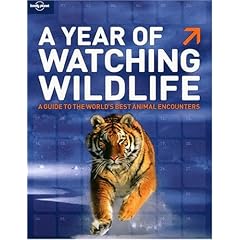
Lonely Planet: A Year of Watching Wildlife (in what passes for easy ways)

Lonely Planet's new A Year of Watching Wildlife: A Guide to the World's Best Animal Encounters is one of those books any animal tourist is going to want. Gorgeous glossy photos show you schools of stingrays swimming from underneath, howler monkeys mid-howl, puffins with icicles hanging from their bright beaks.

The conceit of the book is that it's a calendar. Lonely Planet gives you animals to see in every week of the year and a semi-plausible reason why they picked that week. Lots of the rationales are compelling, reasons like mating or baby season. But the calendar conceit gets a bit worn for all those animals that don't really have a peak week to watch. We're reminded how random travel advice can be with the push "You should visit [Andean condors in Peru] in April for good weather and to avoid the tourist season." True enough, but there are big hunks of the year that applies to. Also, the book tells you to try to see them at Machu Picchu, acknowledging that you're far more likely to see them at a canyon hundreds of miles away, but that "pales in comparison with the experience of seeing one of these ponderous birds towering over the ancient Inca city." Or it would if you actually saw one there.

The book is a nice t's a nice fantasy wish list, compiled as if you've only got a year to live, unlimited funds and all you want to do is see animals. The book also rates the level of difficulty for each adventure, but with very little sense of the real world. Nearly everything is rated low or medium. Hyenias in Ethiopia? That's easy. Same with Gharials in Nepal. How about diving 30 meters to see "the cave of the sleeping sharks" off Mexico? That rates a medium difficulty. Same with camping on a remote Alaska island with walruses. Even polar bears don't rate a high difficulty. In the entire world and entire year, there's apparently only one animal that will give you trouble: the Bactrian Camels in China--and then more for the "bureaucratic and logistical challenges." So, it's not exactly practical travel advice, but it's a fun read.