We've Moved!

Hi and Welcome to the AnimalTourism.com blog. But we've moved just down the street to this site, animaltourism.com/news. Please comment there.
Showing posts with label zoo. Show all posts

Saturday, April 03, 2010

Can We Call Animals Gay? How About This Otter Couple?

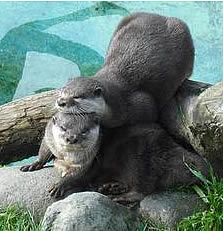
Daz and Chip, gay otters
Two male New Zealand otters who spent 15 affectionate years together at the Natureland Zoo died within an hour of each other this week. The treatment of their story is exactly what The New York Times Magazine story "Can Animals Be Gay?" out tomorrow is about. Biologists are realizing that many animal pairings are same-sex but the debate over whether to consider the animals gay has become more political than scientific.

The Times writer Jon Mooallen whimsically describes it this way:  "It may seem surprising that scientists sometimes don’t know the true sexes of the animals they spend their careers studying — that they can be tripped up in some 'Tootsie' -like farce for so long."

With Asian otters Daz and Chip, everyone knew they were male and bonded. The circumstances of their death just solidified their coupledom. When an animal pair dies so closely--like my dog Jolly did after he lost his girlfriend Shadow--how can you not acknowledge their complex emotional life? "The bottom line is that when one of them had a heart attack, it just set the other one off and he followed through," a zoo spokesman told the New Zealand Herald.

The Times story mainly follows albatrosses, who have a lot of two-mommy households, but the phenomena spans the animal kingdom. A two-mommy, one-daddy family of another albatross species in New Zealand's Taiaroa Head got lots of attention because of the gay-friendly tourist board, Mooallen says.

So back to our New Zealand gay otters.

Daz, 19, and Chip, 16, are described by their caretaker "busy, growly, bitey," but noticeably not gay in the New Zealand Herald. There were part of the zoo's captive breeding program, but the zoo is mum on their contribution. Presumably they made some contribution--willing or not--or they wouldn't have been kept in it for 15 years.

The Daily Mail describes the pair as "best friends [that] lived side-by-side for 15 years."

A local New Zealand station calls them "best friends" that were "always together," but also uses the gay couple codeword "longtime companion."

Everyone does assume Daz and Chip were a gay couple. Their story was memorialized in The Advocate and spread through twitterdom that way.

It is touching to see that these major media outlets now running an animal love story. I'm so tired of hearing people accuse themselves and others of anthropomorphism. What would be the opposite? Rockpomorphism? Treepromorphism? Why is it okay to presume that animals have no emotions or intent? We've gotten to the point at least where we accept what the handlers saw: one otter died after its "longtime companion." Now can we accept that it was its mate?


Where to go to see animals near you--gay or straight

Saturday, January 09, 2010

Visitors to a Chinese Zoo Feed Carp Bananas by Hand

American zoos frown on feeding the animals, but the Nanning Zoo in China isn't so persnickety. Visitors feed their carp bananas by hand.

What I can make out from on online translation of the zoo's story: people in Guangxi got some bad bananas, so naturally they brought them to the zoo. And, of course, the zoo didn't mind people giving the fruit to the monkeys and hornbills. Then, almost inevitably, somebody fed them to the gold fish. And now, as long as you peel the bananas, the carp think of them as a treat.

And it seems to be cultural: only this one pool of fish like bananas. There's another pool in the zoo with the same kind of fish but they have "no enthusiasm on the banana."

Tuesday, August 11, 2009

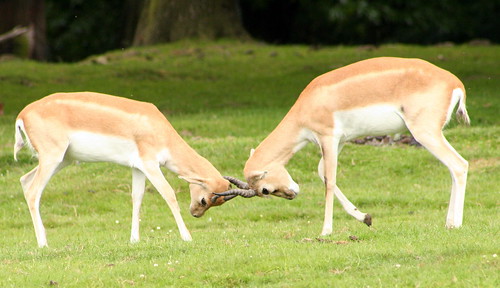
Oz Outraged at Canned Hunt for Rare Antelope-- Which Texas Does in Droves

photo courtesy of Cats 2007
Australians this week were outraged when they realized the Taronga Zoo in Dubbo, NSW, is selling off blackbuck antelopes, which are endangered in their native India, to canned hunting ranches. Meanwhile, these kind of black buck hunts go on non-stop in Texas and nobody cares.

The Sydney Morning Herald reported that Bob McComb, owner of the Dongadale Deer Park and Stud, bought 24 blackbuck antelope from the zoo for between AU$160 and $300 (US$130 - $250). (Later the zoo admitted selling 84 animals to a bunch of these hunt clubs. Sure seems like the zoo was letting them breed to get cute babies to attract visitors.) The deal is he can only breed the ones he got from the zoo, but he'll "hunt" their offspring. He's confident he'll be able to get approval to do it, then charge thousands of dollars per kill.

Australians were suitably taken aback. They called for the zoo's animal welfare chief to quit. And New South Wales Premier Nathan Rees said No, he wasn't going to suddenly allow these widely-ridiculed hunting ranches--even though it'll make it hard to corral conservatives on other issues.

India sent Bollywood star Salman Khan to jail for shooting one of these lanky animals. The eight year court case may now be a movie. Wildlife preserves like the ABOHAR in Punjab are carefully coaxing their numbers up. Nature worshipping Bishnois protect them.

Meanwhile, back on the ranch in Texas, canned hunting is a big business. Even though real hunters looked down on the kind of weasels who shoot caged animals, then boastfully hang their heads on a wall, Texas is fine with it.

The Texas Hunt Lodge--one of many in the state--lets these brave men choose whether to stalk these antelope or hunt them from a blind, then use a bow, rifle, handgun or old fashioned black powder weapon. They'll even let them play safari. The price: $1,750 or $3,000, depending on whether the horns qualify as a mere trophy (about 18 inches) or a "record"--20 inches or more.

How did we end up with such different attitudes toward these antelopes? For starters there are now nearly as many blackbucks on ranches in Texas and Argentina as there are living in the wild in India (50,000.) India declares them endangered (but even some there contemplate hunting schemes because they eat a lot of sorghum crops.) Officially, IUCN calls these Antilope cervicapra "near threatened." That is, not officially endangered.

The black buck on the Edwards Plateau in Texas are considered exotic. Under wildlife laws here, that means they don't even count as wildlife.