We've Moved!

Hi and Welcome to the AnimalTourism.com blog. But we've moved just down the street to this site, animaltourism.com/news. Please comment there.
Showing posts with label ga. Show all posts

Wednesday, December 02, 2009

Atlanta's Wildlife Hosptial


Flirty Arigato - SW Bobcat - L. rufus baileyi (Merriam)
Just 20-30  minutes south-east of Atlanta, wildlife rehabilitator Michael Ellis is nursing some dwarf baby squirrels, teaching a great-horned owl independence and giving permanent shelter to a couple bobcats. His outfit, AWARE (Atlanta Wild Animal Rescue Effort), is the biggest wildlife rehab center so close to such a big city  I've seen.

Ellis, whose been rehabbing wildlife for two decades, says having big Route 20 nearby is crucial. You ride a few miles off the highway through farmland and the Arabia Mountain National Heritage Area and you're at Aware, which looks like a house with an extensive kennel system. If you serve animals, why  be near a city? Most wildlife injuries involve people (or their cars or cats). But more importantly, the best way to help animals is to teach people how not to kill them.

"I could spend 45 days saving one opossum or 45 minutes with one class of 30 kids and end up saving 1,000 animals over their lifetime," Ellis says. The grim truth of wildlife rehab is that--except for maybe a few endangered species--its broad impact on animal populations is pretty much nothing. Squirrels and starlings are in no danger of going extinct. "But it makes a big difference to that one animal," says Ellis. And each of the animal treated impacting the people who find them or learn about them at the center. That's why Aware wants to reach every kid in Atlanta.

A few of those that can't make in the wild live out their time at Aware. A local bulldozed a bobcat den, then decided to raise the cub instead of letting the mom retrieve it. The small shy cat hid in his house while I was there. Meanwhile a much bigger and bolder bobcat, Arigato, preened. He's a southwestern subspecies that someone tried to raise in Georgia as a pet. Lauren Satterfield, a volunteer who hopes to study wildlife conflicts, says ill-treated Arigato is surprisingly friendly.  Indeed, the big cat is absolutely flirty. A big ham, he nuzzled up to the fence, then turned his butt towards me. Much to my surprise, he sprayed me with his pee. All over. In bobcat world, I think Arigato now owns me; he was incredibly pleased with himself, lolling around showing off his spotted belly afterwards. A few flightless owls clicked their beaks at me. I don't speak owl, but I'm pretty sure they were showing me that they are tough guys. Most patients are transients and never see the public so they won't get too comfortable around people. Every fall Aware seems to get a batch of gray squirrels that have fallen out of trees that are about half the normal size and suffer from a skin rash.

Ellis modestly describes Aware as too small, but it seems to me better equipped and organized than most vet offices I've seen. Each animal gets an intake form and individual care, with a view to being released near where it was found. Although Aware meets the technical space requirements of each species, they'd like to give unreleasable tenants a bigger space and more natural and interesting daily life. "When it comes to permanent residents, they deserve the best," Ellis says.

Sometimes they have to turn down requests from wildlife officials for big animals like bears that they don't have the capacity to care for well--yet. That's part of the reason they're planning on adding 5,000 square feet of facilities over the next few years--provided they get the donations.

Donate to Aware
Find other places to see wildlife down south


Fun Facts: Even in good ole boy Georgia, wildlife watchers outnumber hunters about four to one.

Georgia Residents: 

1.1 million fishermen
481,000 hunters
2 million wildlife watchers


Non-Residents Enjoying Wildlife in Georgia:
136,000 fishermen
136,000 hunters
183,000 wildlife watchers

Sunday, August 17, 2008

Big Foot Tours $499

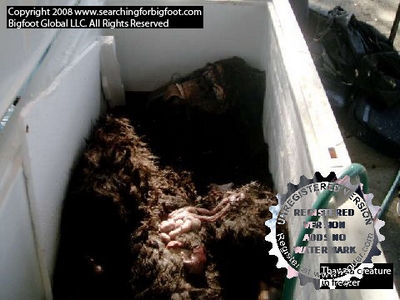
Nobody was impressed with the evidence presented at the Bigfoot press conference last week. Matthew Whitton and Rick Dyer say they have a bigfoot carcass in a freezer in northern Georgia somewhere. But that's not all! They also have video of a few live big foot or sasquatch hanging around the area.

Whitton and Dyer have alternately been described as hunters, hikers and big foot hunters. I tracked down an older story from a big foot blogger, who linked to their expedition site, bigfoottracker.com. Back then Whitton was were referred to as a cop and Dyer a former corrections officer. Dyer says he's a married dad and former Army ranger. Matt calls himself Gary and says he's a great tracker who "has associates who train bloodhounds for tracking."

Most of their current stuff is on the site of Tom Biscardi, who is a more experienced and perhaps more oily bigfoot hawker. The sites share not only a quest for Sasquatch, but also a fondness for blaring completely unrelated music. Biscardi's site includes field reports from around the country--but none in Georgia.

Whitton and Dyer on bigfootblogger describe getting started on the big foot hunt when being awakened by one "on the side of a mountain north of Helen, Georgia." They claim to have sold out a trip to the Blue Ridge-Smokies in June where "there have been actual big foot sightings this year" and plan a September trip to "an even more specific area" in September. They brag that only eight seats remain, but say the maximum they'll take is 10.

Their big foot tours cost $499 for four days, plus renting camping equipment if you don't have any.

Where to See Animals Down South

Wednesday, May 30, 2007

Kangaroo Ranches in Both Georga and South Dakota


For years I've wondered why entrepreneurs don't set up kangaroo ranges around the country. Now they are starting to. I visited the Kangaroo Conservation Center outside Atlanta last year. It's a bit of a stretch to call hauling kangaroos thousands of miles from their natural habitat to live in a fence visited by tourists "conservation." But it's a fun visit just the same.
Now there's a another kangaroo hot spot: the Roo Ranch in South Dakota.
The ranch made it into the news when one of their wallabies briefly escaped at the airport.
I haven't visited--yet--but they seem to be a little bit smaller and less programmed than Atlanta's Kangaroo center. Admission is only $15, but they do seem to count on making a lot of money off getting your picture taken with a kangaroo--kind of low rent like an amusement park.

Where to See Animals Down South
Where to See More Unusual Animals

Tuesday, May 30, 2006

A Trip to Georgia's Kangaroo Conservation Center

Kangaroo Conservation Center, Dawsonville, GA

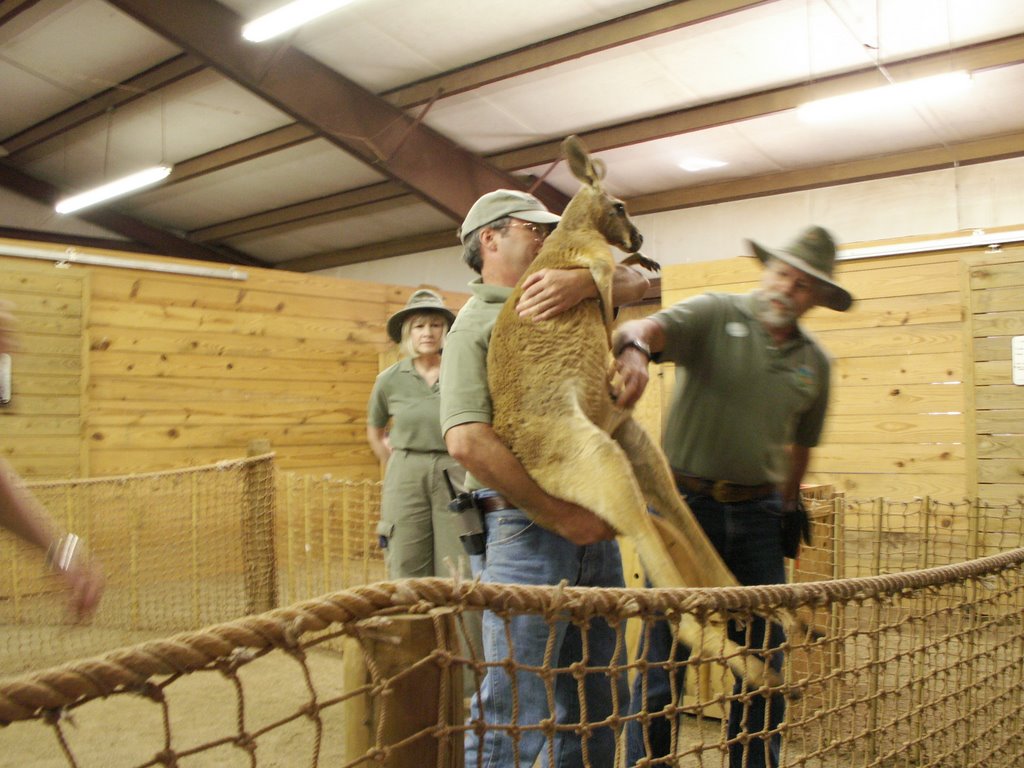
On a farm 90 minutes north of Atlanta, hundreds of kangaroos hop in fields as if they were in their native Australia. The "Conservation Center" is the largest outpost of kangaroos outside Australia and a major source of zoo kangaroos. How much conservation is really on any one's mind is a big question. People come because it's fun to see herds of kangaroos on American soil, some up close.


You'll start out seeing an Australian greenhouse full of birds and tiny rat kangaroos. Then it's onto a tram tour, where you see three kinds of kangaroos behind tall chain link fences. Most kangaroos here happily live in natural social groups and with minimal human interference. After that there's barn show, where you'll get close to the tamer kangaroos and other Australian animals. You'll learn, for instance, that their pouches aren't as big and open-hanging as the cartoons make you think.


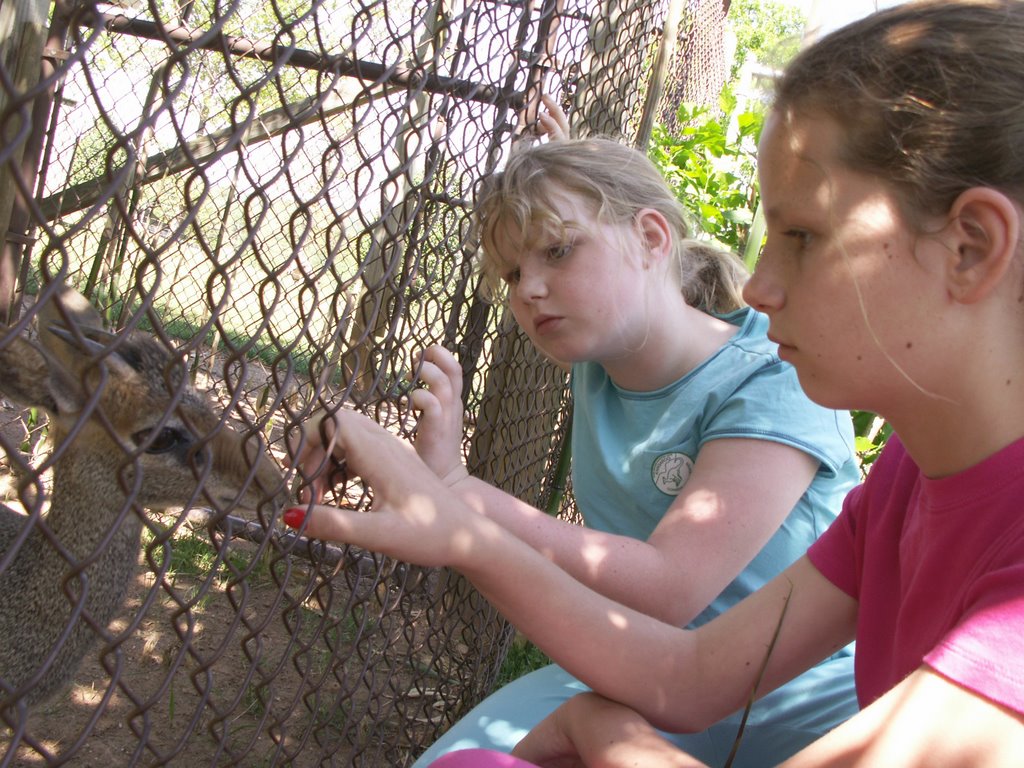
Afterwards, you can walk among the kangroo pens or see some other animals. Don't miss the Dik-Dik, an African antelope who wants to mark you with a tar-like substance from a gland under his eye.

Where to See More Animals Down South