
I'm moving the blog over to my own site: http://animaltourism.com/news/
Please follow me there
Saturday, June 05, 2010


Monday, May 31, 2010
Feral Parrots Land in Lower Manhattan
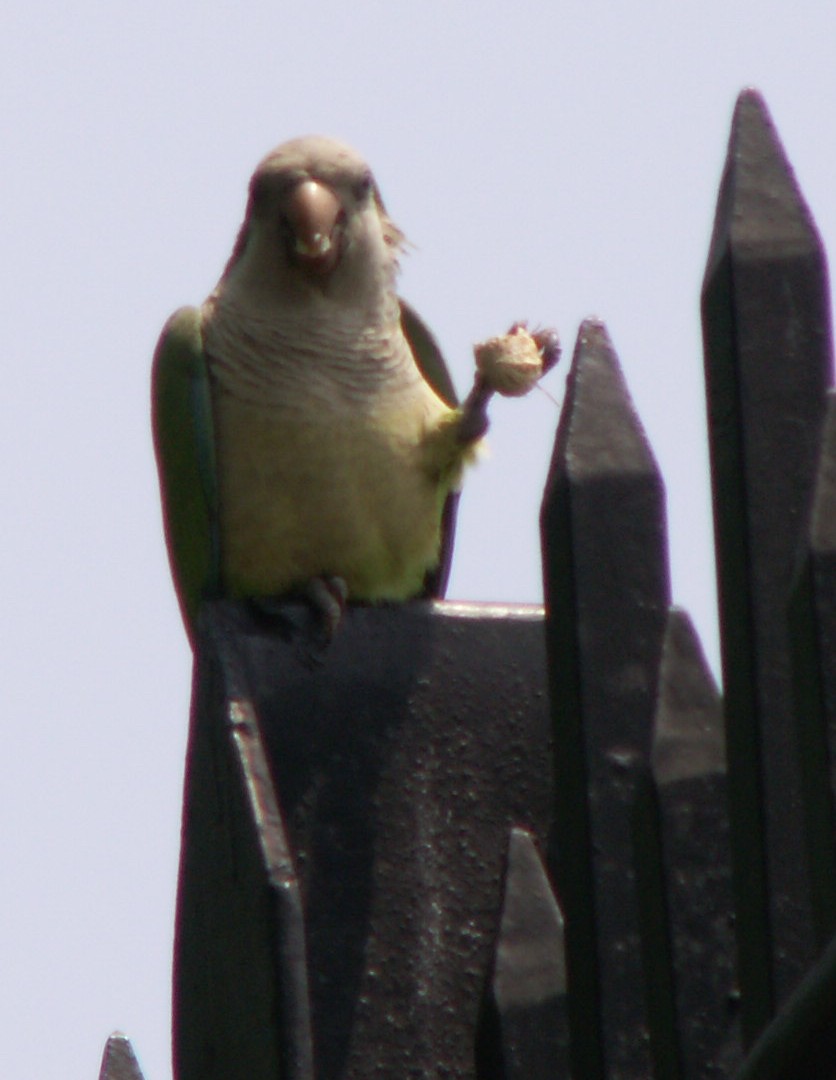 |
| Parrot near Brooklyn College |
It's too late to be building a nest for eggs, he says, but the birds seem to be building something--like one of their insanely huge colony nests, which can grow to the size of a smartcar. No one knows where, but once the colony gets going, it's huge and they like to build them on tall towers (or trees in a pinch), so it shouldn't be hard to fine in the East Village.
Steve Baldwin has done an amazing job tracking and advocating for the monk parakeets or Quaker parrots at BrooklynParrots.com. He gives free, frequent tours by Brooklyn College and Greenwood Cemetery. At one point he had a highly-detailed map on his site of nests around New York City and New Jersey, but he took it down after reports of men showing up in vans and grabbing birds.
 |
| These huge nests make the parrots unpopular. |
Now that red-tailed hawks are becoming commonplace, it's fun to have a new freaky species to look for.
Where to Go to See Parrots in the U.S.
Check Out BrooklynParrots.com
Friday, May 28, 2010
White Squirrels to Bring in 25,000 to Cool N.C. Town
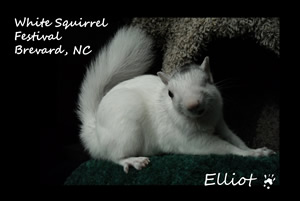 |
| You'll see at least one white squirrel: non-releasable Elliott |
Normally there's just one guy in a squirrel suit called Woody the White Squirrel, but this year's extravaganza will feature 250 people in white squirrel costumes dancing to BrotherBrother for five minutes Saturday afternoon to set a world record. (Coincidentally, robots in Austin will be dancing for their own record nearly simultaneously.)

"We're really having fun with the theme," says the guy who dreamed the whole thing up, Phil Davis. "We're willing to be a little weird." Brevard is joining the ranks of towns that have parties to celebrate something no one can imitate: local wildlife. So along with 32 Bald Eagle Watches, Moose Festivals and events to watch hummingbirds and bats, it's only natural that a town with 1,000 white squirrels would flaunt it.
Many small towns--especially Olney--brag about their white squirrels. Cryptomundo lists 10 white and black squirrel cities and some try to tour them all. White squirrels, which are far more rare and exotic--breed competition that is suitably fierce and fun.
"There's a bunch of wannabe cities," Davis dismisses the competition. "They paint their squirrels is the rumor. We're not in support of towns that bleach their squirrels."
 |
| Typical pattern of Brevard, NC, white squirrel |
"It's primarily a music festival. They just love the fact it's wrapped in white squirrels," he says. "They love the magicalness of it."
 |
| Elaborate and very cool map showing percent of white squirrels around town |
 But there's plenty for people who actually want to see and celebrate the white squirrels. There are free squirrel safaris that center around the likely ground of Brevard College. And they're guaranteed to see at least one: Elliott, a genial white squirrel who couldn't make it in the wild. Elliott was attacked by an adult when he was young, lost an eye and has complicated tooth problems, says wildlife rehabilitator Jennifer Burgin. Now five, Burgin feeds him a special diet by hand twice a day.
Burgin, who has been rehabbing squirrels for 20 years, likes how the town appreciates their squirrels. "They're very serious about their white squirrels," she says. "Everybody is very proud of them." In 1986 Brevard banned killing, catching or hurting its squirrels. People take extra care to avoid hitting them, says Davis, who himself rescued one from the road. "I don't want people of gray persuasion to get angry, but white squirrels do enjoy some special protection."
Another thing Brevard has up on Olney is a population of about 1,000 squirrels and the White Squirrel Research Institute. Founded by a former professor at the college, Bob Glesner, the institute gathers and processes an impressive set of data on white squirrel population. Local residents volunteer for an annual survey to count both the number and percentage of white squirrels.
Glesner is watching whether the population becomes fragmented, but generally thinks they're doing okay. About 37% percent of the town's squirrels are white overall. But around the college, where the tours go, it's 46%. The highest is the performing arts center, where almost 9 in 10 squirrels are white.
The town is quick to point out that their white squirrels are not albinos. They have black eyes and their fur is just a color phase--a hair color, like a chocolate or yellow lab. Brevard's squirrels have a distinct look: a darker stripe down their spine and dark frosting on the top of their head.
Davis thinks the white squirrels are just what Brevard, which sits near the border with Georgia and South Carolina, needs. "Don't laugh," he says. "There was another rodent that saved another city. I don't think anybody's laughing about Disney and Orlando."
Where to Go See Unusual Squirrels
More Interesting Animals You Can See Down South
Adopt a Brevard White Squirrel
Attend the World's Biggest White Squirrel Festival in Brevard, NC
Thursday, May 27, 2010
Mah Wei: Tiny Chinatown Songbirds, but Not Every Day
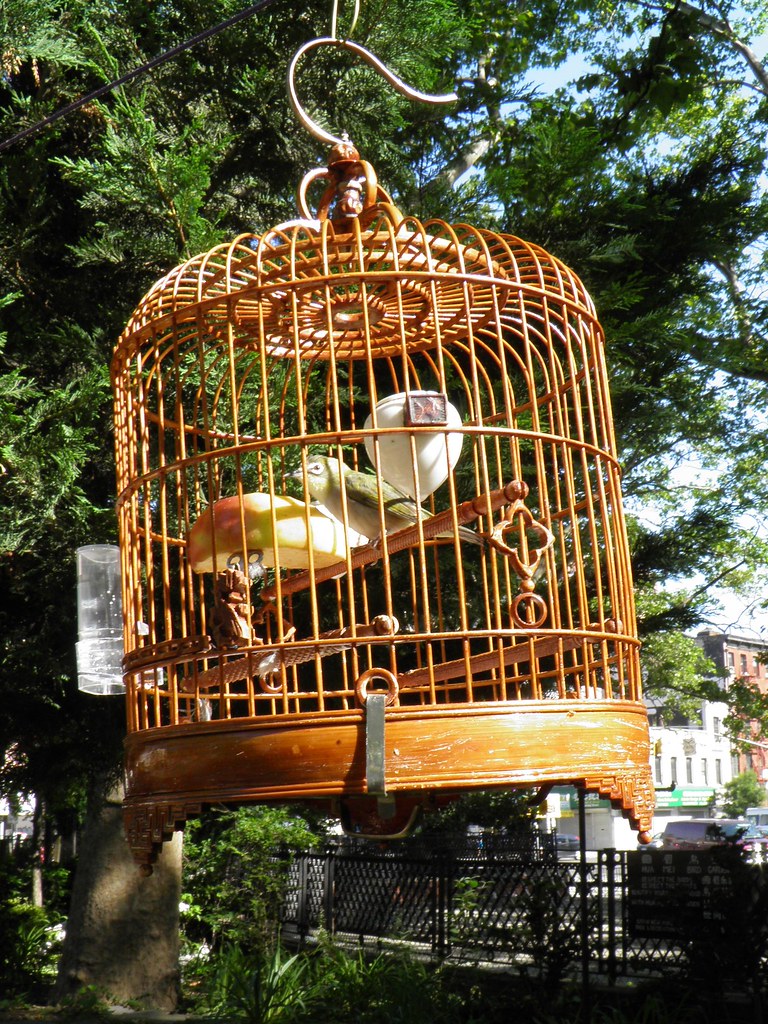
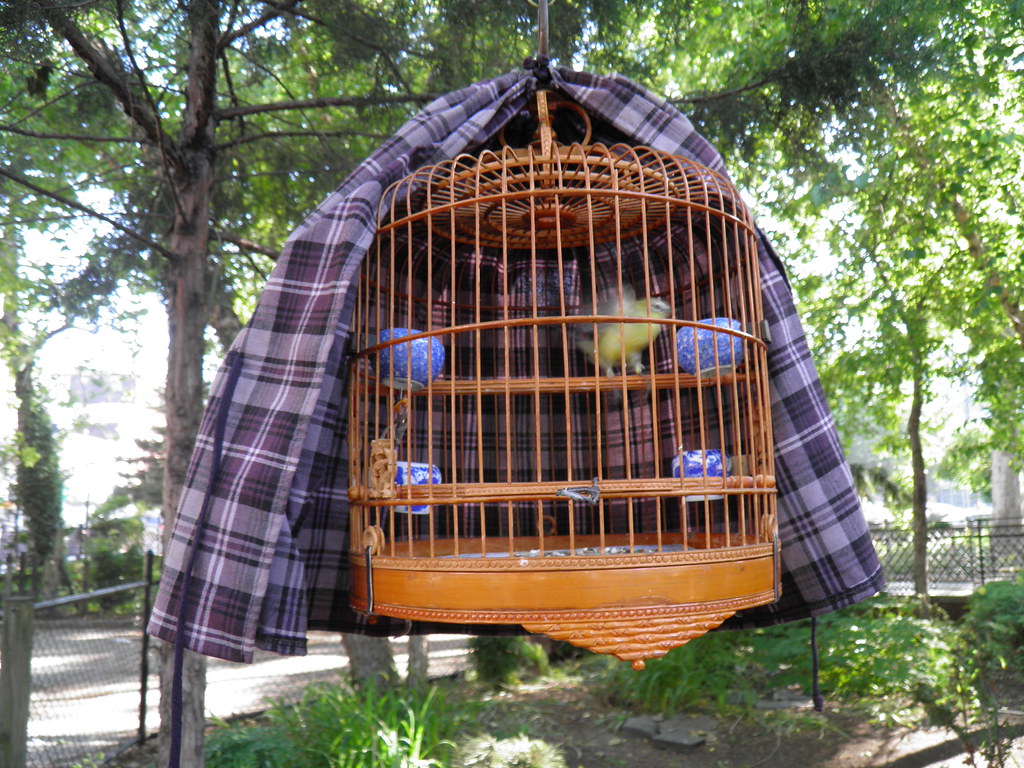 For years I've heard about a Chinatown park where old men bring their exotic birds and this morning I finally went to find it. The Wah-Mei Bird Garden in Sara Delano Roosevelt Park, just south of Delancey, can draw 40-some old Chinese men, each carrying a singing bird in an ornate cage. Or that's what I've heard. I only saw three bird guys.
I arrived around 8, in time to see the first bird man take the flannel cloth off his cage. It must shield the bird from the city, though most of narrow Roosevelt Park itself is not much better. It's got bridge traffic on two sides and it's dark and unkempt with wavy pavement and a drugged-out man lurching around. The cages themselves are fantastically carved wood, bamboo and what looked like ivory. They hang them on a long line over a fence that encloses the official Wah-Mei Bird garden. You can hear the birds sing if you get close. Nearby, other elderly Chinese exercised with swords.
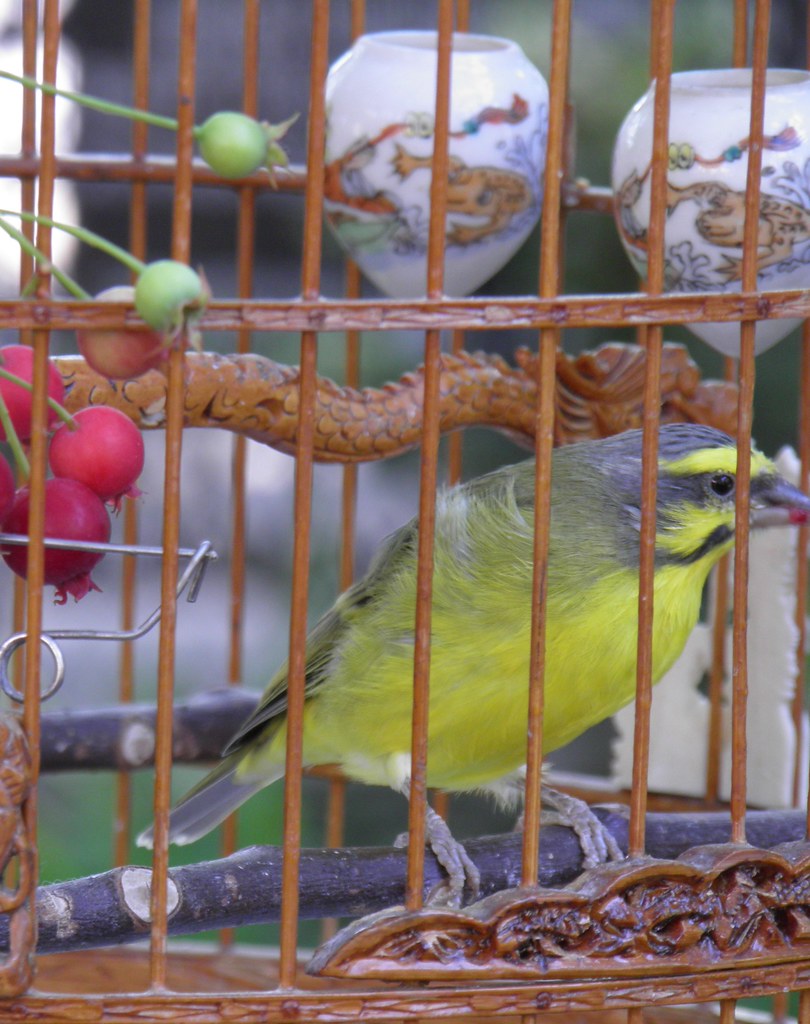 |
| The most friendly and happy bird |
The second bird I saw, another bright yellow one in a fabulous cage that looked like it included ivory, was my favorite. He's a mimic. I whistled to him and she whistled back. And kept the tune going. He was probably annoying his owner with my tuneless notes all day. He ate from fancy porcelain jugs, too.
The third bird was probably the only one that was really a Wah Mei. CITES, which restricted its import after the bird flu outbreak, says that it's the most popular bird traded in China. Before the ban, they figured 1.8 were captured each year, with most of the females just eaten.
 |
| Probably the only real Wah Mei |
Where to Go See Weird Birds
Where to See Animals in New York City
Wednesday, May 26, 2010
New Yorkers Climb Fire Escape to Rescue Baby Blue Jay
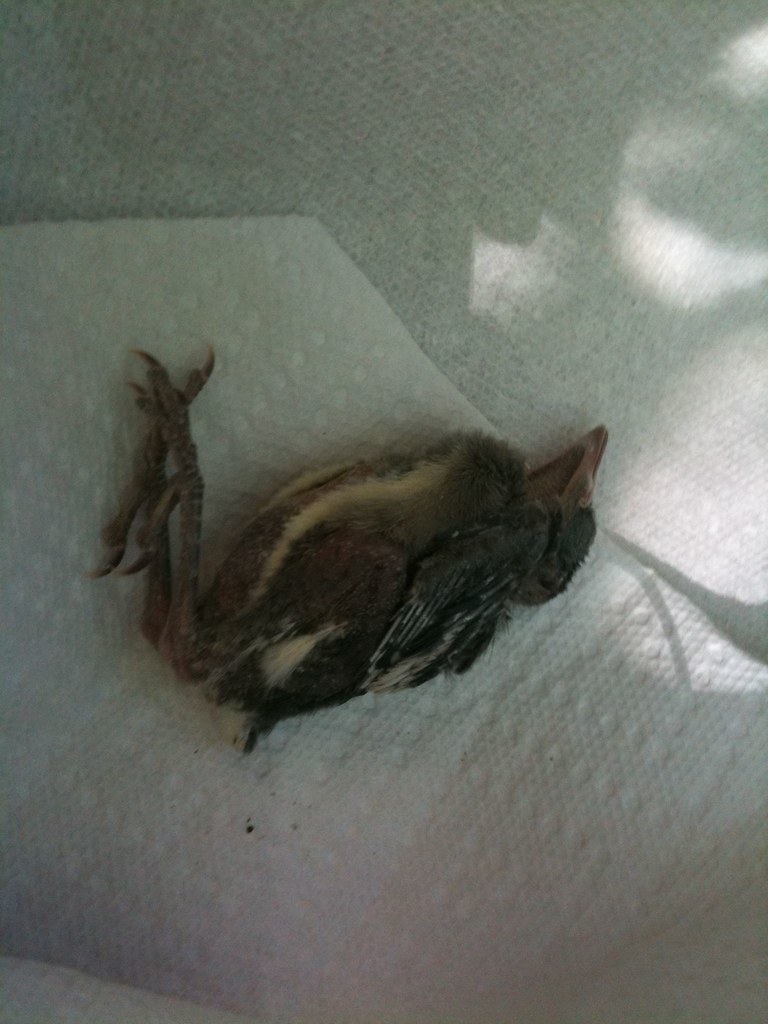
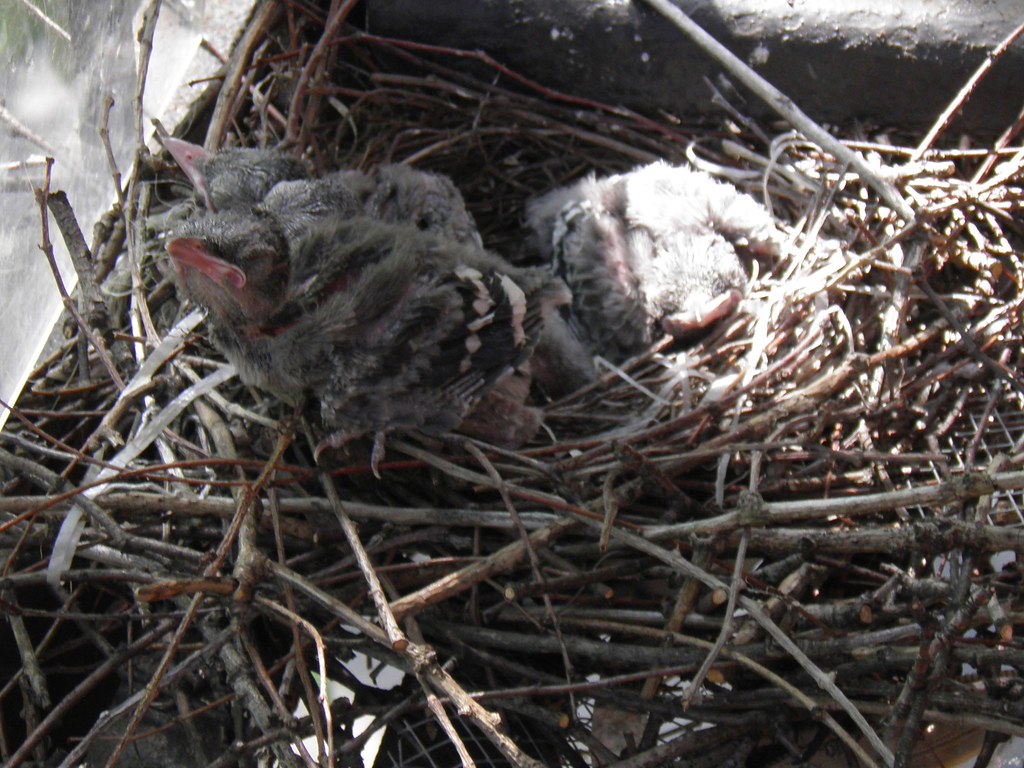
Just yesterday I put up flyers explaining the blue jay babies were up there and it would be normal if they would fall out. If it were a forest instead of Fifth Street, they'd be fine. The parents would feed them for a couple days on the ground. The parents, however, made a really unfortunate real estate choice. Below their nest is sidewalk, street and a tiny tree pit--no grass or bushes or any other baby bird amenity. And thousands of helpful New Yorkers walk by every day. Somebody would pick it up and bring it to their vet. That's what happened to a blue jay nest in the next block two years ago. The mom spent weeks looking for them.
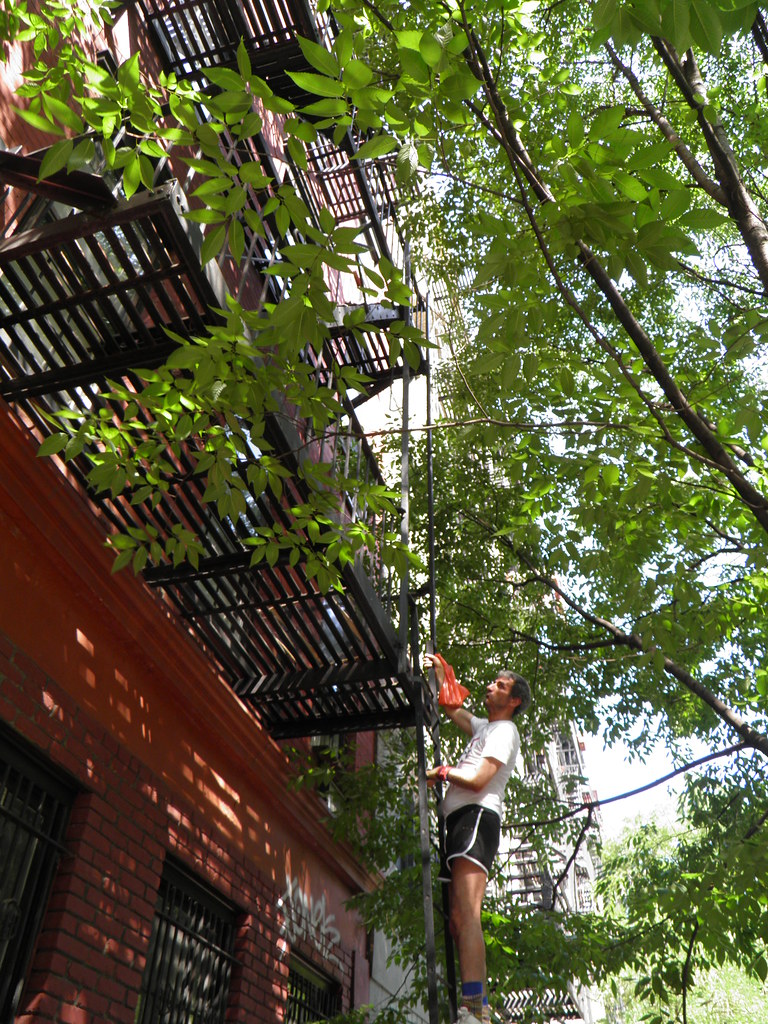 So this afternoon I got a call about the flyer from a neighbor. The one bird on the sidewalk wasn't not fully feathered and was weak and skinny. It looked way too young to be out of the nest to me. People label New Yorkers as harsh, but soon there were six of us trying to figure out how to get the bird back on the fire escape, ringing doorbells, taping on windows.
My friend Pierre found a long board and tripped the fire escape ladder so it would fall. Generally this kind of thing is frowned upon in the city, but Pierre bravely climbed up and replaced the baby. While I was getting some clear plastic, the mother jay returned and swooped at Jonah, a 10-year-old good samaritan. Pierre and I basically lined the fire escape and left some raw peanuts for the blue jays' trouble.
So far, so good. The mom returned, ate peanuts and sat on the nest. I got a call from the people who live in the blue jay apartment. They'd been worried about the birds and didn't mind our clamoring over their fire escape.

Tuesday, May 25, 2010
North Korea: Creepy to Animals, Too
What do you get for a fellow despot of an impoverished country? How about a menagerie? Conservation groups are pissed that Zimbabwe is sending North Korea a mini-menagerie--two of every species from Hwange National Park.
You can only imagine how a nation that can't provide food and electricity for its own people will treat elephants and lions from Africa. Actually, you don't have to imagine. Some news reports make it seem ambiguous where they might go. But there's only one zoo in North Korea and it's totally sad, crappy, creepy and unaccredited.
Asia Times reports that a bunch of animal fighting films have come out of North Korea and pits animals against each other to fight to the death--just the kind of flick our Supreme Court endorsed.
"In all probability, North Korean leader Kim Jong-il sanctioned the filming of Fighting Animals, or at least gave it his curious approval - though there is no evidence he was directly involved despite his well-documented interest in filmmaking," the Asia Times says. "The film's producers would have needed access to rare and valuable animals and the only place in the country that holds them is the Central Zoo in Pyongyang."
Aside from the animal fighting scandal, Lonely Planet says all the animals at the Korea Central Zoo, also known as the Pyongyang Central Zoo, "look pretty forlorn Worst off are the big cats...kept in woefully inadequate compounds." Visitors also describe and photograph lots of cats and dogs at the zoo. Of course, North Korea has a different way to describe it: "Working people and school youth and children have a pleasant time, seeing animals associated with meaningful stories." They also report renovations.
Zimbabwe defended the deal as just a business transaction, not political. Is that better? They're selling two elephants too young to be separated from their mother for $10,000 each, $900 each giraffe, $600 per zebra and then, the AP reports, some cheap birds: $10 each for blue crane, saddle-billed stork and white pelican. The blue crane seems like a real bargain: they're listed as vulnerable on the IUCN Red List, with only 26,000 left and falling and range maps don't even show them in Zimbabwe.
Some animals do get out of North Korea. In 1995 a Siberian tiger named Rail went to the south. In 2005 Seoul got a bear and lynx--but sent in a hippo and llama.
The only good thing that can be said of the deal is that wild animals are pretty much doomed under Mugabe anyway. Zimbabwe's Conservation Task Force explains that Mugabe didn't just take land from white farmers, he took it from parks and wildlife, too.
Where to Go See Big Cats
조선 중앙 동물원
 |
| Somalia gave Kim Il Sung an Ass photo by (stephan) |
Asia Times reports that a bunch of animal fighting films have come out of North Korea and pits animals against each other to fight to the death--just the kind of flick our Supreme Court endorsed.
"In all probability, North Korean leader Kim Jong-il sanctioned the filming of Fighting Animals, or at least gave it his curious approval - though there is no evidence he was directly involved despite his well-documented interest in filmmaking," the Asia Times says. "The film's producers would have needed access to rare and valuable animals and the only place in the country that holds them is the Central Zoo in Pyongyang."
 |
| The Pyongyang Central Zoo was hit by bird flu |
Zimbabwe defended the deal as just a business transaction, not political. Is that better? They're selling two elephants too young to be separated from their mother for $10,000 each, $900 each giraffe, $600 per zebra and then, the AP reports, some cheap birds: $10 each for blue crane, saddle-billed stork and white pelican. The blue crane seems like a real bargain: they're listed as vulnerable on the IUCN Red List, with only 26,000 left and falling and range maps don't even show them in Zimbabwe.
Some animals do get out of North Korea. In 1995 a Siberian tiger named Rail went to the south. In 2005 Seoul got a bear and lynx--but sent in a hippo and llama.
The only good thing that can be said of the deal is that wild animals are pretty much doomed under Mugabe anyway. Zimbabwe's Conservation Task Force explains that Mugabe didn't just take land from white farmers, he took it from parks and wildlife, too.
Where to Go See Big Cats
Monday, May 24, 2010
Whales are People, Too, Group Says
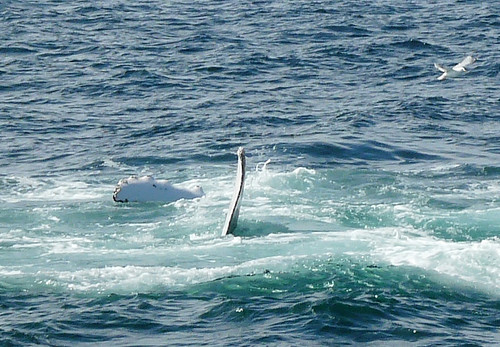
The Declaration of Cetacean Rights, which anyone can sign, basically includes the right not to be killed, captured, abused or owned. The society, which met at the University of Helsinki (nice touch), says their rights to "life, liberty and well-being" are due after we figured out that they have more intelligence, self-awareness and culture than we previously thought. The petition gets at the idea that it's okay to care about the fate of not just the health of a species population or ecosystem, but an individual animal.
Most westerners would go along with most of that--although the part that would ban Sea World or swim with dolphin programs might shock some. We already don't hunt whales and changed the tuna industry to avoid dolphins (which are really just small whales). Japan still kills about 23,000 dolphins a year on purpose. Hundreds of whales are killed each year--no one is sure how many exactly how many--mainly by Japan, Norway, Iceland, Greenland and Russia.
The controversial part, at least in my mind, is that they also "affirm that all cetaceans as persons." I don't think they're persons. Individuals, sure. Anyone who's spent time with higher functioning animals can tell you they're individuals. They don't need to be people to have individuality and rights. Then again, if they didn't put a little bit of crazy talk in there, who would write about them?
Where to Go See Dolphins
Where to Go See Whales
Sunday, May 23, 2010
Wild Squirrel Invades Squirrel Rehab Room

Today I left the office for two minutes and came back to find Mommy Squirrel in my chair. So I grabbed the camera to see what Mickey would do. She came out and deliberately ate in front of Mommy Squirrel, but then seemingly ignored her. My dog Jolly would do give dogs who barked at him a kind of I can't see you kind of nonchalance.
I hope it's not any kind of Mickey's disability that she actually can't see the invading squirrel. I suspect Mickey is like my mom: she only pretends to be oblivious, but is on top of everything going on.

Where to See Wildlife in New York

Saturday, May 22, 2010
Jay Continutes Relentless Battle Against 3rd Floor Cat
 |
| Cat gives blue jay the bird |
This video compared to the last one shows why you should use a tripod.


I've also seen the cat hanging out by the window, waiting for his entertainer to show up.
I don't really understand the feeding procedure. The mother blue jay sometimes gapes for her mate. And she also picks up something from the nest and eats it herself.
Friday, May 21, 2010
San Francisco Parties for Return of Runaway Sea Lions (and one of few marine mammal success stories)
 |
| Sea lions being admired, courtesy of Pier 39 |
Salty The Sea Lion mascot will be "available for hugs and photos," a press release says. The Pier is also celebrating 20 years of having hundreds of 600-pound predators in a major city. They started showing up after a 1989 earthquake. Instead of getting ousted from valuable real estate, they city enjoyed them as a natural wonder--and created a major tourist attraction.
This could have gone down differently. The sea lions took over expensive boat docks. Sure, the Marine Mammal Protection Act covers them. But the government is always willing to make exceptions. Oregon fishermen got permission to kill sea lions that hang out at a dam where salmon congregate.
Last year when 1,700 sea lions showed up, they tested San Francisco's tolerance. The harbor drew up plans to keep them away from the nearby Hyde Street Pier.
The population numbers go up and down with weather, currents and food availability, so maybe they won't need to be pushed out. The sea lions' movements are still inscrutable, but the best going theory is that it was good food that brought them in such numbers last year and then herring that took them to the Oregon's Sea Lion Cave over the winter (they usually go south to the Channel Islands).
The California sea lion is making a huge comeback--too big for some. It's one of the few marine mammals whose numbers are healthy and increasing. Of seven sea lion species in the world, only two are not extinct, endangered or threatened, according to the IUCN Red List. The California sea lion is the only one whose population is increasing. Of about 355,000 animals, 238,000 live in California. Even if the disappearance of this crowd was media hysteria over a non-event, that's still something to celebrate.
Where to go to See Seals and Sea Lions
See the Pier 39 Sea Lion Webcam
Here's where you can see wildlife out West
Thursday, May 20, 2010
Real Life "Fox and Hound" Story at UK Wildlife and Farm Sanctuary
 A rescued fox cub and a dog bred to kill foxes are becoming friends at a hotel/wildlife sanctuary in Cornwall. The Gwel an Mor had already turned wildlife rescue into an eco-attraction at its lodge. Then animal wrangler Gary Zammit heard a fox cub crying in the field. He worried his own dog would attack the cub, but instead they've become wrestling buddies (and UK media celebrities).
 The fox, now called Copper, and dog Jack now play constantly, when they're not being featured on the BBC or the Telegraph or other outlets. Actually, it's their pictures of rassling that have become so popular. "They just play fight there's never any malice in it," says Zammit. Jack is a lurcher--a kind of greyhoundish mixed breed popular in the British Isles, but obscure in the U.S.--a dog traditionally used to hunt rabbit and fox.
The story is like a real life Fox and the Hound, in which a fox cub is raised by a hunter and befriends his hound. I forget the rest of the story, but I remember crying over the book as a kid. Copper isn't going to end up hunted; he'll get to live at Gwel an mor, where guests are lead on wildlife walks to try to spot wild foxes and badgers.

Zammit makes a point of telling the press that the fox cub was crying there for two days. That means he didn't just rush in and scoop it up while its mother was off hunting. He knew to wait to be sure she wasn't coming back.
Gwel an Mor itself is interesting: they're a luxury spa/lodge that also rescues wildlife. They have a fancy restaurant and rooms start around $1,100 a week in the summer. It seems like it would be like going to the Cornish equivalent of a jungle lodge, with nightly safaris to see the local wildlife. "We will look for badgers, owls, deer and foxes close by to the holiday lodges. If the wild foxes don’t show up, don’t worry as you will be sure to meet our own rescued foxes, Todd and Sonny," their website says. "We have all sorts of other rescued wildlife coming in all the time so who knows what other wonderful creatures you might meet on the wildlife experience."
Where to Go to See Wolves (and some other wild canids)
Where to Go See Wild Animals in Europe
Wednesday, May 19, 2010
Will Sea Turtles Be The Big Victims of the Gulf Oil Spill?
 |
| Kemp's Ridley sea turtle trudges through beach, photo by krembo1 |
Dr. Mike Ziccardi, a veterinarian who runs the Oiled Wildlife Care Network and is handling all the non-bird oiled wildlife in the gulf, now says they're getting a high number of dead turtles, 156 so far. Mostly juveniles and mostly the rarest kind, Kemp's Ridley, TampaBay.com reports. The dead sea turtles "are in higher numbers than you would expect," he told Reuters.
No one is sure what killed the turtles. There was Dr. Ziccardi was initially very cautious, noting that turtles just wash up dead this time of year and that they showed no oil. Some blamed shrimpers. OnEarth, the NRDC blog, says that Sea Turtle Restoration Project (STRP) estimates fishermen kill 25,000 sea turtles each year. And that's way down from a decade ago, before the mandated Turtle Exclusion Device, when 86,000 were wiped out.
Now Dr. Ziccardi he's contemplating something more insidious: that they are injesting the oil but it doesn't show up on the outside. "Marine mammals and sea turtles are much more likely to have less apparent external exposure and greater internal exposure than avian species," he wrote on his blog. Animals that don't show oil can have internal oil damage. Sometimes you can see it in their feces but others have "sub-apparent internal exposure." You can find that by looking for microscopic toxin damage or chemical analysis, he says.
Kemp's Ridley's are critically endangered and only found in the gulf and on the east coast. They're carnivorous bottom-feeders, exactly what you don't want to be in this oil spill. It's the smallest sea turtle, nests during the day and en masse at sites called arribadas. In 1947 42,000 nested in one day near Rancho Nuevo, Mexico. That fell to 5,00, but has climbed up to 7,866 in 2006. They nest at Padre Island, TX, too, but only 127 nests were counted in 2007.
A big set back was a 1979 oil spill in the Gulf of Mexico, the Ixtoc I, that's a lot like Deepwater Horizon. the Blow Out Preventer failed. The spill was slow moving. Relatively few dead animals were found. Though the direct link was never found, the Times says, the population went way down.
All seven species of sea turtle are either endangered or threatened and five live in the Gulf of Mexico, the Parks Service says. The other big threat to sea turtles is people stealing the eggs and eating the females when they go ashore to lay them. It's mostly outlawed, but just this week Mexican cops caught two guys with 5,800 eggs near Acapulco. In Denespar, Indonesia, cops confiscated 71 huge, endangered green sea turtles about to be served as food in a stall, the AP reports. The Jakarta Post says they also just caught men smuggling 12,000 turtle eggs in cigarette cartons aboard a ferry.
Looks like we might not have oiled birds being soaped up for camera, but something much slower and grimmer.
Where to Go See Turtles in the Wild
Where to Go See Animals Down South
Tuesday, May 18, 2010
Your Hair Probably Isn't Going to Clean Up the Oil Spill--and Neither Is Your Dog's or Alpaca's
 |
| Hundreds of volunteers are assembling booms at Boom B Qs |
Last week the official spill Facebook page, Deepwater Horizon Response, put out this deeply unpopular message:
We are not using hair booms at this time but are using commercially available sorbent boom when possible. In a February 2010 NOAA field test, commercial sorbent boom absorbed more oil and much less water than hair boom. Widespread deployment of hair boom could exacerbate the debris problem. There is adequate supply of ...sorbent boom for now, but we do encourage ideas of alternative solutions by calling (281) 366-5511.The main group amassing hair, Matter of Trust, does some amazing recycling and has been championing and testing hairmats since at least 2007. The hair, stuffed inside pantyhose, really seems to work. But even they say only the hazmat crews should install and remove the booms. They're taking the rejection graciously, but proceeding full steam ahead:
BP hasn't spent a lot of time thinking about the properties of hair, fur, wool and fleece. And they're a little busy right now.... Matter of Trust is saying officially: "At this time, we are simply providing volunteers the opportunity to make hair boom and stockpile them all along the Gulf Coast, in case BP needs them." We're calling it Plan H (H is for Hair).
But let none of that get in the way of a "local people helping in international crisis" story.
Even the Canadians and horses are getting in on it. Well after the word that booms aren't being used, alpacas are still getting shaved and National Geographic is still doing a story on it. The group collected 10,000 pounds of alpaca hair. Hair is coming from Soho, Petco, and fans of Rachel Maddow. The Miami Herald and About.com are still pushing haircuts. ZooToo has a how-to story on donating your pet's hair. Some stories have a teeny disclaimer on the end--oh, yeah, this may not work or be used sort of thing.
All of this is a sweet gesture, like donating blood after a catastrophe. It's wonderful to see so many people worried about the turtles, pelicans, dolphins and manatees their hair might help. But is it doing any good?
RESCUE GROUPS
- International Bird Rescue Research Center, based in California, started when after 1971 spill by the Golden Gate Bridge killed 96% of birds collected.
- Tri-State Bird is based in Delaware and handles spills up and down the east coast. They offers training for general bird care and oil spills. Tri-State started after a 1976 spill in the Delaware River.
- Oiled Wildlife Care Network would help manage the turtles and marine mammals potentially hurt by the spill. Also based in California, the center has posted channels for volunteers in different states.
PREVIOUS STORIES ON THE DEEPWATER HORIZON SPILL
- The Price of All This Cleaning Up Oiled Wildlife?
- Valdez: A Comparison for Wildlife
- Media Upset Not to Find All Those Oil-Soaked Birds
- How Will the Gulf's Dead Zone Impact the Oil Spill?
- Wildlife Rescuers in Gulf Overwhelmed--By Volunteers, Not Patients
- Groups Recruiting Volunteers to Clean up to 400 Wildlife Species at Risk From Oil Spill
- Pelicans, Otters, Manatees Could be Hurt by Deepwater Horizon Oil Spill
- Several Manatees Swimming Toward Danger and the Oil Spill; Mobile May Release Dammed Waters
Monday, May 17, 2010
Will NYC Get an Official Wildlife Care Center?
The Wild Bird Fund, which is New York City's defacto wildlife rehabilitation center, collected signatures this weekend to become the city's official place to go with injured, sick or orphaned wild birds and animals. They explained to people at a wildlife fest that New York is the only big U.S. city without a real wildlife care center.

So a bunch of volunteer wildlife rehabbers have picked up the slack. Rita McMahon and Karen Heidgerd run the Wild Bird Fund though Animal General, a vet practice that donated care for 1,146 birds and 13 mammals last year.
 A handful of other rehabbers do heroic amounts of work, too. Bobby and Kathy Horvath take the really hard cases, like coyotes and injured hawks. Vivienne Sokol is Manhattan's bird rehab expert. My friends Vicki Puluso, Chris Durham and Maura Mondrano handle squirrel cases.
Because the city is strapped, the Wild Bird fund is hoping to get a grant from Pepsi. Bobby Horvath has told me the plan got a boost after the recent coyote episode.
The New Yorkers that call me with animal troubles are usually surprised the city doesn't do anything for wild animals. Renee, a pregnant mom from outer Queens, about a day and night worrying and searching for some solution for the baby squirrels she found abandoned in her air conditioner. (I got to see them at the fest, looking plump and happy. Another rehabber, Ruby, took them in. New Yorkers see baby squirrels like unseen mythical beasts).
The finders and baby squirrels show up as if with a dowry of a cage, esbilac, dishes, blankets and nuts. Which makes me think New Yorkers would be behind getting the center going.
Donate to the Wild Bird Fund
Sign Their Petition to Get a Real NYC Rehab Center
Where to See Animals Around New York City
So a bunch of volunteer wildlife rehabbers have picked up the slack. Rita McMahon and Karen Heidgerd run the Wild Bird Fund though Animal General, a vet practice that donated care for 1,146 birds and 13 mammals last year.
 |
| Hawk from Teddy Roosevelt Audubon Sanctuary |
A handful of other rehabbers do heroic amounts of work, too. Bobby and Kathy Horvath take the really hard cases, like coyotes and injured hawks. Vivienne Sokol is Manhattan's bird rehab expert. My friends Vicki Puluso, Chris Durham and Maura Mondrano handle squirrel cases. Because the city is strapped, the Wild Bird fund is hoping to get a grant from Pepsi. Bobby Horvath has told me the plan got a boost after the recent coyote episode.
The New Yorkers that call me with animal troubles are usually surprised the city doesn't do anything for wild animals. Renee, a pregnant mom from outer Queens, about a day and night worrying and searching for some solution for the baby squirrels she found abandoned in her air conditioner. (I got to see them at the fest, looking plump and happy. Another rehabber, Ruby, took them in. New Yorkers see baby squirrels like unseen mythical beasts).
The finders and baby squirrels show up as if with a dowry of a cage, esbilac, dishes, blankets and nuts. Which makes me think New Yorkers would be behind getting the center going.
Donate to the Wild Bird Fund
Sign Their Petition to Get a Real NYC Rehab Center
Where to See Animals Around New York City
Saturday, May 15, 2010
Blue Jays Adapt to New York City--Sort Of
 A blue jay has built a nest on the fire escape on Fifth Street in Manhattan. It's not a great spot; sooner or later the babies--in the natural course of things--end up on the ground before they learn to fly. And inevitably some well-meaning person picks them up to save them.
As if the mother blue jay doesn't have enough problems, her mate is not really contributing the to the household. Instead of getting food, he has fixated on a cat that lives in a third floor apartment down the block. The jay constantly buzzes and swoops at the cat's window, as if he's going to convince the cat to move out.
Where to Go to See Unusual Birds
Where to See Animals in the Northeast
Friday, May 14, 2010
Chukotkans Gobble 419 Pounds of Gray Whale Each Year According to Russia's 140 Whale a Year Quota
 |
| A gray whale illegally harpooned off by the Makah tribe in Washington |
They're the ones Sarah Palin can see from her house; Chukotka is a peninsula of Russia on the Bering Sea. Only one-third of the tiny population of Chukotka (53,000) is native. That means 18,000 people are supposed to be eating 140 whales that each weigh 27,6,00 to 36,000 kg (59,000 to 79,000 pounds). That amounts to a stunning 466 pounds of whale per person.
What about bones? Ok, soft tissue makes up 90% of a whale's weight. That's still an amazing 419 pounds per native person. Could anyone eat 18 ounces of whale every single day, all year? Absurd. By contrast, Americans--not known for our tiny appetites--eat 222 pounds of meat a year, up from 144 in 1950.
A while back the Chukotka were caught using their sustenance meat to feed fox on fur farms--which still managed to be unprofitable. A gray whale with a Russian harpoon washed up in California in March. Russia is required to report whales that get away, but never mentioned this one. Gray whale meat with evidence of harpoons has shown up in Japanese markets, according to Oregon State University.
In June The International Whaling Commission, which wants to legalize whale hunting again, is set to consider a proposal to allow the 140 whale a year habit to continue for a decade. Russia has even argued that they would really like 350 whales--even though they are now eating more whale than ever. Whale used to account for 50% of their meat in 1985; now it's 90%.
The western gray whale population is about 26,000; this is the one that migrates to Chukotka. No one thinks they mix with the eastern population, which is only about 130--even though no one is supposed to be hunting it--and lives in an area where it's disturbed by Russian oil drilling. Now California whale watchers are saying that their whales may not be as secure; numbers are mysteriously dropping. Could it have anything to do with where they spend the winter?
About 10% of gray whales are what biologists call "stinky." Stinky whales are inedible. Dogs won't even eat them and if you do eat them, you'll get sick. V. Ilyashenko writes:
hunters state that sometimes they can identify “stinky” whales in the ocean, if the wind blows from the spout toward the whaling boat. In some hunting areas, the hunters have estimated that up to ten percent of the whales are “stinky” in a given year. Skilled hunters do not attempt to kill “stinky whales”. Nevertheless, several “stinky whales” are struck and landed in most years. In some years up to 10 “stinky” whales were harvested. Sometimes the “stinky” whale odor appears only during cutting up the whale or only while cooking whale meat.Stinky whales have been noticed since the 60s and it's no surprise that their numbers are increasing. They're evolving a defense mechanism. The stinkier they are, the safer they are from whalers. If they can pass on their propensity to stinkiness, they're really have something. The stinky factor alone should push the IWC to make the Russians find another food source.

Where to Go to See Whales
Thursday, May 13, 2010
The Price of All This Cleaning Up Oiled Wildlife?
 | |
| BP sign from alvez modified by animaltourism.com |
Mike Ziccardi, a veterinarian who runs Oiled Wildlife Care Network, has been offering the most candid and complete news on the wildlife situation on their blog. He's been bracing for both an onslaught of injured animals and a backlash against the cost of saving them. "This response is likely to be very costly when it is all said and done – especially if compared on a “per-bird” or “per-turtle/mammal” basis (or at least I hope it is, as that will imply low animal numbers)," he writes today.
In Valdez less than 5% of costs went to wildlife care, Ziccardi says. Caring for oiled wildlife is always done on the cheap, staffed by volunteers, who often sleep in their cars. And lord knows you've already heard about Dawn donating its useful soap.
In 1992 James Estes first criticized oiled wildlife rehabilitation efforts as showy and ineffective, pricing the surviving otters at $80,000 each from a total $18 million otter effort. (I'd say that you have to count the dead ones, too--even though that only brings it down to $14,500.) Later he asked "why rehabilitate oiled wildlife"? So you don't hate him, know that Estes, an adjunct professor at UC-Santa Cruz, isn't saying screw you, sea otters. He's saying the money could be better spent trying to prevent spills and shore up vulnerable populations.
In 1999 Dr. David Jessup and Dr. Jonna Mazet argued at the International Oil Spill Conference that the $80,000 figure was wildly inflated and took into account building several extremely remote care facilities from scratch. "The actual cost of collecting and caring for oiled sea otters is about $4,000 to $5,000 and marine birds about $600 to $750 [bargain!]--about one-twentieth the cost often cited from the Exxon Valdez experience," they write.
Replacement cost is another way to value animals (and other kinds of intangible losses). Luckily, the gulf doesn't have those expensive sea otters. But it does have some endangered sea turtles that should be nesting soon and manatees. People would pay a pretty penny for any of those.
But why bother saving them? Because it's the right thing to do. The question itself seems based in the reactionary view that only ecosystems and the environment matter and that it is somehow childish to value the life of an individual animal. Too many people are so afraid of being called anthropomorphic that they rush to something I would call tree-pomorphic, the assumption that other animals have no value beyond their physical properties and contribution to the environment.
PREVIOUS STORIES ON THE DEEPWATER HORIZON SPILL
-
Media Upset Not to Find All Those Oil-Soaked Birds We Were Expecting
- How Will the Gulf's Dead Zone Impact the Oil Spill?
- Wildlife Rescuers in Gulf Overwhelmed--By Volunteers, Not Patients
-
Groups Recruiting Volunteers to Clean up to 400 Wildlife Species at Risk From Oil Spill
-
Pelicans, Otters, Manatees Could be Hurt by Deepwater Horizon Oil Spill
-
Several Manatees Swimming Toward Danger and the Oil Spill; Mobile May Release Dammed Waters
Wednesday, May 12, 2010
Vancouver Suburb Burnaby Loves Its Crows
 |
| Burnaby Crows by Magalie L'Abbé |
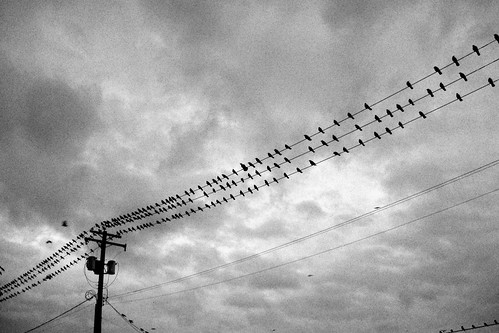
"If you go around dusk they cover the sky," says Kelsey Downey, marketing coordinator for Tourism Burnaby. "I used to go to school right in the area and it’s a pretty amazing site."
The crows fly eastward over the city at dusk. They're more concentrated in the winter. And they tend to be seen most around Willingdon Avenue, which is an exit off Highway 1. Downey recommends checking out Still Creek Drive, which runs next to the highway.
Burnaby sticks up for their crows. Kirsten Starcher, who writes the blog Crows to Burnaby [which is really more about arts than crows] is just one of the residents who fretted when a Costco displaced one of the big roost sites in 2006 about how it would impact their crows. "It was sad to lose it," one crow fan told the Vancouver Sun at the time. Another protested on YouTube.
About 500 students each painted their own model crow for an art project Along the Flight Path, that fixed the crows to a fence. A Vancouver tourism site boasted that the Northwestern Crow was the most conspicuous local bird and that Burnaby had "easily the most amazing gathering in the province." Crows.net says the Burnaby is "one of the most renowned crow roosts." It's great to see a town that appreciates its wildlife.
Where to Go to See Weird Birds or Unusual Bird Events
Where to See Animals Out West
Tuesday, May 11, 2010
Meditteranean Gray Whale: Explorer or Lone Lost Soul
 |
| Gray whale from Israel Marine Mammal Research and Assistance Center |
The Israel Marine Mammal Research and Assistance Center verified it as definitely a gray whale. Biologist are betting on the lone lost soul explanation. NOAA's Phillip Clapham of told Discovery that either "there has been a relict population in the North Atlantic that no one has noticed (virtually impossible), or (more likely) that this whale came down through the ice-free Northwest Passage and is now hopelessly lost."
I'd like to think there's a third possibility: the whale is forging a new route. Maybe in response to the whaling pressure it still faces in Asia. Migration routes aren't stagnant. Animal populations are constantly changing, usually led by a lone male branching out looking for a mate. Marine biologists used to think the manatees that migrate up the east coast were lost, so they'd catch them and haul them down to Florida. Now they realize it's just what they do.
There used to be four populations of gray whales, Jim Darling notes. Two--the ones one the east and west shores of the North Atlantic--are dead.
Two populations survive--on the east and west of the Pacific. The one that hugs the North American coast has been protected since 1947 and now is about 20,000. They thrive, delighting whale watchers with their friendly overtures towards boaters. Gray whales used to roam Florida to New England. Imagine the kind of animal tourism attraction we're missing. Right in Florida we'd probably have the same magical, close-up whale watching experience people now trek to Baja to get.
The Asian population is anemic--only 100 to 200. Even though nobody is supposed to be hunting it. And no one is sure if the two populations touch.
Where to Go to See Whales
Monday, May 10, 2010
Recovering Squirrel Fends Off Invader
 Mickey, the sweet black squirrel with a malocclusion, had an intruder this weekend. A wild squirrel we call Mommy Squirrel bust into the apartment and got Mickey so agitated that for the first time in three months she bothered to escape from her cage and climb a brick wall.
Mickey normally doesn't like to go out of her house. She comes out to eat, go to the bathroom, harumph around to complain if I haven't adequately stocked her with avocado. She only climbs the bars if she's agitated.
Mommy Squirrel lives nearby. Like last year, she is nursing and hungry enough to make a pest of herself. She is both pushy and picky. If she mere peanuts, apples and bananas are offered on the window sill, she'll put her paws to the window. Where's my chestnut? Or even a walnut will do.
Saturday I was painting and had the window open. I walk into the office to find Mommy on my desk chair and Mickey climbing the wall. I'm not sure which of these ladies upset the other. I'd like to think Mickey, enraged at yet another encroachment on her home ownership, came out to drive intruder Mommy Squirrel away.
I shooed Mommy outside, then guided Mickey back to her house. Once Mommy was out, she headed back that way anyway. The only solution I can think of is just to leave plenty of nuts outside for Mommy, who is having a tough time this year because her ne'er-do-well sons from last year have claimed my bountiful window sill as their turf and try to chase her away.

Where to Go to See Special Squirrels
Plenty of Wildlife Lives in NYC. Found Out Where
Subscribe to:
Posts (Atom)
